
The blockchain landscape has evolved significantly since the inception of Bitcoin in 2009. Initially, the digital asset space was dominated by a single network designed primarily for peer-to-peer payments and value storage. As the technology matured, new platforms like Ethereum emerged, introducing programmable smart contracts and decentralized applications. This expansion led to a diverse ecosystem of independent networks, each with unique strengths, consensus mechanisms, and trade-offs.
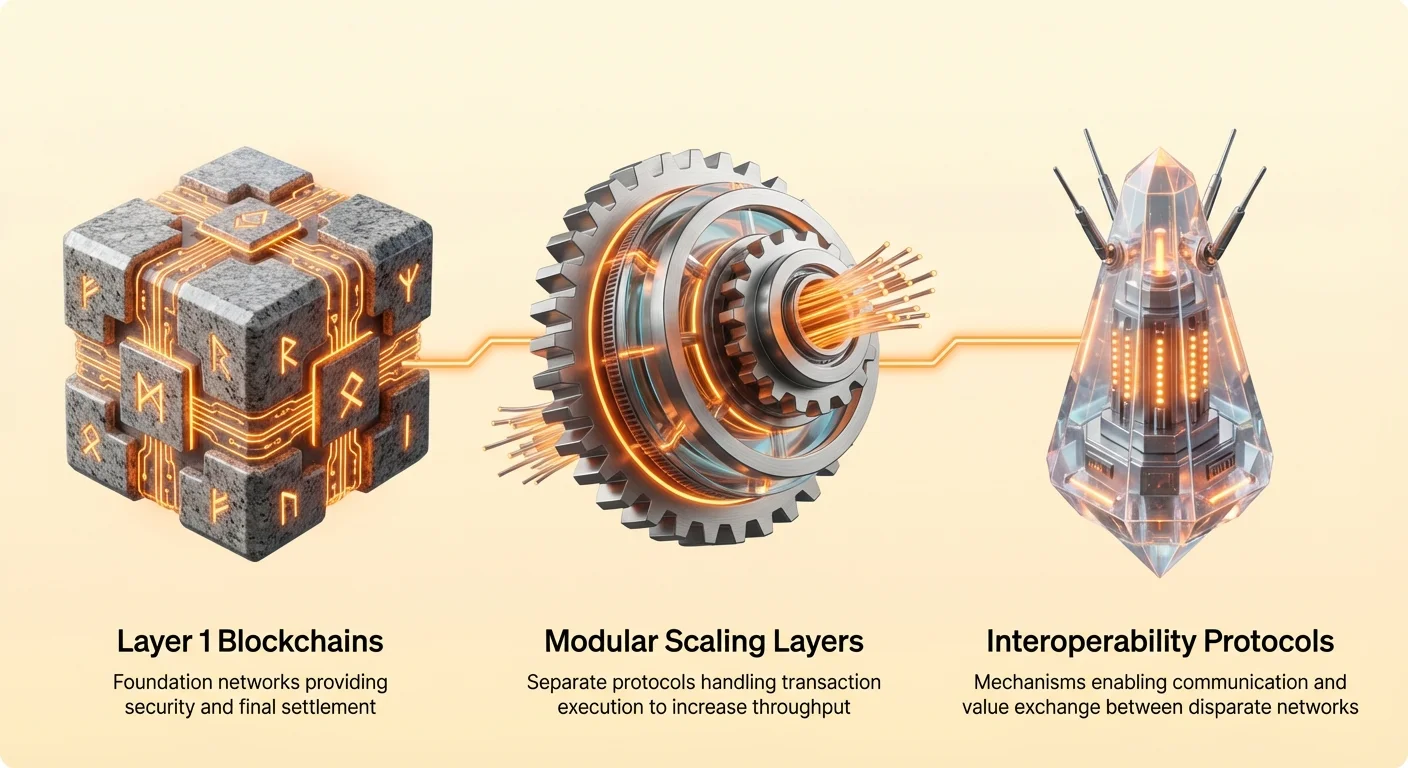
However, this growth created a fragmented environment where different blockchains often operate in isolation. A user holding assets on one network cannot easily interact with applications built on another without specific intermediaries. This limitation highlights the critical need for interoperability, which allows disparate systems to communicate and exchange value. The concept of modularity has also gained traction, encouraging the development of specialized layers that handle specific tasks like execution or settlement to improve efficiency. modular vs monolithic blockchains.
As the industry moves toward a multi-chain future, understanding the mechanics of how these networks connect is essential. Innovations in Layer 2 solutions, sidechains, and bridging protocols are reshaping how users interact with digital assets. These technologies aim to solve the "trilemma" of balancing security, scalability, and decentralization solves the trilemma while enabling a seamless flow of capital across the broader economy.
The Fundamental Distinction: Coins Versus Tokens
Native Architecture and Independence
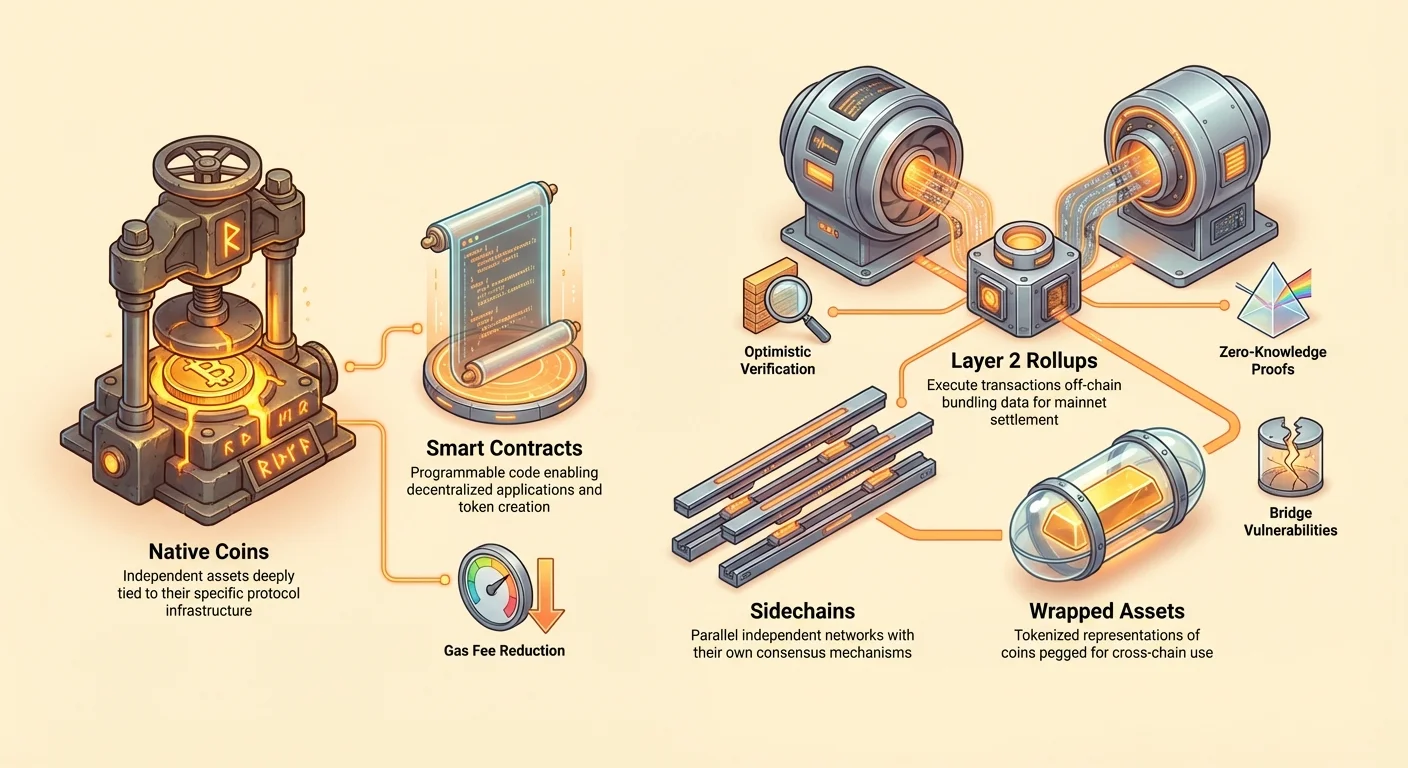
To understand interoperability, one must first grasp the difference between coins and tokens, as this distinction dictates how assets move across networks. A coin is a cryptocurrency that operates on its own independent blockchain. It is native to that specific protocol. For example, Bitcoin (BTC) runs on the Bitcoin blockchain, and Ether (ETH) runs on the Ethereum blockchain. These assets are integral to their respective networks, used to pay transaction fees and incentivize the validators or miners who secure the ledger.
Because coins exist at the protocol level, they are deeply tied to the specific infrastructure of their home chain. They do not rely on another network to function. This independence provides high security but creates challenges for interoperability. Moving a native coin like Bitcoin directly to the Ethereum network is technically impossible because the two ledgers speak different languages and have different consensus rules.
The Role of Tokens and Smart Contracts
In contrast to coins, tokens are digital assets built on top of existing blockchains using smart contracts. They do not have their own proprietary ledger but instead rely on the host chain for security and transaction processing. The most common example is the ERC-20 standard on Ethereum, which enabled the creation of thousands of distinct assets ranging from stablecoins to governance tokens.
Tokens offer immense flexibility because they are programmable. Developers can embed specific rules, supply caps, and functionality directly into the token's code. This programmability is a key enabler for decentralized applications (dApps). However, tokens are also bound by the limitations of their host network. If the host blockchain experiences congestion or high fees, transacting with the token becomes expensive and slow. This dependency drives the need for scaling solutions that can handle token transactions more efficiently.
The Scalability Challenge and Layer 2 Solutions
The rapid adoption of blockchain technology has led to network congestion, particularly on major platforms like Ethereum. As more users interact with decentralized finance (DeFi) and other applications, the demand for block space exceeds supply. This results in slower transaction times and rising costs, known as gas fees. To address these issues without compromising the security of the main chain, developers have introduced Layer 2 solutions.
Layer 2 refers to a secondary framework or protocol built on top of an existing blockchain system. The primary goal is to solve the scalability difficulties of the main chain, often referred to as Layer 1. Layer 2 solutions process transactions off the main chain, thereby reducing the burden on the base layer. They bundle multiple transactions together and submit them to the Layer 1 network as a single proof. This greatly increases throughput and lowers fees for individual users while still deriving security from the underlying blockchain.
Types of Rollups and Execution
Among the most prominent Layer 2 technologies are rollups, which execute transactions outside the main Ethereum chain but post transaction data on it. There are two primary types of rollups: Optimistic Rollups and Zero-Knowledge (ZK) Rollups. Optimistic Rollups assume that transactions are valid by default and only run computations in the event of a dispute. This method reduces the computational load significantly.
ZK-Rollups, on the other hand, generate cryptographic proofs that verify the validity of transactions without revealing the underlying data. This allows for faster finality since the network does not need to wait for a challenge period. Both approaches represent a modular shift in blockchain architecture. Instead of a single chain handling execution, consensus, and data availability, these tasks are separated. The Layer 2 handles the execution, while the Layer 1 ensures security and data availability.
Bridging Networks with Sidechains
Sidechains represent another approach to scaling and interoperability that differs distinctively from Layer 2 solutions. A sidechain is a separate blockchain that runs in parallel to a main blockchain. It operates independently with its own consensus mechanism, meaning it is responsible for its own security. It is connected to the main chain via a two-way bridge, which allows assets to be transferred back and forth.
Because sidechains function as independent networks, they can implement unique parameters optimized for specific use cases. For instance, a sidechain might prioritize speed and low fees over maximum decentralization, making it suitable for gaming or frequent microtransactions. However, this independence introduces different risk factors. If the sidechain's security is compromised, assets on that chain could be at risk, whereas Layer 2 solutions generally rely on the robust security of the main Layer 1 blockchain.
| Feature | Layer 2 Solutions | Sidechains |
|---|---|---|
| Security Source | Main Chain (Layer 1) | Independent Consensus |
| Transaction Speed | High | Variable (often High) |
| Interoperability | Settles on Main Chain | Requires Two-Way Bridge |
Sidechains are crucial for modular ecosystems. They allow specialized environments to exist without clogging the primary network. Projects often deploy sidechains to create a dedicated space for their applications, effectively interacting with the broader ecosystem while maintaining control over their transaction rules and fees. This structure supports the vision of a network of interconnected blockchains rather than a single monolithic ledger.
Wrapped Assets and Cross-Chain Liquidity
The Mechanism of Wrapping
One of the most common methods for achieving interoperability between incompatible blockchains is the creation of wrapped assets. Since a native coin like Bitcoin cannot exist on the Ethereum network, a "wrapped" version must be created to represent it. Wrapped Bitcoin (WBTC) is a prime example of this mechanism. It is an ERC-20 token that lives on Ethereum but is pegged 1:1 to the value of Bitcoin. Bridging BTC cross-chain assets
The process typically involves a custodian or a smart contract protocol. When a user wants to wrap their Bitcoin, the actual BTC is locked in a reserve on the Bitcoin blockchain. Simultaneously, an equivalent amount of WBTC is minted on Ethereum. This allows Bitcoin holders to utilize their assets within the Ethereum ecosystem. If the user wants to retrieve their original Bitcoin, the WBTC is "burned" (destroyed), and the locked BTC is released back to the user's wallet.
Utility in Decentralized Finance
Wrapped assets are foundational to the decentralized finance (DeFi) sector. They allow liquidity to flow from one ecosystem to another, breaking down the silos between blockchains. Without wrapping, Bitcoin's massive market capital would remain isolated, usable only for simple transfers. Through wrapping, that value can be used as collateral for loans, provided as liquidity in decentralized exchanges (DEXs), or used in yield farming strategies on Ethereum.
This functionality extends beyond just Bitcoin. Assets from various chains, such as SOL or AVAX, can also be wrapped and bridged to other networks. This creates a web of cross-chain liquidity where users are not restricted by the technical limitations of a single blockchain. It enables a more efficient market where capital can move to where it is most productive, regardless of the underlying protocol.
The Expanding Role of Altcoins and Specialized Chains
The crypto market is no longer defined solely by Bitcoin and Ethereum. A vast array of alternative cryptocurrencies, or "altcoins," has emerged to address specific limitations of the early networks. These projects often employ different architectural choices to improve speed, reduce costs, or enhance interoperability.
Some altcoins function as native assets for high-performance Layer 1 blockchains. For example, networks like Solana and Avalanche were built to handle high transaction throughput without relying on Layer 2 scaling immediately. They utilize unique consensus mechanisms to achieve fast finality. These platforms act as alternative hubs for decentralized applications, competing with and complementing the Ethereum ecosystem.
Other projects focus specifically on the communication layer between blockchains. While some assets serve as simple mediums of exchange, others are governance tokens for protocols that facilitate cross-chain transfers. The ecosystem also includes stablecoins—tokens pegged to fiat currencies like the US dollar—which act as a neutral medium of exchange across almost all major blockchains. Stablecoins like USDC operate on multiple networks simultaneously, providing a common language of value that simplifies interaction between disparate systems.
The rise of these diverse networks reinforces the need for modularity. Rather than one chain doing everything, the industry is shifting toward a landscape of specialized chains. Some focus on privacy, others on gaming, and others on enterprise solutions. The role of interoperability protocols is to knit these specialized environments together, ensuring that a user on a gaming chain can easily swap assets with a user on a financial chain.
Security Risks in Interoperable Systems
Vulnerabilities in Bridges
While interoperability unlocks immense potential, it introduces significant security risks, particularly concerning cross-chain bridges. Bridges are complex software constructs that hold large amounts of funds in custody to facilitate transfers. This concentration of value makes them attractive targets for malicious actors.
If the smart contract governing a bridge contains a bug or vulnerability, attackers can exploit it to drain the locked assets. Unlike a native blockchain where security is maintained by thousands of miners or validators, a bridge's security often depends on the code of a specific contract or a smaller set of validators. History has shown that bridge hacks can result in substantial losses, highlighting the importance of rigorous auditing and robust design in interoperability protocols.
Smart Contract and Dependency Risks
Beyond bridges, the use of wrapped tokens and dApps introduces "smart contract risk." When a user interacts with a decentralized application or holds a token, they are trusting the code that manages those assets. If a protocol is poorly written, it may be susceptible to exploits. Furthermore, in a highly interconnected system, a failure in one component can have cascading effects.
For instance, if a major wrapped asset were to lose its peg due to a failure in the underlying custody mechanism, it would impact every DeFi protocol that uses that asset as collateral. This "dependency risk" means that users must be aware not only of the security of the blockchain they are using but also of the various protocols and bridges that underpin the assets they hold.
Conclusion
The blockchain industry is transitioning from a collection of isolated islands to a connected archipelago. The shift toward modularity, driven by Layer 2 solutions, sidechains, and specialized altcoin networks, allows for greater scalability and efficiency. By separating execution from settlement and enabling independent networks to communicate, the ecosystem can support a wider range of applications and a larger user base.
Interoperability remains the key to unlocking the full potential of this technology. Through mechanisms like wrapped assets and cross-chain bridges, value can flow freely between Bitcoin, Ethereum, and the growing list of alternative Layer 1 blockchains. While security challenges persist, particularly regarding bridges and smart contracts, the continuous innovation in this space suggests a future where the technical boundaries between chains become invisible to the end user.
A truly interoperable future allows users to access any application on any network without worrying about the underlying infrastructure.