
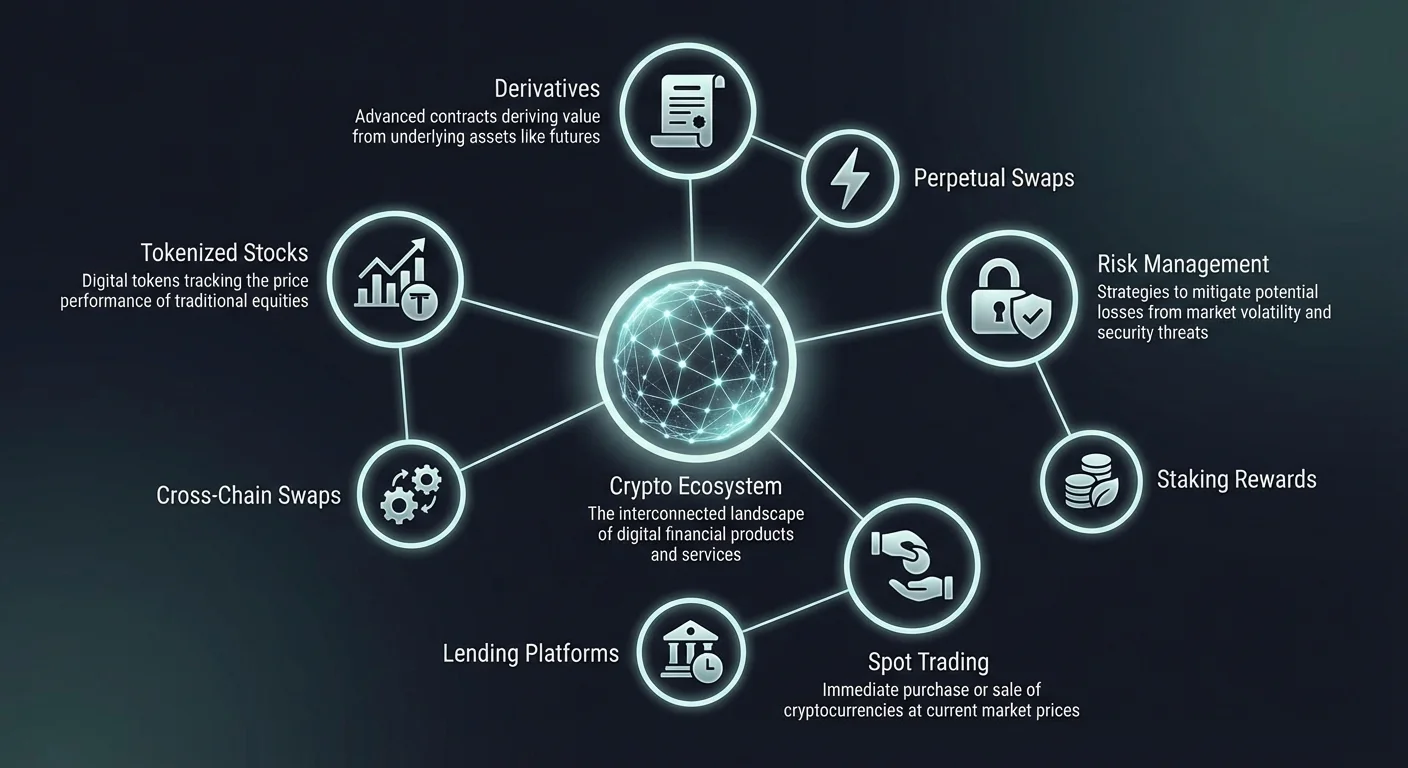
The cryptocurrency landscape has evolved significantly beyond the simple buying and holding of digital coins. Modern traders now have access to a sophisticated ecosystem of financial instruments that mirror and often expand upon traditional market structures. This evolution provides opportunities for cross-market exposure through various mechanisms ranging from derivatives and tokenized equities to automated trading strategies.
Understanding these diverse financial products is essential for market participants looking to diversify their portfolios or hedge against volatility. The integration of traditional financial concepts into the blockchain space has created a hybrid environment where assets operate 24/7. This continuous operation distinguishes the crypto market from legacy financial systems.
Investors can now engage with markets that were previously inaccessible or required significant capital barriers. Through tokenization and decentralized protocols, the friction associated with cross-border trading and asset management is reduced. However, this accessibility comes with a need for deeper technical knowledge regarding how these platforms function and the specific risks involved.
The Shift to Active Market Participation
The transition from passive holding to active trading involves understanding the distinct characteristics of crypto markets compared to traditional assets like stocks or commodities. The most notable difference is the lack of market hours. Cryptocurrency exchanges operate continuously, allowing traders to react to global news and market movements instantaneously at any time of day.
This non-stop nature requires different risk management strategies. Volatility in digital asset markets is typically higher than in traditional finance. Price swings that might occur over a month in the stock market can happen within hours in the crypto space. This volatility creates both opportunities for profit and significant risks of loss.
Regulatory environments also differ substantially. While traditional markets are heavily regulated with circuit breakers and strict oversight, the crypto market is more fragmented. This lack of uniform regulation can lead to increased instances of market manipulation but also offers a lower barrier to entry for new traders.
Technological Dependencies and Market Maturity
Active participation in these markets relies heavily on technology. Unlike floor trading or phone-based brokerage services of the past, crypto trading is purely digital. This dependence introduces specific technical risks, such as platform outages, connectivity issues, or blockchain congestion. Traders must be familiar with the digital infrastructure that supports their activities.
The relative immaturity of the crypto market compared to the centuries-old stock market affects liquidity. While major assets like Bitcoin enjoy high liquidity, niche products and smaller altcoins may experience slippage. Slippage occurs when there is not enough volume at a specific price point to fulfill an order, resulting in the trade executing at a less favorable price.
Exchange Architectures and Platform Types
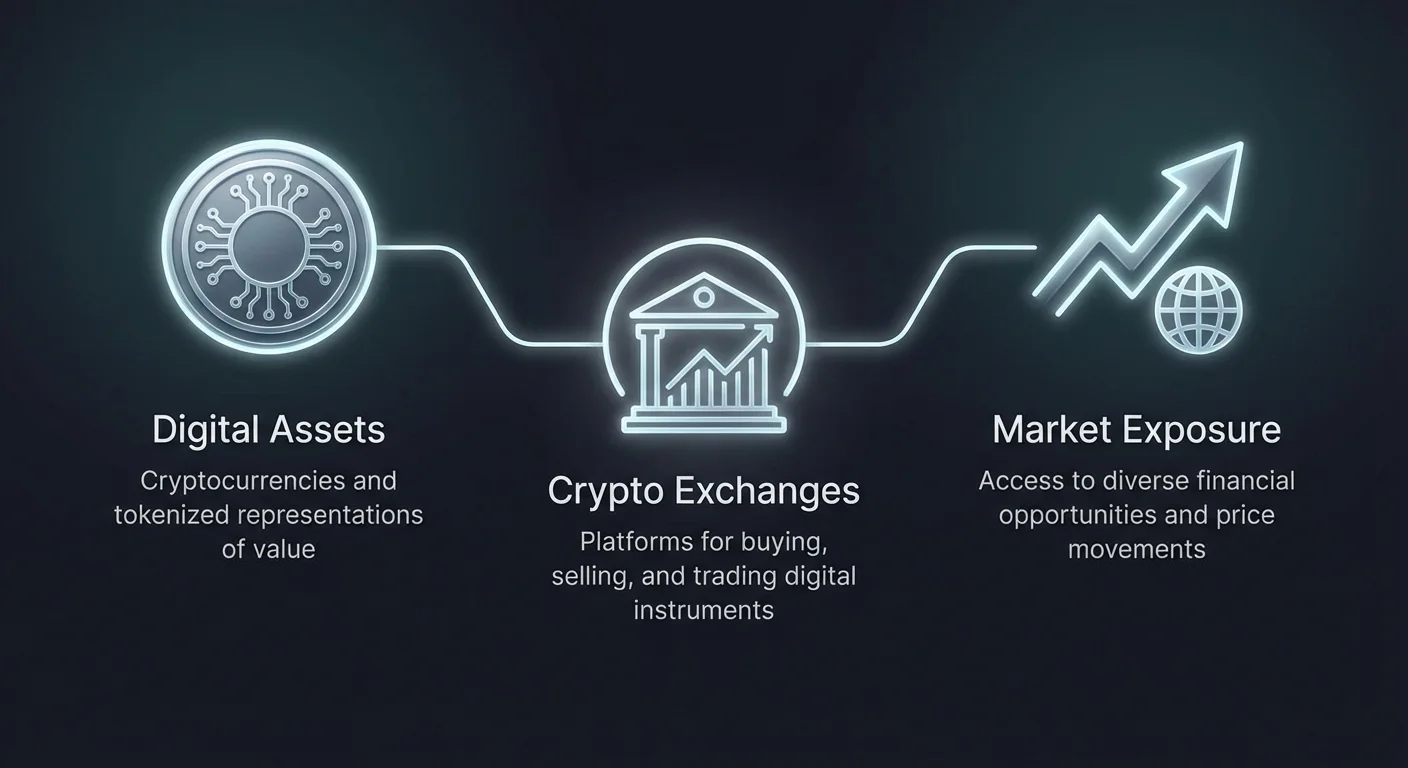
The foundation of cross-market exposure lies in the venue where trading occurs. The ecosystem is divided primarily into centralized and decentralized infrastructures, each serving different user needs. Understanding the architecture of these platforms is the first step in navigating the broader market.
Centralized Exchanges (CEX)
Centralized exchanges function similarly to traditional stock brokerages. A central authority manages the platform, holds user funds in custody, and facilitates order matching. These platforms are typically the entry point for new traders because they offer user-friendly interfaces and fiat-to-crypto gateways.
High liquidity is a primary advantage of CEXs. Because they aggregate orders from millions of users, trade execution is generally fast and reliable. They also offer a wide array of trading pairs and advanced tools like charting software and historical data analysis. However, the custodial nature means users must trust the platform's security measures to protect their funds.
Decentralized Exchanges (DEX)
Decentralized exchanges operate without a central authority. Instead, they rely on smart contracts and blockchain technology to facilitate peer-to-peer trading. On a DEX, users retain control of their private keys and funds throughout the trading process. This non-custodial approach enhances privacy and reduces the risk of platform-wide hacks affecting user balances.
DEXs often utilize Automated Market Maker (AMM) models rather than traditional order books. In this system, users trade against a liquidity pool rather than a specific counterparty. While this improves privacy and reduces censorship risks, DEXs can sometimes suffer from lower liquidity compared to their centralized counterparts. They may also be more complex for beginners to navigate.
Hybrid and Derivatives Platforms
Hybrid exchanges attempt to merge the high performance and liquidity of centralized platforms with the security and privacy of decentralized ones. They aim to offer the best of both worlds, though they are less common than strict CEX or DEX models.
Derivatives exchanges are specialized platforms designed for trading financial contracts rather than the underlying assets themselves. These venues focus on futures, options, and perpetual swaps. They provide the infrastructure for leverage trading, allowing users to speculate on price movements without owning the asset. These platforms require robust risk management engines to handle margin calls and liquidations.
| Exchange Type | Primary Feature | Custody Model |
|---|---|---|
| Centralized (CEX) | High Liquidity | Custodial (Platform holds funds) |
| Decentralized (DEX) | Privacy & Control | Non-Custodial (User holds funds) |
| Derivatives | Leverage Trading | Varied (Usually Custodial) |
The Mechanics of Tokenized Stocks
Tokenized stocks represent a convergence of blockchain technology and traditional equity markets. These are digital tokens that track the price performance of publicly traded companies. By purchasing a tokenized stock, a trader gains exposure to the price movements of shares like Apple or Tesla without necessarily holding the physical share certificate.
Fractional Ownership and Accessibility
One of the primary benefits of tokenized stocks is fractionalization. Traditional shares often have high unit prices that can prohibit smaller investors from building diversified portfolios. Tokenized assets can be divided into smaller fractions, allowing investors to purchase a portion of a share with a smaller amount of capital.
This democratization of access extends to global markets. Investors in regions with limited access to US or European stock exchanges can use cryptocurrency platforms to trade these tokenized representations. This bypasses many of the geographical and banking restrictions associated with traditional international brokerage accounts.
Continuous Trading Availability
Unlike the traditional stock market, which operates with set opening and closing bells, tokenized stocks can often be traded 24/7. This is possible because the tokens live on a blockchain that never sleeps. While the underlying asset may stop trading on the Nasdaq or NYSE, the secondary market for the token continues.
It is important to note that liquidity for tokenized stocks may vary outside of traditional market hours. The price of the token is usually pegged to the real-world asset, but during weekends or holidays, the price discovery mechanism relies on the internal supply and demand of the crypto platform.
Derivatives: Futures and Perpetual Swaps
Derivatives are advanced financial contracts that derive their value from an underlying asset. In the crypto market, these instruments are widely used for both speculation and hedging. They allow traders to gain exposure to price movements without the need to handle the actual cryptocurrency wallets or transfer speeds.
Understanding Futures Contracts
A futures contract is an agreement to buy or sell an asset at a predetermined price on a specific future date. In crypto markets, these are often used by miners or institutions to lock in prices and secure revenue streams. For traders, futures offer a way to bet on the direction of the market.
If a trader believes the price of Bitcoin will rise, they can enter a long position. Conversely, if they anticipate a decline, they can enter a short position. This ability to profit from downward market movements is a key feature of derivatives trading that is not easily accessible in spot trading.
Perpetual Swaps
A specific type of futures contract unique to the crypto market is the perpetual swap. Unlike traditional futures, perpetual swaps do not have an expiration date. Traders can hold their positions for as long as they can maintain the required margin.
To keep the price of the perpetual contract close to the spot price of the asset, exchanges use a funding rate mechanism. This involves payments exchanged between long and short traders. If the contract price trades higher than the spot price, longs pay shorts. If it trades lower, shorts pay longs. This mechanism ensures market stability.
Margin Trading and Leverage
Margin trading involves borrowing funds from a broker or exchange to trade larger positions than one's account balance would normally permit. This process is known as using leverage. It amplifies both potential profits and potential losses, making it a high-risk strategy suitable for experienced market participants.
The Mechanics of Leverage
When using leverage, a trader puts up a fraction of the total trade value as collateral. For example, with 10x leverage, a trader needs only $1,000 to open a position worth $10,000. The remaining $9,000 is borrowed from the platform.
If the market moves in the trader's favor, the returns are calculated based on the full $10,000 position size. However, if the market moves against the position, losses are also calculated on the total value. This means a small price drop can result in the loss of the entire initial collateral.
Liquidation and Margin Calls
Maintaining a leveraged position requires keeping the account value above a certain threshold, known as the maintenance margin. If the value of the collateral drops below this level due to adverse price movements, a margin call occurs.
In traditional finance, a broker might ask the trader to deposit more funds. In the fast-paced crypto environment, exchanges typically employ automatic liquidation. This means the platform will automatically close the position to repay the borrowed funds, resulting in the loss of the trader's collateral. Understanding liquidation prices is critical for survival in margin trading.
Automated Grid Trading Strategies
Grid trading is a quantitative strategy that automates buying and selling. It is particularly effective in markets that move sideways or lack a clear directional trend. This strategy capitalizes on normal market volatility by executing trades at pre-set levels.
Setting Up the Grid
To execute a grid strategy, a trader defines a price range with an upper and lower limit. Within this range, the system places multiple buy and sell limit orders at incremental price levels. These levels form the "grid."
For example, if Bitcoin is trading between $30,000 and $40,000, the bot might place buy orders every $1,000 below the current price and sell orders every $1,000 above it. The goal is to secure small profits frequently rather than waiting for a single large price movement.
Execution in Volatile Markets
As the market price fluctuates, the grid bot executes orders automatically. When a buy order is filled at a lower price, the bot immediately places a corresponding sell order at a higher level. If the price rises and hits that level, the sell order executes, locking in the profit.
This automation removes the emotional component of trading. It ensures that the strategy is followed rigorously without manual intervention. However, grid trading carries risks if the price breaks out of the defined range. If the price drops significantly below the lower limit, the trader may be left holding a losing position.
Crypto Lending and Borrowing
Crypto lending platforms have emerged as a parallel banking system within the digital asset space. They connect users willing to lend their assets with those seeking to borrow. This creates a market for liquidity where interest rates are determined by supply and demand dynamics.
Earning Passive Income
For lenders, these platforms offer a way to generate passive yield on idle assets. Instead of letting cryptocurrency sit in a wallet, a user can deposit it into a lending protocol. The protocol lends these funds to borrowers, often institutional traders or market makers, who pay interest.
The interest rates in crypto lending are often higher than traditional savings accounts. This is due to the high demand for liquidity and the lack of traditional banking infrastructure for crypto assets. However, these higher rates come with increased risk, including platform insolvency or smart contract vulnerabilities.
Collateralized Loans
Borrowing in the crypto space is predominantly collateralized. To take out a loan, a borrower must deposit an asset, such as Bitcoin or Ethereum, as security. The amount one can borrow is determined by the Loan-to-Value (LTV) ratio.
For instance, if a platform offers a 50% LTV, depositing $10,000 worth of Bitcoin allows a user to borrow $5,000 in stablecoins or cash. This allows investors to access liquidity for expenses or further trading without selling their long-term holdings. This is particularly useful for tax planning, as taking a loan is generally not a taxable event compared to selling an asset.
Risk of Collateral Liquidation
The primary risk for borrowers is the volatility of the collateral asset. If the value of the deposited Bitcoin drops significantly, the LTV ratio increases. If it exceeds a critical threshold, the platform may issue a margin call or liquidate the collateral to recover the loan principal.
Borrowers must monitor their LTV ratios closely. During market crashes, liquidation cascades can occur, where selling pressure from liquidations drives prices down further, triggering more liquidations. Managing collateral health is a manual and active process for borrowers.
Staking and Savings Accounts
Savings accounts in the cryptocurrency sector differ structurally from traditional bank accounts. While they share the goal of earning interest, the mechanisms involving risk and custody are distinct. These accounts can be categorized generally into centralized finance (CeFi) and decentralized finance (DeFi) options.
CeFi Savings Platforms
Centralized platforms act as custodians. Users transfer their crypto to the exchange or lending provider, which then manages the funds. These providers often engage in lending, staking, or arbitrage strategies to generate the yield paid to depositors.
The user experience is similar to online banking, with dashboards showing interest accrual. However, users do not control the private keys. If the platform fails or pauses withdrawals, the user's funds may be inaccessible. There is typically no government-backed insurance for these accounts.
DeFi Staking and Yield
DeFi platforms use smart contracts to automate the process of earning yield. Users interact directly with the blockchain protocol. Staking involves locking up tokens to support the security and operations of a Proof-of-Stake blockchain network. In return, the protocol issues rewards in the form of more tokens.
Yield farming is another DeFi concept where users provide liquidity to decentralized exchanges. By depositing a pair of assets into a liquidity pool, they earn a portion of the trading fees. While potential returns can be higher in DeFi, the risks include smart contract bugs and the complexity of managing self-custody wallets.
Flexible vs. Fixed Terms
Crypto savings products often offer a choice between flexible and fixed terms. Flexible accounts allow users to withdraw their principal and interest at any time. These accounts generally offer lower interest rates due to the liquidity premium.
Fixed-term accounts require locking assets for a specific duration, such as 30, 60, or 90 days. In exchange for reduced liquidity, the platform offers a higher Annual Percentage Yield (APY). Early withdrawal from fixed accounts often incurs a penalty or the forfeiture of accrued interest.
Swap Platforms and Instant Exchanges
Swap platforms simplify the trading process by removing the complexity of order books and charts. These services are designed for rapid conversion between different assets. They are particularly popular for users who prioritize speed and ease of use over advanced trading features.
The Mechanics of Swapping
Unlike trading, which often involves speculating on price movements using technical analysis, swapping is primarily about utility or portfolio rebalancing. A user sends one cryptocurrency to the swap service and receives another in return. The exchange rate is often fixed at the moment of the transaction or floats within a narrow range.
Non-custodial swap platforms allow this exchange without requiring users to deposit funds into a platform account permanently. The transaction happens wallet-to-wallet or via a temporary deposit address. This reduces the security risk associated with leaving funds on an exchange.
Cross-Chain Swaps
Advanced swap platforms facilitate cross-chain transactions. This allows a user to swap an asset on the Bitcoin blockchain directly for an asset on the Ethereum or Solana blockchain. Bridging technology or atomic swaps operate in the background to enable these transfers.
This capability is vital for the fragmented crypto ecosystem. It allows capital to flow between different network economies without forcing the user to go through a centralized intermediary or convert to fiat currency first.
Fee Structures and Cost Management
Understanding trading costs is fundamental to profitability. Crypto exchanges employ various fee models that can significantly impact net returns, especially for high-frequency traders. The most common structure is the maker-taker model.
Maker vs. Taker Fees
Exchanges distinguish between orders that provide liquidity and those that take it. "Makers" are traders who place limit orders that sit on the order book, waiting to be filled. Because they add depth to the market, they are often charged lower fees or, in some cases, given rebates.
"Takers" are traders who execute market orders that are filled immediately against existing orders on the book. They remove liquidity from the platform. Consequently, taker fees are typically higher. Active traders often use limit orders to minimize these costs.
Zero-Fee Trading Models
Some exchanges promote zero-fee trading. This can be a powerful marketing tool, but traders must examine the fine print. In some cases, zero-fee trading applies only to specific pairs, such as Bitcoin to stablecoins.
In other instances, platforms may claim zero fees but profit through a wider spread. The spread is the difference between the buying and selling price. A wider spread means the trader pays a premium on the purchase price or receives less on the sale price, effectively acting as a hidden fee.
| Fee Type | Description | Who Pays |
|---|---|---|
| Maker Fee | Charged for adding liquidity (limit orders) | The trader placing the order |
| Taker Fee | Charged for removing liquidity (market orders) | The trader executing immediately |
| Spread | Price difference between buy/sell | Built into the asset price |
Tax Implications of Cross-Market Trading
Navigating the tax landscape is a critical aspect of trading across different crypto products. In many jurisdictions, cryptocurrency is treated as property rather than currency. This classification has significant implications for how trades and swaps are reported.
Taxable Events
Almost every interaction that involves disposing of a cryptocurrency is considered a taxable event. This includes trading one crypto for another, swapping assets, or using crypto to purchase goods. It is not necessary to convert back to fiat currency to trigger a tax liability.
For example, swapping Bitcoin for Ethereum is viewed by tax authorities as selling Bitcoin at its fair market value and immediately using the proceeds to buy Ethereum. If the Bitcoin had appreciated in value since it was acquired, the trader owes capital gains tax on that profit.
Income vs. Capital Gains
Different activities attract different tax treatments. Trading profits are generally subject to capital gains tax. These can be short-term or long-term, depending on how long the asset was held before selling.
Interest earned from lending platforms, staking rewards, or yield farming is typically treated as ordinary income. The value of the reward is calculated at the time it is received. Traders must keep detailed records of cost bases and transaction dates to ensure compliance.
Security and Risk Management
Security is the bedrock of any crypto strategy. The irreversible nature of blockchain transactions means that mistakes or thefts are often permanent. Engaging with niche products and derivatives increases the surface area for potential risks.
Account Security Protocols
Protecting exchange accounts requires more than a strong password. Two-factor authentication (2FA) is a mandatory standard. App-based authenticators or hardware keys are superior to SMS-based 2FA, which is vulnerable to SIM-swapping attacks.
Withdrawal whitelisting is another critical feature. This allows users to specify exactly which external addresses can receive funds from their account. If an account is compromised, the attacker cannot withdraw funds to their own wallet if it is not on the whitelist.
Platform and Smart Contract Risk
When using decentralized protocols for swaps or staking, smart contract risk becomes a primary concern. This refers to the possibility of bugs or vulnerabilities in the code that governs the protocol. Audits by reputable security firms reduce this risk but do not eliminate it.
For centralized platforms, the risk involves insolvency or mismanagement of funds. Proof of Reserves is a developing standard where exchanges publish cryptographic evidence that they hold sufficient assets to cover user liabilities. Traders should prioritize platforms that offer transparency regarding their financial health.
Conclusion
Cross-market exposure in the cryptocurrency ecosystem offers a vast array of tools for traders ranging from novices to institutional professionals. From the immediate execution of spot trading to the complex hedging capabilities of derivatives and the passive income potential of lending, the market has matured into a diverse financial landscape. Each instrument serves a specific purpose, allowing for tailored strategies that can capitalize on volatility, provide liquidity, or bridge the gap to traditional equities.
However, this diversity brings complexity. Success in these markets requires a comprehensive understanding of the underlying mechanics, fee structures, and tax implications. Traders must balance the pursuit of profit with rigorous risk management and security practices. By mastering the technical and financial nuances of these products, participants can navigate the digital asset economy with greater confidence and precision.
Effective cross-market trading requires balancing technical knowledge with disciplined risk management strategies.