
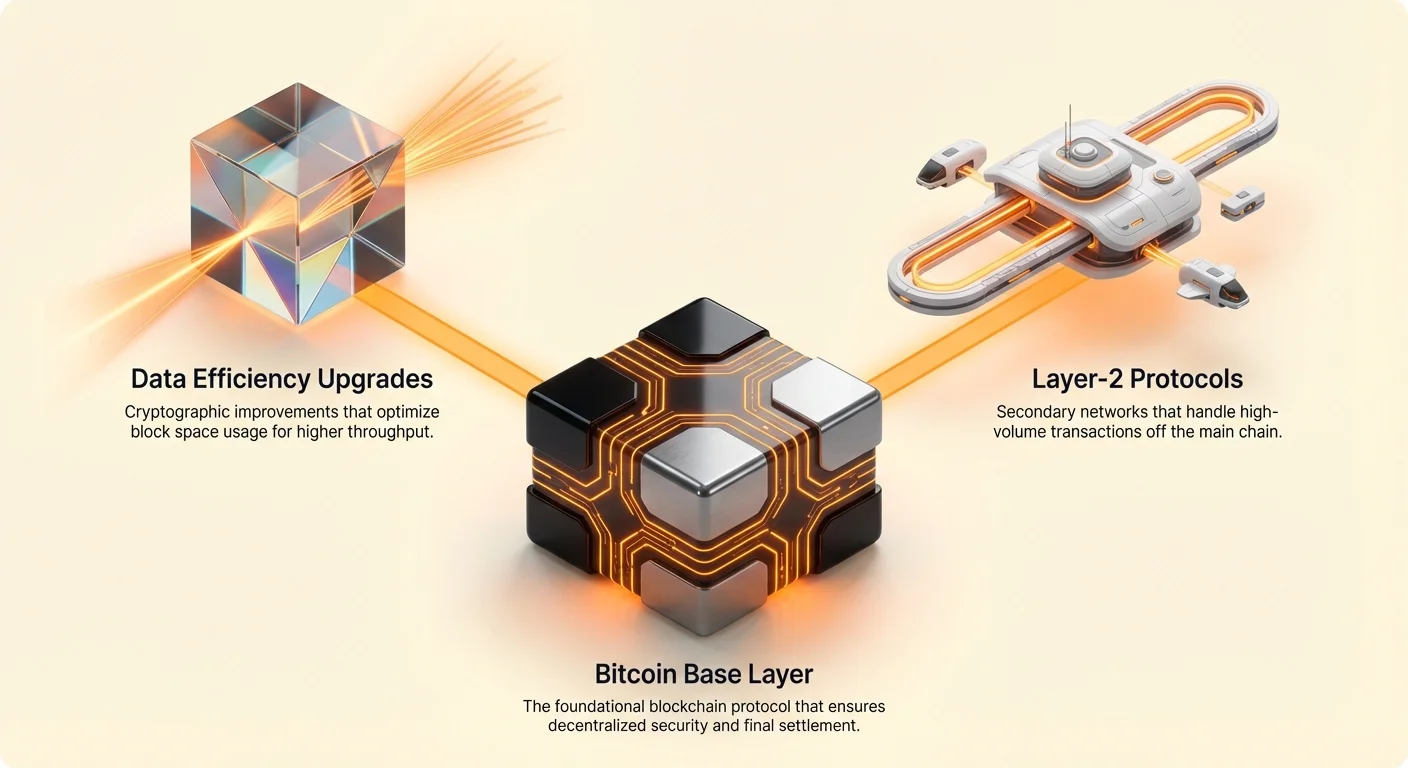
Bitcoin continues to evolve from a simple peer-to-peer cash system into a robust foundation for decentralized finance and complex applications. As adoption grows, the network faces the critical challenge of scaling to accommodate millions of users without sacrificing decentralization or security. The original design, while secure, supports limited transaction throughput. This bottleneck has driven the development of next-generation frameworks designed to optimize how data is stored, verified, and transmitted across the network.
The journey toward a scalable Bitcoin involves a combination of base-layer upgrades and layered protocols. Developers and researchers are constantly exploring methods to compress the state of the blockchain or offload execution to secondary layers. These innovations aim to maximize the efficiency of block space, allowing the network to process orders of magnitude more activity. This evolution is not managed by a central authority but through a consensus-driven process involving developers, miners, and node operators.
From the separation of witness data to the implementation of recursive blockchain structures, the landscape of Bitcoin scaling is diverse. New cryptographic primitives and architectural designs are allowing for denser information packing and faster verification. Understanding these mechanisms requires looking at how the protocol handles data today and how upgrades like Segregated Witness, Taproot, and emerging Layer-2 concepts are reshaping the digital ledger.
The Evolution of Data Efficiency
The quest for scaling began with addressing the fundamental limits of the block size. Early in Bitcoin's history, the 1MB block limit restricted the number of transactions that could be processed every ten minutes. This limitation led to network congestion and higher fees during periods of peak demand. The community realized that scaling required a fundamental change in how transaction data was structured and weighted by the network.
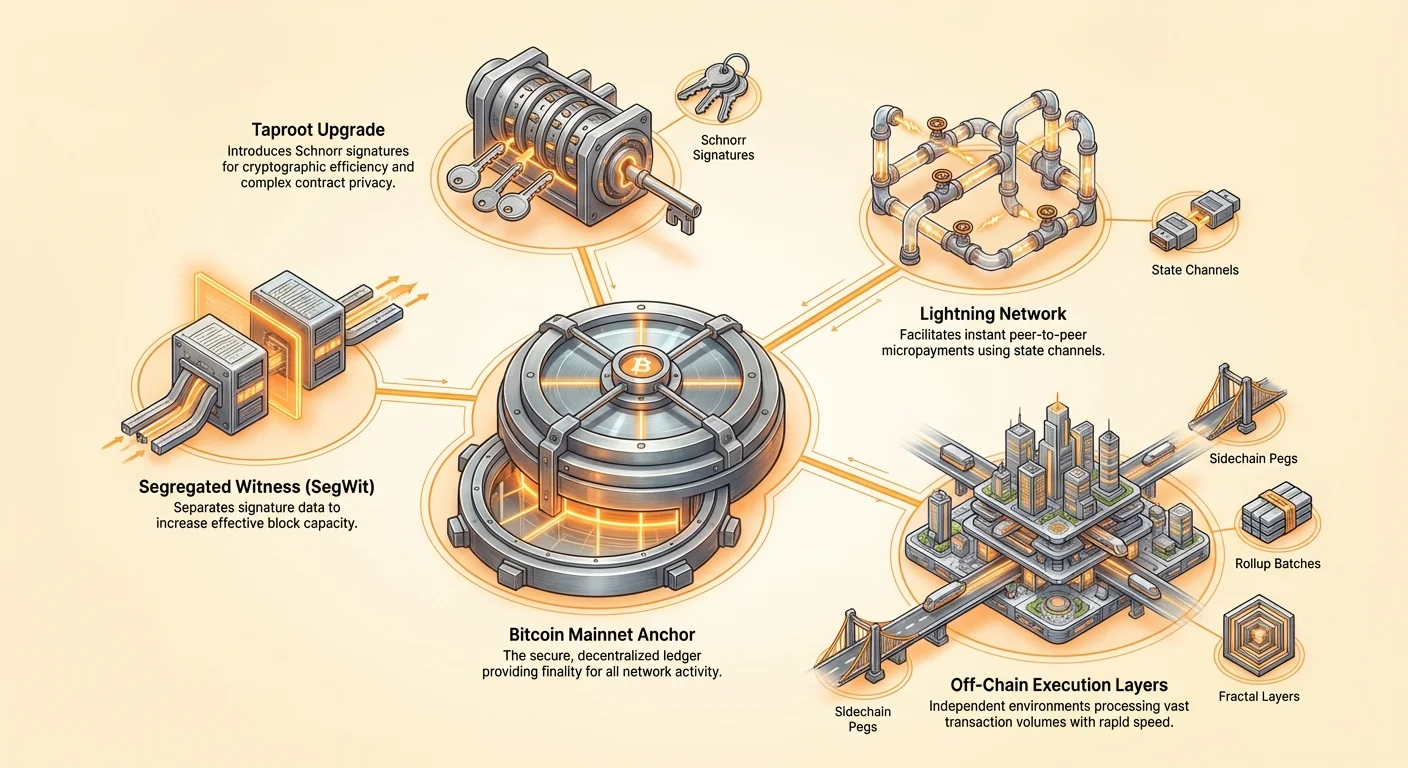
The implementation of Segregated Witness, or SegWit, marked a pivotal shift in this direction. SegWit reorganized the data structure of a block by separating the digital signature, known as the "witness," from the transaction data. Before this upgrade, signatures took up a significant portion of the limited block space. By moving this data to a separate structure, the protocol effectively increased the available space for transactions without technically increasing the original block size limit.
This change introduced the concept of "weight units" to replace the traditional size measurement. In this new system, witness data is counted with less weight than standard transaction data. This modification encouraged users and wallet providers to adopt more efficient transaction formats. The result was an immediate increase in throughput, effectively allowing more activity to settle on the main chain while maintaining compatibility with older nodes.
SegWit also solved a critical technical issue known as transaction malleability. Previously, the unique identifier of a transaction could be modified before it was confirmed on the blockchain. This vulnerability made the development of second-layer protocols difficult and risky. By fixing malleability, SegWit laid the necessary groundwork for advanced scaling solutions, such as the Lightning Network, to operate securely and reliably.
Cryptographic Compression via Taproot
Following the foundation laid by SegWit, the activation of Taproot introduced a new layer of cryptographic efficiency. Taproot was designed to enhance privacy and script processing, but its implications for scaling are equally profound. The upgrade replaced the existing digital signature scheme with Schnorr signatures. This mathematical framework allows for key aggregation, a process where multiple public keys and signatures can be combined into a single verifier.
In traditional Bitcoin transactions involving multiple parties, such as multi-signature wallets, each participant's signature had to be recorded on the blockchain individually. This process consumed significant space and revealed the complexity of the transaction to the public. Schnorr signatures enable these multiple signatures to be aggregated into a single signature. To the network, a complex multi-party transaction looks identical to a standard single-user transfer.
This aggregation acts as a form of data compression. By reducing the amount of data required to authorize complex transactions, Taproot frees up block space for other users. This efficiency becomes increasingly important as the network hosts more sophisticated applications, such as CoinJoins or complex smart contract interactions. The reduction in data size translates directly to lower transaction fees and higher network throughput.
Taproot also introduced Merkelized Abstract Syntax Trees, or MAST. This technology changes how smart contracts and spending conditions are processed. Previously, all conditions of a script had to be revealed on the blockchain, regardless of which condition was actually met. MAST allows users to structure complex contracts where only the executed condition is revealed and recorded.
The unexecuted branches of the contract remain hidden and do not take up space on the public ledger. This creates a massive efficiency gain for complex smart contracts. It allows developers to build intricate logic and extensive contingency plans into Bitcoin transactions without burdening the network with excessive data. The combination of Schnorr signatures and MAST represents a significant leap forward in maximizing the utility of every byte of block space.
Layer-2 Frameworks and State Channels
While base-layer upgrades improve efficiency, true scalability requires moving execution off the main blockchain. Layer-2 solutions build secondary protocols on top of Bitcoin to handle high-volume transactions. These systems create a separate execution environment where parties can transact instantly and cheaply, using the main blockchain only for final settlement. This approach compresses thousands of interactions into a few on-chain transactions.
The most prominent example of this framework is the Lightning Network. It utilizes state channels to facilitate peer-to-peer micropayments. Two parties open a channel by locking funds into a multi-signature address on the main chain. Once the channel is established, they can exchange unlimited transactions privately and instantly. These updates change the balance of funds between the parties without broadcasting anything to the Bitcoin network.
The "state" of the channel is maintained locally by the participants. Only when the parties decide to close the channel is the final balance broadcast to the blockchain. This process effectively compresses an infinite history of economic activity into just two on-chain events: the opening and the closing transaction. This architecture allows Bitcoin to support retail-level transaction volumes that would be impossible on the base layer alone.
The Role of Rollups and Sidechains
Beyond state channels, the industry is exploring Rollups and Sidechains as methods to scale execution. Sidechains operate as independent blockchains that are pegged to Bitcoin. They utilize their own consensus mechanisms, which allows them to optimize for speed and advanced features that the main chain does not support. Users lock assets on the main chain and receive a corresponding token on the sidechain.
Sidechains like the Liquid Network or Rootstock enable faster settlement times and smart contract capabilities similar to Ethereum. They allow specifically optimized environments for different use cases. For instance, a sidechain can prioritize privacy or high-frequency trading. The main Bitcoin chain serves as the ultimate anchor of value, while the sidechain handles the heavy computational lifting and state management.
Rollups represent another frontier in scaling technology. A rollup bundles or "rolls up" multiple transactions into a single data packet. This batch of transactions is executed off-chain, and a cryptographic proof of their validity is submitted to the main blockchain. This method allows the security of the main chain to cover a vast number of off-chain actions without processing each one individually.
There are different approaches to rollups, including validity rollups and sovereign rollups. Sovereign rollups use Bitcoin primarily for data availability. They publish compressed transaction data to the Bitcoin blockchain but manage their own execution rules and consensus. This allows the rollup to inherit the data durability of Bitcoin while operating with the flexibility of an independent network.
| Scaling Method | Primary Mechanism | Throughput Impact | Security Model |
|---|---|---|---|
| SegWit | Witness data separation | Moderate Increase | Main Chain |
| Lightning | State Channels | High (Millions TPS) | Multisig + Main Chain |
| Sidechains | Two-way Peg | High (Dependent on Chain) | Federation / Merge Mine |
Fractal Bitcoin and Recursive Scaling
A newer concept gaining traction is Fractal Bitcoin. This framework proposes a multi-layered approach using smaller, interconnected blockchains called "fractals." The core idea is to create a recursive structure where these fractal chains operate in parallel to the main Bitcoin blockchain. This design aims to increase transaction throughput significantly while maintaining the core engineering principles of the original protocol.
Fractal Bitcoin operates by routing transactions to specific layers based on their requirements. High-value, low-frequency transactions might settle directly on the main chain or a high-security fractal. Conversely, high-volume microtransactions can be processed on lower-tier fractal chains designed for speed and low fees. This hierarchical sorting ensures that block space is utilized efficiently across the entire network ecosystem.
Crucially, these fractal chains can periodically settle their state onto the main Bitcoin blockchain. This settlement process anchors the security of the fractal layers to the immense hash power of the Bitcoin network. It creates a system where security flows downward from the main chain, while scalability flows upward from the fractal layers.
This recursive model also allows for native support of satoshi-based microtransactions. By handling these small value transfers within the fractal environment, the network avoids clogging the main ledger with "dust" transactions. It represents a structural evolution where the network scales by replicating its own logic in a nested, parallel manner rather than changing the fundamental rules of the base layer.
Tilteliai ir tarpgrandinės būsenos
Mastelis taip pat apima efektyvų būsenos ir vertės judėjimą tarp skirtingų blokų grandinių aplinkų. Apvynioti Bitcoin turtai reiškia būdą suspausti Bitcoin vertės pasiūlymą į formatus, suderinamus su kitais tinklais. Šis tarpusavyje veikimas leidžia Bitcoin naudoti decentralizuotų finansų programose, esančiose grandinėse su didesniu pralaidumu ar skirtingomis išmaniųjų sutarčių galimybėmis.
Šių apvyniotų turtų kūrimo mechanizmai skiriasi centralizacijos ir saugumo prasme. Tradiciniai modeliai, tokie kaip WBTC, remiasi centralizuotu saugotoju, kuris laiko tikrąjį Bitcoin ir išleidžia tokenizuotą reprezentaciją. Nors efektyvu, tai įveda patikimą trečiąją šalį į mastelio krūvą. Jei saugotojas žlunga ar yra pažeistas, ryšys tarp apvyniotų žetonų ir pagrindo Bitcoin nutrūksta.
Decentralizuotos alternatyvos, tokios kaip tBTC (Threshold Bitcoin), naudoja slenksčio kriptografiją šiam būsenos perėjimui valdyti. Užuot vienas saugotojas, decentralizuotų mazgų tinklas valdo Bitcoin indėlius. Šie mazgai naudoja daugiašalius skaičiavimus sandoriams pasirašyti ir peguotiems turtams valdyti. Ši sistema užtikrina, kad Bitcoin „būsenos“ būtų išsaugota ir perkeliama be vieno gedimo taško.
Naudodami šiuos tiltelius, Bitcoin ekosistema efektyviai perkelia dalį sandorių paklausos į kitas grandines. Vartotojai, norintys užsiimti didelės frekvencijos prekyba ar sudėtingomis skolinimo rinkomis, gali tai daryti Ethereum ar Solana naudojant apvyniotą Bitcoin. Tai sumažina tiesioginę apkrovą Bitcoin blokų grandinei, didindama paties turto naudingumą ir greitį.
Scenarijų atnaujinimai ir duomenų įrašymas
Bitcoin scenarijų kalbos tobulinimas siūlo tolesnes optimizacijos galimybes. Pasiūlymai, tokie kaip OP_CAT (Opcode Concatenate), siekia sugrąžinti funkcionalumą, leidžiantį efektyvesnį duomenų manipuliavimą scenarijuose. OP_CAT leidžia sujungti du duomenų gabalus scenarijaus stack'e į vieną.
Nors tai skamba paprastai, tai turi gilias implikacijas išmaniųjų sutarčių efektyvumui. Šiuo metu duomenų sujungimas reikalauja sudėtingų ir duomenų gausių apeigų. OP_CAT leistų kūrėjams supaprastinti šiuos scenarijus, sumažinant kodą, reikalingą sutartims vykdyti. Šis scenarijaus dydžio sumažėjimas veikia kaip kita glaudinimo forma, leidžianti sudėtingesnei logikai tilpti į mažesnius sandorių pėdsakus.
Tuo pat metu Ordinals kilimas įvedė naują dinamiką blokų erdvės naudojimui. Ordinals leidžia įrašyti savavališkus duomenis, tokius kaip vaizdus ar tekstą, tiesiogiai ant individualių satoshi. Nors tai gali atrodyti priešinga masteliui (nes prideda duomenis), technologija remiasi SegWit ir Taproot įvestomis efektyvumomis.
Ordinals naudoja sandorio liudijimo duomenų sekciją šiam turiniui saugoti. Kadangi liudijimo duomenys turi nuolaidą svoryje, šie įrašai yra pigesni saugoti nei standartiniai sandorio duomenys. Šis fenomenas sukėlė intensyvias debatus apie geriausią blokų erdvės naudojimą, bet taip pat pabrėžia Bitcoin saugojimo galimybių lankstumą. Tai demonstruoja, kaip „nuolaidinė“ erdvė, sukurta SegWit, gali būti naudojama naujoms programoms už paprastų finansinių perkėlimų ribų.
Išvada
Bitcoin mastelis nėra pasiekiamas per vieną „sidabrinę kulka“ technologiją, o per papildančių protokolų karkasą. Nuo SegWit duomenų optimizacijos iki Taproot kriptografinio efektyvumo, bazinis sluoksnis tapo tankesnis ir gebnesnis. Šie atnaujinimai suteikia būtiną pagrindą sluoksniams, kurie tvarko didžiąją vykdymo dalį, tokiems kaip Lightning Network, šoninės grandinės ir besiformuojantys rekursyvūs modeliai kaip Fractal Bitcoin.
Kol kūrėjai toliau tobulina šias technologijas, dėmesys lieka decentralizacijai, kuri suteikia Bitcoin vertę. Nesvarbu, ar per būsenos glaudinimą rollup'uose, slenksčio kriptografiją tilteliuose, ar lygiagrečią apdorojimą fraktalų grandinėse, tikslas nuoseklus: aptarnauti globalią vartotojų bazę nekompromituojant tinklo vientisumo. Šių sluoksnių tarpusavio veikimas apibrėš Bitcoin ekosistemos ateities talpą.
Bitcoin mastelis yra daugiasluoksnė evoliucija, derinant grandinės duomenų efektyvumą su galingomis ne grandinės vykdymo aplinkomis, siekiant pasiekti globalų pajėgumą.