
Decentralized finance offers a radical alternative to traditional banking systems. It allows individuals to access capital without credit checks, paperwork, or central intermediaries. Instead of visiting a bank branch, users interact with code running on a blockchain. This system relies on a peer-to-peer model where liquidity is sourced from a global pool of lenders. These lenders deposit assets to earn yield, creating a reservoir of funds available for borrowers.
Accessing this capital requires understanding the specific mechanisms of Web3 technology. The process is governed entirely by smart contracts, which are automated agreements that execute when specific conditions are met. Because there is no human loan officer to assess risk, the system relies on over-collateralization. This means a borrower must deposit more value than they intend to take out. This deposit secures the loan and protects the lenders who supply the liquidity.
While the barrier to entry is low, the cost structure is complex. It involves more than just a simple interest rate. Users must navigate a landscape of transaction fees, variable rates, and protocol-specific dynamics. Understanding the true cost of borrowing requires a holistic view of these expenses. It involves calculating the interaction between the interest earned on deposits and the interest paid on loans. This financial balancing act is unique to the crypto ecosystem.
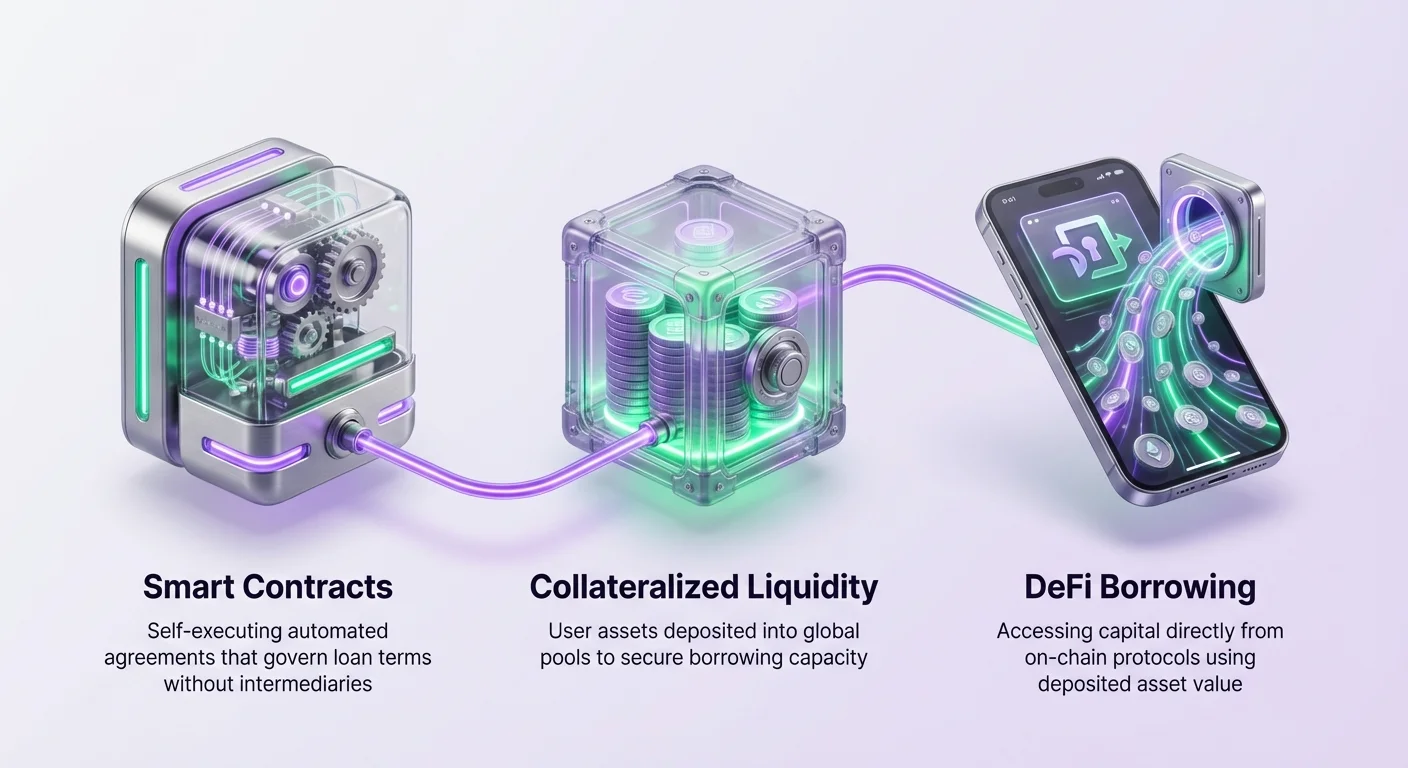
The Mechanics of DeFi Borrowing
To participate in this financial system, a user must first possess a digital wallet. This wallet acts as the primary interface for all transactions. It holds the cryptocurrencies and digital assets that will serve as collateral. Unlike a bank account, a self-custodial wallet gives the user full control over the funds. There is no third party with ultimate authority to freeze or manage the assets. This autonomy is a core tenet of decentralized finance, but it places the responsibility of security entirely on the user.
The Role of Collateralization
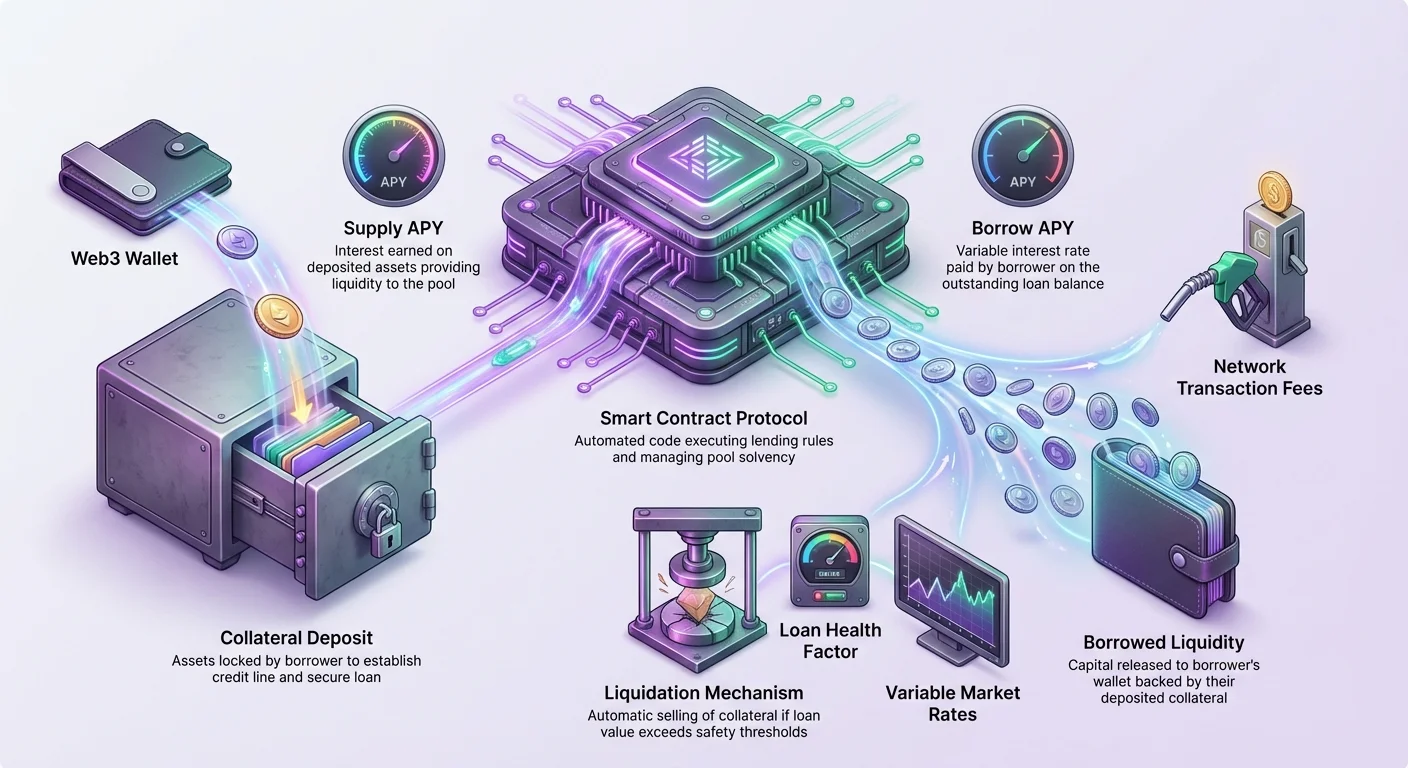
Borrowing in this environment is impossible without first supplying assets. A user deposits cryptocurrency into a lending protocol to establish a credit line. This deposit serves two purposes. First, it allows the user to earn interest on their holdings, known as supply APY. Second, it acts as insurance for the protocol. If a borrower fails to repay or if the market turns against them, this collateral ensures the system remains solvent.
The amount one can borrow is directly tied to the value of this collateral. Different assets have different risk parameters. A stable and highly liquid asset might allow for a higher loan-to-value ratio compared to a volatile altcoin. Users must monitor the value of their collateral closely. If its value drops significantly, the protocol may automatically sell the assets to cover the debt. This mechanism protects the lenders' capital but creates a distinct risk for the borrower.
Smart Contract Interaction
The entire lending and borrowing process is facilitated by decentralized applications, or dApps. Platforms like Aave exist on multiple blockchain networks, including Ethereum and Avalanche. To interact with these platforms, users connect their web3 wallet via services like WalletConnect. This connection authorizes the dApp to view balances and request transaction approvals.
Once connected, the borrowing process is automated. The user selects an asset to borrow and confirms the transaction. Behind the scenes, a smart contract updates the ledger. It records the user's debt and releases the borrowed funds to their wallet. There is no waiting period for approval. As long as sufficient collateral exists and the protocol has liquidity, the loan is executed instantly.
The Impact of Network Transaction Fees
A frequently potential oversight for new borrowers is the cost of blockchain interaction. Every action taken on a blockchain requires a transaction fee. These fees are used to pay for the computational resources needed to update the ledger. They are not paid to the lending platform but to the network validators or miners. Without these fees, the blockchain cannot process transfers or contract executions.
Fees are always paid in the blockchain's native currency. For instance, if a user is borrowing on the Ethereum network, they must hold ETH in their wallet to pay for gas. Even if the loan is in a stablecoin like USDC, the fee to execute the loan is in ETH. This requirement adds a layer of friction and cost. A wallet lacking the native currency cannot process any transactions, regardless of how much collateral value it holds.
The cost of these transactions fluctuates based on network demand. During periods of high congestion, fees can spike dramatically. A simple deposit or borrow action might cost a few dollars one day and significantly more the next. For smaller loans, high transaction fees can disproportionately affect the overall cost of borrowing. It is possible for the fees to exceed the interest paid on the loan itself in the short term.
Calculations for the true cost of a loan must include these entry and exit costs. A borrower incurs fees when depositing collateral, borrowing the asset, repaying the loan, and withdrawing the collateral. Each step is a separate transaction. If a user engages in frequent trading or creates complex loan structures, the cumulative effect of these fees becomes a major expense line item.
Decoding Annual Percentage Yield (APY)
Interest in decentralized finance is typically expressed as APY, or Annual Percentage Yield. This metric is crucial for both lenders and borrowers to understand. It represents the real rate of return or cost over the course of a year. The defining characteristic of APY is that it accounts for compound interest. This differs from simple interest, which calculates earnings only on the principal amount.
Compound Interest Mechanics
Compound interest creates a cycle of growth. For a lender, interest earned is added to the principal, and future interest is calculated on this larger amount. For a borrower, the debt grows in a similar fashion if interest is not paid periodically. The debt compounds, meaning the borrower owes interest on the accrued interest. This can accelerate the growth of the debt obligation faster than a user might anticipate with simple interest calculations.
Protocols often display rates as APY to provide a standardized metric. However, because blocks on a blockchain are produced every few seconds, compounding can happen very frequently. The frequency of compounding impacts the final number. When comparing borrowing costs across different platforms, users must ensure they are comparing equivalent metrics.
Supply vs. Borrow Rates
In a lending protocol, there are always two distinct rates at play. The Supply APY is what the user earns on their deposited collateral. The Borrow APY is what the user pays on the loan. Typically, the Borrow APY is higher than the Supply APY. The difference between the two helps ensure the protocol can pay lenders and maintain a safety reserve.
However, the gap between these rates is not fixed. It shifts based on the utilization of the specific asset pool. If a specific token is in high demand by borrowers but has low supply from lenders, the Borrow APY will rise. This dynamic incentivizes more lenders to deposit that asset to capture the high yield. Conversely, if a pool is awash with liquidity and has few borrowers, the rates will drop to encourage borrowing.
Variable Rates and Market Liquidity
Most decentralized lending protocols operate with variable interest rates. These rates are not set by a central bank or a corporate board. They are determined algorithmically based on supply and demand. This introduces an element of unpredictability to the cost of borrowing. A user might take out a loan at a 5% interest rate, only to find the rate has jumped to 20% a week later.
This volatility is driven by liquidity. In the context of crypto, liquidity refers to the availability of assets in a specific market or pool. When liquidity is deep, large transactions can occur without significantly shifting the interest rates. When liquidity is thin, a sudden surge in borrowing demand can cause rates to skyrocket.
| Market Condition | Borrower Impact | Lender Impact |
|---|---|---|
| High Liquidity | Stable, lower rates | Moderate yield |
| Low Liquidity | Volatile, higher rates | Higher yield potential |
| High Utilization | Expensive borrowing | Maximize returns |
Borrowers must constantly monitor these rates. Unlike a fixed-rate mortgage, a DeFi loan requires active management. If rates rise too high, the cost of holding the loan may become unsustainable. In such cases, the borrower might need to repay the debt quickly or switch to a different asset. This constant fluctuation is a primary risk factor in decentralized money markets.
Calculating the Net APY
The true cost of borrowing in DeFi is rarely just the Borrow APY. Because borrowers are also lenders (by virtue of their collateral), they are simultaneously earning and paying interest. To understand the actual financial impact, one must calculate the Net APY. This figure represents the difference between the interest gained on collateral and the interest paid on the debt.
For example, imagine a user deposits $10,000 worth of Ethereum earning 4% APY. They then borrow $5,000 worth of USDC at 6% APY.
- Interest Earned: $10,000 * 0.04 = $400 per year.
- Interest Paid: $5,000 * 0.06 = $300 per year.
- Net Position: +$100 per year.
In this scenario, the user is effectively being paid to borrow, resulting in a positive Net APY. However, this outcome depends heavily on the loan-to-value ratio. If the user borrowed a larger amount, say $8,000, the interest paid would rise to $480. This would flip the net position to a loss of $80 per year.
This calculation is dynamic. Since both the Supply APY and Borrow APY are variable, the Net APY changes constantly. A profitable position can turn into a cost burden if the borrowing rate spikes or the supply rate drops. Additionally, the value of the collateral itself fluctuates relative to the borrowed asset. This adds another layer of complexity to the calculation.
Risks Associated with Collateral Management
Managing collateral is the most critical aspect of decentralized borrowing. The safety of the user's funds depends on maintaining a healthy buffer between the loan value and the collateral value. Lending protocols enforce strict rules to protect the solvency of the pool. If a user's collateral value falls below a certain threshold, the protocol initiates liquidation.
Understanding Liquidation
Liquidation is the process where the protocol seizes and sells the user's collateral to repay the debt. This usually comes with a liquidation penalty, an additional fee charged to the borrower. This results in a permanent loss of assets. Liquidation happens automatically and without warning. It is triggered strictly by math and price feeds.
Users must be extremely careful when withdrawing assets. The dashboard of a lending protocol will show the deposited assets. While it is possible to withdraw these assets at any time, doing so while a loan is active increases risk. Withdrawing collateral reduces the Total Value Locked (TVL) relative to the debt. If the TVL drops to dangerously low levels, it can instantly trigger a liquidation event.
Price Volatility
The volatility of crypto assets exacerbates this risk. If a user uses a volatile asset like Bitcoin or Ethereum as collateral to borrow a stablecoin, a market crash can be disastrous. Even if the user plans to repay the loan, a sudden 20% drop in the collateral's price might force a liquidation before they can react.
To mitigate this, borrowers often maintain a "health factor." This is a numeric representation of the safety of their loan. Keeping this factor high means leaving a large buffer of unused collateral. While this reduces capital efficiency, it provides a safety net against market downturns.
Tools and Interfaces for Borrowing
Successful borrowing requires using the right tools. The foundation is a secure web3 wallet. Self-custody is essential here. A self-custodial wallet like the Bitcoin.com Wallet ensures the user retains the private keys to their funds. In a custodial arrangement, a third party could theoretically block the user from accessing their collateral or repaying their loan.
The interface for borrowing is typically a web-based dashboard provided by the protocol. Platforms like Aave offer comprehensive views of the user's financial status. They display the current APY, the total amount borrowed, and the health of the loan. These dashboards are the control centers for DeFi users.
Users must also be familiar with concepts like swapping. Often, a user might borrow one asset but need another. Or they may need to swap tokens to acquire the native currency for gas fees. Understanding how to buy or swap cryptoassets efficiently is a prerequisite for managing a loan portfolio. High slippage on swaps can add another hidden cost to the operation.
The integration of wallets with dApps is typically handled through protocols like WalletConnect. This standard allows a secure link between the mobile wallet and the desktop browser. It ensures that sensitive private keys never leave the user's device, even while interacting with complex financial smart contracts.
Conclusion
Borrowing in the decentralized finance ecosystem offers unprecedented freedom and flexibility. It removes the gatekeepers of traditional finance, allowing anyone with assets to access liquidity. However, this freedom comes with the responsibility of self-management. The true cost of a loan is a composite of variable interest rates, network transaction fees, and the opportunity cost of collateral.
Users must look beyond the headline rates to understand the net financial impact. The interplay between supply APY and borrow APY determines whether a loan is cheap or expensive. Furthermore, the mechanical costs of blockchain transactions can erode profits, especially for smaller amounts or frequent adjustments.
Ultimately, success in DeFi borrowing requires vigilance. Monitoring health factors, staying aware of market liquidity, and understanding the mechanics of smart contracts are non-negotiable. By calculating the Net APY and respecting the risks of liquidation, users can effectively use these tools to manage their digital wealth.
Always calculate your break-even point by factoring in gas fees and liquidation risks before opening a crypto loan.