
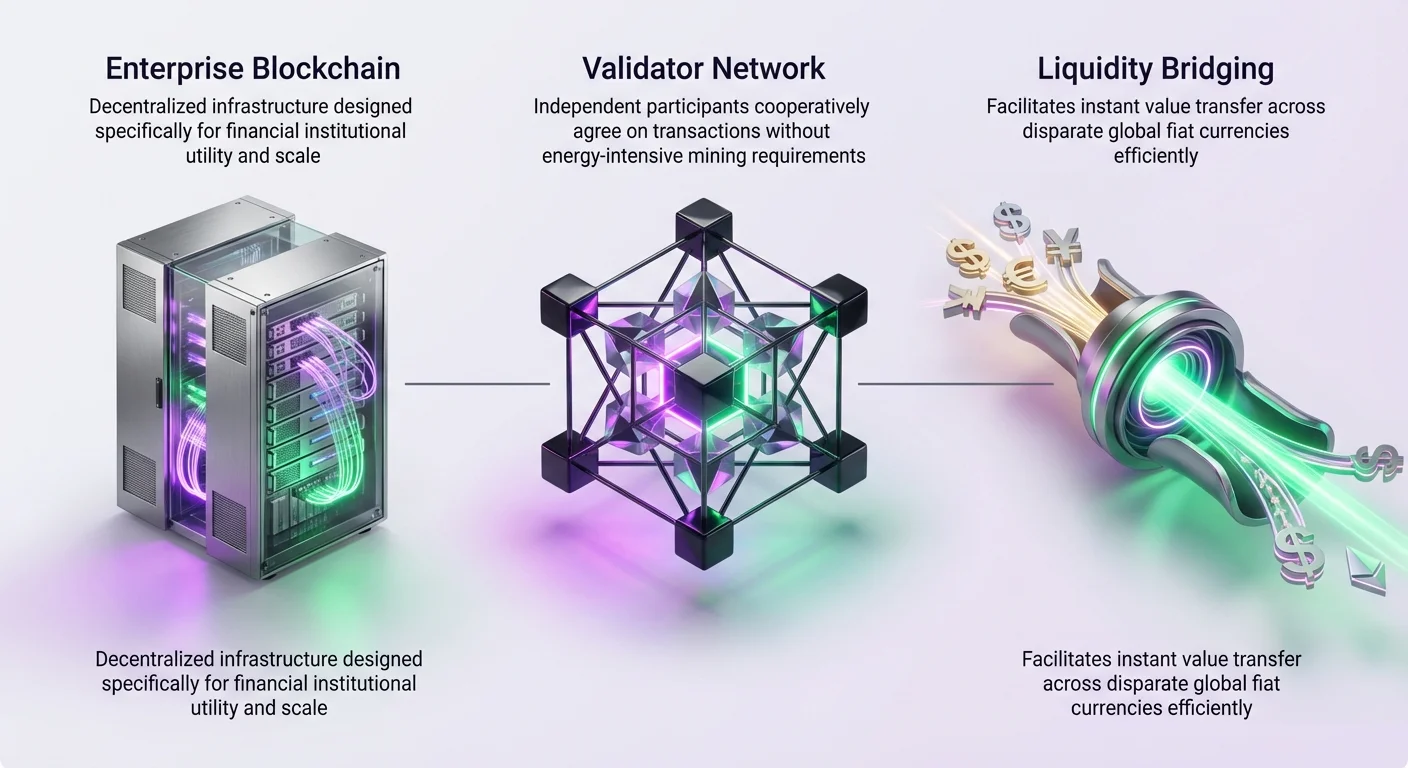
The XRP Ledger (XRPL) represents a distinct approach to distributed ledger technology. It operates as a decentralized, public blockchain specifically engineered to facilitate cross-border payments and liquidity management. Unlike many cryptocurrencies that originated as experiments in digital cash or decentralized computing, the XRPL was designed with a clear focus on enterprise utility. It aims to solve the friction points inherent in the traditional global financial system, particularly regarding the speed and cost of moving money between different currencies.
The network functions independently of the company Ripple, although Ripple is a primary contributor to its code and uses the ledger for its payment products. The ledger is open-source and permissionless, meaning anyone can download the software to run a node or transact on the network. Its native digital asset, XRP, serves as a bridge currency. This asset is critical for facilitating value transfer across disparate fiat currencies without requiring pre-funded accounts in destination markets.
Institutional adoption of blockchain technology often hinges on certainty and efficiency. The XRPL addresses these requirements through a consensus mechanism that eliminates the need for energy-intensive mining. This design choice allows for rapid transaction finality and low operational costs. As the financial sector increasingly explores blockchain solutions, the XRPL positions itself as a mature infrastructure layer capable of handling high-volume, low-value payments alongside complex institutional settlements.
The XRPL Consensus Mechanism
The foundation of the XRP Ledger's performance lies in its unique consensus protocol. Unlike Bitcoin, which relies on Proof-of-Work (PoW), the XRPL uses a Federated Byzantine Agreement model. In this system, a network of independent validators is responsible for confirming transactions. These validators do not compete to solve cryptographic puzzles for block rewards. Instead, they work cooperatively to agree on the order and validity of transactions.
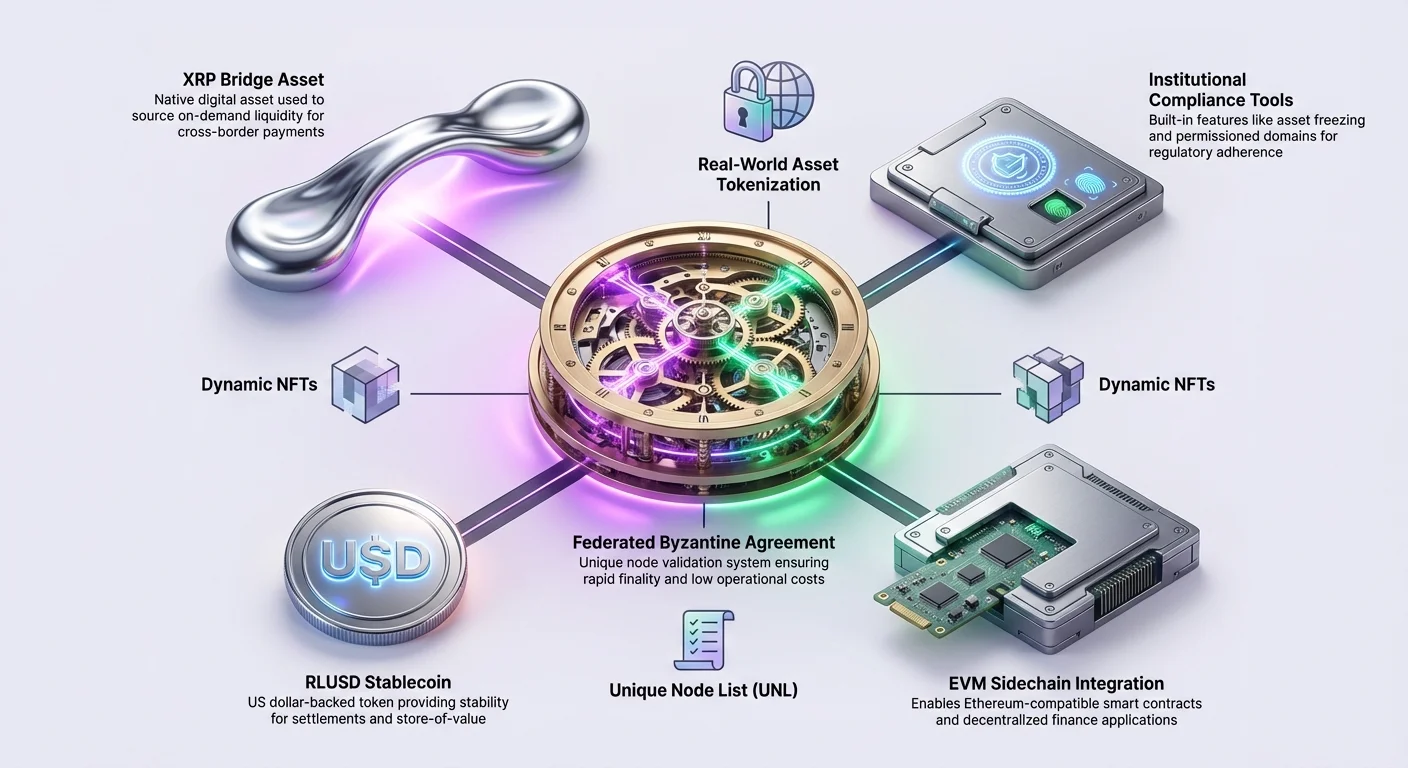
Validators maintain a Unique Node List (UNL), which is a set of other validators they trust not to collude against the network. When a transaction is broadcast, validators propose it for inclusion in the next ledger version. Through an iterative voting process, the network reaches a supermajority agreement. Once a transaction receives enough votes, it is validated and added to the ledger. This process repeats every few seconds.
This approach yields significant efficiency gains. Transactions on the XRPL typically settle in three to five seconds. This near-instant finality is a crucial feature for financial institutions that require certainty of payment. In contrast, PoW networks often require multiple block confirmations to ensure a transaction is irreversible, which can take anywhere from ten minutes to an hour.
The absence of mining also means the network consumes negligible energy compared to PoW chains. There is no "difficulty adjustment" or massive hardware requirements for validators. This sustainability profile appeals to institutions with strict environmental, social, and governance (ESG) mandates. It allows banks and payment providers to adopt the technology without negatively impacting their carbon footprint metrics.
Liquidity and the Bridge Asset Model
Cross-border payments have traditionally been slow and expensive due to the need for liquidity. To send money from the United States to the Philippines, a bank typically needs to hold pre-funded accounts, known as nostro accounts, in the destination currency. This capital is effectively dormant, sitting in foreign accounts to facilitate future transfers rather than being deployed for other business investments.
XRP functions as a bridge asset to eliminate this inefficiency. In a typical transaction, a financial institution converts the sender's currency (e.g., USD) into XRP. The XRP is then instantly sent across the ledger to the destination. Upon arrival, it is immediately converted into the receiver's currency (e.g., PHP). This entire process occurs in seconds.
This mechanism allows financial institutions to free up the capital that was previously trapped in nostro accounts. By sourcing liquidity on-demand, banks can lower their operational costs and reduce their exposure to foreign exchange volatility. The speed of the ledger ensures that the volatility of XRP itself is minimized during the brief window of the transaction.
The total supply of XRP is capped at 100 billion tokens, all of which were created at the ledger's inception. No new XRP can be mined or created. This fixed supply provides a predictable economic model for the asset. However, a significant portion of this supply is held in escrow by Ripple, which releases a predictable amount each month to support the ecosystem and institutional sales.
Institutional-Grade Features and Compliance
For blockchain technology to gain traction in the formal financial sector, it must support regulatory compliance. The XRPL includes specific features designed to meet these needs. Recent updates have introduced capabilities that allow issuers to manage their assets with a high degree of control. This is essential for regulated entities that must adhere to Know Your Customer (KYC) and Anti-Money Laundering (AML) laws.
One such feature is the ability to freeze assets. The ledger supports a function known as "DeepFreeze" (XLS-77). This allows issuers to freeze tokens in specific accounts if suspicious activity is detected or if required by law enforcement. While this contradicts the ethos of purely permissionless crypto anarchism, it is a prerequisite for regulated stablecoins and tokenized securities.
Another critical development is the introduction of Permissioned Domains (XLS-80). This feature enables the creation of restricted environments on the public ledger. Institutions can use these domains to ensure that only authorized participants can interact with specific assets or smart contracts. This allows banks to leverage the benefits of a public blockchain while maintaining the closed-loop security required for internal operations.
These tools demonstrate the ledger's evolution beyond simple payments. The network is adapting to become a comprehensive platform for the issuance and management of regulated digital assets. By embedding compliance controls directly into the protocol layer, the XRPL reduces the technical burden on institutions building on top of the network.
The Introduction of RLUSD
Stability is a cornerstone of financial planning. While XRP serves as an efficient bridge asset, its price volatility can be a barrier for certain types of settlements and store-of-value use cases. To address this, the ecosystem has expanded to include high-quality stablecoins. A major development in this area is the launch of RLUSD, a U.S. dollar-backed stablecoin on the XRPL.
RLUSD is fully backed by U.S. dollar deposits, government bonds, and cash equivalents. This backing model ensures that the value of the token remains pegged to the dollar, providing a reliable medium of exchange for users who wish to avoid market fluctuations. The introduction of RLUSD enhances the liquidity of the overall ecosystem by providing a stable on-ramp and off-ramp for institutional capital.
The presence of a native, compliant stablecoin allows for new trading pairs on the ledger's decentralized exchange. It facilitates smoother entry for traditional finance players who are comfortable holding tokenized dollars but wary of volatile crypto assets. RLUSD can be used alongside XRP, where XRP handles the cross-currency bridging while RLUSD handles the final settlement or stable holding requirements.
This dual-asset strategy strengthens the network's value proposition. It offers institutions a choice in how they manage their liquidity. They can utilize the efficiency of a bridge asset for international transfers or the stability of a dollar-pegged token for payments and settlements that occur within the same currency zone.
Smart Contracts and Sidechains
Historically, the XRPL was viewed primarily as a payment network with limited programmability. However, the landscape has shifted with the introduction of advanced smart contract capabilities. The ecosystem is actively integrating with the broader world of decentralized finance (DeFi) through the development of an Ethereum Virtual Machine (EVM) sidechain.
The EVM sidechain allows developers to write smart contracts using Solidity, the standard programming language of Ethereum. This compatibility is crucial for attracting developer talent and migrating existing applications to the XRPL ecosystem. By using a sidechain, the network can support complex computation without bogging down the main ledger, preserving the speed and low fees that are critical for payments.
Cross-chain interoperability is further enhanced through bridges. The integration with the Axelar Bridge connects the XRPL EVM sidechain to over 55 other blockchains. This creates a web of connectivity where assets can move fluidly between the XRP Ledger and other major networks like Ethereum, Binance Smart Chain, and Solana. This interoperability prevents the XRPL from becoming a siloed ecosystem.
On the main ledger, native smart contract features are also expanding. The network supports automated market makers (AMMs) and other DeFi primitives directly. This allows for decentralized trading and yield generation without leaving the security of the core protocol. These advancements position the ledger as a competitor in the Web3 space, distinct from its reputation as solely a banking tool.
Tokenization of Real-World Assets
The tokenization of real-world assets (RWAs) is widely considered the next frontier for blockchain adoption. The XRPL is architecturally suited for this trend due to its low fees and built-in asset management features. Institutions are exploring the ledger to tokenize everything from real estate and commodities to stocks and bonds.
The ledger supports native asset issuance, meaning tokens are treated as first-class citizens by the protocol. This differs from smart contract-based tokens on other chains, which rely on complex code that can be prone to bugs. On XRPL, issuing a token is a simple protocol command. This reduces the risk of smart contract exploits and lowers the technical barrier for issuers.
Recent standards have introduced Dynamic NFTs (XLS-46). These are non-fungible tokens with metadata that can be updated post-issuance. This functionality is vital for tokenizing assets that change over time, such as real estate with updating valuations or supply chain goods moving through different logistics stages. Dynamic NFTs allow the digital representation to stay in sync with the physical reality of the asset.
The focus on RWAs aligns with the ledger's institutional DNA. As major asset managers looking to tokenize funds or securities, they require a platform that is secure, compliant, and cost-effective. The XRPL's combination of speed, low cost, and regulatory tooling makes it a strong candidate for hosting the next generation of digitized financial products.
| Feature | XRP Ledger (XRPL) | Bitcoin (BTC) | Ethereum (ETH) |
|---|---|---|---|
| Consensus | Federated Consensus | Proof-of-Work | Proof-of-Stake |
| Speed | 3-5 Seconds | ~10-60 Minutes | ~12-15 Seconds |
| Cost | Fractions of a cent | Variable (High) | Variable (Med-High) |
Regulatory Challenges and Centralization
Despite its technical strengths, the XRPL faces hurdles regarding regulatory perception and centralization concerns. The most prominent issue has been the legal status of XRP in various jurisdictions. Regulatory clarity is essential for institutional adoption, as banks are risk-averse and will not engage with assets that face uncertain legal standing.
The distribution of XRP remains a point of contention for some critics. While the ledger is decentralized and maintained by a diverse group of validators, a significant amount of the total XRP supply is held by Ripple. This has led to questions regarding the influence of a single entity over the ecosystem. However, the technical consensus process ensures that no single entity, including Ripple, can censor transactions or alter the ledger's history.
To mitigate these concerns, the ecosystem has prioritized decentralization in its validator set. The list of validators includes universities, exchanges, and independent entities, reducing the network's reliance on any single operator. Furthermore, the governance of the protocol relies on amendments that must be voted on by the validators. If a proposed change does not receive 80% support, it is rejected.
Institutions must weigh these factors against the operational benefits. For many, the efficiency gains of the ledger outweigh the philosophical concerns regarding supply distribution. Additionally, the ability to use the ledger for stablecoins and tokenized assets without directly holding volatile XRP provides a pathway for adoption that sidesteps some of the asset-specific regulatory risks.
Central Bank Digital Currencies (CBDCs)
Central banks around the world are investigating the issuance of their own digital currencies. The technology underlying the XRP Ledger serves as a blueprint for many of these private and public initiatives. The private version of the ledger offers central banks a secure, controlled environment to issue and manage digital fiat currencies.
The XRPL is particularly well-suited for wholesale CBDC applications, where speed and finality are paramount for interbank settlements. Its proven track record of handling millions of transactions without downtime gives it credibility in the eyes of policy makers. Pilot programs and partnerships have explored how the ledger can facilitate cross-border settlement between different CBDCs.
Interoperability is a key theme in CBDC development. A world with multiple digital currencies requires bridges to connect them. The XRPL aims to be that neutral bridge. By using XRP or other bridge assets, the network can facilitate the exchange of a Digital Euro for a Digital Dollar seamlessly. This capability prevents the fragmentation of the global financial system into isolated digital islands.
The focus on CBDCs represents a long-term strategic play. While retail crypto adoption is driven by speculation and consumer apps, the integration with national currency infrastructure would cement the ledger's role in the global economy. It moves the technology from the fringe of finance to the core of monetary policy execution.
Future Connectivity and Interoperability
The future of the XRP Ledger lies in its ability to connect with the broader blockchain universe. Isolation is no longer a viable strategy for any network. The implementation of cross-chain bridges and sidechains ensures that liquidity can flow freely between XRPL and other major ecosystems like Ethereum and Solana.
This interconnectedness is vital for user adoption. Users expect to be able to use their assets across different applications and chains. The XRPL's integration with the Axelar network is a major step in this direction. It allows users to execute smart contracts on other chains using assets held on the XRPL, expanding the utility of their holdings.
Furthermore, the ecosystem continues to refine its amendment process to introduce new features without hard forks. This stability is attractive to developers who need a reliable platform to build upon. As the network adds support for more complex cryptographic primitives and data structures, its potential use cases will expand beyond payments into areas like decentralized identity and secure data sharing.
The combination of a solid mainnet for payments and flexible sidechains for smart contracts creates a dual-layer architecture. This design preserves the integrity of the base layer while allowing for innovation at the edges. It provides a scalable path forward that can accommodate increased transaction volume and application complexity without sacrificing performance.
Conclusion
The XRP Ledger has established itself as a specialized tool within the broader blockchain landscape. By prioritizing speed, low transaction costs, and environmental sustainability, it addresses the specific pain points of the traditional financial sector. Its consensus mechanism offers a robust alternative to energy-intensive mining, delivering the settlement certainty required by institutions.
The continued evolution of the ledger, marked by the introduction of the RLUSD stablecoin, EVM compatibility, and advanced compliance tools, demonstrates a commitment to broader utility. It is transitioning from a purely payment-centric network to a multifaceted platform for digital asset management and decentralized finance. While regulatory and centralization challenges persist, the network's technical resilience and focus on real-world problem solving position it as a critical infrastructure component for the future of cross-border finance.
The XRP Ledger connects traditional banking with blockchain speed, offering institutions a secure, efficient path to modernize global payments.