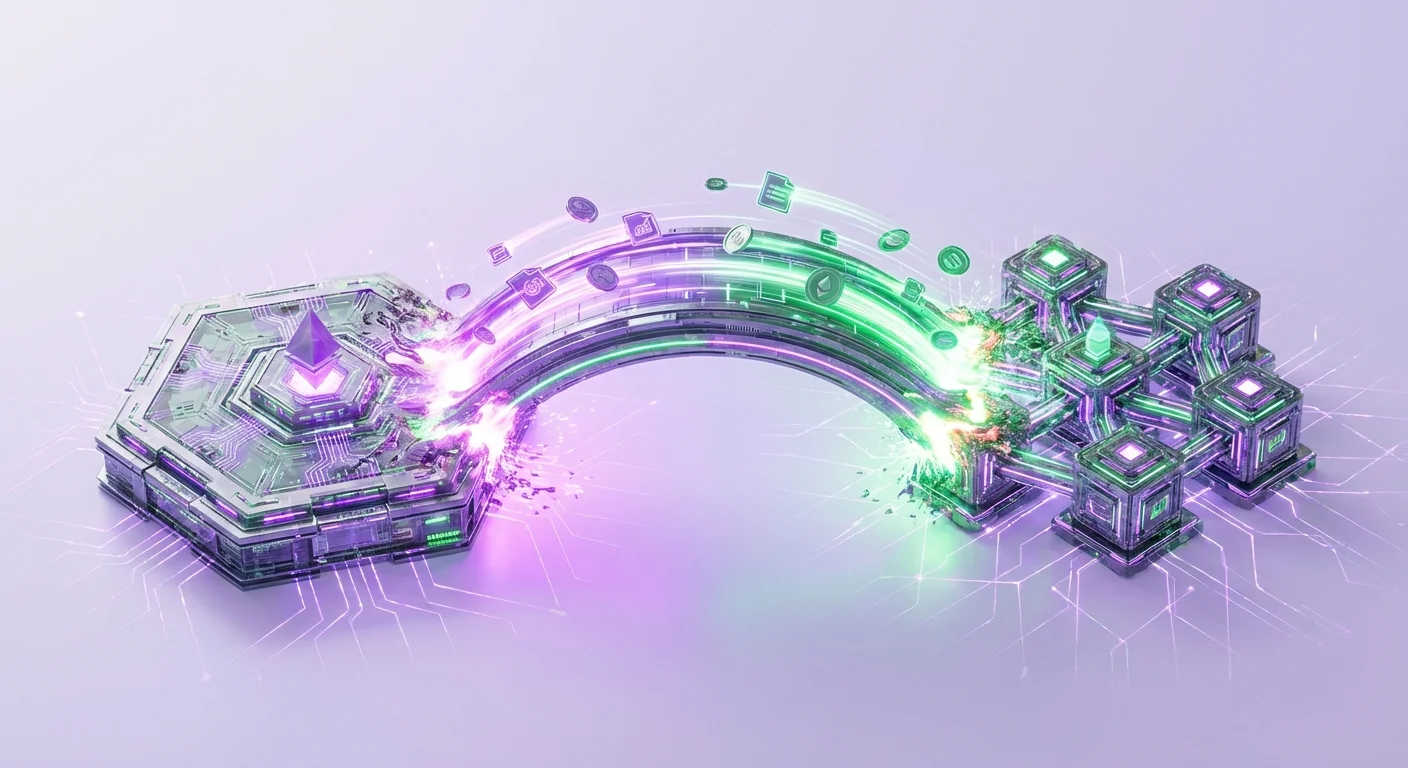
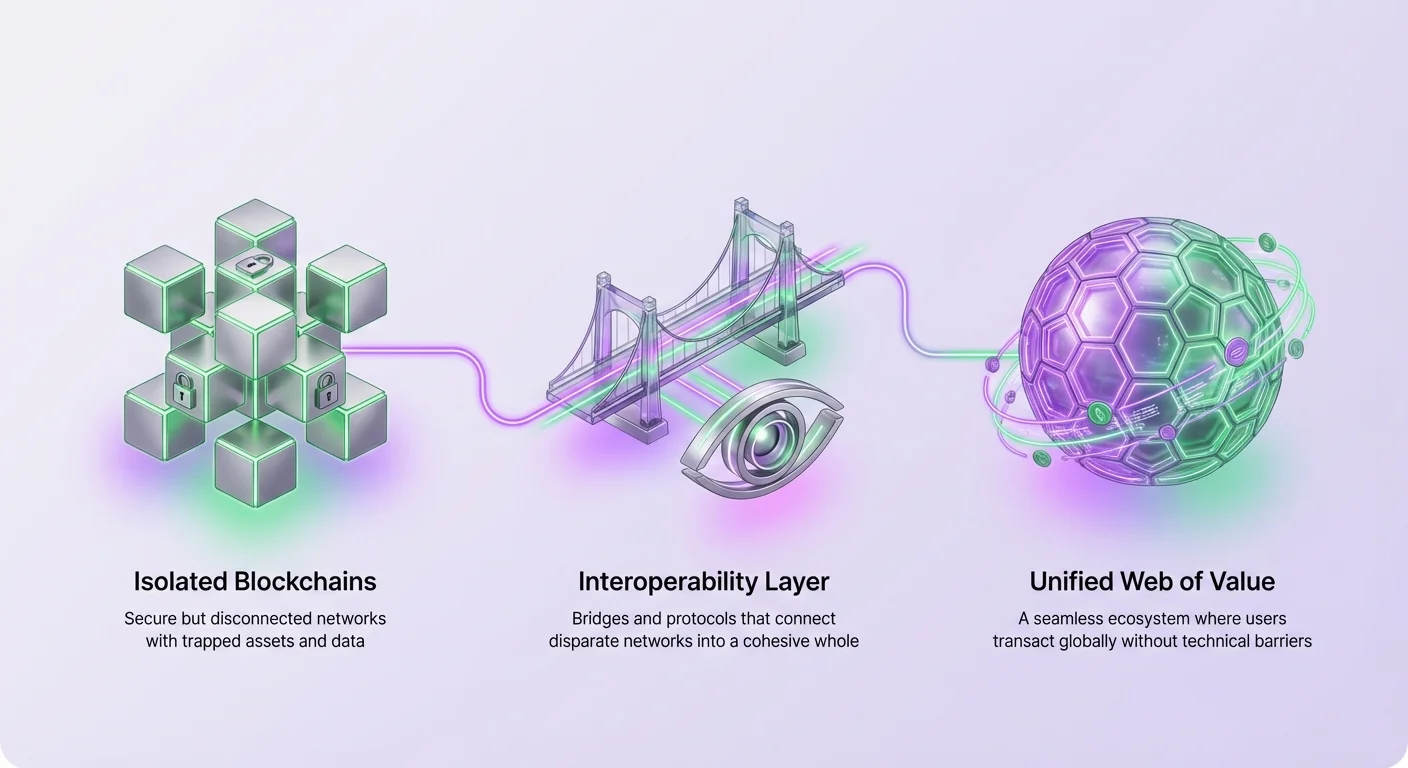
Blockchains were originally designed as isolated environments. They act as secure, immutable ledgers that excel at tracking value and data within their own walls, but they inherently lack the ability to communicate with the outside world or other distinct networks. This isolation creates a fragmented landscape where liquidity, data, and users are trapped in specific ecosystems.
To address this, the industry has developed an "interoperability layer" consisting of bridges, oracles, and cross-chain communication protocols. This layer serves as the connective tissue of the decentralized web, allowing disparate networks to function as a cohesive whole.
However, connecting these secure islands introduces significant complexity. The mechanisms used to transfer messages and value between chains often represent the weakest link in the security chain. Understanding how these systems function, and where their vulnerabilities lie, is essential for anyone navigating the modern crypto economy.
The evolution of this layer is moving beyond simple token bridges. We are seeing the rise of aggregation layers, zero-knowledge proofs, and decentralized oracle networks that aim to verify data without relying on centralized trust. This shift promises a future where users can interact with applications seamlessly, without needing to know which specific blockchain is processing their transaction.
The Data Bridge: Solving the Oracle Paradox
Smart contracts are powerful, self-executing agreements, but they suffer from a critical limitation known as the "oracle problem." By design, a blockchain can only access data that is native to its own ledger. It cannot "see" the price of an asset on a traditional stock exchange, the result of a sports game, or the current weather conditions.
For decentralized finance (DeFi) to function, it requires reliable access to this off-chain data. If a smart contract relies on a single source for this information, that source becomes a central point of failure. If the source is compromised or manipulated, the entire protocol is at risk.
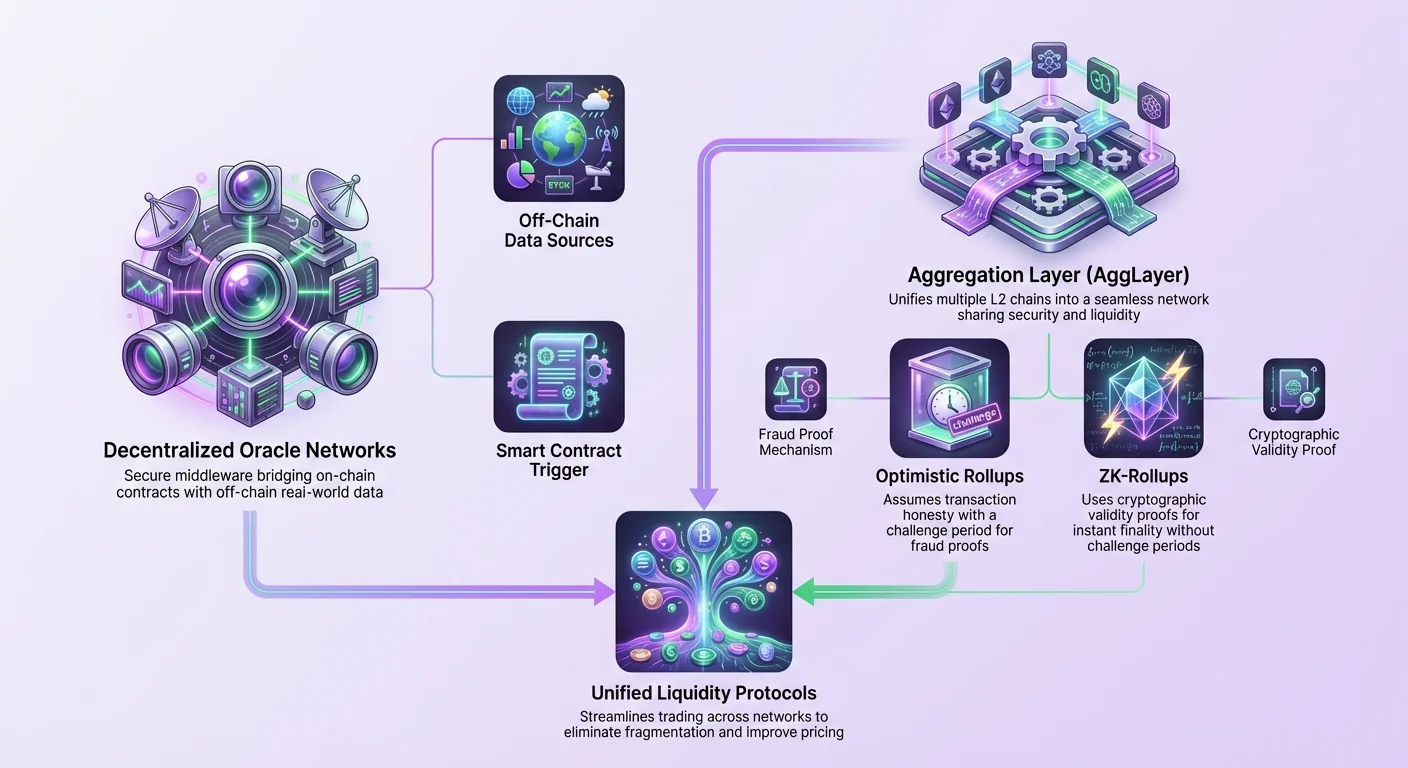
This is where decentralized oracle networks like Chainlink come into play. They act as secure middleware that bridges the gap between on-chain smart contracts and real-world data. The process involves multiple steps designed to ensure integrity and prevent manipulation.
First, a smart contract issues a request for data. The network selects multiple independent node operators to fulfill this request. These nodes retrieve the information from various off-chain sources and APIs. Critically, they do not just pass the raw data back.
The system aggregates the responses from multiple nodes to form a single, validated data point. This aggregation process filters out outliers and erroneous data, ensuring that the final value delivered to the smart contract is accurate and resistant to tampering.
This infrastructure is fundamental to modern DeFi applications. Lending platforms need precise price feeds to determine collateralization ratios. Insurance protocols need verifiable real-world event data to trigger payouts. Without this secure data bridge, the scope of blockchain utility would be severely limited.
Layer 2 Scaling and the Aggregation Thesis
As Ethereum grew in popularity, its limitations in transaction throughput and high costs became apparent. This led to the development of Layer 2 scaling solutions. These networks process transactions off the main chain (Layer 1) to increase speed and reduce costs, while still deriving security from Ethereum.
Polygon has been a primary driver of this evolution. Originally launched as the Matic Network in 2017, it began as a Proof-of-Stake (PoS) sidechain. It has since evolved into a comprehensive ecosystem of scaling solutions, including zero-knowledge (ZK) rollups and developer toolkits.
The next phase of this evolution is focused on unification. The "Aggregation Layer" or "AggLayer" concept aims to connect various L2 chains into a seamless network. Instead of treating each L2 as a separate silo with its own liquidity and user base, this architecture envisions a web of interconnected chains that share security and state.
In this model, zero-knowledge proofs play a central role. ZK-rollups, such as Polygon zkEVM, mirror the Ethereum environment but use complex cryptography to prove the validity of transactions. This allows for high security without the delays associated with traditional fraud-proof mechanisms.
The transition involves significant changes to tokenomics and utility. For instance, the migration from the MATIC token to the POL token represents a shift toward "hyperproductivity." In this new framework, a single token can be re-staked across multiple chains to perform various roles, such as validation or sequencing, simultaneously.
This approach attempts to solve the fragmentation issue. By allowing liquidity and security to flow freely between interconnected L2s, the network creates a user experience that feels like using a single chain, despite the underlying complexity of the multi-chain architecture.
Liquidity Unification and Automated Market Makers
The decentralized exchange (DEX) is another critical component of the interoperability landscape. Platforms like Uniswap pioneered the Automated Market Maker (AMM) model, which replaced traditional order books with liquidity pools.
In an AMM, users trade against a pool of tokens rather than a specific counterparty. The price is determined mathematically based on the ratio of assets in the pool. This innovation allowed for permissionless trading and the bootstrap of liquidity for thousands of new assets.
However, the proliferation of different blockchains and L2s has led to liquidity fragmentation. A specific asset might have deep liquidity on Ethereum Mainnet but very little on an L2 like Optimism or Arbitrum. This results in inefficient pricing and poor execution for traders moving across chains.
To address this, protocols are evolving. Uniswap v4 and the introduction of "Unichain" represent a move toward unifying this fragmented experience. Unichain acts as a cross-chain protocol designed to streamline trading across different networks.
By creating a specific application-chain (app-chain) or a unified protocol layer, these systems aim to standardize governance and liquidity. The goal is to make the chain itself invisible to the user. A trader should be able to swap assets regardless of where those assets technically reside.
Innovations like "hooks" in Uniswap v4 allow developers to inject custom logic into the trading process. This can enable features like on-chain limit orders or dynamic fee structures that adjust based on volatility. These tools give developers the flexibility to build complex cross-chain strategies directly into the liquidity pool structure.
Security Trade-offs: Optimistic vs. Zero-Knowledge
When moving assets or data between chains, security is the paramount concern. Different scaling solutions and bridges use different mechanisms to verify transactions, each with its own set of trade-offs regarding speed, cost, and safety.
The two dominant approaches for Layer 2 scaling are Optimistic Rollups and Zero-Knowledge (ZK) Rollups. Understanding the difference is vital for assessing risk.
Optimistic Rollups operate on a presumption of validity. They assume that transactions are honest and process them immediately. To ensure security, they implement a "challenge period," typically lasting seven days. During this window, anyone can submit a fraud proof if they detect malicious activity. If no fraud is proven, the transactions are finalized.
ZK-Rollups take a different approach. They generate a cryptographic proof for every batch of transactions. This proof mathematically certifies that the transactions are valid before they are ever posted to the main chain. Because the validity is proven instantly via cryptography, there is no need for a week-long challenge period.
| Feature | Optimistic Rollup | ZK-Rollup |
|---|---|---|
| Verification | Fraud Proofs (assume valid) | Validity Proofs (math verified) |
| Finality Time | Slow (approx. 7 days) | Fast (minutes/hours) |
| Complexity | Lower implementation risk | High cryptographic complexity |
The trade-off lies in complexity and cost. ZK-proofs require significant computational power to generate, making them technically harder to implement and potentially more expensive in the short term. However, they offer stronger security guarantees for cross-chain communication because reliance is placed on mathematics rather than economic incentives and watchtowers.
Decentralized Infrastructure and Resource Sharing
Interoperability extends beyond just financial value; it also encompasses the sharing of computational resources. As artificial intelligence (AI) models grow larger, the demand for computing power—specifically GPUs—has outstripped supply.
Centralized cloud providers often charge high premiums for access to high-performance hardware. This has created a market for decentralized infrastructure protocols like NodeAI. These platforms aim to create a transparent market for computing power, similar to how DeFi creates a market for money.
In this model, individuals or data centers with idle GPU capacity can connect their hardware to a decentralized network. Users who need to train AI models or render complex graphics can rent this power on demand.
The system uses blockchain technology to handle payments and verification. A token, such as the GPU token, facilitates these transactions. Stakers and participants in the network earn rewards for contributing resources or securing the protocol.
This democratization of infrastructure is crucial for the future of Web3. It ensures that the underlying hardware powering decentralized applications and AI agents is not monopolized by a few giant tech corporations. It aligns with the broader ethos of decentralization, where value flows to the contributors rather than centralized intermediaries.
Governance and Compliance in Connected Systems
As these cross-chain systems mature, governance becomes a critical layer of security. Decentralized Autonomous Organizations (DAOs) are the standard for managing protocol parameters, treasury spending, and upgrades.
Tokens like UNI (Uniswap) or YFI (Yearn Finance) serve as the voting power within these organizations. Holders can propose changes to fee structures, support for new chains, or the allocation of funds. This collective decision-making process helps align the protocol with the interests of its users.
However, the intersection of DeFi and traditional finance is introducing new hybrid models. Projects like World Liberty Financial are emerging with a focus on regulatory compliance and stablecoin adoption. These platforms often implement strict Know Your Customer (KYC) measures.
While some purists argue this contradicts the permissionless nature of crypto, others see it as a necessary bridge to mass adoption. By creating compliant environments, these projects aim to attract institutional capital that is otherwise sidelined by regulatory uncertainty.
The governance models in these hybrid systems often differ. For example, a governance token might be non-transferable, ensuring that voting power remains with long-term participants rather than short-term speculators. This structure attempts to prevent hostile takeovers and ensure stable stewardship of the protocol.
The User Experience of Abstracted Complexity
For the average user, the technical nuances of bridges, ZK-proofs, and oracle networks should ideally be invisible. The goal of the interoperability layer is abstraction. A user should simply see a wallet interface that allows them to hold and use their assets without worrying about which chain they are on.
Wallets are evolving from simple storage tools into comprehensive portals. Modern self-custodial wallets, like the Bitcoin.com Wallet, support multiple chains and manage the complexity of bridging in the background. They allow users to swap, earn, and play across different ecosystems from a single dashboard.
Ecosystem tokens like VERSE are designed to incentivize this engagement. They provide rewards for liquidity provision, yield farming, and trading within a specific suite of products. This gamification encourages users to explore the capabilities of DeFi while mitigating some of the friction associated with cross-chain interactions.
As protocols like Unichain and Polygon 2.0 mature, we can expect applications to become "chain-agnostic." A game might run its logic on a high-speed Layer 2 while settling high-value asset ownership on Ethereum Mainnet, all without the player ever needing to manually bridge a token.
Risks and the Future of Communication
Despite the advancements, cross-chain communication remains high-risk. Bridges have historically been the most targeted attack vectors in the crypto space. When assets are locked in a bridge contract on one chain to be minted on another, that "honeypot" of locked assets becomes a prime target for hackers.
Smart contract risk is omnipresent. Even with audits, complex code interacting across multiple asynchronous networks can behave in unpredictable ways. Bugs in the code or vulnerabilities in the logic can lead to catastrophic losses.
Furthermore, the reliance on governance introduces human risk. If a DAO is taken over by malicious actors, or if a multisig wallet controlling a bridge is compromised, the security of the entire system fails.
The future of cross-chain communication lies in minimizing trust. The industry is moving away from "trusted" bridges (where you trust a set of validators) toward "trust-minimized" bridges (where you trust cryptography). Zero-knowledge technology is the spearhead of this transition.
By mathematically proving the state of one chain to another, we can eliminate the need for third-party intermediaries. This leads to a "Value Layer" of the internet—a global, interconnected mesh of blockchains where value flows as freely as information does today.
Conclusion
The interoperability layer is rapidly evolving from a patchwork of risky bridges into a sophisticated network of cryptographic proofs and aggregated liquidity. Innovations in zero-knowledge technology and decentralized data verification are laying the groundwork for a more secure and unified blockchain ecosystem. While trade-offs between speed, cost, and security persist, the trend is clearly moving toward systems that abstract complexity away from the user.
As infrastructure projects like Polygon 2.0 and Unichain mature, the boundaries between individual blockchains will blur. This unification will likely drive the next wave of adoption, enabling applications that leverage the strengths of multiple networks simultaneously. The ultimate goal is a seamless web of value where the technology works silently in the background, empowering users to transact globally without technical barriers.
True interoperability is achieved when the user no longer knows—or cares—which blockchain they are using.