
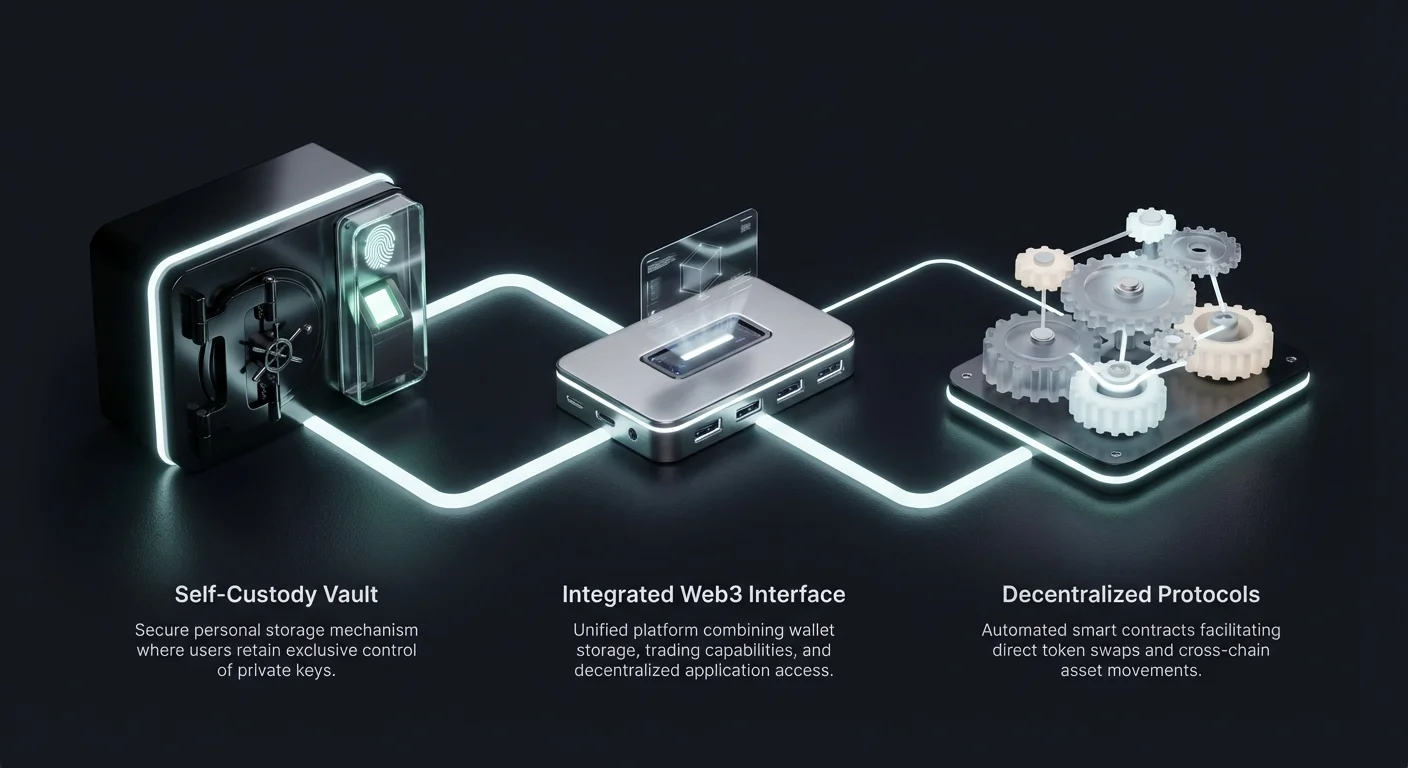
The landscape of cryptocurrency trading has evolved significantly from the early days of simple peer-to-peer transfers. Modern digital asset management now revolves around integrated ecosystems that combine storage, trading, and decentralized access into unified interfaces.
As the industry matures, the line between a storage solution and a trading platform continues to blur. Users no longer view wallets merely as digital vaults. Instead, these tools serve as active gateways to the broader Web3 economy.
This evolution has given rise to integrated trading environments where users can swap tokens, bridge assets across blockchains, and access decentralized finance protocols directly. Understanding the mechanics of these systems is essential for anyone looking to navigate the digital asset space effectively.
The Evolution of Trading Interfaces
The journey of crypto trading began with rudimentary interfaces that required significant technical knowledge. Early adopters had to manage complex keys and navigate command-line tools to execute even basic transactions.
Over time, the industry shifted toward user-friendly platforms that mimicked traditional stock brokerage accounts. This transition democratized access, allowing non-technical users to participate in the market.
From Order Books to Automated Swaps
Traditional centralized exchanges operate on an order book model. This system matches buyers and sellers based on price and volume. While efficient for liquid markets, it requires an intermediary to hold funds and facilitate the trade.
In contrast, the Web3 environment introduced the concept of automated market makers (AMMs). These protocols eliminate the need for a traditional counterparty. Instead, users trade against a pool of assets funded by liquidity providers.
This shift allows for instant token swaps directly within a wallet interface. The software interacts with smart contracts to execute the trade, ensuring that the user retains custody of their assets throughout the process.
The Rise of Non-Custodial Interfaces
A critical development in this sector is the non-custodial exchange interface. Unlike centralized platforms where the exchange holds the private keys, non-custodial solutions ensure that the user remains the sole owner of their assets.
These interfaces connect directly to the blockchain. When a user initiates a trade, they are signing a transaction that approves a specific smart contract to interact with their wallet.
This model significantly reduces the risk of exchange-based hacks. Since the interface does not hold user funds, there is no central honey pot for attackers to target. Security relies on the robustness of the underlying smart contract code and the user's ability to protect their private keys.
Custody Models in Integrated Trading
Understanding custody is fundamental to secure trading. The distinction between custodial and non-custodial services defines who actually controls the digital assets. This choice impacts everything from security to regulatory compliance.
Centralized Custodial Services
Custodial services act as digital banks. When users deposit funds, the platform takes control of the assets and issues an IOU to the user's account. This model offers convenience and recourse in some situations, such as password recovery.
These platforms often employ advanced security measures. These include cold storage, where the majority of assets are kept offline, and multi-signature protocols that require multiple approvals for transactions.
Insurance policies are also common in custodial models. Some platforms maintain insurance funds or third-party coverage to reimburse users in the event of a security breach or operational failure.
Self-Custody and Personal Responsibility
Self-custody places the responsibility entirely on the user. Integrated Web3 wallets provide the tools to manage private keys, but they do not have access to them. If a user loses their seed phrase, the assets are unrecoverable.
The benefit of this model is censorship resistance. No third party can freeze funds or block transactions. This aligns with the core ethos of cryptocurrency, offering true financial sovereignty.
However, this freedom comes with risks. Users must be vigilant against phishing attacks and malware. Without a centralized support team to reverse transactions or recover accounts, the margin for error is non-existent.
Mechanics of Cross-Chain Bridges
The fragmentation of the blockchain ecosystem created a need for interoperability. Different blockchains, such as Bitcoin and Ethereum, speak different languages and cannot directly communicate.
Bridges act as translators and transport mechanisms between these isolated networks. They allow value and information to flow across different blockchain architectures, enabling a more connected Web3 environment.
How Bridging Works
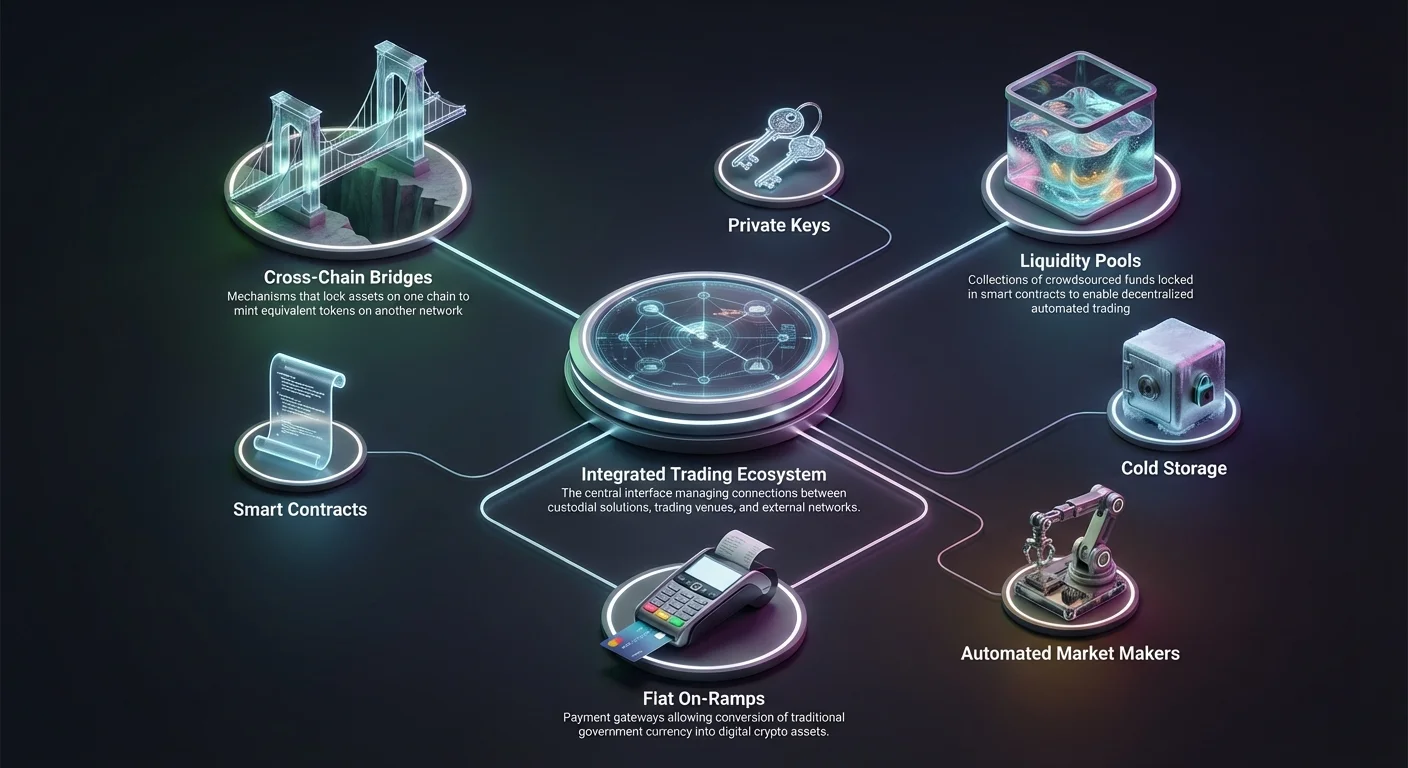
Most bridges operate using a lock-and-mint or burn-and-mint mechanism. When a user wants to move an asset from Chain A to Chain B, the bridge locks the asset in a smart contract on Chain A.
Simultaneously, the bridge issues an equivalent representation of that asset on Chain B. This "wrapped" token tracks the value of the original asset and can be used within the ecosystem of the destination chain.
When the user wants to return, they send the wrapped token back to the bridge on Chain B. The token is burned (destroyed), and the smart contract on Chain A unlocks the original asset.
Risks Associated with Bridges
Bridges are complex pieces of software and have historically been prime targets for exploits. The reliance on smart contracts means that any bug in the code can be catastrophic.
If the smart contract on the source chain is compromised, the locked assets can be drained. This renders the wrapped tokens on the destination chain worthless, as they are no longer backed by anything.
Users must carefully evaluate the security audits and reputation of any bridge they use. Integrated wallets often aggregate reliable bridges, but due diligence remains a critical component of safe cross-chain trading.
Decentralized Exchange Access
Decentralized exchanges (DEXs) are the engine room of Web3 trading. They facilitate peer-to-peer transactions without intermediaries, using code to manage the logistics of the trade.
Accessing a DEX usually involves connecting a Web3 wallet to a specialized interface. This connection allows the decentralized application (dApp) to view public balances and request transaction signatures.
Liquidity Pools and Providers
DEXs rely on liquidity pools rather than order books. A liquidity pool is a collection of funds locked in a smart contract. Liquidity providers (LPs) deposit pairs of tokens into these pools to facilitate trading.
In return for supplying capital, LPs earn trading fees. This system creates a decentralized market where anyone can participate as a market maker. It ensures that there is always capital available for trading, even for less popular assets.
However, providing liquidity comes with the risk of impermanent loss. If the price of the deposited assets changes significantly relative to each other, the LP might end up with less value than if they had simply held the tokens.
Slippage and Price Impact
Slippage refers to the difference between the expected price of a trade and the price at which it is executed. In decentralized pools, large trades can significantly shift the balance of assets, causing the price to move against the trader.
Integrated wallets often include slippage protection settings. Users can define a maximum acceptable percentage of price movement. If the market moves beyond this limit during the transaction, the trade fails to prevent excessive loss.
High liquidity pools generally have lower slippage. Traders dealing with large volumes must seek out pools with sufficient depth or use aggregators that split trades across multiple sources to minimize price impact.
The Role of Aggregators
With liquidity fragmented across hundreds of different exchanges and pools, finding the best price can be difficult. DEX aggregators solve this problem by scanning multiple liquidity sources simultaneously.
When a user initiates a swap through an aggregator, the protocol calculates the most efficient route. This might involve splitting the order into smaller chunks and routing them through different pools to optimize the final output.
Aggregators are increasingly being integrated directly into wallet interfaces. This provides users with "best execution" capabilities without needing to manually check prices across different decentralized exchanges.
Privacy and Anonymity in Trading
Privacy is a significant concern for many digital asset users. While the blockchain ledger is public, the identity of the wallet owner is not necessarily linked to real-world data.
KYC vs. No-KYC Platforms
Centralized exchanges typically require Know Your Customer (KYC) verification. This process involves submitting government-issued ID and proof of address. It connects a user's on-chain activity to their legal identity.
In contrast, decentralized and anonymous exchanges often operate without KYC. Users can trade by simply connecting a wallet. This preserves privacy but can limit access to fiat on-ramps, which almost always require banking integration and identity verification.
Privacy Coins and Mixing
Some traders utilize privacy-focused cryptocurrencies to further obscure transaction data. These assets use advanced cryptographic techniques to hide the sender, receiver, and amount involved in a transaction.
Alternatively, coin mixing services can break the link between a source wallet and a destination wallet. However, these tools are often scrutinized by regulators, and some centralized platforms may flag or block funds that have interacted with mixers.
Security Architecture and Best Practices
Security in the crypto space is multilayered. It involves the security of the underlying blockchain, the smart contracts being used, and the personal security practices of the trader.
Two-Factor Authentication and Encryption
For platforms that require logins, two-factor authentication (2FA) is a non-negotiable standard. This adds a second layer of verification, usually via a mobile app or hardware key, making it difficult for attackers to access accounts even if they have the password.
Encryption protects data in transit and at rest. Reputable platforms use industry-standard encryption protocols to safeguard sensitive user information and private keys.
Cold Storage Integration
The safest way to store cryptocurrencies is offline, in what is known as cold storage. This separates the private keys from the internet, effectively neutralizing remote hacking attempts.
Many integrated trading platforms now support hardware wallet connections. This allows users to keep their keys on a physical device while still interacting with online exchanges and dApps. The hardware device signs the transaction internally and only broadcasts the approved signature.
| Security Feature | Function | User Benefit |
|---|---|---|
| Cold Storage | Keeps keys offline | Prevents remote hacking |
| Multi-Signature | Requires multiple approvals | Eliminates single point of failure |
| 2FA | Second login verification | Stops unauthorized access |
Fee Structures in Web3 Trading
Trading costs in the crypto ecosystem can be complex. They are often a combination of network fees, protocol fees, and service spreads. Understanding these components is vital for cost-effective trading.
Network and Gas Fees
Every transaction on a blockchain requires a fee paid to the network validators or miners. This is often referred to as "gas." Gas fees vary based on network congestion and the complexity of the transaction.
Simple transfers are usually cheap, while complex smart contract interactions, such as swaps or bridging, cost more. Integrated wallets often provide gas estimators to help users time their trades for periods of lower network activity.
Service Fees and Spreads
Exchanges and swap providers charge a fee for their service. On centralized platforms, this is often a percentage of the trade volume, known as maker and taker fees.
Maker fees apply when an order adds liquidity to the book (e.g., a limit order). Taker fees apply when an order removes liquidity (e.g., a market order). Taker fees are generally higher.
In swap interfaces, fees may be hidden in the spread. The spread is the difference between the market price and the price offered to the user. A "zero fee" exchange often generates revenue by offering a slightly wider spread.
Fiat On-Ramps and Off-Ramps
To enter the Web3 ecosystem, users need a way to convert traditional currency (fiat) into cryptocurrency. This gateway is known as an on-ramp. Conversely, converting crypto back to cash requires an off-ramp.
Payment Integrations
Modern exchanges have integrated various payment rails to facilitate these conversions. Bank transfers and wire payments are common for large amounts due to their lower fees.
For speed and convenience, many platforms support credit and debit cards. However, these methods often incur higher processing fees charged by the card networks.
Digital payment processors like PayPal have also entered the space. These integrations allow for instant deposits and withdrawals, leveraging the existing trust and infrastructure of established fintech companies.
Regional Restrictions
The availability of fiat rails depends heavily on local regulations. Banking partners vary by region, meaning that a payment method available in Europe might not be supported in Asia.
Users must verify that an exchange supports their local currency and preferred payment method. Regulatory compliance ensures that these transactions are processed smoothly without risk of funds being frozen by traditional banks.
Peer-to-Peer (P2P) Trading Systems
P2P trading represents a direct exchange of value between two individuals. Unlike AMMs or order books, P2P platforms act as bulletin boards where users post advertisements to buy or sell assets.
The Escrow Mechanism
Trust is the primary challenge in P2P trading. To solve this, platforms utilize escrow services. When a trade is initiated, the seller's crypto is locked in a secure escrow account.
The buyer then sends the payment directly to the seller using the agreed-upon method (e.g., bank transfer). Once the seller confirms receipt of the funds, the platform releases the crypto from escrow to the buyer.
This system protects both parties. The seller knows the crypto is safe until they are paid, and the buyer knows the crypto is locked and cannot be run off with.
Dispute Resolution
Despite escrow, disputes can arise. A buyer might claim they sent payment when they didn't, or a seller might refuse to release funds. P2P platforms provide dispute resolution services where support agents review evidence, such as bank statements, to arbitrate the outcome.
Advanced Trading Capabilities
As the market matures, traders demand more sophisticated tools beyond simple swaps. Integrated platforms are increasingly offering access to derivatives and leverage.
Futures and Perpetual Contracts
Futures contracts allow traders to speculate on the future price of an asset without owning it. Perpetual contracts are a specific type of future that does not have an expiry date, allowing positions to be held indefinitely.
These instruments are used for both speculation and hedging. A trader might short a perpetual contract to protect their portfolio against a market downturn without selling their underlying assets.
Leverage and Margin
Leverage allows traders to borrow funds to increase their position size. For example, with 10x leverage, a $1,000 deposit can control a $10,000 position.
While this amplifies potential profits, it also magnifies losses. If the market moves against the position, the trader risks liquidation, where their initial deposit is seized to pay back the borrowed funds.
Integrated Web3 platforms are bringing these tools to decentralized interfaces. Decentralized perp protocols allow for leveraged trading directly from a wallet, maintaining the non-custodial ethos while offering advanced financial products.
The Importance of User Experience (UX)
The complexity of blockchain technology acts as a barrier to entry. Good user experience design is essential for bridging the gap between technical protocols and everyday users.
Simplifying Complexity
Effective trading interfaces abstract away the technical details. Instead of displaying raw transaction data, they show clear summaries of what is happening. "Approving a token" or "Signing a message" is explained in plain language.
Visual cues helps users understand the status of their transactions. Loading bars, clear success/failure notifications, and intuitive navigation prevent errors and reduce anxiety.
Mobile Accessibility
With the majority of internet usage shifting to mobile, trading platforms must offer robust mobile applications. These apps need to replicate the full functionality of desktop interfaces, including charting, swapping, and asset management.
Mobile security involves biometric authentication (fingerprint or face ID) to ensure that quick access does not compromise safety. The ability to trade on the go is a key requirement for active participants in the 24/7 crypto market.
Brokerage vs. Exchange Models
While often used interchangeably, brokers and exchanges operate differently. An exchange is a marketplace where users trade with each other. A broker is an intermediary that sells assets to the user directly.
The Brokerage Advantage
Brokers simplify the process. They often provide a "convert" feature where a user simply enters an amount, and the broker handles the execution. This is ideal for beginners who find order books and liquidity pools confusing.
Brokers may also offer personalized support and educational resources. They act as a guide, helping users navigate the market complexities.
Cost Implications
The convenience of a broker usually comes at a premium. The spread offered by a broker is typically wider than what can be found on a direct exchange. Advanced traders often prefer direct exchange access to minimize costs and gain more control over their order execution.
Regulatory Considerations
The regulatory landscape for crypto trading is fragmented and constantly changing. Different jurisdictions have different rules regarding KYC, asset classification, and tax reporting.
Compliance and Safety
Regulated platforms must adhere to strict standards regarding capital reserves and security. Using a regulated exchange provides a layer of legal protection and recourse that unregulated platforms lack.
However, regulation can also restrict access to certain assets or features. For example, leverage trading is restricted for retail users in several jurisdictions. Users must be aware of the laws in their region and how they apply to their trading activities.
Conclusion
The integration of trading capabilities directly into Web3 wallets marks a maturing of the cryptocurrency ecosystem. By combining storage, swapping, and bridging into unified interfaces, the industry is reducing the friction that previously hindered adoption. Whether through centralized entities that offer robust support or decentralized protocols that ensure self-sovereignty, users now have unprecedented choices in how they manage their digital wealth.
As these technologies continue to converge, the focus remains on balancing security, convenience, and control. From the mechanics of atomic swaps to the complexities of cross-chain bridges, the tools available today empower individuals to participate in a global, permissionless financial system. Understanding these components ensures that participation is not only effective but also secure.
The most effective trading strategy relies on a deep understanding of custody, rigorous security practices, and the correct use of available tools.