
Cryptocurrency markets operate continuously, creating a trading environment where speed and reliability are paramount for participants. Unlike traditional financial markets with set opening and closing hours, digital asset exchanges run twenty-four hours a day. This perpetual operation demands robust infrastructure capable of handling massive data flows without interruption. Performance benchmarks serve as critical indicators for traders evaluating which platform best suits their strategies.
These benchmarks encompass various metrics that define the efficiency of a trading venue. Latency, system uptime, and the ability to withstand market stress are among the most vital factors. For casual investors, a delay of a few seconds might be negligible during a standard purchase. However, for day traders and automated systems, milliseconds can determine the difference between a profitable trade and a loss.
Evaluating an exchange goes beyond checking its fee schedule or asset list. It requires an understanding of the underlying technology that matches orders and executes transactions. High-performance platforms invest heavily in matching engines that can process thousands of orders per second. This technical capability ensures that user actions are reflected in the order book immediately.
Defining Exchange Latency
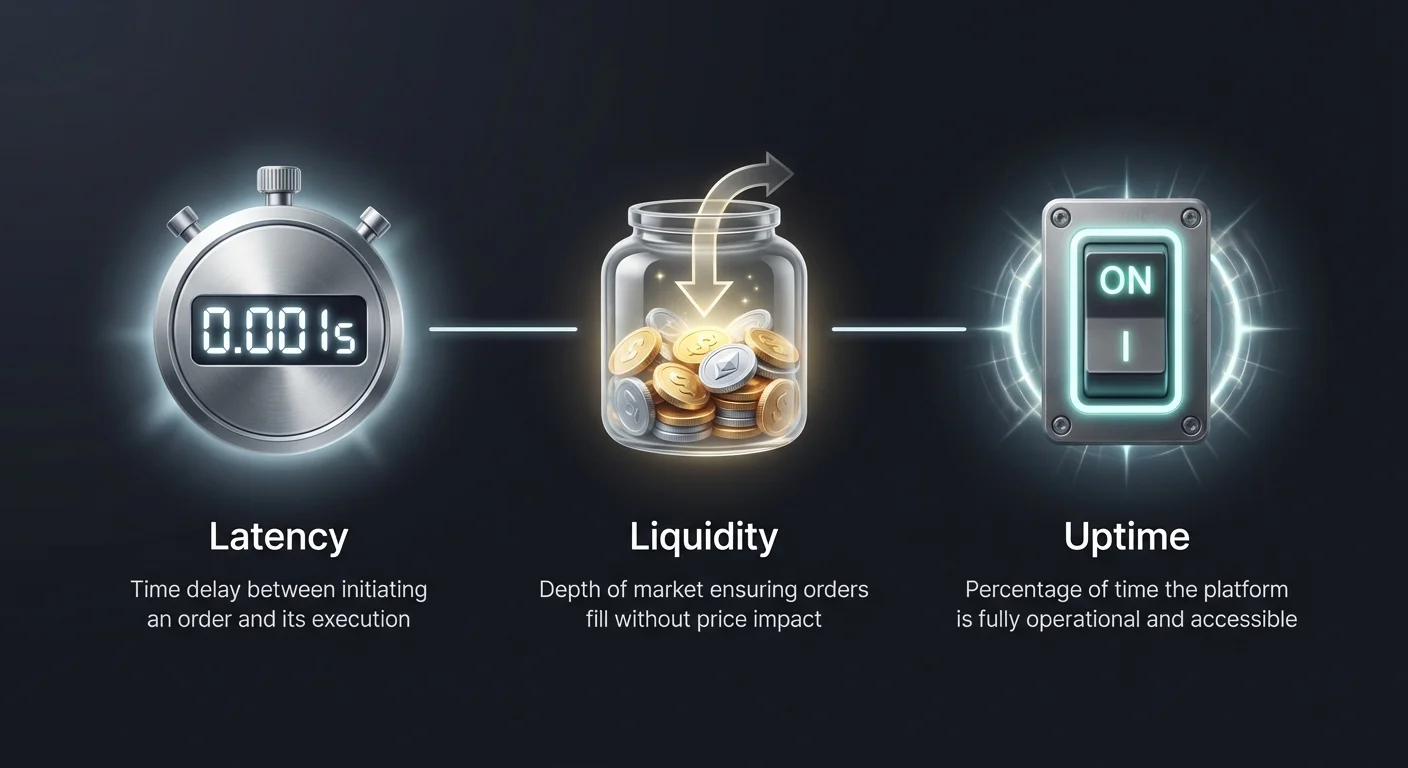
Latency refers to the time delay between a trader initiating an order and the exchange executing that order. In the fast-paced realm of crypto assets, low latency is a defining characteristic of top-tier platforms. When a user clicks "buy," data travels from their device to the exchange's server. The matching engine processes the request, finds a seller, and confirms the transaction.
This entire loop must happen almost instantaneously to be effective. High latency can lead to significant issues in trade execution. If price data on the user's screen is delayed, they may place orders based on stale information. By the time the order reaches the matching engine, the market price may have shifted. This often results in failed orders or execution at unfavorable rates.
The Impact on Day Trading
For day traders, latency is often the single most important technical factor. Day trading involves making frequent trades to capitalize on small price movements throughout the session. Strategies like scalping require entering and exiting positions within minutes or even seconds. A platform with high latency introduces a lag that can render these fast-paced strategies ineffective.
Source material highlights that competitive platforms execute trades in microseconds. This level of speed is necessary to keep up with the volatility inherent in crypto markets. When prices move rapidly, a delay of even half a second can mean missing a breakout or failing to trigger a stop-loss in time. Traders rely on real-time data to make split-second decisions.
Slippage is a direct consequence of poor latency and low transaction speeds. It occurs when the final execution price of a trade differs from the expected price at the time the order was placed. In high-latency environments, the market moves faster than the system can process the request. Minimizing latency is therefore essential for reducing slippage and protecting profit margins.
System Uptime and Stability
System uptime represents the percentage of time an exchange is fully operational and accessible to users. In an industry that never sleeps, the ideal uptime benchmark is 100%, though 99.99% is the industry standard for reliability. Downtime can occur due to scheduled maintenance or unexpected technical failures.
Unexpected outages are particularly damaging during periods of high market volatility. If Bitcoin or Ethereum experiences a sudden price surge or crash, traffic to exchanges typically spikes. Platforms with weak infrastructure may crash under this increased load. This prevents traders from managing their positions exactly when they need to most.
Reliability under pressure is a key differentiator for professional-grade exchanges. A platform that remains stable during a market frenzy allows users to execute orders when liquidity is most active. Conversely, an exchange that frequently goes offline during price swings poses a significant risk. Traders may be left holding depreciating assets without the ability to sell.
Stress Testing Reliability
Stress tests mimic extreme market conditions to evaluate how an exchange performs under heavy loads. While users cannot perform technical stress tests themselves, they can analyze historical performance during past market peaks. A platform's track record during previous bull runs or crashes serves as a practical stress test result.
Analyzing reviews and community feedback often reveals how an exchange behaves during these critical moments. Traders should look for reports of frozen order books, login failures, or delayed withdrawals during high-volume periods. These incidents indicate that the platform's infrastructure may not be scalable enough to handle stress.
Reliable platforms utilize advanced architecture to distribute loads and prevent bottlenecks. This often involves using distributed server networks and redundant systems. If one server fails or becomes overloaded, others take over to ensure continuity. This redundancy is expensive to maintain but necessary for institutional-grade reliability.
Liquidity as a Performance Factor
Liquidity is often discussed as a financial metric, but it functions as a critical performance benchmark as well. High liquidity refers to the presence of many buyers and sellers in the order book. This depth ensures that orders can be filled quickly without causing drastic price changes.
From a performance standpoint, liquidity dictates execution speed. In a highly liquid market, a market order finds a matching counterparty almost instantly. In illiquid markets, the matching engine must search deeper into the order book to fill the request. This search process takes longer and often results in partial fills or worse prices.
Top exchanges maintain high liquidity by attracting a large user base and utilizing market makers. Market makers are entities that continuously provide buy and sell orders to the order book. Their presence ensures there is always someone ready to trade, which streamlines the execution process for retail users.
The Role of Matching Engines
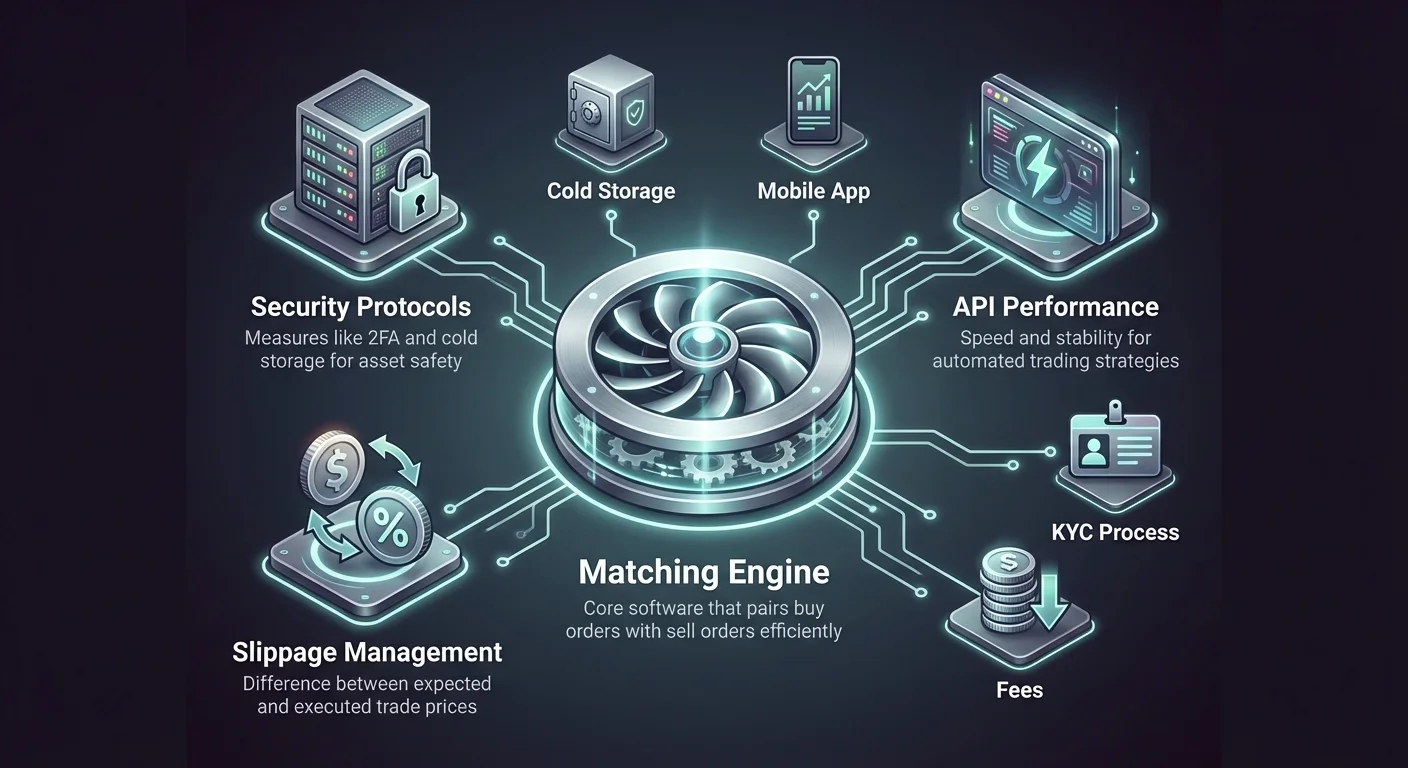
The heart of any crypto exchange is its matching engine. This software component is responsible for pairing buy orders with sell orders. The efficiency of the matching engine determines the platform's throughput, usually measured in transactions per second (TPS).
A high-performance matching engine can handle millions of transactions per second. This capability prevents the system from becoming clogged during moments of peak activity. When an engine's capacity is exceeded, order processing slows down, creating a backlog. This backlog leads to increased latency and user frustration.
Sophisticated platforms are designed to execute trades in microseconds. This engineering feat requires optimizing every step of the data path. For traders using algorithmic strategies or bots, the matching engine's speed is the limiting factor for their potential frequency of trading.
Connectivity for Automated Trading
Automated trading strategies, such as grid trading or arbitrage bots, rely heavily on exchange performance. These systems communicate with the exchange via Application Programming Interfaces (APIs). The speed and stability of the API connection are crucial performance benchmarks for algorithmic traders.
Grid trading bots place a series of buy and sell orders at predetermined intervals. As the market price fluctuates, the bot executes these orders automatically. If the exchange's API is slow or unstable, the bot may miss profit opportunities. It might fail to place a sell order after a buy, leaving the trader with an open position.
Rate limits are another aspect of API performance. Exchanges impose limits on how many requests a user can send per minute to prevent system overload. However, high-performance exchanges offer generous rate limits that accommodate high-frequency strategies. Understanding these technical constraints is vital for anyone using automation.
Decentralized Exchange Performance
Decentralized exchanges (DEXs) operate on different performance principles compared to centralized counterparts. While centralized platforms rely on internal servers, DEXs rely on blockchain networks. Speed on a DEX is largely determined by the block time of the underlying blockchain.
Transactions on a DEX are not instant in the traditional sense. They must be confirmed by network validators or miners. On fast networks like Solana, this might take a few seconds. On slower networks, it could take minutes. This inherent latency is a trade-off for the increased security and custody control that DEXs offer.
However, innovation in the sector is improving DEX performance rapidly. Some modern platforms offer response times as fast as 350 milliseconds. These "instant" swap services bridge the gap between centralized speed and decentralized security. They allow for rapid asset conversion without the need for account registration or custodial wallets.
Interface Responsiveness
The user interface (UI) is the visible layer of exchange performance. A responsive UI updates price charts, order books, and account balances in real-time. Laggy interfaces can lead to user error, such as entering the wrong price or quantity because the display hadn't updated.
Mobile app performance is increasingly important as more traders operate on the go. A well-optimized app should replicate the functionality of the desktop site without sacrificing speed. It needs to handle data streams efficiently over mobile networks, which may be less stable than fiber-optic connections.
Top platforms ensure their mobile applications are lightweight and fast. They strip away unnecessary graphical elements that might slow down loading times. This focus on efficiency ensures that traders can manage their portfolios effectively, regardless of their physical location or device.
Geographic Distribution and Speed
The physical distance between a trader and the exchange's servers impacts latency. Data cannot travel faster than the speed of light. If a user in Europe is trading on a server located in Asia, there will be an unavoidable delay.
To mitigate this, global exchanges utilize Content Delivery Networks (CDNs) and distributed data centers. By placing servers in key regions like the USA, Europe, and Asia, they reduce the physical distance data must travel. This geographic distribution ensures a uniform experience for users worldwide.
When choosing a platform, traders often look for exchanges with a strong presence in their region. This not only aids in transaction speed but often correlates with better compliance with local regulations and banking integrations. Localized infrastructure is a key component of a high-performance global exchange.
Security vs. Speed Trade-offs
There is often a delicate balance between security measures and transaction speed. Features like two-factor authentication (2FA) and email confirmations add steps to the login and withdrawal process. While these add latency to the user experience, they are non-negotiable for asset safety.
Cold storage protocols also impact the speed of withdrawals. Exchanges store the majority of user funds in offline wallets to prevent theft. Moving funds from cold storage to a hot wallet for withdrawal takes time, often requiring human authorization.
This intentional delay is a security feature, not a performance bug. Users should expect instant execution for trading but reasonable delays for large withdrawals. Understanding this distinction helps in setting realistic expectations for platform performance.
Measuring Slippage
Slippage acts as a tangible cost of poor performance. It is the difference between the expected price of a trade and the price at which the trade is actually executed. In fast-moving markets, slippage is inevitable to some degree, but high-performance engines minimize it significantly.
Positive slippage occurs when a trade is executed at a better price than expected. Negative slippage results in a worse price. Consistently high negative slippage is a red flag regarding an exchange's liquidity or engine speed. It effectively acts as a hidden fee that eats into trading profits.
Traders can monitor slippage by comparing their order prices with execution records. If a platform consistently fills orders at prices far from the market rate shown on the chart, it indicates underlying performance issues. This metric is often more telling than stated transaction fees.
The Role of Market Makers
Market makers play a pivotal role in maintaining exchange performance. They are professional traders or firms that commit to quoting buy and sell prices for specific assets. Their activity creates the liquidity that allows retail traders to transact instantly.
Exchanges incentivize market makers through lower fees or rebates. This symbiotic relationship ensures that the order book remains thick, absorbing large market orders without significant price deviations. Without active market makers, an exchange would suffer from wide bid-ask spreads and slow execution.
The presence of robust market making activity is a sign of a healthy, high-performance venue. It indicates that the platform has the technical infrastructure to support professional-grade trading volumes. For the average user, this translates to smoother, faster, and more cost-effective trades.
Historical Uptime Data
Analyzing historical uptime data provides insight into a platform's long-term reliability. While past performance does not guarantee future results, a history of stability suggests a mature infrastructure. Users should look for transparency reports where exchanges publish their uptime statistics.
Frequent scheduled maintenance is a double-edged sword. It indicates that the team is actively improving the system, which is positive. However, excessive maintenance windows that interrupt trading hours can be disruptive. The best platforms perform updates during periods of low liquidity to minimize impact.
Unplanned outages are the most concerning metric. A pattern of crashing during every major market movement suggests a failure to scale. This lack of scalability makes the platform unsuitable for serious trading, as these volatile moments are often the most profitable.
Order Types and Execution Quality
The variety of supported order types can also be linked to system performance. Basic platforms may only offer market and limit orders. High-performance exchanges support advanced options like stop-loss, take-profit, and One-Cancels-the-Other (OCO) orders.
Executing complex order types requires a more sophisticated matching engine. The system must track trigger prices and conditional logic for millions of users simultaneously. The ability to handle these complex instructions without lag is a testament to the platform's backend engineering.
For traders, these tools are essential for risk management. A stop-loss order that fails to trigger due to system lag can be disastrous. Therefore, the reliability of advanced order execution is a critical performance benchmark for any risk-conscious investor.
API Reliability for Institutions
Institutional investors and professional trading firms rely almost exclusively on API connections. For this demographic, API documentation, support, and stability are the primary performance metrics. A poorly documented or buggy API renders an exchange unusable for professional integration.
These users often conduct their own stress tests on the API before committing capital. They measure the round-trip time for data packets and the consistency of websocket data streams. If the data feed lags behind the actual market, arbitrage opportunities are lost.
Exchanges catering to this sector often provide dedicated servers or colocation services. Colocation allows high-frequency traders to place their servers in the same physical facility as the exchange's matching engine. This minimizes network latency to the absolute physical limit.
| Metric | Description | Importance |
|---|---|---|
| Latency | Time from click to execution | Critical for day trading |
| Uptime | % of time platform is live | Vital for risk management |
| Throughput | Orders processed per second | Prevents system backlog |
Customer Support Response Time
While technical metrics dominate performance discussions, human support speed is also a benchmark. When technical issues arise, the speed at which customer service responds can be crucial. This is especially true for account lockouts or stuck transactions.
Top exchanges offer 24/7 support via live chat. The response time for these channels is a measure of the platform's operational efficiency. A wait time of minutes versus days makes a significant difference in user experience and trust.
Support quality also matters. Rapid responses that are automated and unhelpful do not constitute good performance. Efficient resolution of issues requires knowledgeable staff and streamlined internal processes.
Evaluation of Fee Structures
Cost efficiency is a performance metric for a trader's portfolio. High fees act as friction, slowing down capital growth. Zero-fee trading options or competitive tiered structures improve the net performance of a trading strategy.
Some platforms offer zero fees on specific pairs to attract liquidity. Others reduce fees for makers who add liquidity to the book. Understanding how these fee structures interact with trading frequency is part of performance optimization.
For high-frequency traders, fees are the largest operational cost. Even a small difference in percentage points compounds over thousands of trades. Therefore, the "performance" of the fee schedule is as important as the speed of the engine.
Cross-Chain Swap Speeds
For platforms specializing in token swaps, cross-chain performance is key. Swapping Bitcoin for Ethereum involves interacting with two different blockchains. The efficiency of this bridge determines the total transaction time.
Standard exchanges may require users to deposit, trade, and then withdraw, incurring multiple delays and fees. Dedicated swap platforms streamline this into a single process. They utilize liquidity pools to facilitate instant conversion.
The benchmark here is the time-to-finality. Users want to know exactly when the new asset will be available in their wallet. Platforms that offer fixed rates and guaranteed execution times provide a layer of predictability to this complex process.
Impact of Regulatory Compliance
Regulatory compliance can influence platform performance in indirect ways. Regulated exchanges often have stricter identity verification (KYC) processes. While this adds friction during onboarding, it ensures smoother banking integrations.
Unregulated platforms may offer faster sign-ups but often struggle with fiat gateways. Payment processing speeds for deposits and withdrawals are often faster on regulated, compliant venues. This is because they have direct relationships with traditional banking partners.
Operational transparency is another benefit. Regulated entities are often required to audit their systems and prove their reserves. This accountability contributes to the overall reliability and trustworthiness of the exchange infrastructure.
Scalability Solutions
As the crypto market grows, exchanges must scale their infrastructure. Scalability refers to the ability to handle increasing numbers of users and transactions without performance degradation. A platform that was fast with 10,000 users may become sluggish with 1 million.
Cloud computing solutions allow exchanges to scale resources dynamically. During peak times, they can spin up additional servers to handle the load. This elasticity is essential for maintaining performance benchmarks during market cycles.
Users can gauge scalability by observing how a platform evolves over time. Continuous updates to the trading engine and interface suggest a proactive approach to growth. Stagnant platforms often struggle to keep up with the demands of a modern user base.
Cold Storage and Asset Access
Security protocols regarding asset storage have a direct impact on withdrawal speeds. Exchanges keeping 98% or more of assets in cold storage prioritize safety over immediate liquidity. This means that only a small fraction of funds is available in "hot wallets" for instant withdrawal.
If a massive "bank run" style withdrawal event occurs, the hot wallets may be depleted. The exchange then needs time to access cold storage to replenish funds. This can cause withdrawal delays of several hours.
While frustrating, this latency is a safeguard against catastrophic hacks. Performance in this context is defined by the safety of funds rather than the speed of access. Traders should plan their liquidity needs accordingly, keeping only necessary trading capital on the exchange.
Data Accuracy and Transparency
The accuracy of market data provided by an exchange is a fundamental performance requirement. Price feeds must reflect the true state of the market without filtering or manipulation. Inaccurate data leads to bad trading decisions.
transparency involves publishing real-time order book data. Traders need to see the depth of the market to assess liquidity. Hiding this information or providing delayed feeds degrades the trading environment.
High-performance exchanges provide comprehensive data APIs. These allow users to download historical trade data for backtesting strategies. The availability and quality of this data are benchmarks for serious analytical traders.
User Education and Resources
A platform's ability to onboard and educate users contributes to the ecosystem's overall efficiency. Educated traders make fewer errors and understand platform limitations better. Resources that explain order types, fees, and risks help users utilize the platform more effectively.
Educational modules that reward users for learning create a more engaged user base. This engagement often translates to higher liquidity and more stable trading activity. While not a technical benchmark, it is an operational strength.
Conclusion
Performance benchmarks in the cryptocurrency exchange landscape are multifaceted, encompassing technical speed, system reliability, and operational efficiency. Latency remains the critical factor for day traders and automated systems, where microseconds dictate profitability. System uptime and the ability to weather market stress distinguish professional platforms from unreliable ones. Liquidity acts as the lubricant for the entire engine, ensuring that speed translates into actual trade execution without slippage.
Investors must weigh these technical metrics against their personal needs, such as security protocols and ease of use. A platform excelling in raw speed might sacrifice some user-friendly features, while a beginner-focused exchange might prioritize interface simplicity over millisecond latency. Ultimately, understanding these benchmarks empowers traders to select a venue that not only safeguards their assets but also provides the technical foundation necessary for successful trading strategies.
The best exchange is one that balances speed, reliability, and security to match your specific trading style.