
The cryptocurrency market operates on a twenty-four-hour cycle that never sleeps. Unlike traditional stock markets with defined opening and closing bells, digital asset exchanges function continuously. This relentless schedule presents a unique challenge for human traders who need rest and cannot monitor price action at all times. Consequently, automated solutions have become an essential component of modern trading strategies.
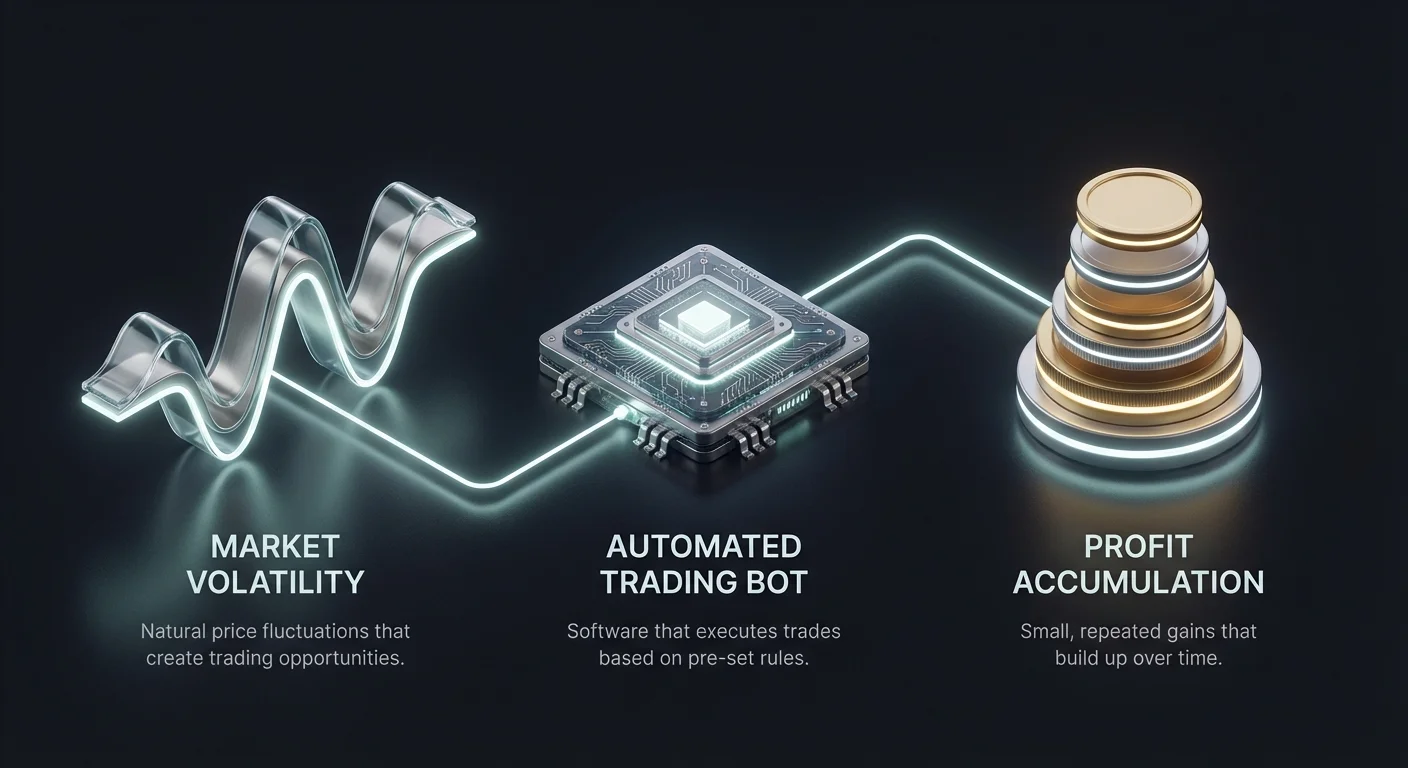
Automated volatility capture represents a method where traders utilize software to profit from price fluctuations without predicting the ultimate direction of the market. This approach relies heavily on the natural variance of asset prices. Rather than betting on a moonshot or a crash, volatility capture strategies aim to accumulate small profits repeatedly as prices oscillate.
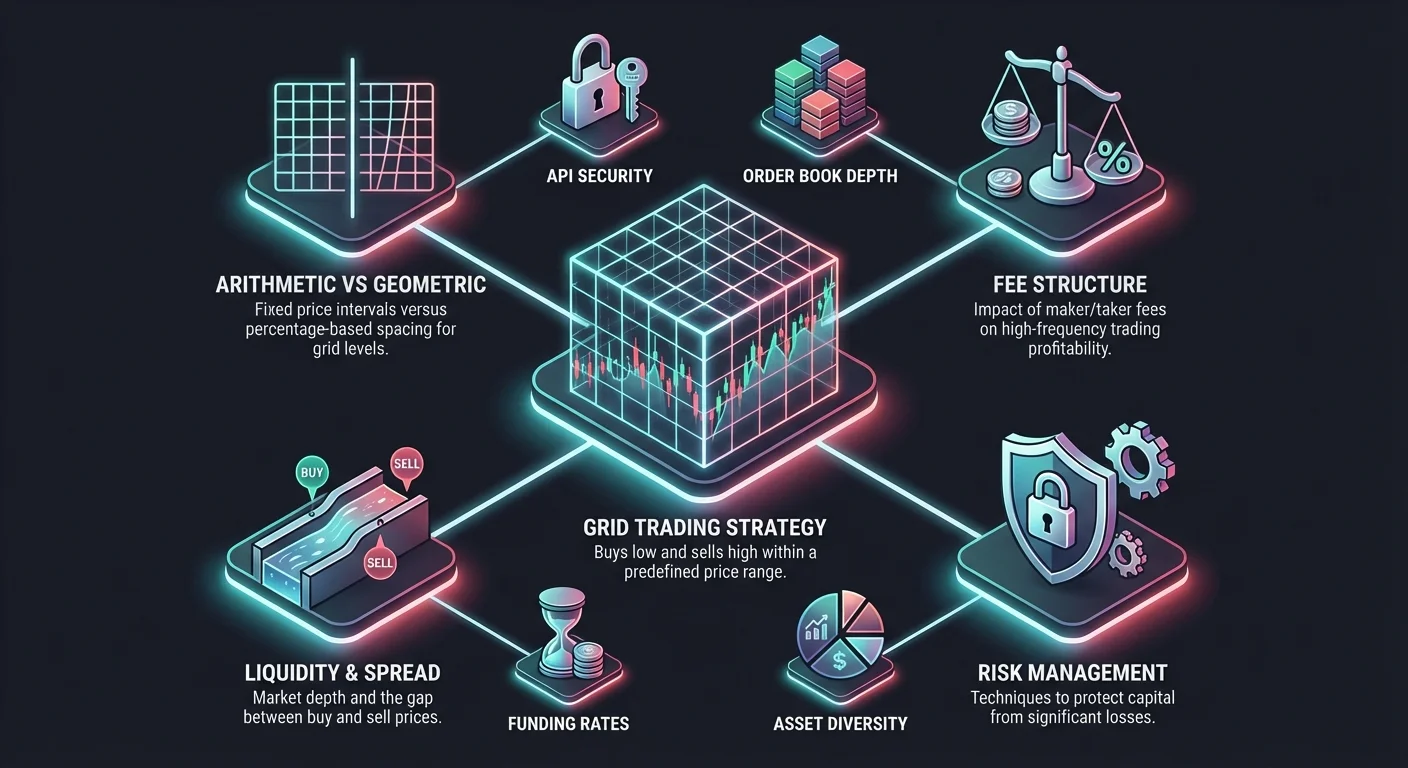
Grid trading stands out as one of the most popular implementations of this philosophy. It involves placing a series of buy and sell orders at predefined intervals around a set price. As the market moves up and down, the system executes these orders automatically. It buys when the price dips and sells when it rises slightly. This creates a mesh of opportunities that converts market noise into realized gains.
Choosing the right platform to execute these strategies is not merely a matter of preference. It is a decision that impacts profitability, security, and efficiency. The technical infrastructure of an exchange determines how effectively a bot can operate. Factors such as API stability, fee structures, and liquidity depth play critical roles in the success of automated systems.
The Mechanics of Grid Trading
Grid trading is a systematic approach that treats market volatility as a resource rather than a risk. The core concept involves dividing a specific price range into multiple levels. Each level represents a potential trade execution point. When the asset price crosses a grid line, the system triggers an order.
The beauty of this strategy lies in its removal of emotional decision-making. A human trader might hesitate to buy during a dip due to fear. An automated grid system simply executes the pre-programmed instruction. It accumulates assets as prices fall and distributes them as prices recover.
This strategy thrives in sideways markets where prices bounce between support and resistance levels without establishing a strong trend. In such environments, a grid bot can execute hundreds of trades over a short period. Each trade captures a small spread. Over time, these small gains accumulate into significant returns.
Arithmetic vs Geometric Grids
Traders must decide how to space their grid levels. This choice fundamentally alters how the strategy performs. Arithmetic grids place orders with a fixed price difference between each level. For example, a trader might set a buy order every $100 drop in Bitcoin’s price. This creates a uniform structure that is easy to visualize and manage.
Geometric grids use a percentage-based approach. Instead of a fixed dollar amount, the levels are spaced by a fixed percentage ratio. This ensures that the profit margin for each grid step remains constant relative to the capital deployed. As the price increases, the gaps between grid lines become wider in absolute terms but remain consistent in percentage terms.
Geometric spacing is often preferred for long-term strategies covering a wide price range. It accounts for the compounding nature of asset growth. Arithmetic spacing is typically favored for shorter-term strategies operating within a tight consolidation zone where price action is more predictable.
Evaluating Fee Structures for High-Frequency Automation
Cost efficiency is the mathematical backbone of any automated trading strategy. Grid trading involves high-frequency execution. A bot might perform dozens or even hundreds of trades in a single day. Consequently, trading fees become the primary adversary of profitability. A seemingly low fee of 0.1% can erode a massive portion of profits if the grid profit per trade is only 0.3%.
Traders must scrutinize the fee schedule of any potential platform. The distinction between maker fees and taker fees is particularly important. In a grid strategy, the system typically places limit orders. These orders add liquidity to the order book. Therefore, the bot acts as a market maker.
Exchanges often incentivize liquidity provision by offering lower maker fees. Some platforms even provide rebates where the trader is paid to provide liquidity. Choosing an exchange with a favorable maker fee structure can significantly boost net returns. Conversely, platforms with high flat fees can render tight grid strategies mathematically impossible.
Zero-Fee Trading Options
The rise of zero-fee trading options has altered the landscape for automated strategies. Some exchanges offer specific pairs or promotional periods where spot trading incurs no cost. This environment is ideal for grid trading. It allows traders to set extremely tight grid intervals without worrying about the break-even cost of fees.
However, traders should investigate the terms of zero-fee offers carefully. Sometimes these benefits are restricted to specific stablecoin pairs or require holding a native exchange token. In other cases, the exchange might compensate for the lack of fees by having wider spreads. This implicit cost can be just as damaging as an explicit fee if not monitored.
Tiered Fee Discounts
For high-volume traders, tiered fee structures provide a pathway to reduced costs. Exchanges typically calculate trading volume over a thirty-day rolling period. As a bot continues to trade, it naturally accumulates volume. This can push the user into a higher VIP tier, unlocking lower rates.
When selecting a platform, one should calculate the projected volume of the automated strategy. If the bot is aggressive, it might quickly qualify for these discounts. Some platforms offer more generous tiers for lower volume levels, which benefits retail traders. Others reserve the best rates for institutional-level volume, which may be out of reach for individual investors.
Liquidity and Execution Quality
Liquidity refers to the ability to buy or sell an asset without causing a drastic change in its price. For manual traders, liquidity ensures they can enter or exit positions easily. For automated bots, liquidity is a matter of operational integrity. A bot relies on its limit orders being filled at specific price points.
If an exchange lacks sufficient liquidity, a phenomenon known as slippage occurs. The bot may attempt to buy at a specific price, but there may be no sellers available at that level. The order might be filled at a worse price, or it might not be filled at all. This disrupts the grid logic and can leave the strategy with unbalanced positions.
Analyzing Order Book Depth
High trading volume does not always equate to high liquidity at every price level. Traders should look at the depth of the order book. A deep order book has a significant volume of buy and sell orders stacked at various price points. This acts as a buffer against volatility and ensures that the bot’s orders are executed precisely.
Exchanges with shallow order books are risky for automation. During periods of high volatility, the price can gap through grid levels without triggering fills. This leaves the trader with missed opportunities and potential exposure to losses if the market reverses without having secured the intended positions.
The Impact of Spread
The spread is the difference between the highest buy offer and the lowest sell offer. Tight spreads are essential for grid trading. The bot captures profit from the movement between buy and sell levels. If the spread is wide, the price must move significantly more for the trade to be profitable.
Major exchanges typically maintain tighter spreads due to the presence of professional market makers. Smaller or less active platforms often have wider spreads. For a grid strategy targeting small price movements, a platform with wide spreads is unsuitable. The friction costs of crossing the spread will eat into the calculated profit margins.
Security Protocols for Automated Accounts
Security is paramount when funds are left on an exchange for automated trading. Unlike cold storage where assets are kept offline, funds used for grid trading must be accessible to the matching engine. This "hot" state increases exposure to potential threats. Therefore, the platform’s security infrastructure is a non-negotiable criterion.
Two-factor authentication (2FA) is the baseline standard. However, for automated trading, users should look for platforms offering hardware key support. This provides a physical layer of security that is difficult for remote attackers to bypass. Additionally, whitelisting withdrawal addresses is a critical feature.
API Security Permissions
Most sophisticated bots run on external servers and connect to the exchange via an Application Programming Interface (API). This connection allows the software to read data and execute trades. Managing API permissions is a vital security practice.
When generating API keys, the user must ensure that withdrawal permissions are disabled. The bot only needs permission to trade. If an attacker compromises the API keys, they might be able to execute bad trades, but they cannot siphon funds out of the account. Platforms that offer granular control over API permissions are superior choices for automation.
Custody and Insurance
The underlying custody solutions of the exchange also matter. Reputable platforms keep the vast majority of user assets in cold storage, even while facilitating active trading. They maintain only a small fraction of funds in hot wallets to service immediate liquidity needs. This minimizes the potential impact of a system breach.
Insurance funds are another layer of defense. Some exchanges maintain a dedicated fund to cover losses in the event of a hack or technical failure. While not a guarantee of total safety, the existence of such a fund demonstrates a commitment to user protection. Regulatory compliance and third-party audits further validate the platform’s security claims.
Integrated vs. External Trading Bots
Traders have two primary options for deploying grid strategies. They can use the tools built directly into the exchange interface, or they can use third-party software that connects via API. Each approach has distinct advantages depending on the user's technical expertise and requirements.
Integrated bots offer simplicity. The exchange provides a user-friendly interface where the trader inputs the range and number of grids. The system handles the execution internally. There is no need to manage API keys or pay for external subscriptions. This is often the best starting point for beginners.
Native Automation Features
Many modern exchanges now include robust copy trading and automated strategy hubs. Users can browse strategies created by other traders or select from pre-set AI parameters. These native tools are deeply integrated with the exchange’s matching engine. This often results in lower latency compared to external connections.
However, native tools may lack advanced customization. They might offer a standard arithmetic grid but lack complex features like trailing stops or multi-pair correlation. For traders with simple requirements, the convenience of an integrated solution outweighs the lack of granular control.
Third-Party Connectivity
External trading bots are standalone software solutions. They connect to multiple exchanges, allowing the trader to manage strategies across different platforms from a single dashboard. These tools usually offer far more sophisticated logic. Users can backtest strategies using historical data to optimize parameters before risking real capital.
The downside is complexity and cost. External bots often require a monthly subscription. They also introduce an additional point of failure—the connection between the bot and the exchange. If the API connection drops during a volatile move, the strategy is left unmanaged. Traders choosing this route must ensure the exchange has a reputation for API stability.
Asset Selection and Diversity
The choice of assets available on a platform dictates the opportunities for volatility capture. Grid trading works best on pairs with sufficient volatility to trigger orders but enough stability to avoid crashing to zero. Major cryptocurrencies like Bitcoin and Ethereum are standard choices, but they may not always offer the highest yields.
Altcoins can provide higher volatility, leading to more frequent grid triggers. However, they come with increased risk. A platform with a wide selection of assets allows the trader to diversify their automated strategies. Running grids on uncorrelated assets can smooth out the overall equity curve.
Stablecoin Pairs
Trading stablecoin pairs is a specialized form of grid trading. For example, trading USDT against USDC. These pairs usually trade in a very tight range. A grid bot can capture tiny deviations from the peg. While the profit per trade is minuscule, the risk of major price depreciation is minimal.
Exchanges with zero-fee stablecoin pairs are essential for this strategy. Since the price movements are so small, fees would instantly destroy any potential profit. Platforms that support a variety of stablecoin pairs offer a low-risk environment for conservative yield generation through automation.
Tokenized Stocks
Some innovative platforms offer tokenized representations of traditional stocks. This opens up a new frontier for automated trading. Traders can apply grid strategies to assets like Tesla or Apple using cryptocurrency as collateral. This provides exposure to traditional market hours and volatility patterns while remaining within the crypto ecosystem.
Tokenized stocks allow for fractional ownership. A grid bot can trade small fractions of a high-priced stock, allowing for fine-tuned grid spacing that would be impossible with whole shares. This capability bridges the gap between traditional equity investing and algorithmic crypto trading.
Derivatives and Leverage in Grids
Advanced traders often seek to amplify their returns by applying leverage to their grid strategies. Futures exchanges allow traders to borrow capital to increase the size of their positions. A grid strategy running on a futures contract can generate significantly higher profits from the same price movements compared to a spot strategy.
However, leverage introduces the risk of liquidation. In a spot grid, if the price drops below the lower limit, the trader is simply left holding the asset. In a leveraged futures grid, a significant drop can wipe out the entire margin balance. Platforms offering futures grids must provide robust risk management tools.
Margin Management
Cross-margin and isolated-margin modes are critical features on derivatives platforms. Isolated margin limits the risk to a specific amount of capital allocated to that strategy. If the position is liquidated, the rest of the account balance remains safe. Cross margin uses the entire account balance to prevent liquidation.
For automated trading, isolated margin is generally safer. It prevents a single malfunctioning bot or an extreme market move on one pair from draining the entire portfolio. Traders must understand the liquidation mechanisms of the platform before deploying leveraged automated strategies.
Funding Rates
Futures contracts involve funding rates. These are periodic payments between longs and shorts to keep the contract price anchored to the spot price. A grid strategy that holds positions open for a long time will be subject to these payments.
If the market is trending strongly, funding rates can become a significant cost or a source of income. A neutral grid strategy that holds both long and short positions might have these costs net out, but an unbalanced grid could bleed capital through funding fees. Platforms with transparent and historical funding rate data help traders plan for these costs.
User Interface and Monitoring
The user interface (UI) determines how effectively a trader can monitor and adjust their strategies. A cluttered or confusing UI can lead to input errors, such as setting the wrong decimal point on a price range. Good design visualizes the grid on the chart, showing exactly where buy and sell orders will be placed.
Real-time monitoring is essential. Users need to see the active profit, the floating loss, and the number of completed transactions at a glance. Mobile app functionality is also crucial. Markets move quickly, and a trader might need to pause or terminate a bot while away from their desk.
Reporting and Analytics
Post-trade analysis is vital for improvement. The platform should provide detailed history logs of every trade executed by the bot. Analytics tools that show the performance of the strategy over time, including total return and drawdown, help traders refine their parameters.
Some platforms offer profit and loss (PnL) analysis that separates grid profit from valuation change. Grid profit is the realized gain from the buy-low/sell-high mechanism. Valuation change is the unrealized gain or loss from the assets held. Distinguishing between these two metrics is necessary to understand if the strategy itself is working or if the profit is simply due to the market going up.
Support and Educational Resources
Automated trading involves technical complexity. When issues arise, responsive customer support is invaluable. If an API disconnects or an order gets stuck, the trader needs immediate assistance. Support teams that understand the specific nuances of algorithmic trading are far more helpful than generic support scripts.
Educational resources also play a significant role. The best platforms provide tutorials, guides, and documentation on how their automated tools work. They explain the math behind the grids and offer examples of optimal parameters for different market conditions. This knowledge transfer empowers users to build better strategies.
Community and Social Trading
Active user communities can be a source of valuable intelligence. Forums and social trading features allow users to discuss strategies and share settings. Some exchanges display a leaderboard of the top-performing bots. While past performance does not guarantee future results, analyzing successful configurations can provide a starting point for new traders.
Copy trading functions allow users to automatically replicate the grid parameters of successful veterans. This can be an effective way to learn. By observing how an experienced trader adjusts their grid range in response to market shifts, a novice can gain insights that would take months to learn through trial and error.
| Feature | Spot Grid Trading | Futures Grid Trading |
|---|---|---|
| Ownership | You own the actual asset | You hold a contract (derivative) |
| Risk Profile | Lower (No liquidation) | Higher (Liquidation possible) |
| Profit Potential | Linear (1x) | Amplified (Leverage available) |
Regulatory Compliance and Know Your Customer (KYC)
The regulatory status of an exchange affects its long-term viability and the safety of user funds. Regulated exchanges are required to adhere to strict financial standards. They must segregate user funds from corporate operating funds. This protects users in the event of exchange insolvency.
For automated trading, regulatory compliance can also impact feature availability. Some jurisdictions restrict the use of leverage or certain derivatives products. Traders must ensure that the platform they choose is legally permitted to offer the services they intend to use in their region.
KYC Requirements
Most centralized exchanges require identity verification (KYC) to access full trading features and higher withdrawal limits. This process involves submitting government identification. While some privacy-focused traders prefer to avoid this, KYC is often a prerequisite for the high limits needed for serious algorithmic trading.
Decentralized exchanges (DEXs) offer an alternative for those prioritizing privacy. They facilitate trading via smart contracts without an intermediary. However, building bots for DEXs requires different technical skills, as the interaction occurs directly with the blockchain rather than a centralized matching engine.
Network Latency and Infrastructure
In the world of automated trading, speed is a competitive advantage. Network latency is the delay between the bot sending a signal and the exchange receiving it. High latency can result in missed opportunities. If the price hits a grid level but moves away before the order reaches the engine, the trade fails.
Exchanges invest heavily in their matching engine technology to minimize latency. Platforms that host their servers in major financial data centers often provide faster connections. For professional traders, some exchanges offer colocation services, where the trader’s server is placed in the same facility as the exchange’s engine to achieve microsecond execution speeds.
Downtime and Reliability
System reliability is just as important as speed. Cryptocurrency exchanges can experience downtime during periods of extreme market stress. If the site goes down during a crash, the bot cannot act. It cannot buy the dip, nor can it stop out to prevent losses.
Reviewing an exchange’s historical uptime is a prudent step. Platforms with a track record of stability during "black swan" events are preferable. Status pages that show real-time system health help traders monitor the integrity of the infrastructure they are relying on.
Strategic Capital Allocation
Successful automation requires smart capital management. Traders rarely put 100% of their portfolio into a single grid strategy. Instead, they allocate portions of their capital to different strategies and assets. A savings account or lending platform can serve as a parking spot for capital that is currently waiting to be deployed.
For instance, profits generated from a grid bot can be automatically swept into a flexible savings account to earn interest. This compounds the returns. Some exchanges facilitate this integration, allowing for seamless movement of funds between the trading account and the earn account.
Diversification Across Platforms
Platform risk is a reality in the crypto space. To mitigate this, advanced traders often split their capital across multiple exchanges. If one platform experiences technical issues or regulatory halts, the bots running on other platforms continue to operate.
This approach requires software that can handle multi-exchange connections. It adds complexity to portfolio tracking but significantly increases resilience. It ensures that the automation strategy is not reliant on a single point of failure.
The Future of Automated Volatility Capture
The landscape of automated trading is evolving rapidly. Artificial Intelligence (AI) is beginning to play a larger role. The next generation of bots will not just follow static grid lines. They will dynamically adjust their ranges based on real-time volatility analysis. They will widen the grid when the market is chaotic and narrow it when the market calms.
Exchanges are already integrating these smart parameters. "AI-recommended" settings are becoming common features. These tools analyze historical data to suggest the most probable profitable parameters for the current market cycle. As these technologies mature, the barrier to entry for sophisticated volatility capture will continue to lower.
Decentralized Grid Trading
The growth of Decentralized Finance (DeFi) is also influencing grid strategies. Automated Market Makers (AMMs) like Uniswap are essentially passive grid trading mechanisms. Providing liquidity to a pool is mathematically similar to running a grid.
New protocols are emerging that allow for active grid trading on-chain. This eliminates the custody risk of centralized exchanges entirely. While currently slower and more expensive due to gas fees, layer-2 scaling solutions are making on-chain grid trading increasingly viable. This represents a convergence of code-is-law security with algorithmic trading logic.
Conclusion
Selecting a platform for automated volatility capture is a foundational step that dictates the ceiling of a trader's success. It requires a balance of technical performance, economic efficiency, and security. A platform with low fees but poor liquidity will fail to execute positions. Conversely, a highly secure platform with exorbitant fees will render the strategy unprofitable. The ideal environment offers deep order books, robust API connectivity, and a fee structure that rewards liquidity provision.
As the market matures, the distinction between manual and automated trading continues to widen. The tools available today allow retail traders to execute strategies that were once the domain of hedge funds. By carefully vetting exchanges based on the criteria of security, costs, and infrastructure, traders can build resilient systems that turn the inherent noise of the crypto market into a consistent stream of opportunity.
Success in automated trading comes not from predicting the future, but from building a system robust enough to profit from the uncertainty.