
Introduction to Decentralized Financial Instruments
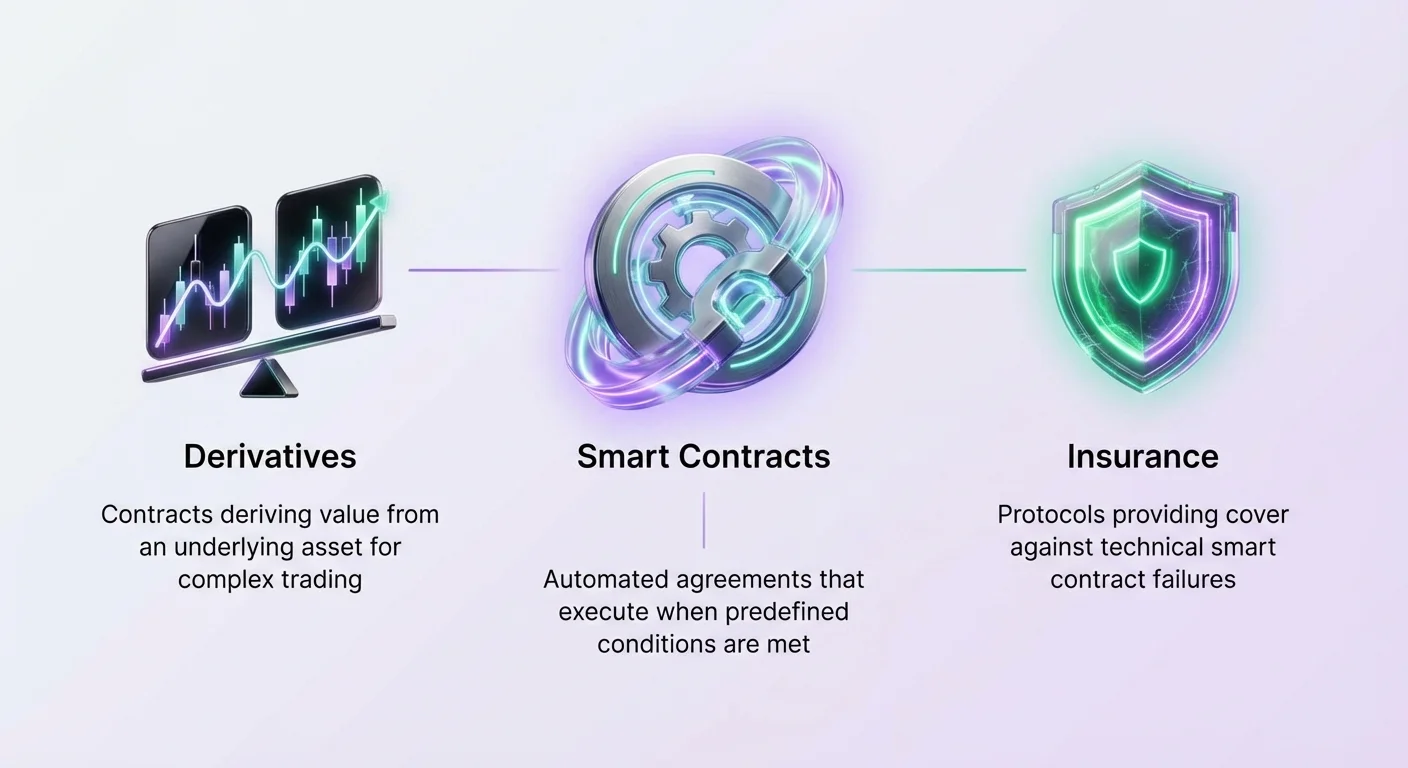
The landscape of digital asset management has evolved significantly beyond simple buying and holding strategies. As the decentralized finance ecosystem matures, it offers sophisticated tools that mirror traditional financial markets while maintaining the core ethos of blockchain technology. Among these tools, derivatives and insurance protocols stand out as critical components for advanced risk management. These instruments allow participants to express nuanced views on market movements and protect capital against unforeseen systemic failures.
Derivatives in the decentralized space primarily function as financial contracts. These contracts derive their value from an underlying asset, such as Bitcoin or Ethereum, without requiring the trader to physically own that asset. This distinction is crucial. It separates the utility of the asset from the speculation on its price movements. By utilizing smart contracts, these platforms enable complex trading strategies that were previously the domain of centralized institutions.
The primary utility of these instruments lies in their ability to manage exposure. In a standard spot market transaction, a user buys an asset hoping it increases in value. This is a unidimensional strategy. Derivatives introduce multidimensionality. They allow users to profit from price declines, hedge existing portfolio value, and utilize capital efficiency through leverage. This flexibility transforms a passive holder into an active market participant capable of navigating various market conditions.
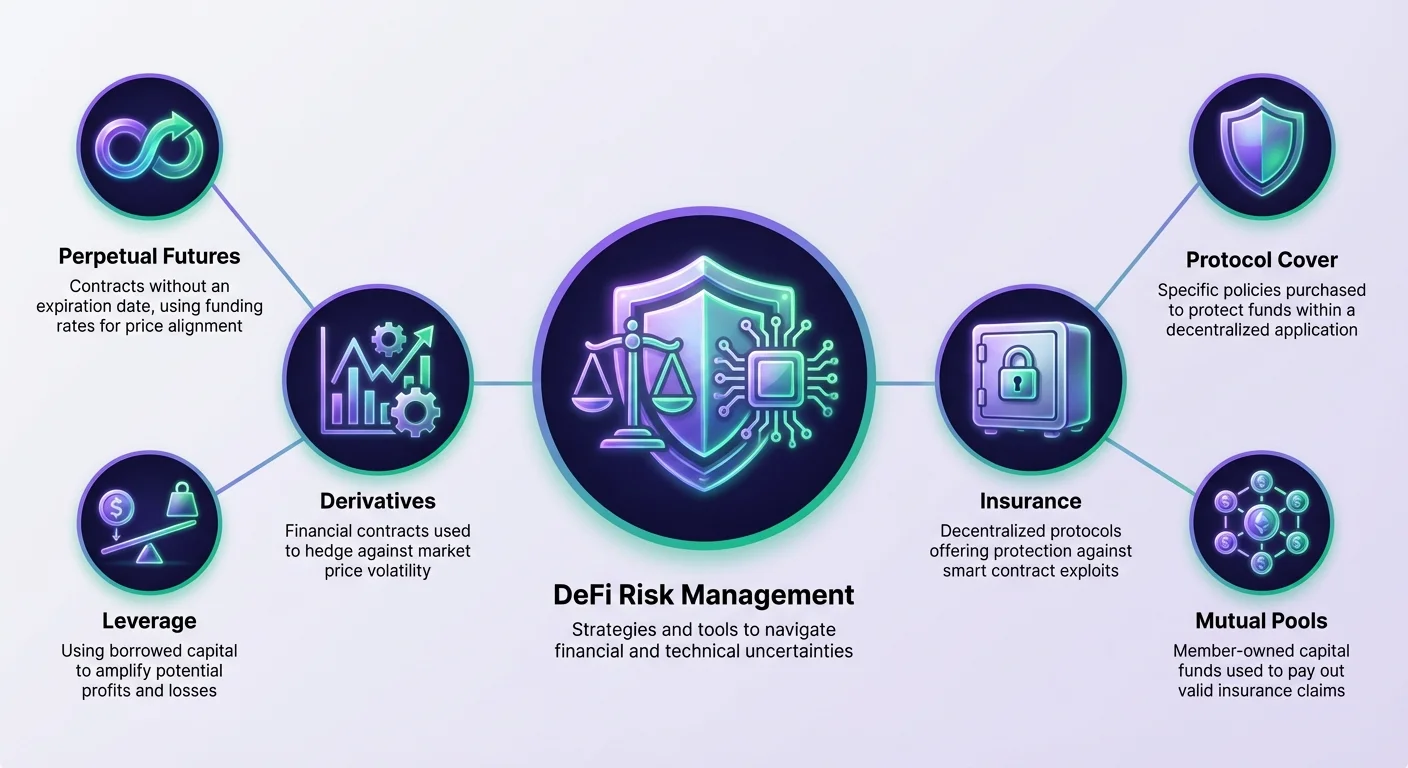
Concurrently, the rise of decentralized insurance offers a counterbalance to the risks inherent in complex financial protocols. While derivatives manage market risk (price volatility), insurance protocols manage technical risk. Together, these two pillars form the basis of a robust risk management strategy in the decentralized economy. They empower users to separate price exposure from protocol security, creating a more resilient investment approach.
The Mechanics of Decentralized Derivatives
defining value in a trustless environment
A derivative contract in DeFi operates on the principle of price tracking. Unlike a spot purchase where you exchange one currency for another immediately, a derivative creates a synthetic relationship. You are entering an agreement where the outcome is determined by the future price of an asset. In the centralized world, a broker or exchange acts as the guarantor of this contract. They hold your funds and ensure the counterparty pays up.
In the decentralized sector, smart contracts replace the broker. Code dictates the terms of the engagement. When you enter a trade, you deposit collateral into a smart contract. This contract monitors the price of the underlying asset via data feeds known as oracles. The contract automatically calculates profit and loss based on these price updates. There is no human intervention required to settle the trade.
This architecture eliminates several layers of counterparty risk found in traditional finance or centralized crypto exchanges. In a centralized exchange, you face the risk that the exchange itself acts fraudulently or becomes insolvent. In a decentralized derivative protocol, your risk is primarily tied to the code and the market itself. The assets remain in a non-custodial state or locked in a transparent contract until the trade is settled.
layer 2 solutions and transaction efficiency
Trading derivatives often requires high-frequency interactions with the blockchain. Opening positions, adjusting margin, and closing trades generate significant network activity. On the Ethereum base layer, this can result in prohibitive transaction costs and slow settlement times. To address this, leading derivative platforms like dYdX utilize Layer 2 scaling solutions.
Layer 2 technology processes transactions off the main blockchain. It bundles hundreds of transactions into a single batch. This batch is then finalized on the main Ethereum network. This method drastically reduces the gas fees associated with trading. It also increases the speed at which orders are matched and executed. For a trader, this means near-instant trade confirmation similar to a centralized experience.
The integration of Layer 2 solutions is vital for the viability of decentralized derivatives. Without it, the friction of transaction fees would make high-frequency trading or smaller position sizing mathematically impossible. It allows the protocol to offer a responsive order book where prices update in real-time. This responsiveness is non-negotiable for derivative markets where price slippage can significantly impact profitability.
Understanding Perpetual Futures
the concept of no expiration
The most common form of derivative in the crypto space is the perpetual future, often referred to simply as a "perp." In traditional futures markets, a contract has a specific expiration date. On that date, the contract settles, and the trader must either roll over their position to a new month or accept settlement. This creates logistical friction and forces decision-making based on the calendar rather than market conditions.
Perpetual futures remove the expiration date. A trader can hold a position for as long as they maintain the necessary collateral. This infinite duration makes perps the preferred instrument for most crypto traders. It allows for long-term hedging strategies or short-term speculation without the complexity of managing different contract months.
Because there is no settlement date, the price of the perpetual contract must be anchored to the spot price of the underlying asset through a different mechanism. Without this mechanism, the price of the contract could drift significantly away from the real value of the asset it represents. This mechanism is known as the funding rate.
funding rates as a correction mechanism
Funding rates are the heartbeat of the perpetual futures market. They act as a periodic payment between traders that incentivizes price alignment. The concept is straightforward: if the contract price deviates from the spot price, one side of the market pays the other. This payment encourages traders to take positions that push the price back toward the spot value.
When the market is bullish, the price of the perpetual contract often trades higher than the underlying asset. In this scenario, the funding rate is positive. Traders who are "long" (betting on price up) must pay a fee to traders who are "short" (betting on price down). This fee acts as a tax on the popular trade and a rebate for the contrarian trade. It incentivizes arbitrageurs to open short positions to collect the fee, which effectively drives the contract price down closer to spot.
Conversely, when the market is bearish, the perpetual price may dip below the spot price. Here, the funding rate turns negative. Short sellers must pay fees to the long holders. This incentivizes traders to buy (long) the asset, pushing the price back up. Understanding funding is critical because it represents a carrying cost. Holding a position against the majority sentiment can generate income, while following the herd costs money over time.
Leverage and Margin Management
initial versus maintenance margin
Trading derivatives involves the use of two distinct types of capital requirements: initial margin and maintenance margin. Understanding the difference is essential for avoiding catastrophic losses. Initial margin is the deposit required to open a position. It acts as a down payment. For example, if you wish to control $1,000 worth of Bitcoin with 10x leverage, your initial margin requirement would be $100.
Maintenance margin is the minimum amount of equity you must hold in your account to keep the trade open. As the price of the asset fluctuates, your equity balance changes. If the market moves against you, your equity decreases. If your equity drops below the maintenance margin level, the protocol initiates a liquidation.
This distinction ensures the solvency of the system. The protocol requires a buffer to close out losing positions before they fall into negative equity. Traders must monitor their margin ratios closely. Adding more collateral to a position increases the buffer between the current price and the liquidation price. Ignoring this ratio usually results in the total loss of the deposited collateral.
the mechanics and risks of leverage
Leverage is a powerful tool that amplifies both buying power and risk. It allows a trader to control a position size larger than their actual capital. If a user deposits 100 USDC and selects 3x leverage, they can purchase contracts worth 300 USDC. This amplification applies to profits and losses equally. A 5% move in the underlying asset becomes a 15% move in the trader's equity at 3x leverage.
For new users, high leverage is the primary cause of capital loss. The higher the leverage, the closer the liquidation price is to the entry price. At 20x leverage, a mere 5% move against the position wipes out the entire collateral. At 100x leverage, a 1% move results in liquidation. The probability of volatility triggering a liquidation increases exponentially with leverage.
Below is a comparison of how different leverage levels impact purchasing power and risk, assuming a $100 initial deposit.
| Leverage | Position Size | Risk Level | Liquidation Sensitivity |
|---|---|---|---|
| 1x | $100 | Low | None (Spot equivalent) |
| 5x | $500 | Moderate | 20% price move |
| 10x | $1,000 | High | 10% price move |
Using leverage effectively requires strict discipline. It is generally recommended that beginners start with 1x leverage or less. This provides the utility of the derivative structure (such as the ability to short) without the amplified risk of liquidation.
Strategic Trading Positions
taking a long position
Going "long" is the financial term for buying an asset with the expectation that its value will rise. In the context of derivatives, opening a long position involves buying a perpetual contract. Unlike the spot market, where you simply own the coin, a long derivative position is a contract that gains value as the index price increases.
This strategy is used when a trader is bullish on the market. By using derivatives, the trader can enhance their potential returns through leverage. For example, if Bitcoin rises from $20,000 to $22,000, a spot holder gains 10%. A derivative trader with 2x leverage on the same move would gain 20% on their collateral.
However, the cost of maintaining a long position must be considered. In a strong bull market, funding rates are typically positive. This means the long trader is continuously paying a small fee to the short sellers. Over extended periods, this funding fee can eat into the profits of the trade. Therefore, long derivative positions are often more tactical and shorter-term than holding spot assets in cold storage.
executing a short position
Shorting is the act of selling a contract with the intent to rebuy it lower. This allows traders to profit from declining prices, a capability not available in standard spot trading. When you short, you are essentially borrowing the asset to sell it now, promising to return it later. If the price drops, you buy it back cheaper, return the asset, and keep the difference.
In DeFi derivatives, this process is abstracted via smart contracts. You deposit stablecoins as collateral and sell the perpetual contract. If the price of the underlying asset falls, your account equity increases. This strategy is vital for hedging. If a user holds a large amount of physical Bitcoin but fears a short-term crash, they can open a short position. The profits from the short position can offset the loss in value of their spot holdings.
Shorting also allows for "market neutral" strategies. By holding the spot asset and shorting the equivalent amount via a derivative, a trader effectively locks in the dollar value of their portfolio. This removes price exposure entirely while potentially earning yield from funding rates if the market sentiment is bullish.
Order Types and Execution
market versus limit orders
Successful trading relies on understanding how to enter and exit the market. There are two primary methods for executing trades: market orders and limit orders. A market order is a request to buy or sell immediately at the best available current price. It prioritizes speed over price precision. If you need to get in or out of a position instantly, a market order is the appropriate tool.
However, market orders carry the risk of slippage. Slippage occurs when the executed price is worse than the expected price due to low liquidity or high volatility. For large orders, a market buy might sweep through several price levels in the order book, resulting in a higher average entry price. This necessitates mastering execution strategies.
Limit orders offer control. A limit order specifies the exact price at which you are willing to buy or sell. The trade will only execute if the market reaches that price. For example, if Bitcoin is trading at $21,000, you might set a limit buy at $20,500. The order sits in the book until price drops to that level. This guarantees your entry price but does not guarantee that the trade will ever happen if the price never hits your target.
managing active positions
Once a position is open, active management is required. Traders must monitor their "Unrealized P&L" (Profit and Loss). This figure represents the theoretical profit or loss if the position were closed immediately. Until the position is closed, these gains or losses are not final.
Closing a position turns unrealized P&L into realized P&L. If the trade was profitable, the initial margin plus the profit is returned to the account balance. If the trade was a loss, the loss is deducted from the margin. In DeFi protocols, this process is non-custodial. The smart contract updates the user's balance on the ledger without a centralized approval process.
Traders must also be aware of the "Close" function within the DApp interface. It is possible to close a position partially. For instance, a trader might sell half of their long position to lock in some profit while letting the rest run. This flexibility is key to managing risk and securing gains during volatile market swings.
Decentralized Insurance Frameworks
the necessity of protocol cover
While derivatives allow users to hedge against market price risk, they do not protect against technical failure. The DeFi ecosystem is built on code, and code can contain bugs. Smart contracts hold billions of dollars in value, making them attractive targets for hackers. If a lending protocol or a decentralized exchange is exploited, users can lose their deposited funds regardless of their trading performance.
This is where decentralized insurance comes into play. It provides a safety net for on-chain risks. Insurance in DeFi is often referred to as "cover." Users can purchase cover specifically for the protocols they interact with. If you are trading on a decentralized exchange or lending assets on a money market, you can buy a policy that pays out if that specific protocol suffers a hack or failure.
This type of protection is distinct from standard deposit insurance found in traditional banking. There is no government bailout in crypto. If a protocol fails, the funds are typically gone forever unless they were insured. Therefore, purchasing protocol cover is a prudent step for anyone with significant capital deployed in DeFi applications.
how decentralized mutuals operate
Nexus Mutual is a prime example of how decentralized insurance functions. It operates as a Discretionary Mutual, a structure where members share risk. It is not a corporate entity selling policies to customers. Instead, it is a DAO (Decentralized Autonomous Organization) owned by its members.
Members of the mutual pool their capital into a common fund. This fund is used to pay out valid claims. The platform issues a token, such as NXM, which represents membership and governance rights. This token model aligns incentives. Members want the mutual to be solvent, so they are incentivized to assess risks accurately.
When a user wants to buy cover, they contribute to the pool in exchange for a policy. The price of this cover is determined by the market's assessment of the risk. Protocols that are viewed as safer will have cheaper cover, while newer or riskier protocols will command higher premiums. This creates a transparent, market-driven pricing mechanism for smart contract risk.
The Insurance Claim Process
submitting proof of loss
The claims process in decentralized insurance differs significantly from traditional insurance. In the traditional world, you file a claim with an agent who works for the company. That company has a financial incentive to deny your claim to save money. In a decentralized mutual, the process is governed by the community and defined by clear parameters.
To make a claim, the policyholder must first verify that the incident falls under the terms of their cover. Most policies cover specific events, such as unintended code usage or severe economic attacks that drain funds. Once an incident occurs, the user connects their wallet to the platform and submits a claim.
This submission usually requires providing details of the loss. Because all transactions are on the blockchain, the "proof" is often verifiable on-chain data. The claimant points to the specific transaction where funds were lost or the smart contract address that was exploited. This transparency streamlines the fact-checking process compared to paper-based insurance systems.
community assessment and payout
Once a claim is submitted, it is not decided by a CEO or a claims adjuster. It is decided by the members of the mutual. Token holders vote on the validity of the claim. They review the evidence provided and the terms of the smart contract cover. If the community agrees that the loss is valid and covered, the claim is approved.
This voting mechanism relies on the collective intelligence of the participants. To prevent fraud or collusion, the system often includes staking mechanics. Members who vote usually have to stake their tokens. If they vote maliciously (e.g., denying a valid claim to save money), they may face penalties. This ensures that the long-term reputation and viability of the mutual are prioritized over short-term savings.
Payouts are typically executed automatically via smart contracts once the vote passes. The funds are sent directly to the affected user's wallet. This eliminates the waiting period often associated with bank transfers or bureaucratic approval chains. It is a direct settlement from the risk pool to the insured party.
Operational Security in DeFi
wallet management and custody
Engaging with derivatives and insurance requires a robust approach to digital wallet security. The interface for all these activities is the Web3 wallet. A self-custodial wallet, such as the Bitcoin.com Wallet app, gives the user total control over their private keys. This is the foundational layer of security. If the wallet is compromised, neither derivative strategies nor insurance policies can protect the funds.
Users must ensure their wallet contains the necessary assets for gas fees. Every interaction—depositing collateral, buying a perp, purchasing cover, or claiming a payout—is a blockchain transaction. These transactions require fees paid in the native token of the network (e.g., ETH for Ethereum). Running out of gas can lead to failed transactions at critical moments, such as when trying to prevent a liquidation.
connecting to dapps safely
Interaction with DeFi protocols happens through "connecting" the wallet to a Decentralized Application (DApp). This is often done via protocols like WalletConnect. It is vital to ensure that the DApp being connected to is the authentic version. Phishing sites often mimic the interfaces of popular derivative or insurance platforms to steal credentials.
When trading derivatives, users often deposit funds into a smart contract. This deposit moves the asset from the user's wallet into the control of the protocol. While the user retains the right to withdraw, the funds are technically in the custody of the code. This highlights the importance of the insurance discussed earlier. By combining a secure self-custodial wallet, verified DApp connections, and protocol cover, a user establishes a defense-in-depth strategy for their digital assets.
Conclusion
The integration of derivatives and insurance within the decentralized finance ecosystem represents a maturation of the crypto market. Tools like perpetual futures on dYdX offer traders the ability to manage directional risk and utilize capital efficiency through leverage. These instruments allow for sophisticated strategies that go beyond simple accumulation, enabling profit generation in both bullish and bearish environments. However, the power of leverage necessitates a disciplined approach to margin management and a deep understanding of funding mechanisms.
Simultaneously, decentralized insurance protocols like Nexus Mutual provide the necessary infrastructure to mitigate the technical risks inherent in programmable money. By allowing users to purchase cover against smart contract failures, these platforms unlock a higher level of security for capital deployment. The shift from centralized corporate insurers to member-owned DAO structures aligns incentives and creates a more transparent claims process.
Combining these tools creates a comprehensive risk management framework. A prudent DeFi participant uses derivatives to hedge market volatility and insurance to hedge protocol insecurity. As the technology evolves, these instruments will likely become the standard for institutional and retail adoption alike, bridging the gap between traditional financial safety and blockchain innovation.
Mastering derivatives and insurance transforms crypto from a gamble into a calculated, protected financial strategy.