
Decentralized exchanges represent a fundamental shift in how financial markets operate, moving away from centralized intermediaries toward permissionless, peer-to-peer systems. At the heart of this ecosystem lies liquidity, the lifeblood that enables smooth and efficient trading without reliance on traditional market makers. For investors and crypto participants, providing liquidity offers a pathway to utilize capital efficiently, transforming static assets into productive holdings that generate yield.
Unlike centralized counterparts where a single entity or designated market makers control the order book, decentralized platforms rely on community-sourced liquidity. This democratization of market making allows anyone with the requisite assets to participate in the financial infrastructure of the exchange. By depositing assets into smart contracts, users ensure that traders can swap tokens instantly and with minimal price impact.
The efficiency of this capital deployment is critical for both the health of the exchange and the returns of the provider. When liquidity is managed effectively, it reduces slippage for traders and maximizes fee generation for providers. This creates a symbiotic relationship where deep liquidity attracts more trading volume, which in turn generates more fees, further incentivizing liquidity provision.
Optimizing capital efficiency involves more than simply depositing assets. It requires an understanding of how pools function, the mechanics of fee distribution, and the additional opportunities provided by yield farming. By layering these strategies, liquidity providers can significantly enhance the productivity of their capital.
The Mechanics of Liquidity Pools
Defining the Liquidity Pool
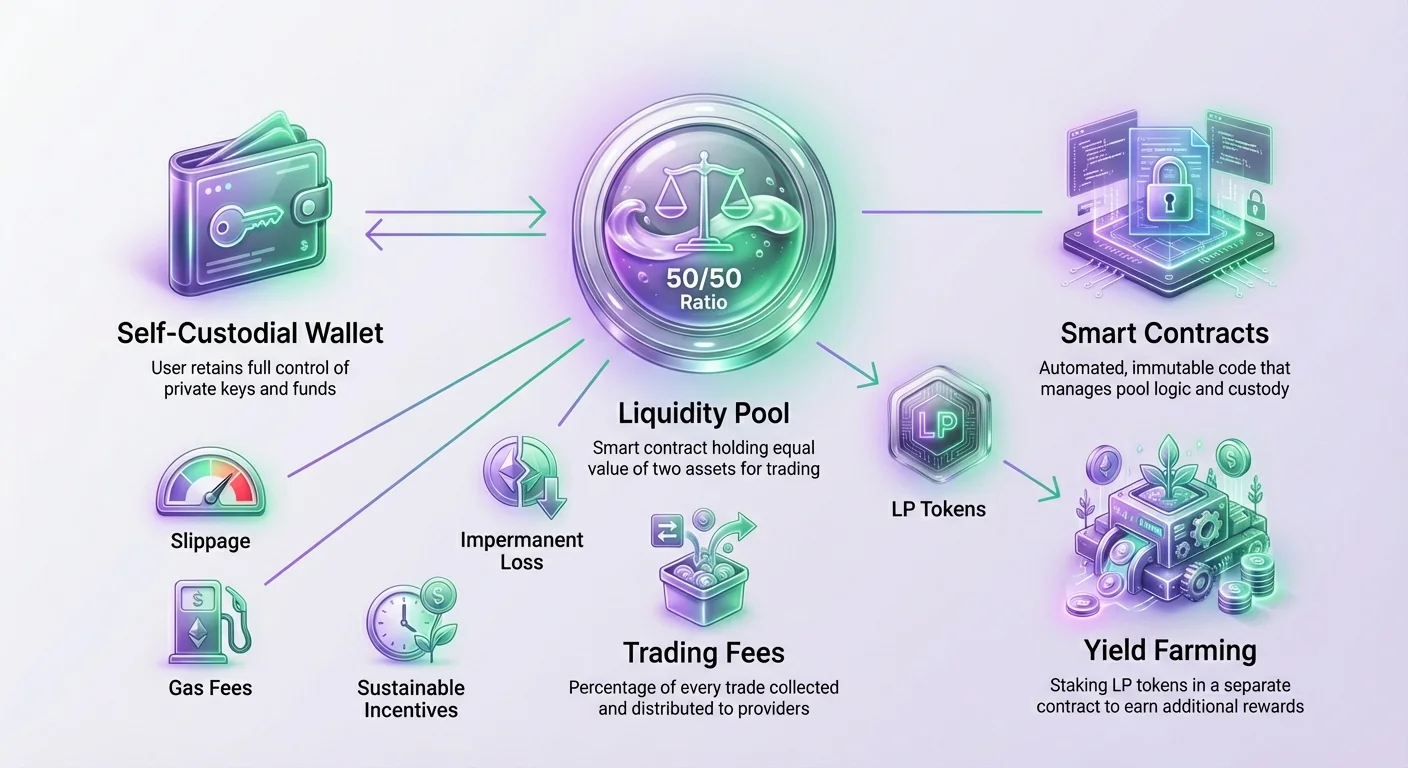
A liquidity pool is essentially a collection of funds locked in a smart contract. These pools form the backbone of automated market makers (AMMs), the protocol used by most decentralized exchanges to facilitate trading. Instead of matching a buyer with a seller, the DEX allows users to trade against the pool itself. This mechanism ensures that liquidity is available 24/7, regardless of whether another human trader is currently active on the other side of the trade.
Each trading pair on a DEX has its own distinct pool. For instance, a trading pair between a protocol’s native token and Ethereum would reside in a specific smart contract designed to hold those two assets. The depth of this pool—the total value of assets locked within it—directly determines the stability and efficiency of trades executed against it. Deeper pools can handle larger trade sizes with less disruption to the price.
The 50/50 Ratio Requirement
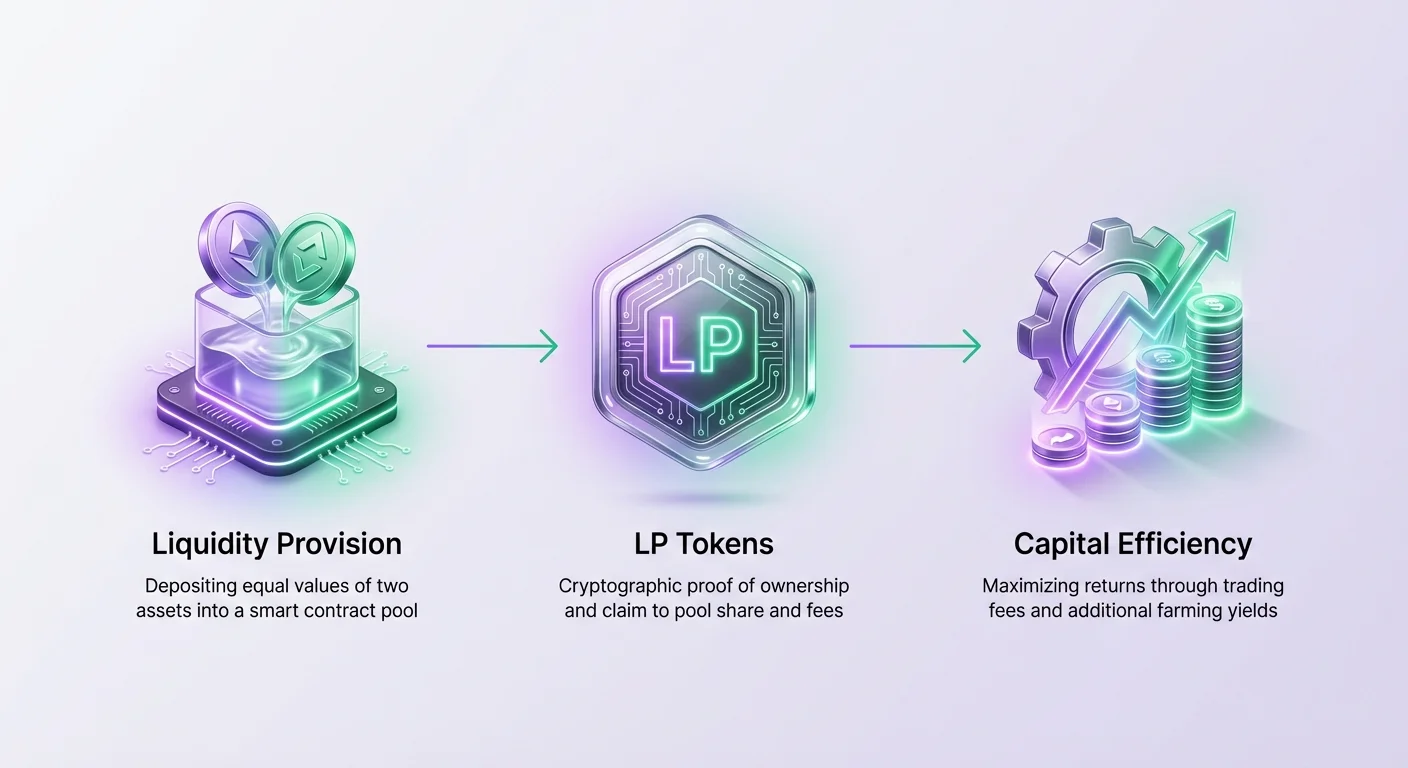
When contributing to a standard liquidity pool, providers must adhere to specific deposit ratios. In most decentralized exchanges, the smart contract requires the depositor to provide equal value of both assets in the trading pair. This 50/50 split is calculated based on the current market price of the assets at the moment of deposit.
For example, if a user wishes to provide liquidity to an ETH-USDC pool, and the price of one Ethereum is 1,600 USDC, they cannot simply deposit ETH alone. If they wish to deposit 1 ETH, they must also deposit 1,600 USDC. This ensures that the pool remains balanced relative to the market price. If a user attempts to deposit unbalanced amounts, the smart contract will typically reject the transaction or require a swap to balance the assets first.
Smart Contract Custody
Upon depositing these assets, the user transfers control of the tokens to the DEX’s smart contract. However, this does not mean they lose ownership. The smart contract acts as a decentralized custodian, holding the funds according to strict, immutable code. In a non-custodial environment, the protocol has no authority to access or move these funds outside of the pre-programmed trading and withdrawal logic.
This distinction is vital for security and trust. In centralized systems, a third party has ultimate control over user funds. In a DEX environment, the user retains the right to withdraw their share of the liquidity pool at any time, subject to the rules of the protocol. This self-custodial nature puts the responsibility and control firmly in the hands of the liquidity provider.
Capital Efficiency Through Fee Generation
The Fee Revenue Model
The primary incentive for providing liquidity is the ability to earn a share of the trading fees generated by the platform. Every time a trader executes a swap on the exchange, they pay a small percentage of the trade value as a fee. This fee is collected by the smart contract and distributed to the liquidity providers of that specific pool.
On platforms like the Verse DEX, the fee structure is often transparent and fixed. For instance, a common fee rate is 0.25% of the trading volume. This revenue stream transforms a passive holding into a productive asset. Instead of assets sitting idle in a wallet, they are actively working to facilitate market activity and capturing value from the ecosystem’s turnover.
| Component | Role | Revenue Source |
|---|---|---|
| Liquidity Provider | Supplies capital | Exchange Fees + Farm Rewards |
| Trader | Swaps assets | Pays fees for liquidity utility |
| DEX Protocol | Facilitates trade | Protocol fees (if applicable) |
Volume and Yield Correlation
The yield generated from trading fees is directly correlated to the trading volume of the pool. A pool with high liquidity but low trading volume will generate minimal fees for providers, resulting in a low Annual Percentage Yield (APY). Conversely, a pool with high trading volume relative to its liquidity depth will generate substantial fees.
Consider a scenario where a pool has $100,000 in trading volume over a specific period. If the fee rate is 0.25%, the total fees collected would be $250. If there is only one liquidity provider in that pool, they receive the entire $250. However, if there are multiple providers, this amount is shared proportionally based on their contribution to the pool.
Proportional Earnings
Capital efficiency is maximized when a provider captures a larger share of volume-heavy pools. If a user provides 50% of the liquidity in the example above, they would earn $125 (50% of the $250 fees). This underscores the importance of pool selection. Providers must analyze trading pairs to find those with healthy volume-to-liquidity ratios.
This dynamic creates a competitive market for liquidity. As yields increase in a specific pool due to high volume, more providers are attracted to deposit assets. This influx of new liquidity dilutes the share of existing providers, eventually normalizing the APY. Successful management requires monitoring these metrics to ensure capital is deployed where it remains most productive.
Liquidity Provider (LP) Tokens
Proof of Ownership
When a user deposits assets into a liquidity pool, the DEX must provide a mechanism to track their specific contribution. This is achieved through the minting of Liquidity Provider (LP) tokens. These tokens function as a digital receipt, cryptographically proving the user’s claim to a portion of the pool’s reserves.
These receipt tokens are standard ERC-20 tokens (or the equivalent on other blockchains) and are transferred directly to the user’s wallet upon deposit. They represent a pro-rata share of the liquidity pool. If a user provided 1% of the pool’s total liquidity, they would receive LP tokens representing 1% of the pool’s shares. These tokens are crucial for tracking earnings and managing the position.
Realizing Rewards and Withdrawals
LP tokens are not just static receipts; they are the key to redeeming deposited assets and claiming accrued fees. When a provider decides to exit their position, they must return the LP tokens to the smart contract. The contract then burns these tokens and releases the user’s share of the underlying assets, along with any fees that have accumulated during the deposit period.
It is important to note that the ratio of assets returned may differ from the ratio originally deposited. Due to trading activity within the pool, the balance of Token A and Token B changes as traders buy and sell. The LP token guarantees a claim on a value share of the pool, not the exact number of tokens originally deposited. This fluctuation is a natural part of the AMM mechanism.
Optimizing Returns with Yield Farming
The Concept of Farming
To further enhance capital efficiency, decentralized exchanges often implement secondary incentive layers known as yield farming. While trading fees provide a baseline return, farming allows liquidity providers to earn additional rewards on top of those fees. This practice involves depositing the LP tokens—received from providing liquidity—into a separate smart contract called a Farm.
Farming effectively puts the "receipt" to work. Instead of the LP tokens sitting idle in the user’s wallet while the underlying assets earn fees, the LP tokens themselves generate a second stream of income. This creates a double-yield scenario: the underlying assets earn trading fees, and the LP tokens earn farming rewards.
Stacking Rewards for Efficiency
The combination of trading fees and farming rewards is what drives optimal capital efficiency in DeFi. By participating in a Farm, a user maximizes the utility of their deployed capital. The rewards for farming are typically paid in the DEX’s native utility token or another partner token.
The process requires an active management step. After adding liquidity and receiving LP tokens, the user must manually stake these tokens into the appropriate Farm. For example, on the Verse DEX, a user providing liquidity to the VERSE-ETH pair would receive VERSE-ETH LP tokens. To optimize returns, they would then deposit these specific LP tokens into the VERSE-ETH Farm.
Calculating Total APY
The total return on investment for a liquidity provider is the sum of the fee APY and the farming APY. The farming APY is often dynamic, fluctuating based on the total number of LP tokens staked in the Farm and the rate of reward distribution. Exchanges often display these figures on analytics pages to help users estimate potential returns.
Efficiency is achieved when a user identifies pools that offer a strong combination of organic trading volume (fees) and sustainable farming incentives. This "stacking" strategy is a cornerstone of advanced liquidity management, allowing users to extract the maximum possible value from their crypto assets.
Sustainable Incentive Models
Token Distribution Strategies
The sustainability of farming rewards is a critical factor for long-term capital efficiency. If a DEX emits rewards too aggressively, it risks hyper-inflation of its native token, which can lead to a collapse in token value. Therefore, well-designed ecosystems implement carefully structured distribution schedules.
For instance, the Verse ecosystem allocates a specific portion of its token supply (35%) to incentives, distributing them linearly over a multi-year period (e.g., 7 years). This controlled release ensures that rewards remain available for the long term, supporting the ecosystem's growth without flooding the market with excess supply.
Avoiding Mercenary Capital
High APYs can sometimes be a trap. Some platforms offer astronomical yields (over 1000%) to attract short-term liquidity. This often attracts "mercenary" capital—providers who deposit funds solely to harvest the high rewards and then immediately sell the tokens and withdraw their liquidity once the rate drops.
This behavior destabilizes the exchange and hurts long-term holders. A sustainable model aims for attractive but realistic yields, such as an initial target of 80% APY for farms, as seen in balanced ecosystems. This approach attracts committed liquidity providers who are interested in the long-term health of the protocol, rather than just short-term extraction.
Reward Distribution Periods
Farming rewards are typically calculated and distributed over set periods, often weekly. The model usually assumes that all liquidity providers for a pool are staked in the farm. If fewer people stake, the APY for those who do participate is effectively higher than projected.
Conversely, if a large amount of new capital enters the farm during a distribution period, the APY will temporarily decrease as the fixed rewards are shared among a larger number of participants. Monitoring these fluctuations is part of active liquidity management.
Essential Tools for Liquidity Management
Self-Custodial Wallets
To participate in liquidity provision and farming, a user requires a self-custodial digital wallet. Unlike custodial wallets found on centralized exchanges, self-custodial wallets (like the Bitcoin.com Wallet) give the user full control over their private keys and funds. This is a prerequisite for interacting with smart contracts directly.
Self-custody ensures that the user can interact with the blockchain without permission from a third party. It allows for direct connection to DEX interfaces and the signing of transactions required to deposit liquidity or stake tokens.
Native Currency for Gas
Managing liquidity positions requires performing transactions on the blockchain, such as approving tokens, depositing funds, and claiming rewards. Each of these actions incurs a network fee, known as "gas." This fee must be paid in the native currency of the blockchain where the transaction takes place.
| Blockchain | Native Currency | Usage |
|---|---|---|
| Ethereum | ETH | Paying transaction fees |
| Polygon | MATIC | Paying transaction fees |
| Avalanche | AVAX | Paying transaction fees |
Liquidity providers must ensure they always hold a sufficient balance of the native currency in their wallet. Running out of ETH on Ethereum, for example, would leave a user unable to withdraw their liquidity or claim their rewards, effectively locking their position until they top up their wallet.
Risks and Market Dynamics
Understanding Slippage
Slippage creates a discrepancy between the expected price of a trade and the actual execution price. It occurs most frequently in pools with low liquidity. When a trader attempts to execute a large order in a shallow pool, their trade significantly alters the ratio of assets in the pool, causing the price to slide against them.
For liquidity providers, high slippage in a pool can indicate a need for deeper liquidity. While slippage primarily hurts the trader, it can also deter trading volume, which ultimately reduces the fees earned by providers. Maintaining deep, healthy pools is the solution to minimizing slippage and attracting consistent volume.
Price Accuracy and Depth
Liquidity depth serves as a buffer against volatility. In a pool with deep liquidity, large trades have a minimal impact on the asset price. In contrast, a thin pool can experience dramatic price shifts from relatively small transactions. This instability renders the market practically unusable for serious traders.
Low liquidity can also lead to inaccurate asset pricing compared to the wider market. If a DEX pool is too shallow, its price may lag behind or diverge from the global average, creating arbitrage opportunities that, while correcting the price, can be detrimental to passive liquidity providers.
Impermanent Loss Risks
While not explicitly labeled in every guide, the concept that the "ratio of returned cryptoassets might be different" alludes to a fundamental risk in AMMs. If the price of one asset rises significantly relative to the other, the pool automatically sells the appreciating asset and buys the depreciating one to maintain the 50/50 value ratio.
This means that when a provider withdraws their liquidity, they may end up with less of the appreciating asset than they started with. This difference between holding the assets in a wallet versus providing liquidity is known as impermanent loss. Yield farming rewards and trading fees act as compensation for taking on this risk.
Execution Strategies for Providers
Contributing to Pools
The process of adding liquidity begins with identifying a pool that matches the user’s risk tolerance and asset holdings. The user must navigate to the DEX’s "Pool" section and select the desired pair. The interface typically shows the current exchange rate and the required ratio of assets.
Once the assets are selected, the user must approve the smart contract to spend their tokens. This is a one-time security measure for each asset. After approval, the user signs the deposit transaction. The blockchain confirms the action, and the user receives their LP tokens, marking the start of their fee-earning journey.
Managing Farm Deposits
To maximize efficiency, the next step is moving the LP tokens into a Farm. This is a separate action from adding liquidity. The user must navigate to the "Farms" tab on the DEX and locate the farm that corresponds to their LP tokens.
Similar to the initial deposit, the user usually needs to approve the farming contract to interact with their LP tokens. Once deposited, the dashboard will begin updating in real-time, showing the "pending rewards" that are accumulating. These rewards can typically be claimed at any time without withdrawing the underlying liquidity, allowing for flexible income management.
Conclusion
Managing liquidity on a decentralized exchange is a dynamic process that goes beyond simple asset storage. It involves a strategic approach to capital efficiency, where users leverage the interconnected mechanisms of trading fees and yield farming to maximize returns. By providing the essential infrastructure for permissionless trading, liquidity providers earn a stake in the platform's success, capturing value from every swap executed against their pool.
However, true optimization requires vigilance and an understanding of the underlying mechanics. From monitoring trading volume and liquidity depth to assessing the sustainability of farming APYs, successful providers actively manage their positions. They navigate the technical requirements of self-custodial wallets and smart contracts while balancing the potential for rewards against market risks.
Efficient liquidity management transforms static crypto assets into productive capital by stacking trading fees and farming rewards.