
Managing digital assets effectively requires a nuanced understanding of the various tools available for storage and transaction execution. For active traders, the choice of wallet extends beyond simple storage capabilities. It involves a balance between accessibility, speed, and the rigorous security protocols necessary to protect capital. Professional traders often look to integrate custom infrastructure to optimize execution speed, a concept covered in our guide on high-frequency API trading. The ecosystem comprises different wallet categories, ranging from custodial exchange accounts to self-custodial software and hardware solutions. Each type serves a distinct function in the lifecycle of a trade, influencing how quickly an investor can react to market movements.
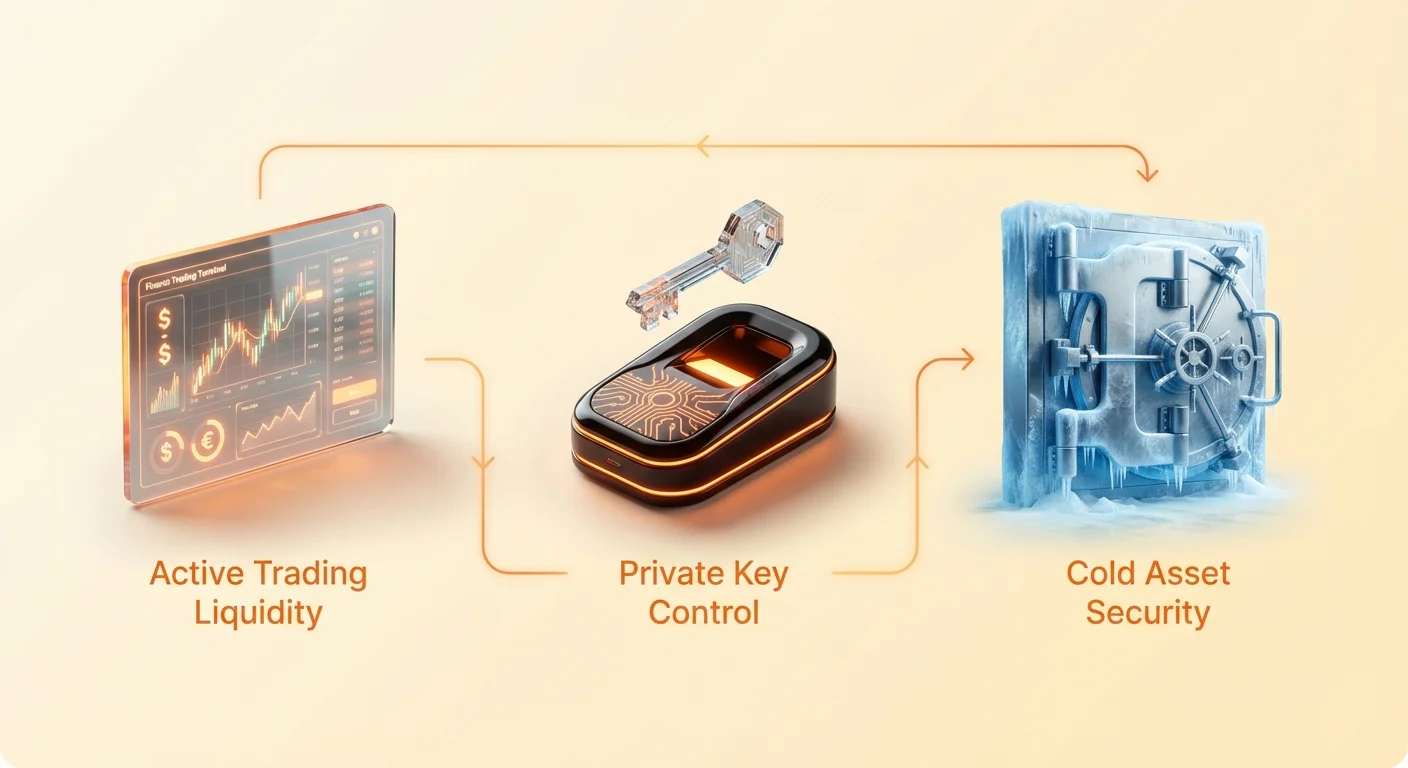
The fundamental distinction in asset management lies in the control of private keys. These cryptographic keys act as the unique password to access funds on the blockchain. In some trading environments, third-party services manage these keys, while in others, the responsibility falls entirely on the user. Understanding this dynamic is critical for anyone engaging in frequent transaction activity. Speed is often prioritized during active market hours, but long-term asset preservation requires different strategies.
Traders must navigate the integration of these tools with broader networks. This includes connecting to decentralized applications, managing multiple blockchain standards, and ensuring that the interface used for execution does not compromise the security of the underlying assets. The convergence of trading utility and security infrastructure forms the backbone of a robust crypto management strategy.
Centralized Exchange Custody
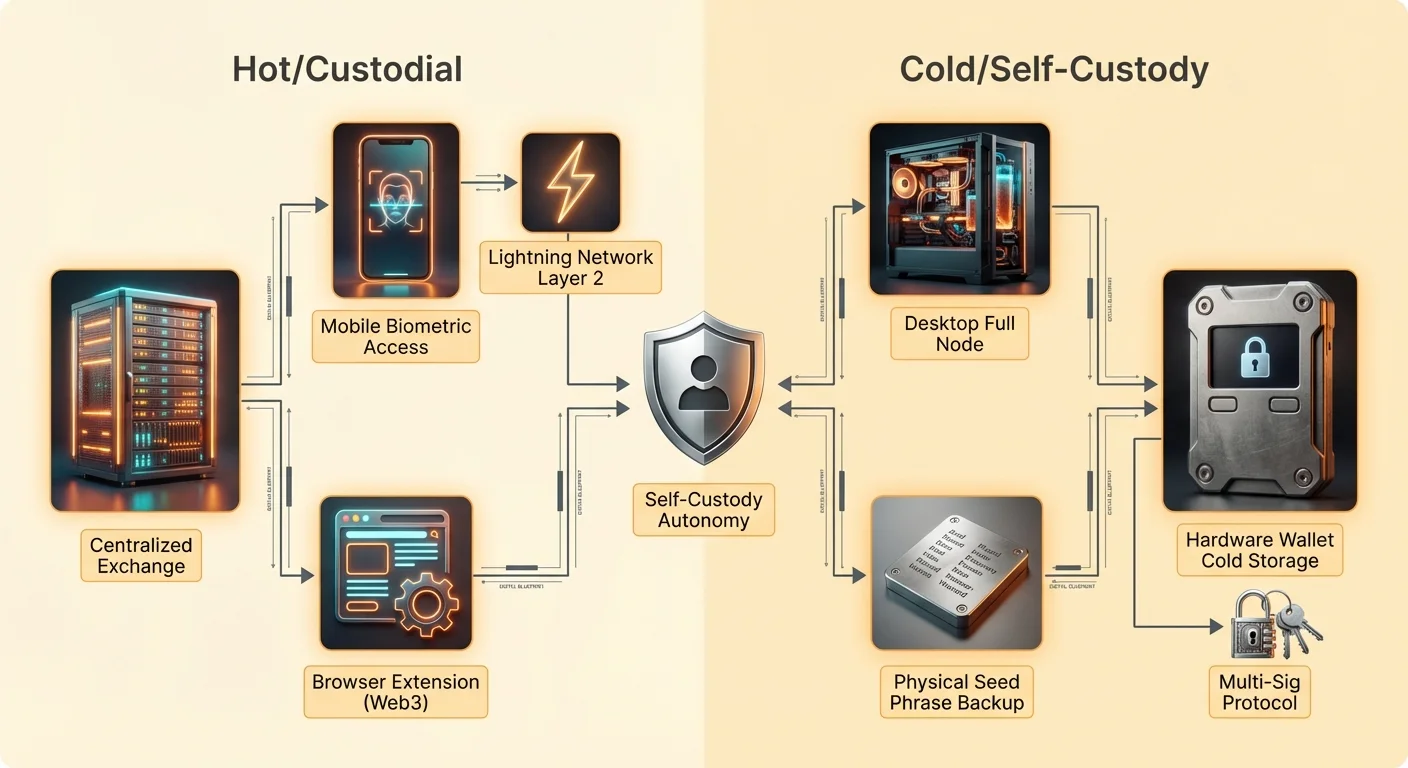
Centralized exchanges (CEXs) function as the primary gateway for many market participants. When a user deposits funds into a CEX, they are essentially transferring custody of their assets to the platform. The exchange manages the private keys and provides the user with an account interface to execute trades. This model offers high liquidity and the ability to execute orders rapidly without waiting for on-chain confirmations for every move.
However, this convenience introduces counterparty risk. The user relies on the exchange's internal security measures to protect their funds. Reputable platforms employ cold storage strategies, where the vast majority of client assets are kept in offline environments, inaccessible to internet-based threats. Only a small fraction of funds remains in "hot" wallets to facilitate immediate withdrawals and trading activity. This tiered storage approach minimizes the potential impact of a security breach.
Despite these protections, traders must remain aware that they do not possess direct ownership of the coins while they reside on the exchange. The assets are represented as a database entry within the platform's internal ledger. This distinction is vital during periods of market volatility or platform instability. For a detailed comparison of risks, see our guide on the custody spectrum. Users should understand the specific security protocols their chosen exchange employs, such as multi-signature requirements and insurance policies for digital assets.
Assessing Custodial Risks
The reliance on a third party for key management simplifies the user experience but removes the autonomy central to cryptocurrency philosophy. If an exchange halts withdrawals or suffers a technical failure, the trader loses access to their capital. This scenario highlights the importance of using exchange wallets primarily for active order execution rather than long-term holding.
To mitigate risks, traders often employ a strategy of rotating funds. Only the capital necessary for immediate trading positions is kept on the custodial platform. Profits or long-term holdings are routinely swept into self-custodial solutions where the user controls the private keys. This practice limits exposure to any single point of failure within the centralized infrastructure.
Desktop Wallets for Portfolio Management
Desktop wallets offer a middle ground between the high accessibility of web interfaces and the robust security of cold storage. These software applications are installed directly on a computer, storing private keys locally on the device's hard drive. For active traders, desktop clients often provide richer interfaces with advanced charting tools, detailed transaction histories, and portfolio analytics that might be cumbersome on mobile screens.
These wallets are particularly favored by power users who require control over technical specifics. Many desktop solutions allow for the customization of transaction fees, which is crucial when the network is congested. A trader can choose to pay a higher fee to prioritize a transaction, ensuring it is confirmed in the next block. Conversely, for non-urgent consolidation of funds, they can select lower fees to reduce overhead costs.
Security on desktop environments relies heavily on the hygiene of the operating system. Since the computer is connected to the internet, it is theoretically susceptible to malware and keyloggers. Traders must ensure their machines are free of viruses and that they download wallet software only from official sources. Verifying digital signatures or checksums before installation is a standard procedure to confirm the software has not been tampered with.
Advanced Features and Privacy
Certain desktop wallets operate as "full nodes." This means they download and verify the entire blockchain history, rather than relying on a third-party server to check balances. Running a full node offers the highest level of trustlessness and privacy, as the user broadcasts their own transactions directly to the network. This prevents outside observers from easily linking IP addresses to specific transaction requests.
Privacy-focused desktop wallets may also integrate features like CoinJoin. This mechanism mixes a user's coins with those of others in a large transaction, obscuring the origin and destination of the funds. For traders concerned with financial privacy and preventing blockchain analysis firms from tracking their trading history, these advanced desktop features are essential tools.
Mobile Wallets and Immediate Access
Mobile wallets have evolved into powerful tools for managing cryptocurrency on the go. These applications store private keys on a smartphone, often utilizing the device's secure enclave elements to protect sensitive data. The primary advantage of mobile wallets is their use of biometric authentication. Fingerprint scanners and facial recognition add a layer of security that is both robust and convenient for quick access.
For traders, mobile wallets serve as an essential connection point for retail transactions and urgent portfolio adjustments. They support the scanning of QR codes, which simplifies the process of sending and receiving funds. This eliminates the risk of typing errors associated with manually entering long alphanumeric addresses. Many mobile wallets also integrate with ATM networks, allowing users to purchase or sell crypto for cash at physical locations.
Integrated Exchange Features
Modern mobile wallets frequently incorporate built-in exchange functionality. Through API integrations with third-party liquidity providers, users can swap assets directly within the wallet interface. This allows for immediate rebalancing of a portfolio without needing to deposit funds onto a centralized exchange. While the fees for these convenient swaps may be higher than standard exchange orders, the speed and ease of use are valuable for capturing sudden market opportunities.
The ability to manage multiple blockchain networks from a single app is another hallmark of top-tier mobile wallets. A trader can hold Bitcoin, Ethereum, and Solana in one interface, monitoring the total value of their diverse portfolio in real-time. This unified view helps in making informed decisions about asset allocation and risk exposure across different sectors of the crypto market.
Browser Extensions and Web3 Interaction
The rise of decentralized finance (DeFi) has necessitated a new type of wallet interface: the browser extension. These lightweight wallets plug directly into web browsers like Chrome or Firefox, acting as a bridge between the user and Web3 applications. They allow traders to interact with decentralized exchanges (DEXs), lending platforms, and NFT marketplaces without creating an account or providing personal identification.
Browser extension wallets store private keys encrypted within the browser's data store. When a user visits a DeFi site, the site requests permission to connect to the wallet. Once connected, the user can approve transactions and smart contract interactions. This seamless integration enables high-frequency trading on decentralized protocols, where the user retains custody of their funds until the exact moment the trade executes.
Security in the Browser Environment
While convenient, browser extension wallets carry unique security risks. They are always "hot," meaning they are connected to the internet whenever the browser is open. This makes them susceptible to phishing attacks where malicious websites mimic legitimate dApps to trick users into signing harmful transactions. Traders must be vigilant, verifying URLs and contract addresses before approving any interaction, following an ultimate DeFi security checklist.
Additionally, the risk of fake extensions is prevalent. Bad actors often upload counterfeit versions of popular wallets to extension stores. These fake apps harvest seed phrases and drain funds. Users must ensure they are installing the official extension by navigating from the wallet project's verified website. Using a hardware wallet in conjunction with a browser extension adds a necessary layer of safety, requiring physical confirmation for every web-based transaction.
High-Speed Transactions via Lightning
For traders dealing in high-frequency or lower-value transactions, the Bitcoin network's base layer can sometimes be too slow or expensive. The Lightning Network offers a solution as a second-layer protocol built on top of Bitcoin. It enables off-chain transactions that are settled nearly instantly. This technology is particularly useful for arbitrage opportunities where speed is the defining factor of profitability.
Lightning wallets manage payment channels. A user locks a certain amount of Bitcoin into a channel, which then allows them to transact back and forth with other network participants without broadcasting every move to the main blockchain. Only the final balance is recorded on-chain when the channel is closed. This mechanism drastically reduces fees, making micro-transactions viable.
Privacy is also enhanced on the Lightning Network. Because individual transactions within a channel are not recorded on the public ledger, they are more difficult to trace than standard on-chain transfers. This offers a degree of anonymity for traders who wish to keep their daily spending or smaller trading activities private. However, users must manage the liquidity of their channels, ensuring they have enough "inbound capacity" to receive funds. Learn more about optimal channel setup in our guide to Lightning Network implementation.
Cold Storage and Private Key Security
While active wallets facilitate trading, cold storage remains the gold standard for securing accumulated profits. Cold storage refers to keeping private keys completely offline, physically separated from any device that connects to the internet. This isolation renders the funds immune to remote hacking attempts, malware, and online phishing scams.
Paper wallets represent one of the most fundamental forms of cold storage. A user generates a public and private key pair on an offline computer and prints them onto a piece of paper. The paper is then stored in a physical vault or safe. To access the funds, the user must physically retrieve the paper and import the private key into a software wallet. This method is cost-effective and highly secure, provided the creation process is handled correctly on an air-gapped machine.
Integration with Hardware Devices
Hardware wallets offer a more modern approach to cold storage. These physical devices store private keys on a secure element chip. When a user needs to send a transaction, the software wallet creates the unsigned transaction data and sends it to the hardware device. The device signs the transaction internally and returns the signed data to the computer for broadcasting. The private key never leaves the device. This process is detailed further in our ultimate guide to hardware wallets.
For active traders, hardware wallets act as the ultimate safety net. Funds not needed for immediate positions are moved to the hardware device. Many software wallets and browser extensions now support hardware wallet integration. This allows a trader to view their cold storage balance and initiate transactions through a familiar interface, while still requiring the physical device to authorize any movement of funds. This hybrid approach combines the usability of hot wallets with the security of cold storage.
| Feature | Mobile/Desktop (Hot) | Hardware/Paper (Cold) | Exchange Custody |
|---|---|---|---|
| Security | Moderate (Internet exposed) | High (Offline) | Variable (Third-party) |
| Access Speed | Instant | Slow (Physical steps) | Instant |
| Control | Self-Custodial | Self-Custodial | Custodial |
| Best Use | Daily transactions | Long-term savings | Active trading |
Best Practices for Wallet Security
Regardless of the wallet type chosen, specific security protocols are non-negotiable for protecting digital wealth. The most critical component is the recovery phrase, often called a seed phrase. This sequence of 12 to 24 words can regenerate the entire wallet if the device is lost or damaged. This phrase must never be stored digitally. Saving it in a cloud document, email, or photo library exposes it to hackers. It should be written down and secured physically.
Two-factor authentication (2FA) is an essential layer of defense for custodial accounts and some software wallets. However, SMS-based 2FA is vulnerable to SIM-swapping attacks. Traders should rely on authenticator apps or hardware security keys (like YubiKeys) to generate time-based codes. This ensures that even if a password is compromised, the attacker cannot access the account without the physical second factor.
Addressing Phishing and Social Engineering
The human element is often the weakest link in wallet security. Phishing scams often attempt to trick users into revealing their seed phrase or private keys. Support teams for wallet providers or exchanges will never ask for this information. Traders must be skeptical of unsolicited communications and verify all links before clicking.
Regular software updates are also vital. Developers frequently release patches to fix vulnerabilities in wallet software. Running an outdated version can leave assets exposed to known exploits. For desktop users, ensuring the underlying operating system has the latest security definitions is just as important as updating the wallet application itself.
Conclusion
The management of active trading wallets requires a strategic approach that differentiates between capital used for execution and capital reserved for preservation. Custodial exchange accounts provide the liquidity and speed necessary for rapid market entry and exit, but they carry inherent counterparty risks that must be managed through disciplined fund rotation. Self-custodial solutions, ranging from desktop interfaces to mobile apps, offer traders autonomy and control, empowering them to interact directly with blockchain networks and decentralized finance protocols.
Security remains the foundation of this ecosystem. Whether utilizing the lightning-fast execution of a browser extension or the deep freeze of a paper wallet, the protection of private keys is paramount. By integrating a mix of hot and cold storage solutions, and adhering to rigorous security practices like offline backups and robust authentication methods, traders can effectively navigate the digital asset landscape.
True financial sovereignty in the crypto space is achieved when a trader balances the efficiency of modern integration tools with the uncompromising security of self-custody.