
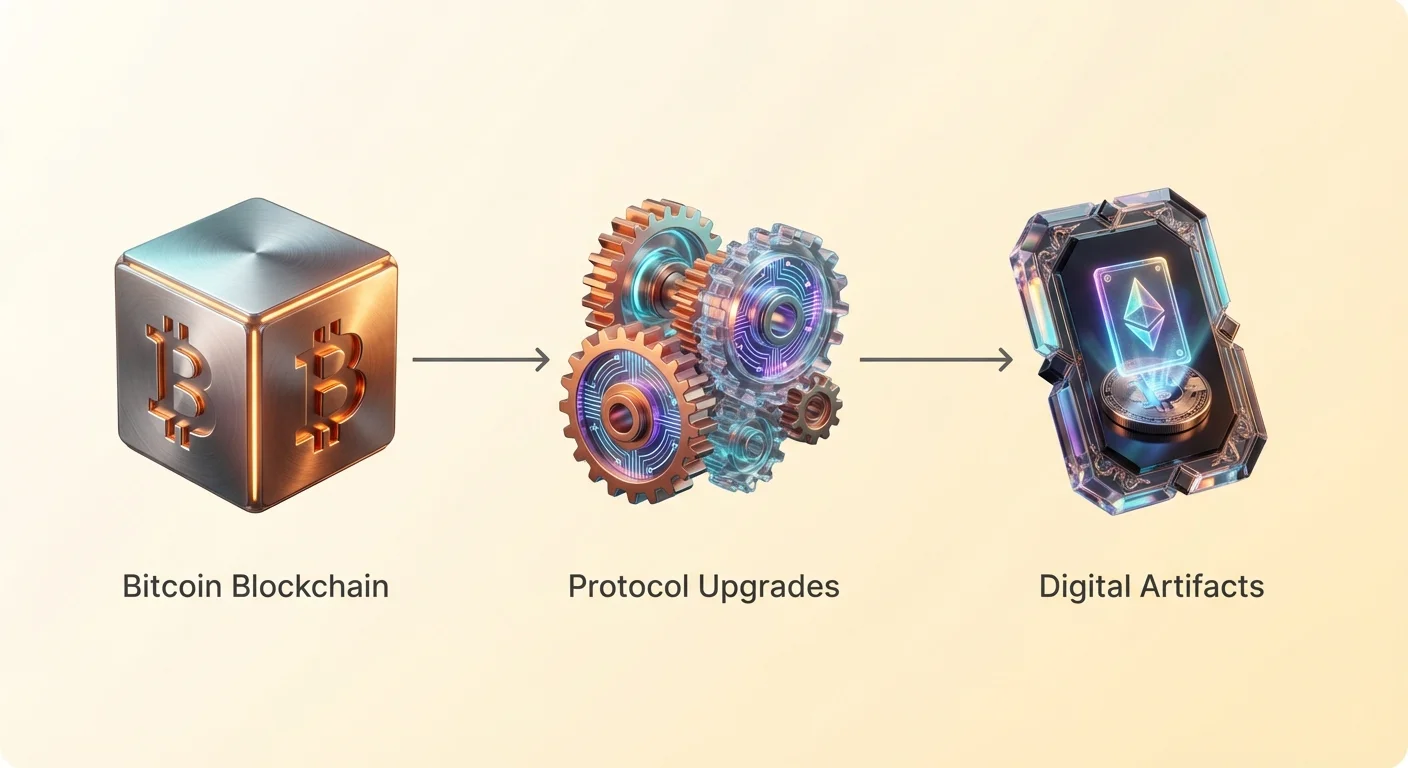
For over a decade, the primary narrative surrounding the world's leading cryptocurrency focused on its utility as a decentralized digital currency or a store of value. The network was viewed as a ledger for financial transactions, meticulously recording the movement of funds between addresses. This perception shifted dramatically with the introduction of protocol upgrades that inadvertently unlocked new capabilities on the blockchain. The emergence of Ordinals and Inscriptions has fundamentally altered how block space is utilized, transforming the network into a database for immutable digital artifacts.
This shift has sparked intense debate regarding the proper use of the blockchain. While some view these additions as essential innovation that brings new utility and demand, others see them as network congestion that deviates from the original mission of peer-to-peer electronic cash. Regardless of the philosophical stance, the economic reality is undeniable. The demand for storing data directly on the chain has created new pressure on transaction fees, forcing a reevaluation of how the network scales and how users interact with it.
The Technical Foundation: SegWit and Taproot
To understand why Ordinals exist and how they impact fees, one must first understand the specific upgrades that made them possible. These innovations were not originally designed to host digital art, but their technical specifications created the perfect environment for it.
Segregated Witness (SegWit)
Implemented in 2017, Segregated Witness (SegWit) was a major upgrade designed primarily to fix a vulnerability known as transaction malleability and to improve scalability. Before SegWit, digital signatures (witness data) were included alongside transaction data within the 1MB block size limit. This structure made transactions heavy and expensive. SegWit separated the signature data from the transaction data, effectively moving it to the end of the transaction structure, improving transaction efficiency and block weight.
Crucially, SegWit introduced a new way of measuring block size called "block weight." Instead of a strict byte limit, blocks were measured in weight units. Data in the witness section was given a significant discount, counting as only one-quarter of the weight of regular transaction data. This effectively increased the block size limit to 4MB of weight units, provided the data was mostly witness information. This discount was intended to make standard transactions cheaper, but it later provided the economic incentive to store large data files in the witness section.
The Taproot Upgrade
The activation of Taproot in November 2021 further paved the way for Inscriptions. Taproot was designed to enhance privacy and efficiency by combining Schnorr signatures with Merkelized Abstract Syntax Trees (MAST). This allowed complex smart contracts to look like standard transactions on the blockchain. Learn more about Taproot and MAST.
More importantly for Ordinals, Taproot removed strict size limits on the witness data within a transaction script. Prior to this, there were constraints on how much data could be pushed into these scripts. By relaxing these restrictions, Taproot inadvertently allowed developers to put nearly 4MB of arbitrary data—such as images, audio, or text—into a single transaction's witness field. This combination of SegWit's discount and Taproot's data capacity created the infrastructure necessary for Inscriptions to function.
Defining Ordinals and Inscriptions
While the terms are often used interchangeably, Ordinals and Inscriptions represent two distinct technical concepts that work together to create digital artifacts on Bitcoin. Understanding the difference is key to grasping their impact on the network.
Ordinal Theory
Ordinal Theory is a methodology for tracking individual satoshis, the smallest unit of the currency. There are 100 million satoshis in a single coin. Ordinal Theory assigns a specific number to every single satoshi based on the order in which it was mined. This numbering system allows users to track a specific satoshi through every transaction it is involved in, from the moment it is created to its current location.
This system operates entirely off-chain as a social convention. The blockchain itself does not distinguish between one satoshi and another; they are fungible at the protocol level. However, software running Ordinal Theory can recognize these unique identifiers, effectively turning fungible tokens into non-fungible collector's items based on their rarity or history.
The Process of Inscription
Inscription is the act of attaching data to one of these specific, numbered satoshis. This is where the "on-chain" aspect comes into play. To create an inscription, a user sends a transaction that includes the data (like a JPEG image) within the witness portion of the transaction input. This process effectively "writes" the file onto the blockchain, permanently linking it to the satoshi.
The mechanism involves a two-step transaction process. First, a "commit" transaction is created, which hashes the data and sends it to a Taproot script. Second, a "reveal" transaction spends that output, exposing the full script and the data to the network. Once mined, this data becomes an immutable part of the ledger, hosted by every full node on the network.
Comparing On-Chain Storage Models
The approach taken by Bitcoin Inscriptions differs significantly from the NFT standards found on other blockchains like Ethereum. These differences have major implications for storage requirements and transaction costs.
| Feature | Ethereum NFTs | Bitcoin Inscriptions |
|---|---|---|
| Data Storage | Usually off-chain (IPFS/Servers) | Fully on-chain (Witness data) |
| Mutability | Metadata can often be changed | Immutable once mined |
| Complexity | Smart contract based | Transaction script based |
In the Ethereum model, the token on the blockchain typically contains a link pointing to an image hosted elsewhere. If the server hosting the image goes down, the image can be lost, leaving only a broken link on the chain. In contrast, Inscriptions store the actual raw data of the file directly on the Bitcoin blockchain. This ensures that as long as the network exists, the artifact exists, but it also means that the data takes up valuable space in every block, directly competing with financial transactions.
The Economics of Block Space
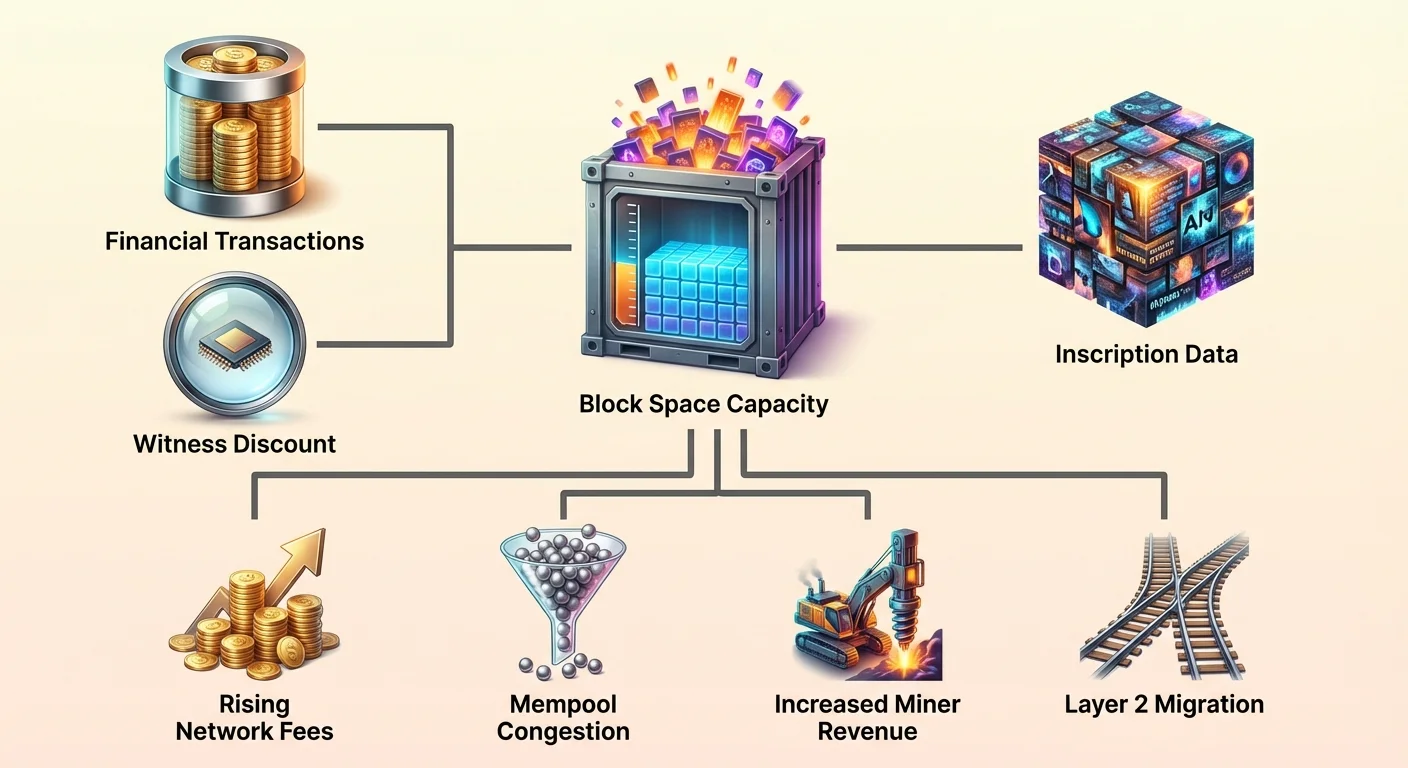
The introduction of Inscriptions has fundamentally changed the supply and demand dynamics of block space. Previously, block space was primarily consumed by financial transfers. Now, financial transactions must compete with data storage, leading to a more complex fee market.
The Witness Discount Loophole
The controversy surrounding Inscriptions often centers on the fee discount provided by SegWit. Because Inscription data is stored in the witness field, it costs four times less per byte than regular transaction data. This means that an Inscription user can occupy a significant portion of a block while paying a fraction of the fees that a financial transaction of the same size would pay.
Critics argue that this exploits the upgrade's original intention, which was to lower fees for standard payments, not to subsidize data storage. However, supporters point out that Inscriptions still pay a fee, and without this demand, blocks might otherwise be partially empty. The discount makes it economically viable to store images on the most secure blockchain, a use case that would be prohibitively expensive without the witness weight reduction.
Rising Demand and Floor Prices
When the network is uncongested, Inscriptions act as a "buyer of last resort" for block space. They fill up the remaining weight of a block with low-fee transactions, ensuring miners receive some revenue for space that would otherwise go unused. This can be seen as a positive development for network security, as it provides a consistent baseline for miner revenue.
However, during periods of high demand, this dynamic changes. If Inscription users are willing to pay higher fees to mint a popular collection, they compete directly with regular users sending money. This raises the "floor price" for inclusion in a block. Standard transactions that previously cleared for a few cents may be pushed into the mempool backlog, requiring significantly higher fees to be confirmed in a timely manner.
Impact on the Mempool and Network Health
The mempool (memory pool) is the waiting area for transactions that have been broadcast but not yet confirmed by a miner. Since the rise of Ordinals, the behavior of the mempool has shifted. It is now frequently populated by heavy transactions waiting for a dip in fees.
Increased Node Requirements
Every full node on the network must download and store the entire blockchain history to verify transactions. Because Inscriptions put actual file data on-chain, the size of the blockchain has grown at an accelerated rate. Blocks are now consistently full, often reaching close to the 4MB weight limit.
This rapid growth increases the hardware and bandwidth requirements for running a node. While storage is relatively cheap, the initial synchronization time and bandwidth usage have increased. Purists argue that this centralization pressure could make it harder for average users to verify the chain, potentially weakening the decentralized nature of the network over the long term.
Congestion as a Feature
Proponents argue that full blocks and high fees are not a bug, but a feature of a successful blockchain. For the network to remain secure as block subsidies (the new coins given to miners) decrease every four years, transaction fees must replace that lost revenue.
Inscriptions have demonstrated that there is a high demand for block space beyond simple currency transfers. This creates a robust fee market that could sustain the network's security budget in the future. If fees remain low forever, the security of the chain could be compromised once the block subsidy reaches zero.
Miners and the Security Budget
The primary beneficiaries of the Inscription phenomenon are the miners. As the entities securing the network, miners are paid in block rewards and transaction fees. The advent of Ordinals has led to periods where transaction fees constitute a significant percentage of total miner revenue, a scenario that was previously rare. Read about the shift to fee reliance.
Revenue Diversification
Historically, miner revenue was dominated by the block subsidy. Fees were often negligible. With Inscriptions, miners have seen days where fees exceeded the subsidy itself. This diversification of revenue streams makes the mining industry more resilient to price volatility of the asset itself. Even if the price of the currency drops, high demand for block space can keep mining profitable.
Incentivizing Hashrate
Higher profitability attracts more miners to the network, increasing the total hashrate. A higher hashrate means the network is more secure against attacks. Therefore, an argument can be made that despite the congestion and higher fees for users, the existence of Inscriptions directly contributes to the physical security of the blockchain by paying for more energy to defend it.
The Community Debate: Spam vs. Innovation
The rise of Inscriptions has triggered a philosophical civil war within the community. This divide touches on the core identity of the project and its future direction.
The "Spam" Argument
Maximalists often view Bitcoin solely as sound money. From this perspective, filling the blockchain with "monkey JPEGs" and meme tokens is an attack on the network's efficiency. They label Inscriptions as "spam" or "dust attack," arguing that it crowds out legitimate financial activity and degrades the user experience for people trying to use the currency for payments, especially in developing nations where fees matter most.
Some developers have even proposed software updates that would filter out Inscription transactions, effectively banning them from the network. They argue that the witness data discount was a technical oversight that is being abused and should be rectified to preserve the chain for financial transactions.
The Permissionless Argument
On the other side, innovators and developers argue that the blockchain is a permissionless protocol. If a transaction pays the required fee and follows the consensus rules, it is valid. They contend that labeling paid transactions as "spam" is a subjective judgment that goes against the censorship-resistant ethos of the network.
Furthermore, they argue that value is subjective. If a user is willing to pay $50 to inscribe an image, that transaction is economically valid. Attempting to censor specific types of data would require centralized decision-making about what constitutes "good" usage, a slippery slope that could undermine the neutrality of the protocol.
Accelerating Layer 2 Adoption
Perhaps the most significant consequence of rising mainnet fees is the acceleration of Layer 2 (L2) adoption. As the base layer becomes more expensive, users are economically forced to seek alternative solutions for smaller transactions.
The Lightning Network Necessity
The Lightning Network is a Layer 2 protocol designed for instant, low-fee micropayments. It works by opening a payment channel between users, allowing them to transact unlimited times off-chain while only recording the opening and closing balance on the main chain. Review various Lightning Network wallets.
High on-chain fees act as a catalyst for Lightning adoption. When a simple on-chain transfer costs $10 or $20, paying for a coffee becomes impossible on the main layer. This pushes users toward Lightning wallets. However, the high fees also present a challenge for Lightning: opening and closing channels requires on-chain transactions. If the base layer becomes too expensive, onboarding new users to Lightning becomes costly, potentially pricing out the very users the network aims to serve.
Sidechains and Bridges
Beyond Lightning, the fee pressure has renewed interest in sidechains and other scaling solutions. Sidechains are independent blockchains pegged to the main chain, allowing assets to be transferred back and forth. They offer faster and cheaper transactions by using different consensus mechanisms.
Projects like the Liquid Network or Stacks offer environments where users can engage in DeFi, trading, and other activities without clogging the main Bitcoin ledger. The congestion caused by Inscriptions serves as a stress test, proving the necessity of these off-chain scaling solutions. It reinforces the idea that the main chain should function as a high-value settlement layer, while daily commerce moves to more efficient layers.
Future Innovations: Fractal Bitcoin and Beyond
The challenges posed by Inscriptions have spurred new research into scaling architectures. Developers are exploring ways to accommodate the demand for digital artifacts without compromising the efficiency of the monetary network.
One concept gaining traction is the idea of recursive inscriptions, where developers can reference data already on the chain to build complex applications without uploading new code every time. This could significantly reduce the data footprint of future projects. Additionally, scaling proposals like Fractal Bitcoin aim to create a multi-layered approach, using smaller, interconnected chains to handle throughput. These "fractals" would operate in parallel, processing transactions off the main chain while periodically settling on it, theoretically offering unlimited scaling for both financial and data transactions.
New opcodes, such as the proposed OP_CAT, are also being discussed. These would enable more efficient smart contract functionality directly on the base layer, potentially allowing for better management of complex assets and reducing the data overhead required for current inscription methods.
Conclusion
The emergence of Ordinals and Inscriptions represents a pivotal moment in blockchain history, marking a transition from a singular focus on currency to a broader utility as a secure data anchor. While this evolution has introduced challenges regarding congestion and rising costs, it has also revitalized the development ecosystem and provided a glimpse into a sustainable economic future for network security. The high fees driven by this new demand are not merely a nuisance but a market signal accelerating the migration of daily payments to Layer 2 solutions.
Ultimately, the conflict between digital artifacts and digital cash is forcing the network to mature. It is testing the limits of block space and proving that the protocol can serve as a robust foundation for diverse economic activities. Whether Inscriptions remain a dominant force or fade into a niche use case, their impact on transaction fee dynamics has permanently altered the trajectory of the network, ensuring that the quest for scalability remains the industry's most urgent priority.
The transformation of block space into a commodity for both finance and art is securing the network's long-term economic survival.