
At its core, the Bitcoin network operates as a vast, decentralized ledger that tracks the movement of value from one location to another. The fundamental endpoint for these movements is the Bitcoin address. To a new user, this string of alphanumeric characters might appear random or chaotic, yet it represents a precise cryptographic coordinate. It serves a function similar to a bank account number or an email address, acting as a public destination where funds can be received. However, unlike a bank account, a Bitcoin address is not a vault that holds coins inside it.
Instead, an address is a digital identifier derived from complex mathematical proofs. When you share this identifier with a sender, you are essentially providing them with a location on the blockchain to lock funds. Only the person possessing the corresponding digital key can unlock and spend those funds later. This distinction is vital for understanding how custody works. The coins exist on the public network, but the control of those coins remains exclusively with the holder of the private key associated with the address.
Understanding the anatomy of these addresses helps users navigate the ecosystem more effectively. It allows you to distinguish between different network standards, optimize for lower transaction fees, and maintain higher levels of privacy. As the Bitcoin protocol has evolved, so too have the standards for these addresses, moving from simple legacy formats to complex structures that support advanced scripting and efficiency upgrades.
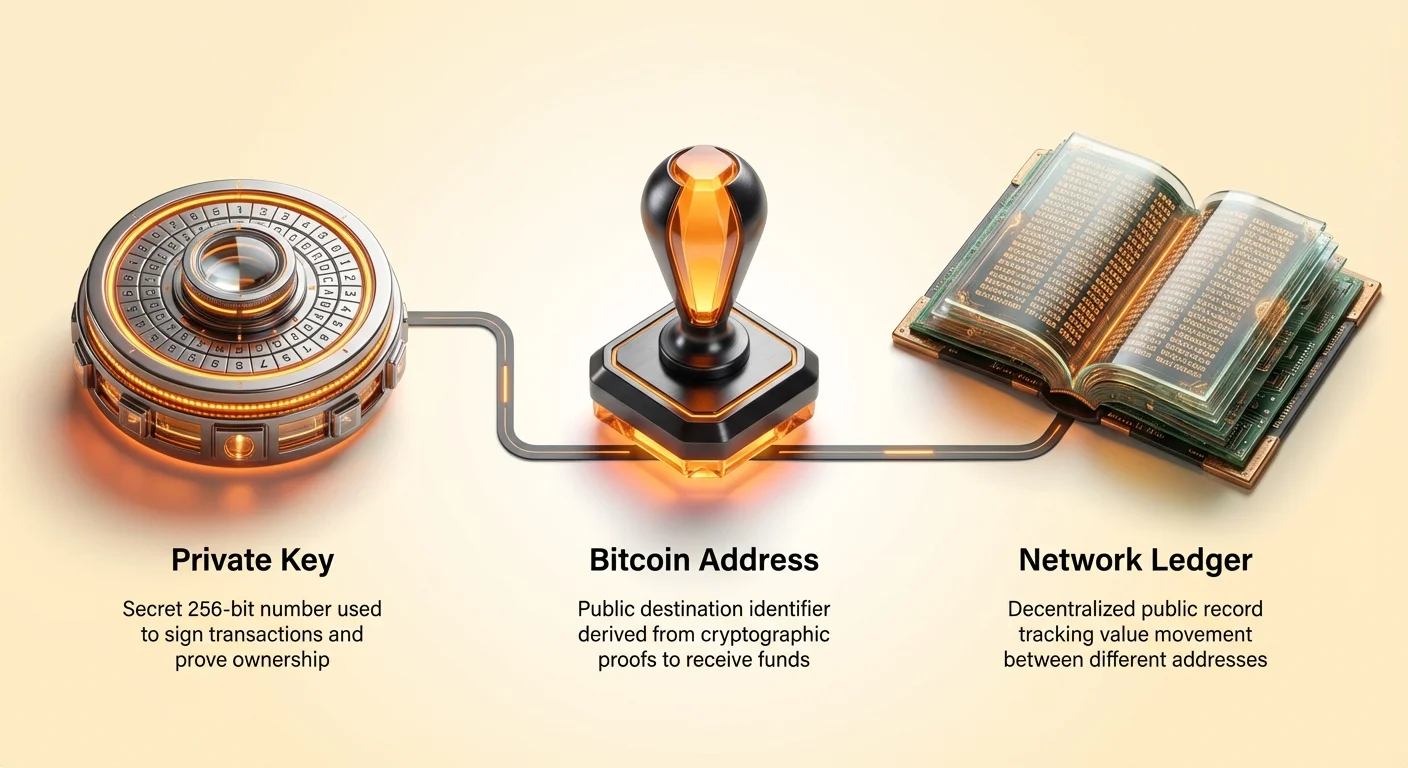
The Cryptographic Pair: Public and Private Keys
The relationship between a Bitcoin address and the wallet that manages it is built on public-key cryptography. A wallet does not technically store Bitcoin. Rather, it stores and manages the private keys that grant access to Bitcoin addresses. Every address is mathematically linked to a specific key pair. This pair consists of a public key, which is visible to the network, and a private key, which must remain secret.
The private key acts as the master password. It is a 256-bit secret number that allows the user to sign transactions. When you wish to send Bitcoin, your wallet uses this private key to create a digital signature. This signature proves to the network that you own the funds without ever revealing the private key itself. If this key is lost, the funds associated with it become permanently inaccessible.
The public key is derived from the private key through a one-way mathematical function. This means you can generate the public key from the private key, but you cannot reverse the process to find the private key. The Bitcoin address is then generated by hashing the public key. This double layer of cryptographic security, built on public key cryptography, ensures that sharing your address is completely safe. Even with the address exposed to the world, the private key remains mathematically secure and hidden.
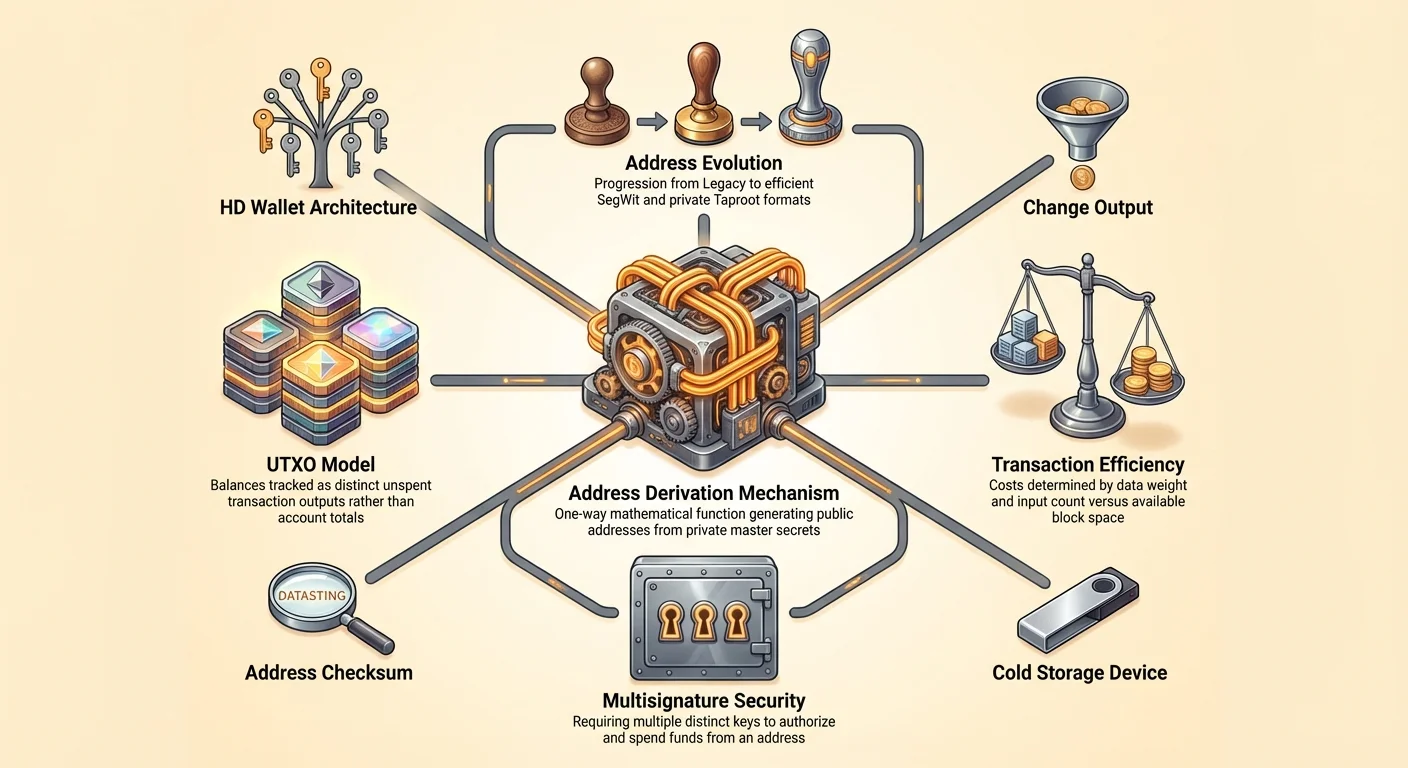
The Evolution of Address Formats
Not all Bitcoin addresses look the same. Over the years, developers have introduced upgrades to the network to improve scalability, reduce fees, and enhance functionality. These upgrades have resulted in different address formats that are easily identifiable by their leading characters. Recognizing these formats can help you understand the capabilities and potential costs associated with a transaction.
Legacy Addresses (P2PKH)
The original address format is known as Pay-to-Public-Key-Hash (P2PKH). These addresses always begin with the number 1. For many years, this was the standard for the network. While still functional, legacy addresses are less efficient in terms of data usage. Transactions sending from these addresses typically occupy more space on the blockchain, resulting in higher network fees compared to modern formats.
Nested SegWit (P2SH)
Addresses starting with the number 3 are known as Pay-to-Script-Hash (P2SH). This format is versatile. It is commonly used for multisignature wallets, where multiple keys are required to authorize a transaction. It was also used as a transitional format to introduce Segregated Witness (SegWit) upgrades. While more efficient than legacy addresses, they are slightly less efficient than the native SegWit format.
Native SegWit (Bech32)
Addresses starting with bc1q are known as Native SegWit or Bech32 addresses. This format was introduced to fully utilize the benefits of the Segregated Witness upgrade. Transactions involving these addresses are smaller in size (measured in bytes), a benefit derived from the Segregated Witness upgrade, which translates to significantly lower transaction fees. They are also case-insensitive, reducing the risk of human error when typing, although copying and pasting is always recommended.
Taproot (P2TR)
The most recent major upgrade introduced Taproot addresses, which begin with bc1p. Taproot enhances privacy and efficiency, particularly for complex transactions involving smart contracts or multisignature setups. By making complex transactions look identical to standard ones on the blockchain, Taproot improves fungibility and privacy for advanced users.
Unspent Transaction Outputs (UTXO)
To truly understand the anatomy of a Bitcoin address, one must understand how the network tracks balances. Bitcoin does not use an account-based model like a traditional bank, where a database simply updates a total balance figure. Instead, it uses the Unspent Transaction Output (UTXO) model. This is similar to handling physical cash or gold coins.
When you receive Bitcoin, you are receiving a specific "chunk" of digital value. If you receive 0.5 BTC from one person and 0.5 BTC from another, your wallet does not just say "1 BTC" in the background. It holds two separate distinct coins (UTXOs), each worth 0.5 BTC. When you want to spend 0.2 BTC, your wallet must select one of those 0.5 BTC coins to use as an input for the transaction.
The network "melts down" the selected 0.5 BTC coin. It sends 0.2 BTC to the recipient and sends the remaining 0.3 BTC back to you. This returning amount is known as "change." This change does not usually go back to the original address. Modern wallets automatically generate a new address, called a change address, to receive this remainder. This mechanism is crucial for privacy, as it makes it harder for outside observers to track the flow of funds.
Transaction Efficiency and Fees
The cost of sending Bitcoin is not determined by the dollar value of the transaction but by the amount of data it consumes. Learning to manage this data is key to optimizing transaction costs. This data is measured in bytes or weight units. Because block space on the Bitcoin blockchain is limited, miners prioritize transactions that pay a higher fee per unit of data. This market dynamic creates a direct link between address types and transaction efficiency.
Complex transactions require more data. For example, if your wallet balance consists of many small inputs (dust) received from dozens of different people, sending a full Bitcoin will require your wallet to bundle all those small inputs together. Each input adds data to the transaction size. A transaction with ten inputs will be significantly more expensive than a transaction with only one input, even if the total Bitcoin amount sent is identical.
This is where address formats play a major role in efficiency. SegWit addresses separate the digital signature data (the witness) from the main transaction block. The network counts this witness data at a lower weight than other data. Consequently, spending from a Native SegWit (bc1q) address is cheaper than spending from a Legacy (1) address. For frequent users, adopting modern address formats provides substantial savings on network fees over time.
Privacy Implications and Address Reuse
The Bitcoin blockchain is a transparent, public ledger. Anyone with an internet connection can view the entire history of transactions associated with any specific address. If an individual publicly links their identity to a Bitcoin address—perhaps by posting it on social media or using it to receive a salary—observers can easily calculate their net worth and track their spending habits.
The Risks of Static Addresses
Using the same address for every transaction is a significant privacy risk. It creates a comprehensive history that clusters all your financial activity into a single, easily observable point. If a malicious actor discovers the owner of that address, they have a complete map of that person's financial interactions associated with that specific identifier.
Hierarchical Deterministic (HD) Wallets
To combat this, modern wallet software uses Hierarchical Deterministic (HD) architecture. An HD wallet uses a single master seed phrase to generate a virtually infinite sequence of public and private keys. While the user only needs to back up one recovery phrase, the wallet creates a fresh address for every new transaction.
This practice fractures your digital footprint. To an outside observer, the funds appear to be moving to unrelated locations, even though they are all controlled by the same wallet. Most modern mobile and hardware wallets handle this automatically. When you hit "receive," the app displays a new address. Once that address receives funds, the wallet generates a fresh one for the next payment.
Understanding Multisignature Security
While standard addresses rely on a single private key to authorize spending, the Bitcoin protocol supports more advanced security structures. A shared wallet, or multisignature (multisig) wallet, distributes control across multiple keys. These setups typically utilize the P2SH (starting with 3) or P2WSH (starting with bc1) address formats.
In a multisig setup, the address functions like a vault with multiple keyholes. The user defines the rules upon creation, such as "2-of-3." This means three private keys are generated, but any two are required to sign a valid transaction. This structure eliminates the single point of failure inherent in standard wallets.
If a hacker manages to steal one private key, they still cannot access the funds because they lack the second required signature. This approach is widely used by exchanges to secure cold storage and by companies to manage treasury funds. It also allows for personal security setups where one key is on a laptop, one on a phone, and one on a hardware device, ensuring that the compromise of one device does not lead to a loss of funds.
Shared Wallets for Governance
Beyond security, multisig addresses enable shared governance. They allow groups to manage funds collectively without trusting a single individual. For instance, a board of directors might use a 3-of-5 multisig wallet for corporate expenses. No single board member can drain the treasury, but a majority consensus allows for legitimate spending.
The creation of these addresses involves complex scripting. The address itself represents the hash of a script that outlines these requirements. When funds are sent to this address, the sender does not need to know who controls the keys or how many signatures are required. They simply send Bitcoin to the identifier. The rules are only revealed and enforced when the funds are moved out of the address.
Safety and Verification
Because Bitcoin transactions are irreversible, accuracy when handling addresses is paramount. There is no "undo" button if funds are sent to the wrong location. To mitigate this risk, Bitcoin addresses include built-in checksums. A checksum is a small piece of data derived from the address itself, added to the end of the string.
When you type or paste an address into a wallet, the software runs a mathematical check to ensure the checksum matches the rest of the address. If you mistype even a single character, the checksum will fail, and the wallet will reject the address as invalid. This prevents users from accidentally burning funds by sending them to a nonexistent destination.
Clipboard Hijacking
Despite these safeguards, users must remain vigilant against malware known as clipboard hijackers. This malicious software monitors a computer's clipboard for text resembling a Bitcoin address. When the user copies a legitimate address, the malware instantly replaces it with an attacker's address. Always verify the first and last few characters of the address after pasting it to ensure it matches the intended destination.
Hardware Wallets and Cold Storage
For users holding significant value, the security of the keys generating these addresses is critical. Software wallets, while convenient, keep private keys on internet-connected devices. This exposes the keys to potential malware, viruses, or remote hacking attempts.
Hardware wallets offer a superior solution by generating and storing private keys offline. These physical devices look like USB drives and are designed specifically to isolate cryptographic secrets from the internet. When a user wants to spend funds, the transaction is constructed on the computer but sent to the hardware wallet for signing. The device signs the transaction internally and returns only the digital signature.
This process ensures that the private keys never leave the device. Even if the computer is infected with viruses, the keys remain secure within the hardware wallet's secure element. Using a hardware wallet creates a "cold storage" environment, which is the gold standard for preserving the integrity of Bitcoin addresses over the long term.
The Role of QR Codes
To make addresses more human-friendly, the ecosystem heavily utilizes QR codes. A QR code is simply a visual representation of the alphanumeric address string. Scanning a QR code eliminates the risk of typographical errors and the potential for clipboard hijacking.
Most mobile wallets can automatically scan these codes to populate the recipient field. Additionally, QR codes can contain more than just the address; they can encode the requested amount and a label for the transaction. This standard, known as BIP21, streamlines the payment process for merchants and retail users, bridging the gap between complex cryptography and everyday commerce.
Comparison of Address Types
Different address formats offer distinct advantages depending on the user's needs. The following table outlines the primary differences between the three most common formats found in modern wallets.
| Format Name | Prefix | Key Feature | Best Use Case |
|---|---|---|---|
| Legacy (P2PKH) | 1... | Original format | Compatibility with very old services |
| Nested SegWit (P2SH) | 3... | Script support | Multisig wallets & backward compatibility |
| Native SegWit (Bech32) | bc1q... | Lowest fees | General daily transactions |
The Future: Silent Payments and Privacy
The evolution of Bitcoin addresses is ongoing. Developers continue to work on proposals that enhance privacy and scalability. One such concept gaining traction is reusable payment codes or "silent payments." This technology aims to allow a user to post a single static identifier publicly without revealing their transaction history.
In this system, the sender's wallet and the receiver's wallet perform a cryptographic exchange to derive a unique, one-time address for the transaction. This happens automatically in the background. The blockchain records a transaction to a fresh address that has no visible link to the receiver's public ID. This would effectively solve the privacy issues associated with static donation addresses or public business profiles.
While not yet universally adopted, these innovations highlight the programmable nature of Bitcoin addresses. They are not merely static inboxes but dynamic cryptographic tools that can be engineered to protect user identity and secure value in increasingly sophisticated ways.
Conclusion
The anatomy of a Bitcoin address reveals a system designed for security, precision, and adaptability. While they function as simple destinations for value, the underlying technology involves a sophisticated interplay of cryptographic keys, script hashes, and evolving network standards. From the robust legacy formats to the efficiency of Native SegWit and the privacy potential of Taproot, each address type serves a specific role in the broader ecosystem.
Understanding how these addresses function empowers users to take full ownership of their financial sovereignty. It enables smarter decisions regarding transaction fees, privacy hygiene, and security setups like multisignature wallets. As the network continues to mature, the mechanisms governing these addresses will likely become even more efficient, further cementing Bitcoin's utility as a global, decentralized transfer layer.
Your keys are your control; protecting them and understanding the addresses they generate is the first step toward true financial independence.