
For decades, the financial bedrock of investment strategy rested upon established principles, primarily defined by asset classes like stocks, bonds, and commodities. These classes offered predictable, if sometimes limited, returns based on known economic factors. The emergence of Bitcoin, an asset characterized by extreme volatility yet unprecedented returns, initially perplexed traditional finance professionals. How could something so volatile be integrated into a stable investment plan?
The answer lies in Modern Portfolio Theory (MPT), a quantitative framework developed by Nobel laureate Harry Markowitz. MPT teaches us that risk should not be viewed in isolation, but rather in the context of the overall portfolio. An asset's value to a portfolio is less about its individual volatility and more about its relationship (correlation) to the other assets held.
This guide provides an analytical framework for integrating Bitcoin into a traditional investment structure. We will move beyond simple definitions and evaluate Bitcoin using the tools of investment analysts: mean-variance optimization, the efficient frontier, and risk-adjusted return metrics like the Sharpe Ratio. By understanding Bitcoin’s unique low correlation and asymmetric return profile, investors can strategically use small allocations to potentially improve portfolio performance and achieve better risk-adjusted returns than traditional allocations alone.
The Foundations of Modern Portfolio Theory (MPT)
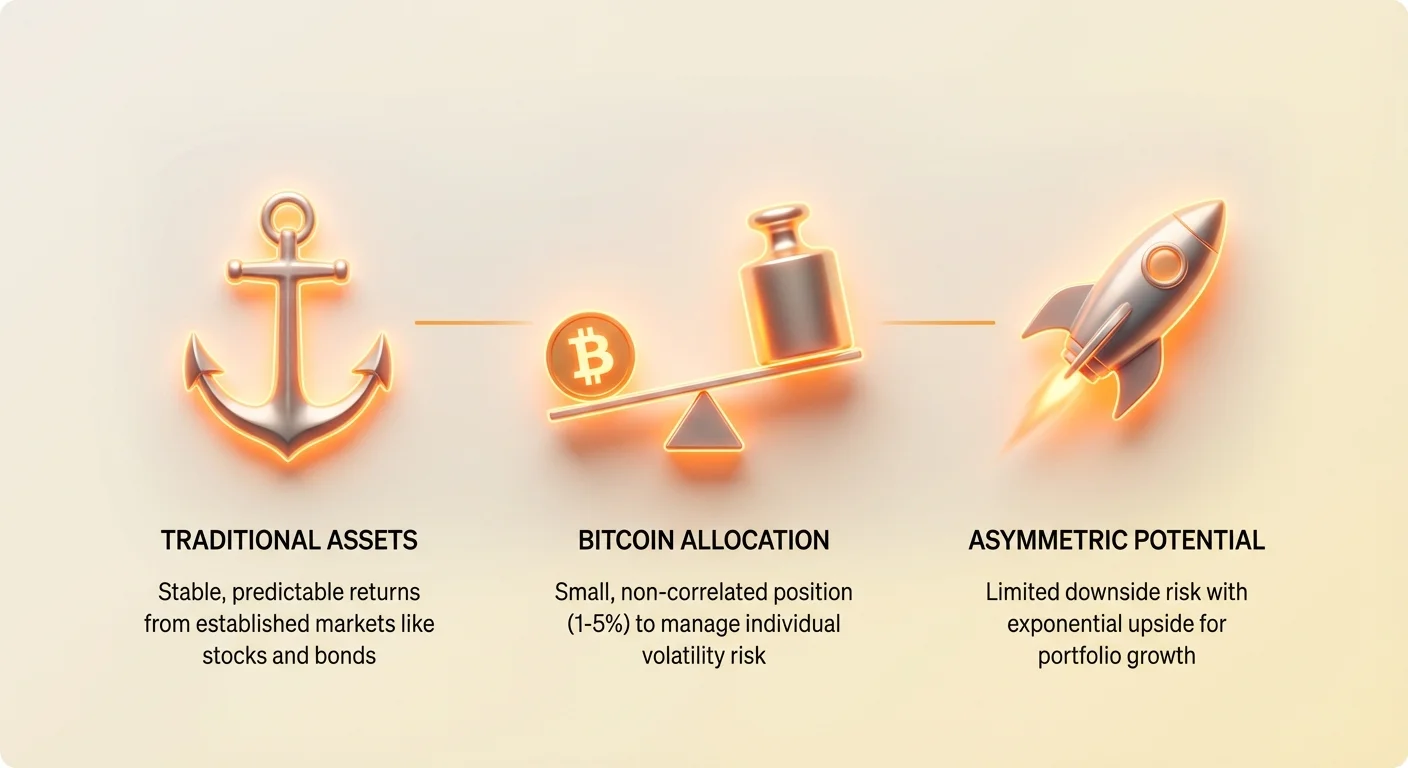
Modern Portfolio Theory (MPT), introduced in 1952, revolutionized how investors approach risk. Its core insight is that diversification is not just about holding different things; it’s about holding assets that do not move in lockstep. The goal of MPT is simple: to construct a portfolio that delivers the highest possible expected return for a given level of assumed risk.
Risk vs. Return: The Fundamental Trade-off
In finance, risk is typically measured by volatility, which is the degree to which an asset’s price fluctuates up or down over a period. Generally, assets with higher potential returns (like growth stocks) come with higher volatility, while assets with lower returns (like Treasury bonds) offer greater stability.
MPT views these two factors as coordinates on a graph. Every portfolio can be plotted based on its expected return (Y-axis) and its expected risk/volatility (X-axis). The goal of optimization is to shift your portfolio as far "up and to the left" as possible—meaning higher returns for lower risk. Without introducing a new type of asset, this trade-off is fixed. To increase return, you must accept more volatility.
The Power of Non-Correlation: The Diversification Principle
The most powerful component of MPT is the concept of correlation. Correlation measures how two assets move relative to each other.
- Positive Correlation (Close to +1): Assets move together. If Asset A goes up, Asset B usually goes up. (Example: Oil stocks and the price of oil). Adding these assets together increases overall risk, as both fall during the same market stress events.
- Negative Correlation (Close to -1): Assets move oppositely. If Asset A goes up, Asset B usually goes down. (Example: Stocks and certain short-term volatility funds). This is the holy grail of diversification, though true negative correlation is rare and fleeting.
- Zero/Low Correlation (Close to 0): Assets move independently. The price changes in Asset A have little to no relationship with the price changes in Asset B.
When you combine assets with low correlation, the specific risks of the individual assets often cancel each other out, reducing the overall portfolio volatility without sacrificing the expected aggregate return. This is the mechanism by which Bitcoin can dramatically improve a portfolio, despite its high individual volatility.
Bitcoin’s Unique Role in Traditional Portfolios
Bitcoin is an entirely new asset class, operating independently of the primary drivers of traditional markets (central bank policy, GDP growth, corporate earnings). This structural independence is what makes it a potentially ideal tool for modern portfolio diversification.
Analyzing Bitcoin’s Volatility Profile
It is undeniable that Bitcoin is an extremely volatile asset. Since its inception, daily price movements have far exceeded those of major indices like the S&P 500 or even individual growth stocks. For an investor focused purely on minimizing short-term fluctuations, this volatility seems like an immediate disqualifier.
However, the nature of Bitcoin's volatility must be understood:
- Concentrated Allocation Risk: If Bitcoin constituted 50% of your portfolio, its volatility would overwhelm everything else.
- Diluted Portfolio Risk: If Bitcoin constitutes only 3% of your portfolio, its individual volatility is diluted across 97% of more stable assets (like bonds and major equities). In this configuration, the potential for huge asymmetric returns outweighs the marginal increase in overall portfolio volatility.
This framing shifts the perspective: the issue is not Bitcoin’s high volatility, but the size of its allocation. Small allocations of highly volatile, low-correlated assets are the mathematical sweet spot MPT seeks.
Bitcoin as a Unique Non-Correlated Asset
Bitcoin’s market drivers are fundamentally different from those driving stocks and bonds.
- Stocks and Bonds: Driven by interest rates, inflation, corporate profits, and government policy.
- Bitcoin: Driven by structural supply shock events (Halvings), decentralized network adoption curves, institutional infrastructure development (e.g., ETF flows), and the global shift towards digital scarcity.
While Bitcoin’s correlation with tech stocks (the Nasdaq) increased during certain macro periods (like the 2020-2022 liquidity boom), its long-term, structural correlation remains low compared to the correlation between traditional asset pairings (e.g., European equities vs. US equities).
This low correlation means that during periods when the traditional 60/40 portfolio (60% stocks, 40% bonds) suffers—such as simultaneous stock and bond crashes driven by high inflation and rate hikes—Bitcoin may be reacting to its own internal economic schedule (like a Halving cycle) or global adoption trends, offering diversification precisely when it is most needed.
The Asymmetry of Risk and Reward
Bitcoin has historically demonstrated an asymmetric return profile. This means that the potential upside far exceeds the potential downside, especially over multi-year cycles.
If an asset has a maximum possible loss of 100% (it goes to zero) but a historical maximum gain of thousands of percent, the potential reward greatly outweighs the catastrophic risk, provided the allocation is small.
For a traditional portfolio, even a small 2% allocation to Bitcoin offers a high "optionality value." If the 2% allocation fails (goes to zero), the total portfolio loss is minimal (2%). However, if the 2% allocation increases 5x or 10x, the capital appreciation provides a massive uplift to the overall portfolio’s returns, justifying the inclusion of the volatile component. This asymmetry is the engine driving the improvement of the Efficient Frontier.
The Efficient Frontier and Mean-Variance Optimization
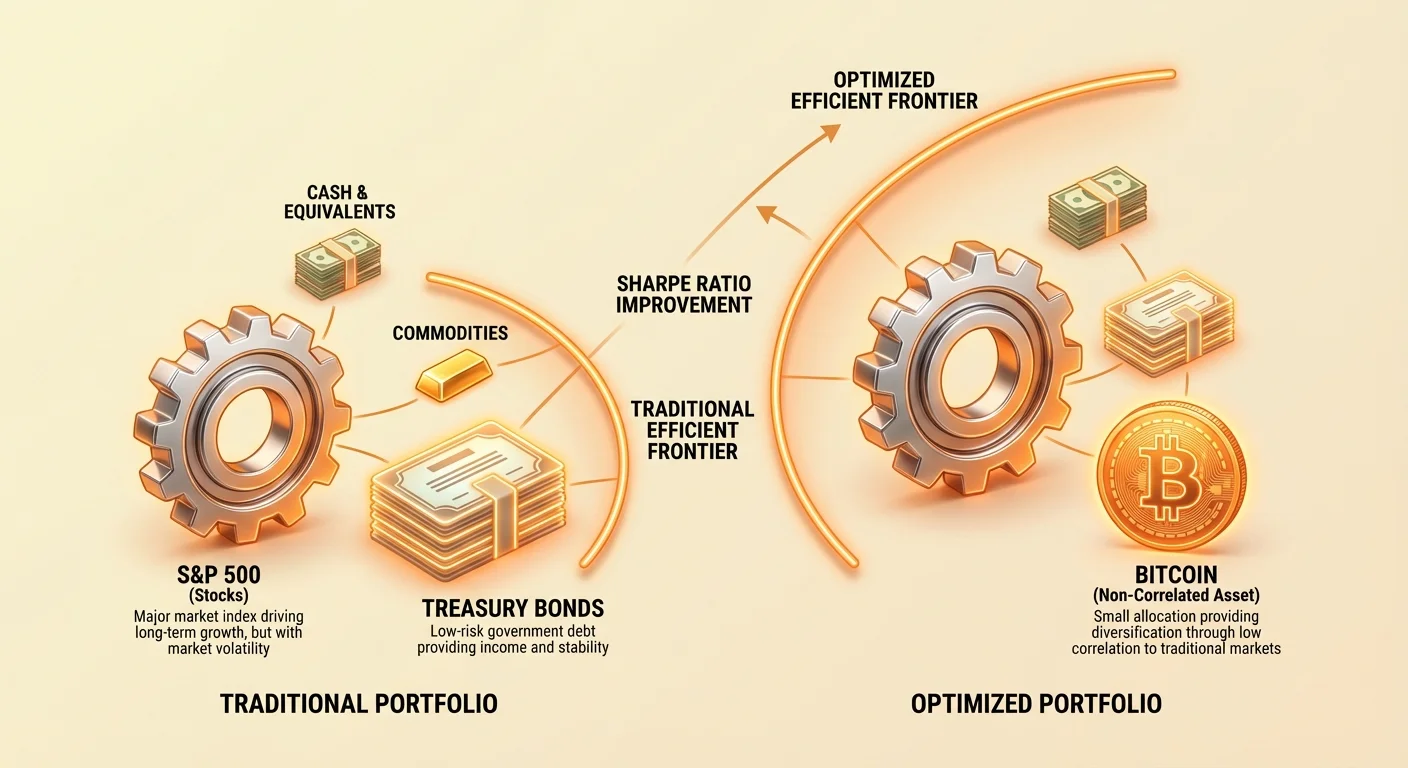
The core objective of utilizing Bitcoin within MPT is to shift the Efficient Frontier—the graphical representation of optimal risk-return portfolios—up and to the left. This process is called Mean-Variance Optimization.
Defining the Efficient Frontier
Imagine a graph where the X-axis measures risk (volatility) and the Y-axis measures expected return. If you plot every possible combination of traditional assets (stocks, bonds, cash), the resulting cloud of points forms a boundary. The Efficient Frontier is the upper edge of that boundary.
Any portfolio combination that sits below the Efficient Frontier is considered inefficient, because it is possible to achieve the same return with lower risk, or a higher return with the same risk, simply by reallocating.
The key limitation of the traditional Efficient Frontier is that it is defined only by the assets included in the model (e.g., S&P 500 and Treasury Bonds).
How Bitcoin Shifts the Frontier
When Bitcoin is introduced into the optimization calculation, even at small allocations (typically 1% to 5%), its low correlation and high historical returns create new, previously unattainable portfolio combinations.
The effect is dramatic: The entire Efficient Frontier curve shifts outward, demonstrating that optimal portfolios now exist with higher returns for every level of risk compared to the traditional universe.
Consider a hypothetical portfolio aimed at a 10% annual return:
| Portfolio Type | Allocation | Expected Return | Expected Volatility (Risk) |
|---|---|---|---|
| Traditional 60/40 | 60% Stocks, 40% Bonds | 9.8% | 10.5% |
| Optimized w/ BTC | 58% Stocks, 40% Bonds, 2% BTC | 10.3% | 10.1% |
In this simplified example, the addition of a small, volatile Bitcoin allocation allows the investor to achieve a higher return while simultaneously lowering the overall portfolio volatility. This is the mathematical proof of diversification via non-correlation, and it is the central justification for Bitcoin inclusion.
The Optimal Portfolio: Maximizing Risk-Adjusted Returns
In MPT, the ultimate goal is not just high returns, but achieving the highest risk-adjusted return. This is often represented by the Capital Market Line (CML), which connects the risk-free rate (like short-term US Treasury bills) to the market portfolio (M).
When Bitcoin is added, the CML rotates upward, creating a new "tangency portfolio" that offers a better balance between risk and reward. The specific allocation that creates the best tangency portfolio is the "optimal" allocation under MPT.
Historically, quantitative analyses covering the last decade often show that the inclusion of 1% to 5% Bitcoin in an otherwise diversified portfolio significantly outperforms pure traditional allocations on a risk-adjusted basis. This is crucial for institutional investors and pension funds where capital preservation and stability are paramount, yet mandates require meeting return targets.
Quantifying Portfolio Improvement: The Sharpe Ratio
While the Efficient Frontier provides a visual understanding of optimization, the Sharpe Ratio provides the critical quantitative metric for measuring performance improvement. It is the single most important metric for evaluating the success of a diversification strategy.
Deconstructing the Sharpe Ratio
The Sharpe Ratio measures the excess return achieved per unit of risk taken. It helps answer the question: Was the additional return worth the extra volatility?
Where:
- : Expected return of the portfolio.
- : Risk-free rate (return from zero-risk assets like T-bills).
- : Standard deviation (volatility/risk) of the portfolio.
A higher Sharpe Ratio is always better. A fund manager or investor who achieves a 10% return with a Sharpe Ratio of 1.0 is considered a better risk manager than one who achieves a 12% return but has a Sharpe Ratio of 0.8, because the first manager generated more return efficiently without excessive risk.
Case Study: Bitcoin’s Historical Sharpe Enhancement
Bitcoin, viewed in isolation, has a highly volatile denominator (), which would suggest a poor Sharpe Ratio. However, when integrated into a broader portfolio, two effects occur that boost the aggregate Sharpe Ratio:
- Massive Uplift in Return (): The extremely high historical return of Bitcoin, even when weighted at just 2%, significantly raises the overall expected return of the total portfolio (the numerator).
- Volatile Offset (Low Correlation): Because Bitcoin moves independently, it doesn't dramatically increase the portfolio's overall standard deviation (the denominator), as its non-correlated nature helps smooth out the combined portfolio volatility.
Example Scenario:
| Portfolio | Annualized Return | Annualized Volatility | Risk-Free Rate (3%) | Sharpe Ratio |
|---|---|---|---|---|
| Traditional (60/40) | 8.0% | 10.0% | 3% | (8-3) / 10 = 0.50 |
| Optimized (58/40/2) | 9.5% | 10.3% | 3% | (9.5-3) / 10.3 = 0.63 |
The 2% Bitcoin allocation caused a slight increase in volatility (0.3%), but the substantial increase in returns (1.5%) resulted in a much improved Sharpe Ratio (0.50 to 0.63). This demonstrates that the portfolio is utilizing risk more efficiently and is better compensated for the risk taken. This is the fundamental, quantifiable argument for incorporating Bitcoin into a serious, institutional-grade investment strategy.
Managing the Downside: Volatility and Drawdown Analysis
The most common fear preventing investors from embracing Bitcoin is the risk of massive, sudden price crashes—known as "tail risk." While Bitcoin’s volatility is high, MPT helps us manage the actual impact of this volatility on the portfolio through strict allocation controls and focused drawdown analysis.
Understanding Volatility vs. Systemic Risk
It is crucial to distinguish between an asset’s inherent volatility and its contribution to systemic risk.
- Inherent Volatility: Bitcoin’s price can drop 30-50% in a short timeframe.
- Systemic Risk: The risk that the failure of this asset will cascade and destabilize the entire global financial system.
While Bitcoin’s inherent volatility is high, its contribution to the systemic risk of a well-diversified portfolio is extremely low, provided the allocation is small. If a 3% Bitcoin allocation drops by 50%, the total portfolio loss is only 1.5%. This is a manageable drawdown that is easily offset by performance in the traditional components or subsequent returns from the Bitcoin allocation itself.
Furthermore, Bitcoin often performs well when traditional assets are under stress due to inflation or excessive debt monetization. If Bitcoin acts as an escape valve during a major financial crisis affecting the stock market, its volatility becomes a net benefit, protecting the overall portfolio value.
Drawdown Management and Portfolio Stability
Drawdown refers to the peak-to-trough decline of an investment during a specific period. Investors hate drawdowns because they require higher subsequent returns just to break even.
A major benefit of the non-correlated 1-5% allocation is its role in limiting the maximum drawdown (MDD) of the total portfolio.
During market cycles where traditional assets (like US stocks) experience a significant MDD (e.g., 20% in 2008 or 2020), Bitcoin may or may not experience a simultaneous crash. Even if it does crash, the small allocation limits the absolute damage. More importantly, when the market recovers, the high-octane Bitcoin allocation can often accelerate the portfolio’s return to its previous peak, minimizing the duration of the drawdown period.
Risk Management Tip: When calculating the risk of a Bitcoin allocation, focus not on Bitcoin’s standalone maximum drawdown, but on the marginal change in the total portfolio’s maximum drawdown. Historically, adding small Bitcoin exposure has not dramatically increased portfolio MDD, while significantly increasing long-term returns.
Using Smaller Sizing to Mitigate Tail Risk
For institutional investors, the mitigation of tail risk—the risk of extreme, unexpected losses—is paramount. The portfolio allocation strategy for Bitcoin hinges entirely on mitigating this tail risk through size.
The common industry consensus suggests an initial allocation between 1% and 3%.
- 1% Allocation: Often used by highly risk-averse institutions. The risk of total loss is negligible (1%), but the upside potential remains substantial due to Bitcoin’s historical price action.
- 3% Allocation: A common target for optimizing the Sharpe Ratio and maximizing the shift of the Efficient Frontier.
This conservative sizing ensures that the investor gains exposure to Bitcoin’s non-correlated benefits and asymmetric upside, while rigidly protecting the overall stability of the primary equity and fixed income holdings. It treats Bitcoin as an insurance policy and a growth catalyst, rather than a core capital component.
Practical Allocation Strategies and Implementation
Moving from theoretical models like MPT to actionable investment plans requires clear rules regarding sizing, maintenance, and custody. The decision to include Bitcoin is only the first step; the successful execution relies on discipline.
Determining Optimal Portfolio Sizing (The 1% to 5% Rule)
While academic models often suggest an MPT-optimal allocation might be as high as 6% to 8% based on historical data, most investment managers advise a more conservative range due to Bitcoin’s relatively short history and extreme regulatory uncertainty.
Initial Allocation (1%): A great starting point for beginners or institutions concerned about short-term volatility headlines. This is sufficient to capture diversification benefits without causing significant portfolio discomfort during bear markets.
Target Allocation (2% - 3%): This range is often cited as the sweet spot for maximizing the Sharpe Ratio uplift, balancing the non-correlation benefit with acceptable portfolio risk.
Maximum Allocation (5%): Only recommended for investors with high-risk tolerance or those who have a deep conviction in Bitcoin’s long-term economic thesis. Exceeding 5% typically begins to overwhelm the diversification benefits, and the portfolio's performance becomes highly dependent on Bitcoin’s volatility.
The choice should align with the investor's established risk profile. If an investor is inherently conservative (e.g., a retiree), starting at 1% is the appropriate approach.
Rebalancing and Maintaining the Allocation
A critical component of successful MPT implementation is rebalancing. Because Bitcoin is highly volatile, its market value percentage within the portfolio will frequently drift above or below the target allocation (e.g., 3%).
The Rebalancing Mechanism:
- Drift Up: If the 3% Bitcoin allocation doubles in value to 6%, the investor must sell the excess 3% and reallocate those proceeds back into the lower-performing traditional assets (stocks, bonds). This forces the investor to systematically sell high.
- Drift Down: If the 3% Bitcoin allocation falls to 1%, the investor must buy more Bitcoin using funds from the higher-performing traditional assets to bring the allocation back up to 3%. This forces the investor to systematically buy low.
This counter-cyclical discipline prevents the single asset from taking over the portfolio and locks in profits from Bitcoin’s massive growth cycles, ensuring that the portfolio continuously adheres to the mathematically optimized risk profile. Without strict rebalancing, the diversification benefits are lost.
Self-Sovereignty and Custody Considerations
While traditional assets are managed through brokers and custodians, a key philosophical and practical component of the Bitcoin thesis is self-custody (self-sovereignty). For the MPT thesis to hold its full value, especially regarding systemic risk protection, the investor must control the private keys to their allocation.
Custody Options:
- Institutional/Beginner: Using regulated vehicles like spot Bitcoin ETFs or highly regulated custodians. This simplifies management but reintroduces counterparty risk.
- Self-Custody (The Purist MPT Approach): Using hardware wallets to store the private keys themselves. This eliminates counterparty risk (risk of bank or custodian failure), which reinforces Bitcoin’s role as a low-correlated hedge against monetary system risk. For the sophisticated investor, the minor complexities of managing a hardware wallet are a small trade-off for eliminating third-party custody risk.
For the purpose of MPT optimization, the ultimate goal is not just diversification of price movement, but diversification of holding structure. True portfolio security means having assets that cannot be frozen or confiscated by intermediaries, a value proposition unique to bearer assets like Bitcoin.
Conclusion: Bitcoin as the Modern Portfolio Catalyst
The integration of Bitcoin into traditional finance is no longer a fringe idea; it is a quantitative necessity for investors seeking optimal risk-adjusted returns in the 21st century. Modern Portfolio Theory provides the academic and analytical justification for this inclusion.
By rigorously applying the principles of Mean-Variance Optimization, we see that Bitcoin’s high individual volatility is not a liability, but a feature, when utilized as a small, non-correlated allocation. This strategic sizing allows portfolios to capture the asymmetric upside and diversification benefits, resulting in a quantifiable shift of the Efficient Frontier and a measurable improvement in the Sharpe Ratio.
For those navigating the complexities of the digital economy, understanding the quantitative framework behind Bitcoin allocation is paramount. This thesis moves the conversation beyond speculation and into the realm of sound financial engineering. Allocating Bitcoin is not just about betting on its price; it is about utilizing a unique, low-correlated tool to strengthen, stabilize, and optimize the overall structure of a sophisticated, modern investment portfolio.