
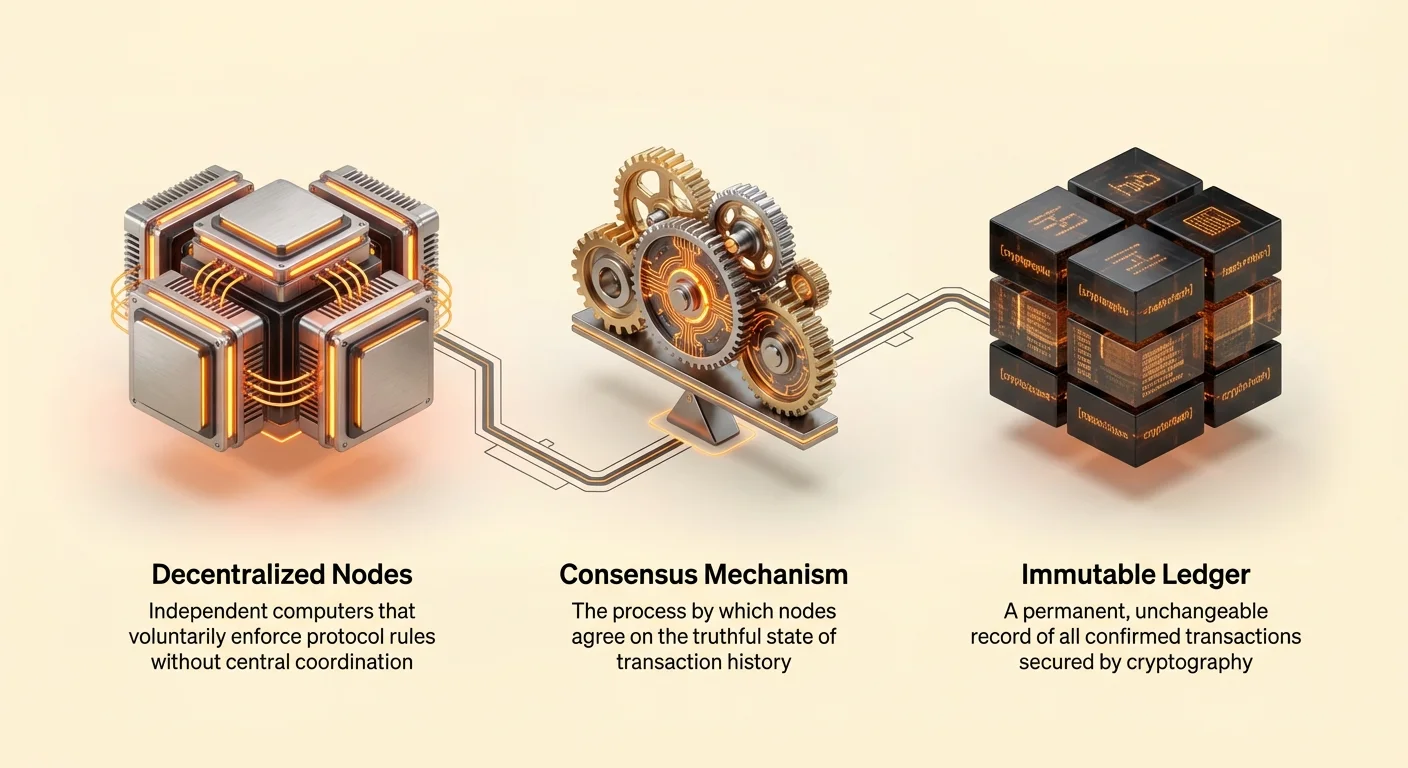
The foundation of Bitcoin operates without a central server or administrator. Instead of a single entity managing the ledger, the network relies on a distributed system of computers known as nodes. These participants voluntarily run the Bitcoin software to maintain the network's integrity. They act as the referees of the system, enforcing the rules of the protocol without requiring permission or coordination from a central authority. This architecture creates a mesh network where information propagates from peer to peer, ensuring that the system remains resistant to censorship and single points of failure.
Every participant in this system holds a level of power. When a transaction occurs, it is not sent to a bank for approval. It is broadcast to these nodes, which independently verify the data against their own copy of the ledger. This redundancy is deliberate. It ensures that even if large portions of the network were to go offline or attempt to act maliciously, the remaining honest nodes would continue to uphold the correct version of the transaction history. The collective agreement of these nodes constitutes the "truth" of who owns what at any given moment.
Understanding the architecture of Bitcoin requires a deep dive into how these nodes function, communicate, and reach consensus. It involves examining the lifecycle of a transaction, from the moment it is digitally signed to the point it is permanently etched into the blockchain by a miner. This system of validation and relay is what transforms digital information into a scarce, transferable asset that functions as money.
The Core Definition and Function of a Bitcoin Node
Defining the Software and Participation
A Bitcoin node is simply a computer that runs the Bitcoin software and connects to other computers on the network. The most common implementation of this software is Bitcoin Core. When a user installs and runs this client, their machine joins the global network of peers. The primary function of a node is to validate transactions and blocks. It acts as an independent auditor that checks every piece of data it receives against the strict rules of the Bitcoin protocol. If a transaction violates a rule, such as trying to spend coins that do not exist, the node rejects it immediately.
The Peer-to-Peer Mesh Network
Nodes connect to each other in a mesh topology. There is no hierarchy where one node is more important than another in terms of validation. When a node receives new information, such as a new transaction or a block, it relays that information to the peers it is connected to. This creates a gossip protocol where data ripples across the globe in seconds. This structure ensures that the network is robust. If one node shuts down, the network continues to function seamlessly because the ledger is replicated across thousands of other machines.
Autonomy and Trustlessness
The most critical aspect of running a node is autonomy. A user running their own node does not need to trust a bank, a website, or even other miners to tell them their balance. They verify it themselves by scanning the blockchain history stored on their local drive. This capability is often referred to as "sovereignty" in the crypto space. By removing reliance on third parties, nodes enforce the trustless nature of the system. The network assumes that participants should verify everything rather than trusting anyone.
Transaction Architecture and Data Structure
Inputs, Outputs, and Digital Signatures
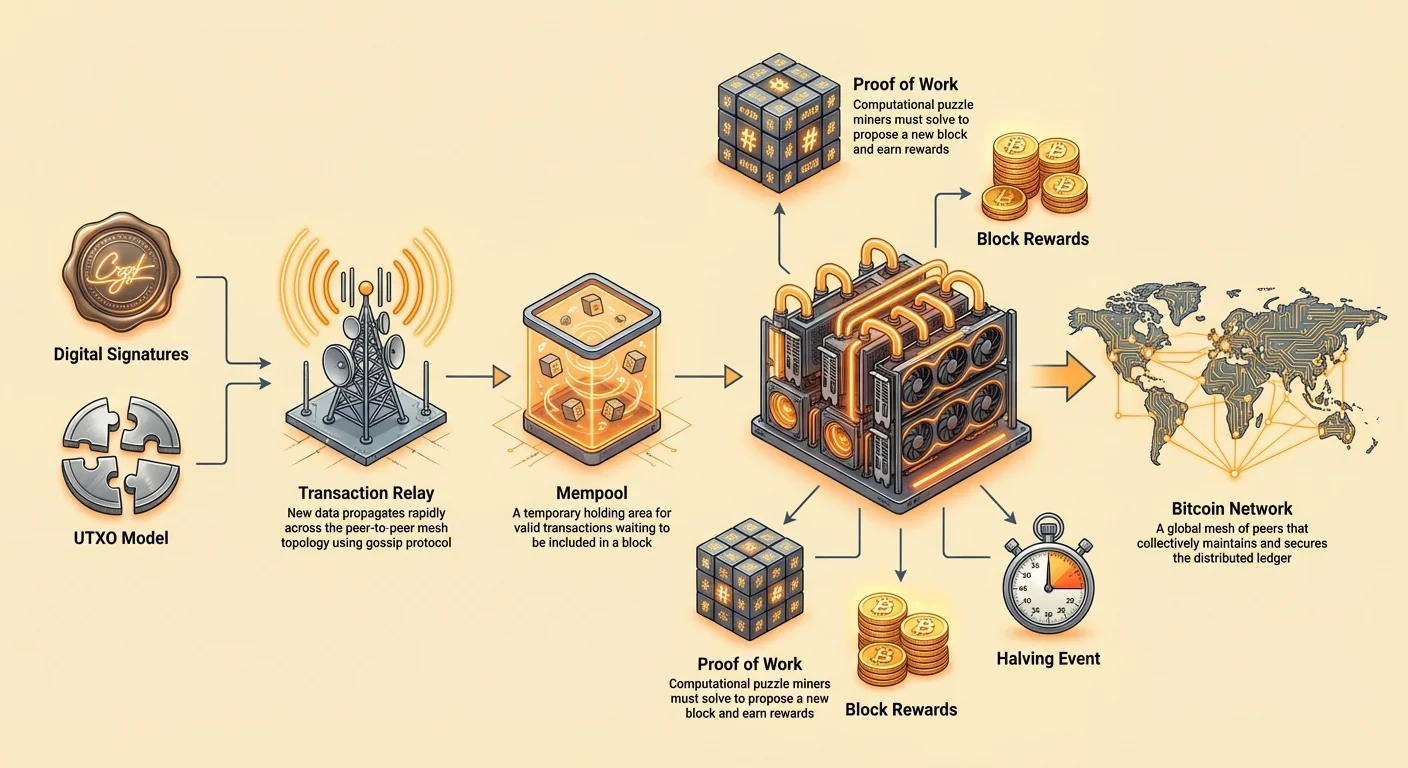
At a technical level, a Bitcoin transaction is a message that transfers value from one place to another. It does not work like a bank account balance that simply goes up or down. Instead, transactions are composed of inputs and outputs. An input refers to bitcoin that was received in a previous transaction, while an output designates where that bitcoin is going next. To authorize a transfer, the sender must generate a digital signature using their private key. This signature proves they have the authority to move the funds associated with a specific public key or address.
The Unspent Transaction Output (UTXO) Model
Bitcoin uses the Unspent Transaction Output (UTXO) model to track ownership. There are no accounts in the protocol, only UTXOs. When a user receives bitcoin, the network records it as an unspent output locked to their address. To spend it, they must create a new transaction that consumes that UTXO as an input. If the UTXO is larger than the amount they wish to send, the transaction creates two outputs: one for the recipient and one for the "change" that returns to the sender. This is central to the transaction lifecycle.
Cryptographic Verification
When a node receives a transaction, it performs a series of cryptographic checks. It verifies that the digital signature matches the public key and that the inputs being spent actually exist in the current UTXO set. The node also ensures that the sum of the inputs is greater than or equal to the sum of the outputs. Any difference between the inputs and outputs is claimed by the miner as a transaction fee. This rigorous verification process prevents users from spending money they do not have.
The Mempool and Transaction Relay
The Role of the Memory Pool
Once a transaction is verified by a node, it is not immediately added to the blockchain. Instead, it enters a waiting area known as the mempool, or memory pool. The mempool is a collection of all valid, unconfirmed transactions that a node has seen but that have not yet been included in a block. Each node maintains its own version of the mempool. Because transactions propagate across the network at different speeds, the mempool of one node might differ slightly from the mempool of another node at any given second. Understanding these differences reveals the key challenges of transaction economics.
Congestion and Fee Markets
The mempool acts as a buffer zone. Because blocks on the blockchain have a limited size, currently capped largely by the block weight limit, only a certain number of transactions can be processed every ten minutes. When the network is busy, the number of transactions entering the mempool may exceed the number leaving in blocks. This leads to congestion. In this environment, a fee market develops. Users attach transaction fees to incentivize miners to prioritize their transactions over others.
Prioritization Mechanics
Miners view the mempool as a menu of potential revenue. They are economically incentivized to select transactions that offer the highest fee per byte of data. Consequently, transactions with low fees may sit in the mempool for hours or even days during periods of high activity. Users who need urgent confirmation can use services like transaction accelerators or simply attach a higher fee initially. If a transaction remains unconfirmed for too long, it may eventually be dropped from the mempool, effectively cancelling the request and returning the funds to the sender's control.
Mining Nodes and the Proof of Work Mechanism
Aggregating Transactions into Blocks
Mining nodes are a specialized subset of the network. While all nodes validate transactions, only miners construct new blocks. A miner selects a batch of high-fee transactions from their mempool and organizes them into a candidate block. This block serves as a proposed update to the public ledger. The miner's goal is to add this block to the blockchain to claim the block reward and the accumulated transaction fees. However, the network does not allow just anyone to add a block at will.
The Proof of Work Lottery
To add a block, the miner must solve a computational puzzle known as Proof of Work (PoW). This involves repeatedly running the block's header data through the SHA-256 hashing algorithm. The miner changes a random number called a "nonce" with each attempt, looking for a hash result that is lower than a specific target value set by the network difficulty. This process is energy-intensive and functions like a digital lottery. The more computing power or hashrate a miner contributes, the more "tickets" they effectively hold in this lottery, reinforcing the computational cost of trust.
Network Difficulty and Stability
The difficulty of this puzzle is not static. The protocol adjusts the difficulty every 2,016 blocks, or roughly every two weeks, to ensure that blocks are produced every ten minutes on average. If more miners join and hashrate increases, the puzzle becomes harder. If miners leave, it becomes easier. This self-regulating mechanism ensures the stability of the monetary supply schedule, regardless of how much hardware is dedicated to the network. It makes the cost of attacking the network prohibitively expensive.
Consensus and the Longest Chain Rule
Achieving Distributed Agreement
Consensus is the process by which independent nodes agree on the state of the ledger. In a decentralized system, it is possible for two miners to solve the Proof of Work puzzle at roughly the same time. This creates a temporary fork where two valid blocks compete to be the next link in the chain. Different parts of the network may receive different blocks first. To resolve this, Bitcoin nodes follow the "longest chain" rule, which is technically the chain with the most accumulated proof of work.
Resolving Temporary Forks
When a fork occurs, nodes keep both versions in memory but build on the one they received first. As soon as the next block is found, it will reference one of the two competing blocks. The chain that grows longer becomes the accepted truth, and the shorter chain is discarded. The block on the discarded chain becomes an "orphan block." Transactions that were in the orphan block are not lost; they simply return to the mempool if they are not already included in the winning chain.
The Importance of Confirmations
This probabilistic nature of consensus is why "confirmations" matter. A transaction has one confirmation when it is included in a block. As more blocks are added on top of it, the number of confirmations increases. With each new block, the energy required to reverse the transaction grows exponentially. Generally, six confirmations are considered the standard for absolute finality, as it effectively renders a double-spend attack impossible for any attacker without overwhelming computational superiority.
Bitcoin Script and Programmability
The Stack-Based Language
Bitcoin uses a scripting system simply called "Script" to define how funds can be spent. It is a stack-based language, meaning it processes data by pushing items onto a stack and popping them off to perform operations. Unlike languages used in general computing, Script is intentionally limited. It is not Turing-complete, meaning it lacks complex loops. This design prevents infinite loops that could freeze the network, prioritizing security and predictability over flexibility.
Locking and Unlocking Scripts
Every transaction output contains a "locking script" (ScriptPubKey) that specifies the conditions needed to spend the funds. Usually, this condition is providing a valid digital signature that matches a specific public key hash (an address). To spend these funds, the user's wallet generates an "unlocking script" (ScriptSig) containing the signature and public key. Validating nodes run these two scripts together. If the result is "True," the transaction is valid.
Smart Contract Capabilities
While simple, Script allows for basic smart contracts. The most common example is a Multi-Signature (Multi-Sig) wallet, which requires signatures from multiple private keys to authorize a transaction. It also enables time-locks, where funds cannot be spent until a certain block height or timestamp is reached. More advanced innovations like the Lightning Network rely on these scripting capabilities to create payment channels that function off-chain while remaining secured by the main network.
Preventing Double Spending
The Digital Cash Problem
A fundamental challenge for any digital currency is the double-spend problem. Because digital files can be perfectly copied, a malicious actor could theoretically try to send the same digital token to two different recipients simultaneously. In a centralized system, a bank prevents this by updating a master database. Bitcoin must prevent this without a central authority. The combination of the transparent ledger and Proof of Work provides the solution.
Chronological Ordering
The blockchain serves as a timestamp server. By grouping transactions into blocks and linking them cryptographically, the network establishes a rigid chronological order. If a user broadcasts two conflicting transactions, nodes will only accept the first one they see. Once that transaction is included in a block, the second transaction becomes invalid because the inputs it tries to spend are no longer in the UTXO set. The network creates a definitive history that cannot be altered.
Security Against Reversal
To double spend confirmed coins, an attacker would need to rewrite the blockchain history. This would require re-mining the block containing the original transaction and every block that came after it, effectively overtaking the honest chain. This is known as a 51% attack. The immense energy required to achieve this makes the network secure. The cost of the electricity and hardware needed to attack Bitcoin usually outweighs the potential profit, aligning the incentives of miners with the security of the network.
Node Varieties and Storage Requirements
Full Nodes
Full nodes are the backbone of the network. They download and store the entire blockchain history, from the very first block mined in 2009 to the present day. They independently verify every transaction rule. Running a full node requires significant disk space and bandwidth, but it offers the highest level of privacy and security. A user running a full node trusts no one and contributes to the overall health of the ecosystem by rejecting invalid blocks.
Pruned Nodes
For users with limited storage space, the software allows for "pruning." A pruned node downloads and verifies the entire blockchain but deletes older block data to save space, keeping only the most recent history and the complete UTXO set. A pruned node is still a fully validating node. It offers the same security model as a standard full node but cannot serve the full history to other new nodes joining the network.
Lightweight Clients (SPV)
Simplified Payment Verification (SPV) nodes, or lightweight clients, do not download the whole blockchain. Instead, they only download block headers—the small data structures that verify the proof of work. They rely on full nodes to provide information about specific transactions. While this makes them fast and mobile-friendly, they are less secure because they must trust that the full nodes they connect to are providing accurate data. They cannot independently verify that the rules of the protocol are being followed.
Economic Architecture: Fees and Halving
The Block Reward Schedule
Miners are compensated through block rewards, which consist of newly minted bitcoin. This subsidy is the only way new bitcoin enters circulation. To ensure scarcity, the protocol includes a "halving" mechanism. Approximately every four years, the block reward is cut in half. It started at 50 BTC, dropped to 25, then 12.5, 6.25, and so on. This event reduces the inflation rate and reinforces the deflationary nature of the asset.
Transition to a Fee-Based Security Model
The halving also impacts the long-term security budget of the network. As the block subsidy decreases, miners must rely more on transaction fees to cover their operational costs. This transition is designed to ensure the network remains self-sustaining even after the last bitcoin is mined around the year 2140. At that point, the miners will be supported entirely by the fees users pay for secure and censorship-resistant transactions. This market shift defines the mining profitability business model.
Market Dynamics
The fee market is dynamic. When demand for block space is low, fees can be mere cents. When demand is high, fees rise. This fluctuation forces efficient use of the network. It encourages the development of scaling layers like the Lightning Network for small, frequent payments, while the main blockchain acts as a high-security settlement layer for high-value transfers. The economic incentives ensure that miners continue to secure the chain as long as there is value in the network.
Conclusion
The architecture of the Bitcoin network represents a careful balance of cryptography, game theory, and distributed computing. By distributing the role of validation across thousands of independent nodes, the system eliminates the need for a central administrator. The interplay between the mempool, miners, and the immutable ledger ensures that transactions are processed securely and fairly. While the Proof of Work mechanism requires significant energy, it provides the unforgeable costliness necessary to secure a global value transfer system against attacks and double-spending.
As the network evolves, the role of nodes remains constant: they are the guardians of the protocol. Whether through running a full node to enforce rules or participating in the fee market to prioritize transactions, every interaction with the network relies on this underlying infrastructure. The system's design—from the scripting language to the halving schedule—prioritizes stability and security, creating a digital monetary network that is robust, transparent, and open to anyone with a computer.
Bitcoin nodes allow you to be your own bank by verifying the entire ledger history yourself.