
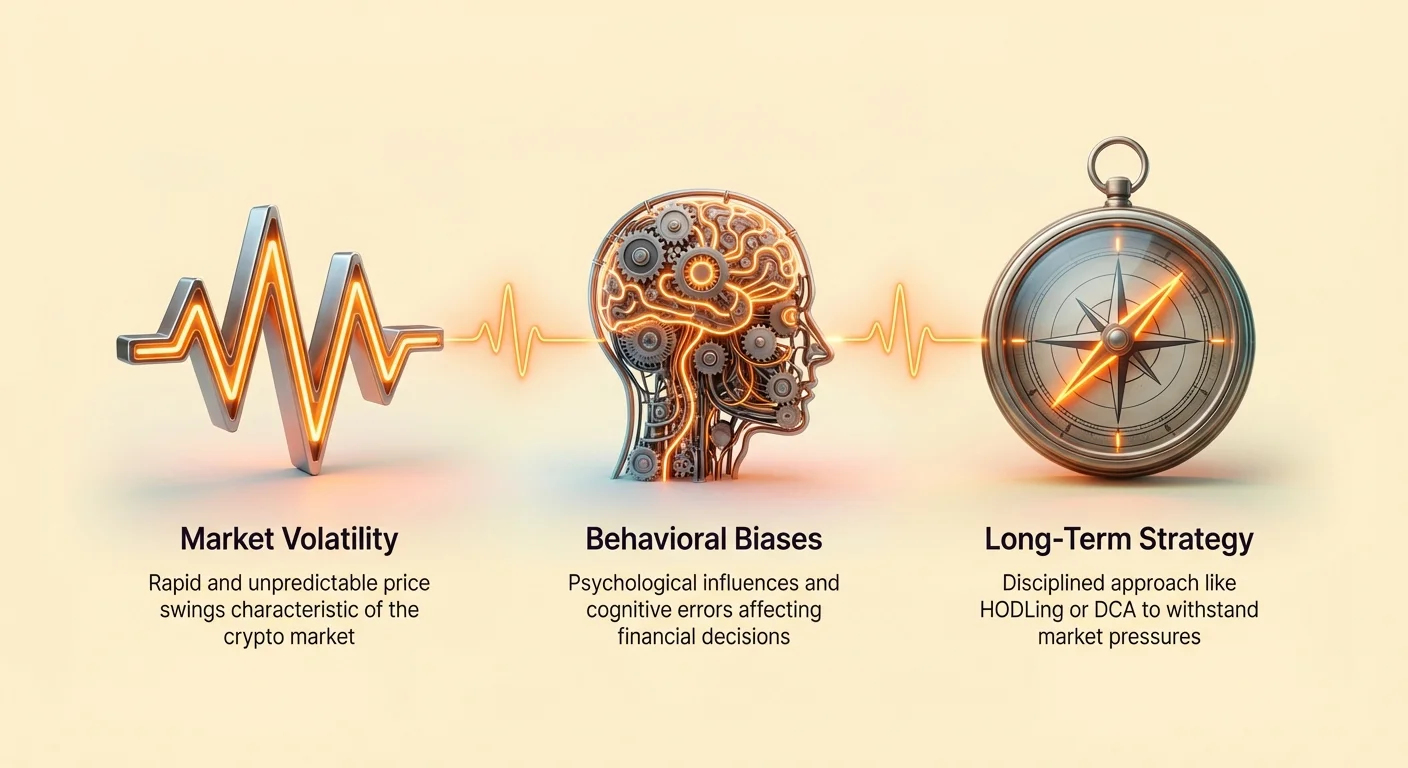
Bitcoin’s price history is a story of dramatic rises and falls that reflects its volatile nature. Since its inception in 2009, the market has captivated investors globally. However, this volatility often triggers deep-seated psychological responses. Investors frequently struggle with behavioral biases that cloud judgment. Understanding these mental traps is essential for anyone navigating the landscape between long-term holding and active trading.
Behavioral finance examines how psychological influences and cognitive errors affect financial decisions. In the crypto market, these factors are amplified by 24/7 trading and rapid price swings. Emotional reactions to market data often lead to buying at peaks and selling at bottoms. Whether one chooses to HODL or trade, the primary enemy is often one's own psychology rather than market conditions.
The tension between the desire for quick profits and the need for long-term conviction creates a fertile ground for cognitive errors. New investors often enter during hype cycles, driven by the fear of missing out. Conversely, seasoned traders may fall victim to overconfidence or illusion of control. Recognizing these patterns is the first step toward building a resilient investment strategy that withstands the pressures of digital asset markets.
The Psychology of Market Cycles and Volatility
Bitcoin price history reveals a pattern of boom and bust cycles that test investor resolve. From the 2011 crash to the 2017 surge and subsequent correction, volatility is a constant feature. Investors often suffer from recency bias, where they give disproportionate weight to the most recent market events. During a bull run, this manifests as euphoria and the belief that prices will climb forever. During a bear market, it turns into despair and the conviction that the asset is dead.
Recency Bias and Historical Context
Recency bias blinds investors to the broader historical context of Bitcoin. When prices dropped over 80% in 2018, many assumed the experiment was over. Yet, analyzing long-term charts reveals a trajectory of recovery and growth across multiple cycles. Investors who focus solely on the immediate timeframe often panic sell at the wrong moment. They fail to recognize that corrections are a natural part of market maturation.
Historical data shows that Bitcoin has repeatedly surpassed previous all-time highs after significant drawdowns. However, the emotional impact of a portfolio losing value today often overrides the logical understanding of historical resilience. Successful navigation requires zooming out and viewing volatility as a feature of a developing asset class rather than a sign of impending failure.
The Fear of Volatility
Volatility is frequently misunderstood as synonymous with risk. While high volatility implies price instability, it also presents opportunities for growth. The fear of volatility often leads to loss aversion, a bias where the pain of losing is psychologically twice as powerful as the pleasure of gaining. This drives investors to exit positions prematurely during temporary dips.
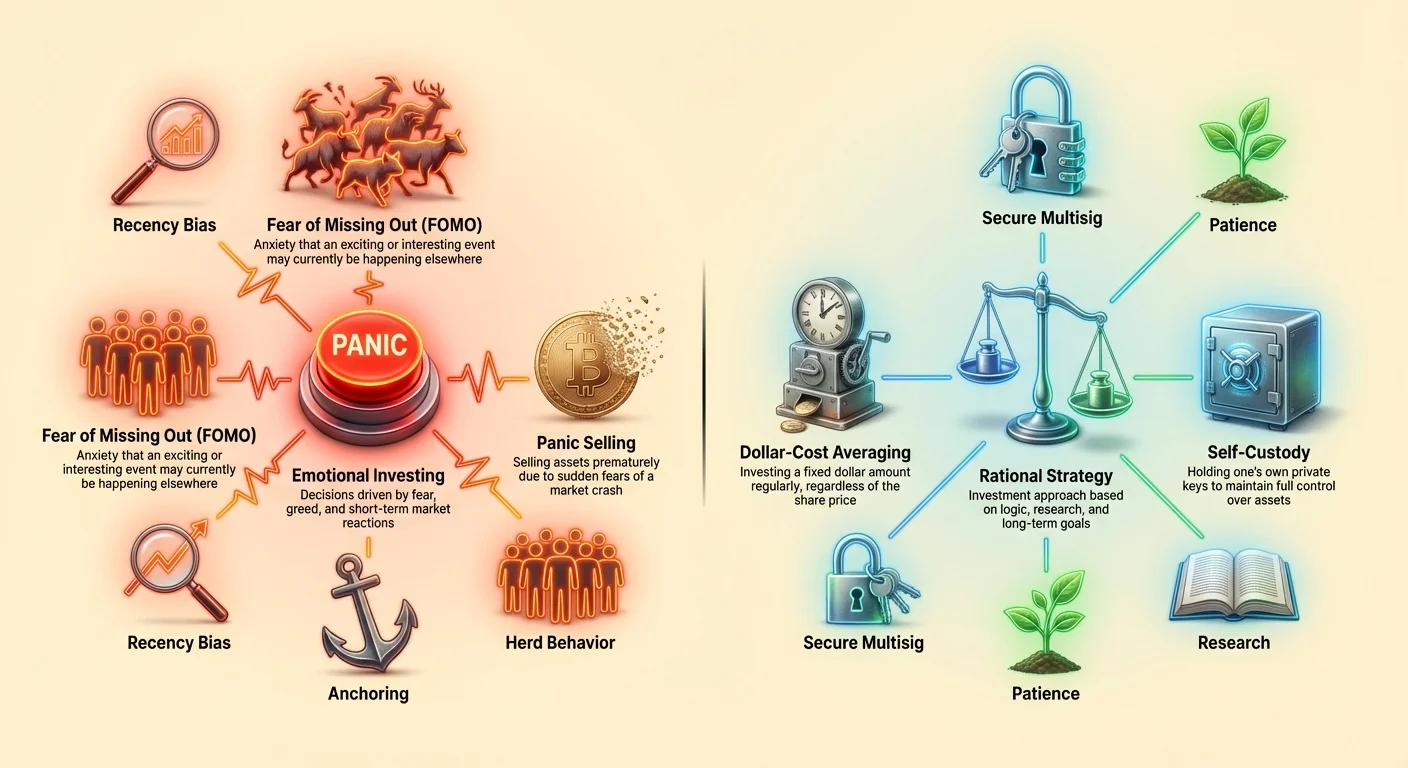
To manage this stress, strategies like dollar-cost averaging (DCA) are often recommended. By investing a fixed amount regularly, regardless of price, investors remove the emotional burden of timing the market. This mechanical approach counters the impulse to react to short-term volatility. It forces the investor to buy low when the market is down, even when fear dictates otherwise.
Anchoring Bias in Price Predictions
Predicting the future value of Bitcoin is a complex task influenced by halving cycles and macroeconomic conditions. A common trap here is anchoring bias. This occurs when investors rely too heavily on the first piece of information they receive. For example, if an influential analyst predicts a specific price target, investors may fixate on that number. They might ignore changing market variables that make the target unrealistic.
The Bitcoin halving is a frequent source of anchoring. Because previous halvings were followed by bull markets, investors often anchor their expectations to this specific event. They assume a direct and immediate causal link between supply reduction and price explosion. While scarcity is a fundamental driver, market dynamics are multifaceted. Relying solely on historical patterns without considering current adoption rates or regulatory changes can lead to disappointment.
Investors also anchor to previous all-time highs. If Bitcoin reached $68,000 in the past, holders often view any price below that as "cheap" and any price above it as "expensive." This binary thinking ignores the utility of the network or shifts in global inflation. Valuation should be based on current fundamentals, not just past price tags.
The Digital Gold Narrative and Status Quo Bias
The comparison between Bitcoin and gold is a staple of crypto analysis. Both are viewed as stores of value and hedges against inflation. However, this comparison can trigger status quo bias. Investors who are comfortable with traditional assets like gold may struggle to accept a digital alternative. They prefer the tangible familiarity of physical metal over the abstract security of a blockchain.
Tangibility vs. Utility
Gold has a millennia-long track record, which provides a sense of security. Bitcoin, often called "digital gold," mimics gold’s scarcity but adds portability and divisibility. Status quo bias leads investors to dismiss Bitcoin because it lacks physical form. They perceive the digital nature as a weakness rather than an evolution. This bias prevents them from appreciating advantages like censorship resistance and global transferability.
Conversely, crypto-native investors might suffer from a pro-innovation bias. They may prematurely dismiss gold as an obsolete "boomer rock." A balanced view recognizes that both assets can coexist. Gold offers stability and history, while Bitcoin offers high growth potential and technological utility. Diversification across both asset classes can mitigate the risks inherent in favoring one too heavily.
Inflation Hedge Misconceptions
Many investors flock to Bitcoin as an inflation hedge. The theory is that a fixed supply of 21 million coins protects against fiat currency devaluation. However, confirmation bias can lead investors to ignore periods where Bitcoin correlates with risk assets rather than acting as a safe haven. When macroeconomic factors drive all markets down, Bitcoin often follows.
Holding Bitcoin requires understanding that its correlation with other asset classes changes over time. It does not always behave exactly like gold or real estate. Investors must remain flexible in their thesis. Blindly adhering to the "inflation hedge" narrative during deflationary liquidity crunches can result in poor portfolio management.
Altcoins and the Unit Bias Trap
The cryptocurrency market extends far beyond Bitcoin, encompassing thousands of altcoins. A major behavioral trap in this sector is unit bias. This is the tendency to prefer owning a whole unit of something rather than a fraction. New investors often look at Bitcoin’s high price and feel they "missed the boat." They turn to altcoins priced at pennies, believing it is easier for a $0.10 coin to go to $1.00 than for Bitcoin to double.
The Allure of "Cheap" Coins
This psychological preference for "cheap" coins ignores market capitalization. A coin with a low price but a massive supply is not necessarily undervalued. Investors chasing low unit prices often end up in high-risk assets with poor fundamentals. They prioritize the quantity of coins held over the quality of the project.
Bitcoin is divisible into satoshis, meaning one does not need to buy a whole Bitcoin. Overcoming unit bias involves understanding that percentage gains matter more than the number of coins owned. A 10% gain on $1,000 of Bitcoin is identical to a 10% gain on $1,000 of a penny stock. The psychological satisfaction of owning "thousands" of a token often leads to suboptimal asset allocation.
Dominance and Risk Appetite
Bitcoin dominance measures BTC’s share of the total crypto market cap. It serves as a barometer for market sentiment. When dominance falls, it often signals a "risk-on" environment where capital flows into speculative altcoins. Investors driven by greed may chase these trends, ignoring the higher volatility and liquidity risks associated with smaller caps.
During market corrections, liquidity often flows back to Bitcoin, causing dominance to rise. Investors who remain overexposed to altcoins during these shifts can suffer significant losses. Understanding the interplay between Bitcoin and the broader market helps in managing risk. It prevents the behavioral error of treating all crypto assets as identical in their risk profiles.
The Influence of Whales and Attribution Bias
"Whales" are individuals or entities holding massive amounts of Bitcoin. Their activities are closely watched because they can move markets. However, retail investors often suffer from attribution bias regarding whales. When the price drops, it is comforting to blame a faceless "whale" manipulating the market rather than accepting random market variance or poor timing.
Tracking the Smart Money
Blockchain transparency allows for the tracking of large transactions. While this data is useful, misinterpreting it is common. A large transfer to an exchange is often assumed to be a sell signal. However, it could be for custody, staking, or over-the-counter deals. Reacting impulsively to "whale alerts" can lead to being shaken out of positions unnecessarily.
Investors often try to mimic whale strategies without understanding their time horizons. A whale might be selling to rebalance a multi-billion dollar portfolio, not because they believe the asset is crashing. Copying these moves without context is a form of cargo cult investing. It mimics the form of smart investing without understanding the substance.
Decentralization vs. Concentration
The existence of whales raises concerns about centralization. If a few entities hold too much supply, they could theoretically sway the market. This fear can lead to paranoia. However, as Bitcoin matures and distribution spreads, the influence of individual whales diminishes. Focusing too heavily on whale watching distracts from fundamental analysis.
| Concept | Behavioral Trap | Reality Check |
|---|---|---|
| Whale Movements | Paranoia / Attribution Bias | Transfers have many purposes beyond selling. |
| Price Dips | Loss Aversion | Volatility is standard; historical trends show recovery. |
| Unit Price | Unit Bias | Market cap matters more than the price of a single coin. |
Institutional Validation and Authority Bias
The approval of Bitcoin ETFs and the rise of corporate treasuries have brought traditional finance into the crypto space. This brings authority bias into play. Investors often look to big institutions like BlackRock or Tesla for validation. If a major company buys Bitcoin, retail investors feel safe to follow.
The ETF Effect
Bitcoin ETFs allow exposure without direct ownership. This appeals to those intimidated by self-custody. However, relying solely on institutional vehicles can lead to complacency. Investors might assume that because a regulated product exists, the asset itself is risk-free. They confuse the safety of the vehicle (ETF) with the stability of the underlying asset (Bitcoin).
Institutional adoption creates a "social proof" feedback loop. As more companies add Bitcoin to their balance sheets, the perceived risk decreases. While this drives adoption, it can also create herd behavior. If institutions suddenly sour on the asset class, retail investors who followed them in might panic and follow them out, locking in losses.
Corporate Treasuries
When companies hold Bitcoin as a reserve asset, it signals confidence. However, corporate strategies differ from individual goals. A corporation might sell Bitcoin to cover operational costs or meet quarterly earnings targets. Retail investors attempting to align their portfolios with corporate treasuries must realize that their liquidity needs are different. Blindly following corporate moves ignores personal financial context.
Security, Control, and the Endowment Effect
The mantra "not your keys, not your coins" emphasizes self-custody. However, the endowment effect creates a barrier. Once people own an asset, they value it more highly. In crypto, this can manifest as a fear of moving funds. Investors might be terrified of making a mistake with a private key, so they leave funds on exchanges despite known risks.
The Paradox of Custody
Centralized exchanges offer convenience but introduce counterparty risk. The history of exchange collapses highlights this danger. Yet, the convenience bias keeps users on these platforms. They trade security for ease of use, underestimating the probability of platform failure.
On the flip side, self-custody requires responsibility. Managing private keys and recovery phrases demands diligence. The fear of personal error can be paralyzing. This is where technology like shared wallets (multisig) becomes relevant.
Shared Wallets as Commitment Devices
Shared wallets require multiple approvals to authorize a transaction. While technically used for security, they also serve as behavioral commitment devices. By requiring consensus among multiple parties—or even multiple devices owned by one person—impulsive decision-making is reduced.
For example, a 2-of-3 multisig setup prevents a user from panic selling at 3 AM. They would need to access a second key, perhaps stored in a different location, or get approval from a trusted partner. This friction is a feature, not a bug. It forces a "cooling off" period that allows rational thought to override emotional impulses.
The Illusion of Stability with Stablecoins
Stablecoins are pegged to assets like the US dollar to minimize volatility. They are essential for trading and DeFi. However, they introduce an illusion of safety. Investors often park funds in stablecoins during downturns, believing they are risk-free.
This ignores the counterparty and regulatory risks specific to stablecoins. Just because the price is stable does not mean the asset is invulnerable. The collapse of certain algorithmic stablecoins proves that pegs can break. Investors suffering from the "status quo" bias of fiat currency might over-allocate to stablecoins, missing the point that they are holding a digital proxy for fiat inflation.
Furthermore, holding stablecoins for long periods creates an opportunity cost. While waiting for the "perfect" dip to buy back into Bitcoin, investors often miss the reversal. This is a form of paralysis by analysis. The safety of the stablecoin becomes a trap that prevents re-entry into the market.
OTC Trading and Information Asymmetry
Over-the-Counter (OTC) trading occurs directly between parties, away from public exchanges. This is the domain of high-net-worth individuals and institutions. For the retail investor, the existence of OTC markets can fuel suspicion. They fear that "real" price discovery is happening behind closed doors.
This fear stems from a sense of unfairness or information asymmetry. Retail traders see the public order book and assume it reflects the whole market. When prices move seemingly without volume, they suspect manipulation. Understanding that OTC desks handle large volume to prevent slippage helps mitigate this fear.
The bias here is the assumption that all market participants have the same goals. OTC traders prioritize execution price and privacy over public signaling. Retail investors must accept that they are playing in a market with participants who operate on a different scale.
Conclusion
Navigating the Bitcoin market requires more than just technical analysis; it demands a mastery of one's own psychology. Biases like recency, anchoring, and herd mentality are deeply ingrained in human nature. They cause investors to chase hype, panic at bottoms, and misunderstand the fundamental value of digital assets. Whether one chooses the path of the HODLer or the active trader, the risks of emotional decision-making remain constant.
Tools like dollar-cost averaging, self-custody, and shared wallets offer structural ways to mitigate these behavioral flaws. By creating friction against impulsive actions and establishing clear, mechanical rules, investors can protect themselves from their own worst instincts. The market will always be volatile, but your reaction to it does not have to be.
Success in Bitcoin investing comes not from predicting the price, but from mastering your reaction to it.