
When most people begin their journey into self-custody—the act of holding and controlling one's own crypto assets—they start with a standard single-key hardware wallet. This setup, where a single private key or seed phrase controls access to all funds, represents a massive leap in standard hardware wallet security compared to leaving assets on a centralized exchange. You achieve true financial sovereignty because you alone hold the keys.
However, as your assets grow or as your organization’s needs become more complex, the single-key model reveals a critical weakness: it is a single point of failure. If that one device is destroyed, if that one seed phrase is discovered, or if the sole keyholder becomes incapacitated, the funds are potentially lost or inaccessible forever.
This is where the concept of progressive security comes in. Just as a bank vault uses multiple safeguards, advanced users and institutions require layers of cryptographic redundancy. This article moves beyond standard cold storage to explore multi-signature (Multi-Sig) and Multi-Party Computation (MPC) wallets—the two dominant solutions for distributing trust, mitigating human error, and creating institutional-grade security accessible to anyone committed to genuine self-sovereignty.
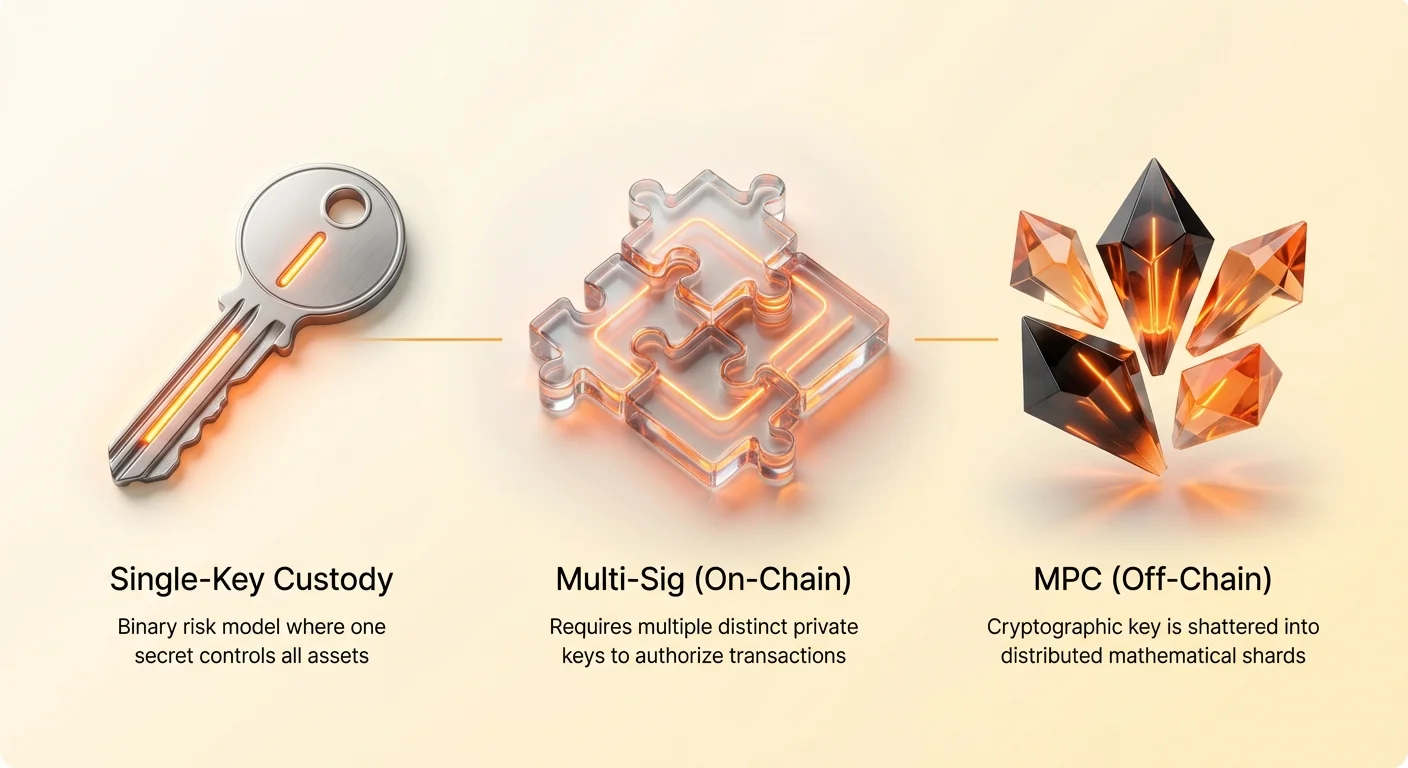
The Single Point of Failure: Reviewing Standard Self-Custody
Before diving into advanced distributed schemes, it is crucial to clearly understand the limitations of the standard setup that we are seeking to overcome.
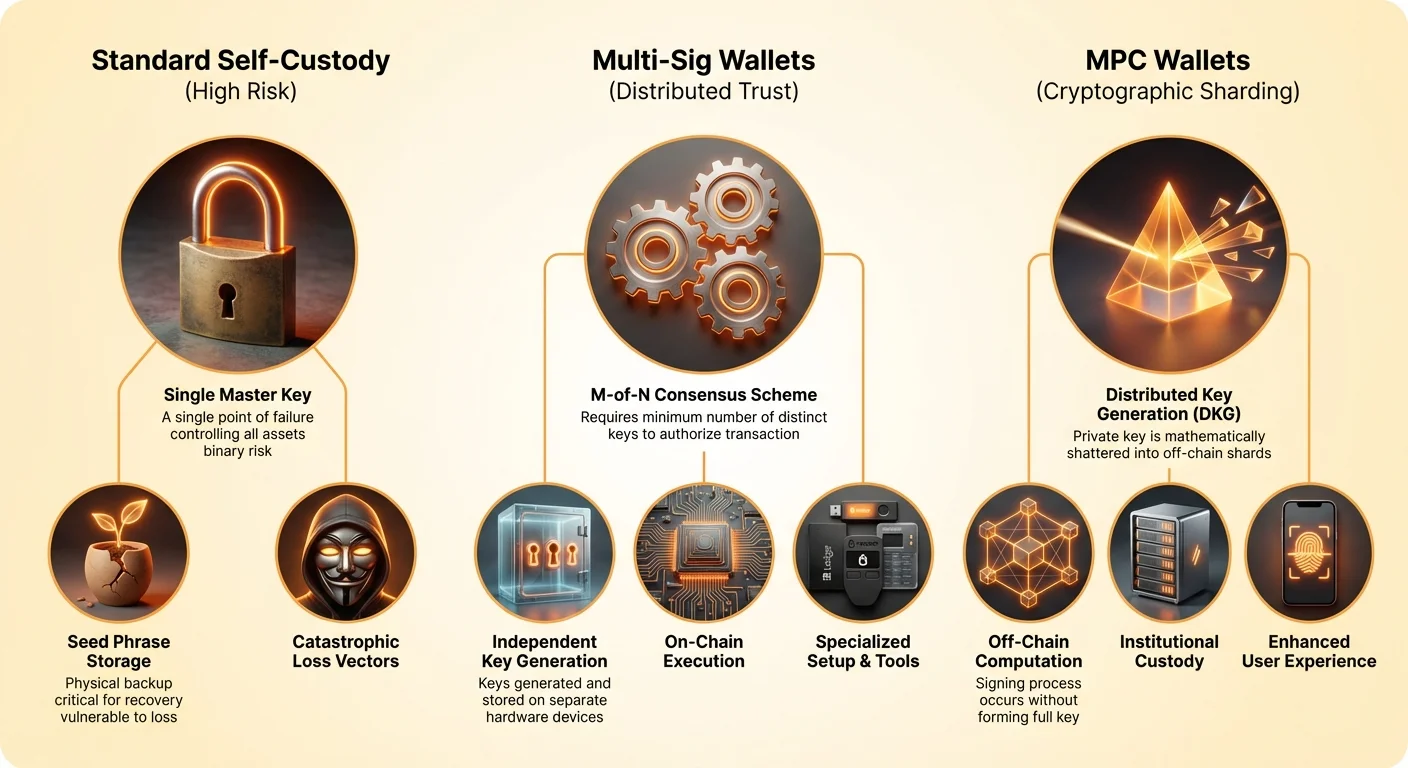
In a typical self-custodial wallet, all cryptographic access is derived from a single Master Key, usually represented by a 12 or 24-word seed phrase (or recovery phrase). For a detailed look at how these keys are generated, read our guide on private key mechanics and derivation paths. This seed phrase generates every private key needed to sign transactions for every asset within that wallet.
The Problem of Binary Risk
The greatest advantage of the single-key system—simplicity—is also its greatest vulnerability. The security of your entire holdings is binary: either the seed phrase is perfectly secure, or the entire stack is compromised.
The risk factors associated with single-key custody generally fall into two categories:
- Catastrophic Loss: The loss, destruction, or unrecoverable damage of the only physical storage location (e.g., a fire destroying the metal plate containing the phrase).
- Theft or Coercion: A hacker gaining access to the stored phrase, or a keyholder being coerced or forced to reveal the key.
For users holding significant amounts of wealth, relying on the perfect, perpetual security of one key is often deemed unacceptable. This risk assessment drives the need for cryptographic solutions that distribute the control across multiple entities or locations, ensuring that no single mistake or attack can lead to total loss.
The Cornerstone of Distributed Trust: Multi-Signature (Multi-Sig) Wallets
Multi-Signature (often shortened to Multi-Sig) wallets solve the single point of failure problem by requiring more than one private key to approve a transaction. Explore the full guide on Multi-Sig setup and use cases. Introduced early in Bitcoin's history, Multi-Sig is a powerful, transparent, and proven security primitive built directly into the core protocols of many major blockchains.
How M-of-N Addresses Function
Multi-Sig works based on an $M$-of-$N$ scheme.
- N represents the total number of private keys (signers) that are designated to control the funds.
- M represents the minimum number of keys required to collectively sign and authorize any transaction.
For example, a 2-of-3 Multi-Sig wallet requires two out of the three available keys to agree before any funds can move. If one key is lost or stolen, the remaining two keys can still work together to recover the funds or sign new transactions, effectively mitigating the threat of a single key failure.
Critically, Multi-Sig addresses are established on-chain. This means the blockchain itself is aware that the address requires multiple, distinct signatures to validate the spending conditions.
Setting Up and Implementing Multi-Sig
Implementing Multi-Sig requires specialized software and hardware planning, as each of the $N$ keys must be generated and stored independently, ideally using separate hardware devices.
1. Independent Key Generation
Each participant (or each storage location) must generate its own unique seed phrase and private key. These keys should be generated on separate hardware wallets (e.g., a Ledger, a Trezor, and a Coldcard) to prevent any single device vulnerability from compromising all keys simultaneously.
2. Specialized Wallet Software
Standard single-key wallet apps do not support Multi-Sig configuration. Users must rely on dedicated client software that supports the process of coordination and construction of the required complex transactions. Popular examples include Bitcoin-focused tools like Sparrow Wallet or Caravan, or enterprise solutions that manage the signing workflow.
3. Creating the Shared Wallet
The $N$ public keys derived from the $N$ private keys are collectively used to create the final Multi-Sig wallet address. This address is then used to receive funds. When a user wants to spend the funds, they initiate a transaction request, and the $M$ required keyholders must individually sign the transaction using their respective hardware devices before the final, authorized transaction is broadcast to the network.
Practical Use Cases for Multi-Sig
Multi-Sig is not just a high-security measure; it is a vital tool for organizational governance and risk management.
Corporate Treasury Management (2-of-3 or 3-of-5)
A business holding cryptocurrency as assets often cannot risk allowing a single CEO or CFO to have unilateral control. This is a critical factor in risk management for corporate treasuries.
- Setup: Key 1 held by the CEO, Key 2 held by the CTO, Key 3 held by the Legal Counsel.
- Benefit: Requires consensus among leadership. If the CEO is compromised or goes rogue, the CTO and Legal Counsel can block unauthorized spending or move funds to a safe location.
Digital Inheritance and Estate Planning (3-of-5)
This is a robust solution for ensuring funds can be accessed after the primary owner passes away, without sacrificing security during their lifetime.
- Setup: Key 1 (Primary owner), Key 2 (Spouse/Family Member A), Key 3 (Family Member B), Key 4 (Trust/Legal Counsel), Key 5 (A highly secure cold storage location, e.g., a bank vault).
- Benefit (3-of-5): While the owner is alive, they only need two other keys (e.g., Key 1 + Key 5 + one family member) to move funds. After the owner’s death, the family (Keys 2, 3, 4, 5) can collaborate to reach the 3 required signatures without needing Key 1.
Escrow and Mediation Services (1-of-2 or 2-of-3)
Multi-Sig is the foundational tool for creating trustless escrow.
- Setup (2-of-3): Key A (Buyer), Key B (Seller), Key C (Trusted Arbitrator).
- Process: If the transaction is successful, A and B sign, and the funds release instantly (2 signatures). If there is a dispute, A and B block the funds. The Arbitrator (C) reviews the evidence and sides with either A (A+C sign) or B (B+C sign) to release the funds.
Navigating the Complexity of Multi-Sig Implementation
While Multi-Sig offers unparalleled resilience, its complexity means it introduces unique administrative and operational risks that must be carefully managed. This security layer trades simplicity for redundancy.
The Administrative Overhead
Managing a single seed phrase is difficult enough; managing $N$ independent seed phrases is exponentially harder.
- Storage Segregation: Each of the $N$ keys must be stored in geographically separate, secured locations, following the principles of creating effective deep cold storage strategies. Storing all three keys in the same safe defeats the purpose of distributed trust, as a single event (e.g., a home invasion or fire) could compromise the entire setup.
- Key Tracking: The user must accurately track which specific keys belong to which $M$-of-$N$ configuration. As advanced users implement multiple Multi-Sig schemes (e.g., a 2-of-3 for daily operating funds and a 3-of-5 for legacy savings), the potential for confusion and error increases significantly.
- Setup Failure: A common pitfall is failing to thoroughly test the recovery process immediately after setup. If one key is incorrectly generated or the setup file is corrupted, the funds deposited into the address may be permanently locked.
The Critical Challenge of Recovery Thresholds
The beauty of Multi-Sig is its protection against the loss of a single key. However, losing too many keys results in an absolute loss of funds.
Consider a 2-of-3 setup:
- Scenario 1 (Successful): Key 1 is lost. Keys 2 and 3 can still sign transactions and move funds to a new 2-of-3 address.
- Scenario 2 (Fatal): Key 1 and Key 2 are lost. Only Key 3 remains. Since the threshold ($M=2$) cannot be met, the funds are permanently inaccessible, regardless of how perfectly preserved the remaining Key 3 is.
Advanced users must carefully calculate the $M/N$ ratio to balance resilience against administrative burden. Higher $N$ (more keys) increases resilience but exponentially increases the required coordination and management overhead.
Technical Limitations and Blockchain Footprint
Because Multi-Sig is an on-chain requirement, it has technical implications for transaction cost and privacy:
- Transaction Size and Fees: A transaction that requires three distinct signatures is significantly larger than a standard single-signature transaction. This larger data footprint means higher network transaction fees (gas fees) must be paid.
- Software Dependency: If the specialized wallet software used to create the Multi-Sig setup goes out of business or stops supporting the specific configuration, the user must rely on complex open-source tools to manually reconstruct and sign the transactions, which is often beyond the capability of even technically proficient users.
The Next Evolution: Multi-Party Computation (MPC) Wallets
Multi-Party Computation (MPC) represents a newer, powerful cryptographic technique for distributed custody. We explore how MPC eliminates the single point of failure. While Multi-Sig relies on multiple independent private keys coordinating signatures on-chain, MPC focuses on mathematically shattering a single private key off-chain before it is ever fully formed.
MPC aims to provide the benefits of distributed security (no single point of failure) while solving the administrative complexity and high transaction costs associated with Multi-Sig.
Key Sharding and Distributed Key Generation (DKG)
The fundamental difference between MPC and Multi-Sig lies in key generation.
- MPC Generation: Instead of generating one master seed phrase, the MPC protocol uses a process called Distributed Key Generation (DKG). During DKG, the final private key is never computed in a single piece. Instead, it is immediately broken into cryptographic pieces, or shards, which are then distributed among different parties or devices.
- No Full Key Ever Exists: Crucially, no single shard holder ever possesses enough information to reconstruct the full private key on their own. The full key is a theoretical construct—it never fully exists in RAM, on a hard drive, or on paper.
The Signature Process in MPC
When an MPC wallet needs to sign a transaction, the process is decentralized and asynchronous:
- Request: The user initiates a transaction request (e.g., "Send 1 BTC").
- Computation: The required number of key shards (similar to the $M$ threshold in Multi-Sig) perform complex mathematical calculations locally on their respective devices.
- Signature Output: These local calculations are communicated among the shard holders. This communication is not the transmission of the key shards; rather, it is the exchange of mathematical inputs that, when combined, yield a valid, single transaction signature.
- On-Chain Result: The resulting transaction signature looks identical to any standard single-signature transaction on the blockchain. The chain itself has no visibility into the distributed signing mechanism.
MPC vs. Multi-Sig: A Technical Comparison
MPC is often viewed as "Multi-Sig 2.0," as it solves several legacy challenges while offering unique benefits, particularly for institutions.
| Feature | Multi-Signature (Multi-Sig) | Multi-Party Computation (MPC) |
|---|---|---|
| Key Status | Multiple, independent private keys. | One theoretical private key, shattered into shards. |
| Key Assembly | Full private key exists on each signing device (temporarily during signing). | Full private key never exists in one place. |
| On-Chain Footprint | Explicitly visible on the blockchain (required multiple signatures). | Invisible on the blockchain (appears as a standard single signature). |
| Transaction Fees | Higher fees due to larger transaction data. | Standard fees, identical to single-signature wallets. |
| Flexibility | Limited to chains that support the Multi-Sig standard (e.g., Bitcoin, Ethereum, etc.). | Highly flexible; security applies off-chain regardless of the underlying blockchain protocol. |
| Recovery | Complex manual recovery based on seed phrase storage locations. | Often relies on standardized key rotation and recovery services provided by the MPC vendor. |
Use Cases for MPC Wallets
MPC is rapidly becoming the standard for institutional custody and centralized exchanges because of its security, speed, and flexibility.
Institutional Custody and Exchanges
Exchanges must hold massive amounts of user funds while minimizing attack vectors. If a hacker breaches a central server, they gain access to one cryptographic shard, which is useless without the others. MPC allows the exchange to hold Shard A, while a regulated third-party custodian holds Shard B, requiring coordination between two distinct, regulated entities for any movement of funds.
Enhancing User Experience
Many MPC vendors abstract the complexity of key management entirely from the user. For instance, a user might use their mobile device (Shard A) and a cloud backup (Shard B) to create a 2-of-2 setup. If they lose their phone, the vendor can help them use their authentication credentials to regenerate Shard B, allowing them to recover funds without ever touching or managing a 12-word seed phrase—a major boost to mass adoption.
Applying Progressive Security: Choosing Your Layer
Moving from a single hardware wallet to a distributed custody solution like Multi-Sig or MPC is a significant decision. The choice depends entirely on your specific threat model, asset value, and tolerance for administrative complexity. This is the essence of progressive security—matching the security mechanism to the risk profile.
The Decentralization vs. Convenience Spectrum
The core trade-off when selecting an advanced custody method is the balance between true decentralization and user convenience.
Multi-Sig: Maximizing Decentralization
If your primary goal is absolute self-sovereignty—ensuring no single third party, service provider, or corporation can ever interfere with your funds or hold a key component—Multi-Sig is the ideal choice. All $N$ keys can be held purely by the user (or their trusted associates/family), granting total, unfiltered control.
- Trade-off: Requires high technical literacy, meticulous record-keeping, high administrative overhead, and higher transaction costs.
MPC: Maximizing Convenience and Abstraction
Many commercial MPC solutions involve a trusted service provider that holds one of the cryptographic shards (e.g., a 2-of-3 setup where the user holds Shard 1 and 2, and the vendor holds Shard 3). The vendor’s shard is used primarily for rapid key rotation, redundancy, and simplified recovery if the user loses one of their local shards.
- Trade-off: You introduce a small degree of third-party trust (the vendor should not be able to collude with a single local shard holder to steal funds), but you gain massive advantages in usability, fee structure, and standardized recovery processes.
Progressive Risk Modeling for Asset Segregation
No single wallet setup is appropriate for all assets. Advanced users must apply different layers of security based on the value and frequency of access required for those funds, often guided by a strategy of analyzing hot vs cold storage trade-offs.
| Asset Tier | Asset Value | Required Access | Recommended Security Solution |
|---|---|---|---|
| Tier 1 (Working Funds) | Small (Day-to-day spending) | High/Frequent | Hot Wallet (Mobile or Desktop App) |
| Tier 2 (Core Savings) | Medium (Mid-term investments) | Moderate/Periodic | Single-Key Hardware Wallet (Air-Gapped) |
| Tier 3 (Legacy Wealth) | High (Long-term savings, inheritance) | Low/Rare | Self-Managed Multi-Sig (2-of-3 or 3-of-5) |
| Tier 4 (Institutional/Enterprise) | Very High (Treasury, Custody) | Moderate/High | Commercial MPC Solution |
By adopting this progressive approach, you minimize exposure for your most critical assets (Tier 3 and 4) while maintaining the necessary liquidity and convenience for lower-value, Tier 1 assets.
Best Practices for Implementing Distributed Security
Regardless of whether you choose Multi-Sig or MPC, adhering to best practices is essential to avoid the catastrophic loss of funds.
1. Document the Procedure, Not Just the Keys
Do not simply store the seed phrases or key shards. You must document the entire recovery procedure. For a Multi-Sig setup, this means writing down the $M/N$ ratio, the specific derivation paths used, the software used to configure the address, and the precise physical location of each key. If you are incapacitated, the remaining signers must have a clear, step-by-step roadmap to access the funds.
2. Conduct a Recovery Drill
Before sending substantial funds to any new Multi-Sig or MPC address, simulate a failure. For Multi-Sig, test losing one key ($N-1$) and ensuring the remaining $M$ keys can successfully sign a transaction to a new address. This validates your setup and documentation.
3. Segregate Key Management Tools
For Multi-Sig, ensure that the hardware wallets used for the $N$ keys are manufactured by different companies running different operating systems. This diversification minimizes the risk that a vulnerability discovered in one specific hardware wallet model compromises your entire $N$ key set.
4. Understand Your Trust Model
If using a commercial MPC solution, understand the provider’s security model completely. How many shards do they hold? How do they perform recovery? Are they regulated? The trust you place in a vendor must be based on verifiable security protocols, not marketing copy.
Conclusion
The evolution from standard single-key custody to distributed solutions like Multi-Sig and MPC marks the maturation of the self-custody movement. These tools replace the outdated and vulnerable concept of simply relying on a hidden paper wallet with modern, institutional-grade security mechanisms focused on redundancy, distributed trust, and cryptographic complexity.
For the user committed to true financial sovereignty, adopting Multi-Sig provides maximal decentralization and protection against singular failure. For enterprise users and those seeking advanced convenience without sacrificing core security principles, MPC offers a streamlined, flexible, and mathematically sound alternative.
By understanding the technical mechanics, the administrative challenges, and the appropriate use cases for these advanced hardware and cryptographic techniques, you move beyond the basics and start building a genuinely resilient foundation for managing wealth in the digital economy.