
When most people enter the crypto space, their primary goal is security—protecting their assets from hackers and theft. This leads to the adoption of "cold storage," or wallets designed for long-term holding (HODLing). However, the needs of an active trader or an arbitrageur are fundamentally different. For these individuals, microseconds matter, and the ability to execute transactions instantly often outweighs the traditional priority of maximum long-term security.
A trading and arbitrage wallet is not a vault; it is a high-speed operational account. It requires configurations that prioritize synchronization speed, low latency, and secure integration with trading platforms or automated bots via Application Programming Interfaces (APIs). This necessitates a strategic balance: keeping enough capital liquid and accessible to capture fleeting market opportunities, while rigorously minimizing the counterparty risk associated with centralized exchanges and the security risks associated with automated trading tools.
This guide provides a professional framework for configuring your operational crypto wallets. We will move beyond simple hot storage concepts to explore the security protocols, configuration settings, and fundamental strategies necessary to maximize speed and efficiency without needlessly exposing your entire portfolio to market or technological risk.
The Core Conflict: Speed vs. Security in Active Trading
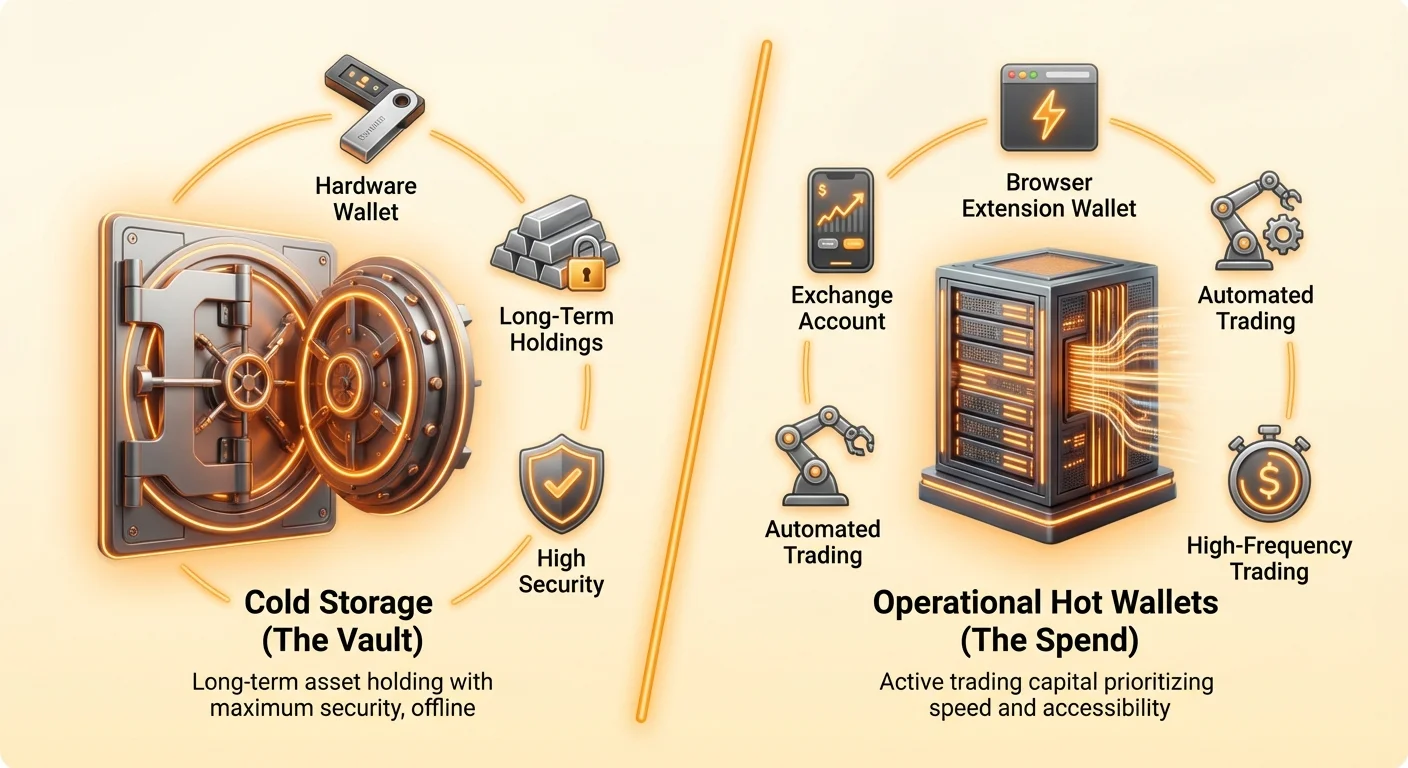
In the world of crypto custody, we typically divide wallets into two major categories: cold (offline) and hot (online). A HODLer will always choose cold storage. An active trader, however, must use some form of hot storage, as being offline means being slow, and slowness means missing opportunities.
Understanding Latency and Synchronization
Latency refers to the delay between initiating an action (like placing a trade order) and the execution of that action. For high-frequency trading (HFT) or arbitrage, latency must be near zero. This demand for speed forces traders to rely on systems that are constantly synchronized with the blockchain or, more commonly, centralized exchanges (CEXs).
A self-custody wallet (like a dedicated desktop application) must periodically synchronize its view of the blockchain by downloading transaction data. While fast broadband has made this much quicker, it is still orders of magnitude slower than placing a trade directly on an exchange’s matching engine. Arbitrageurs, who try to profit from small price differences across different platforms, often must have funds already deposited on multiple centralized exchanges to achieve the necessary speed.
Defining Operational vs. Storage Capital
The single most important rule in professional crypto management is the strict separation of capital based on its intended use. Your trading wallet should never hold more funds than are required for immediate market operations.
Storage Capital (The Vault): This is the bulk of your assets, intended for long-term holding. It belongs in cold storage (hardware wallets) and should only be accessed for deposits or major rebalancing. This capital is entirely shielded from exchange hacks, API exploits, or trading losses.
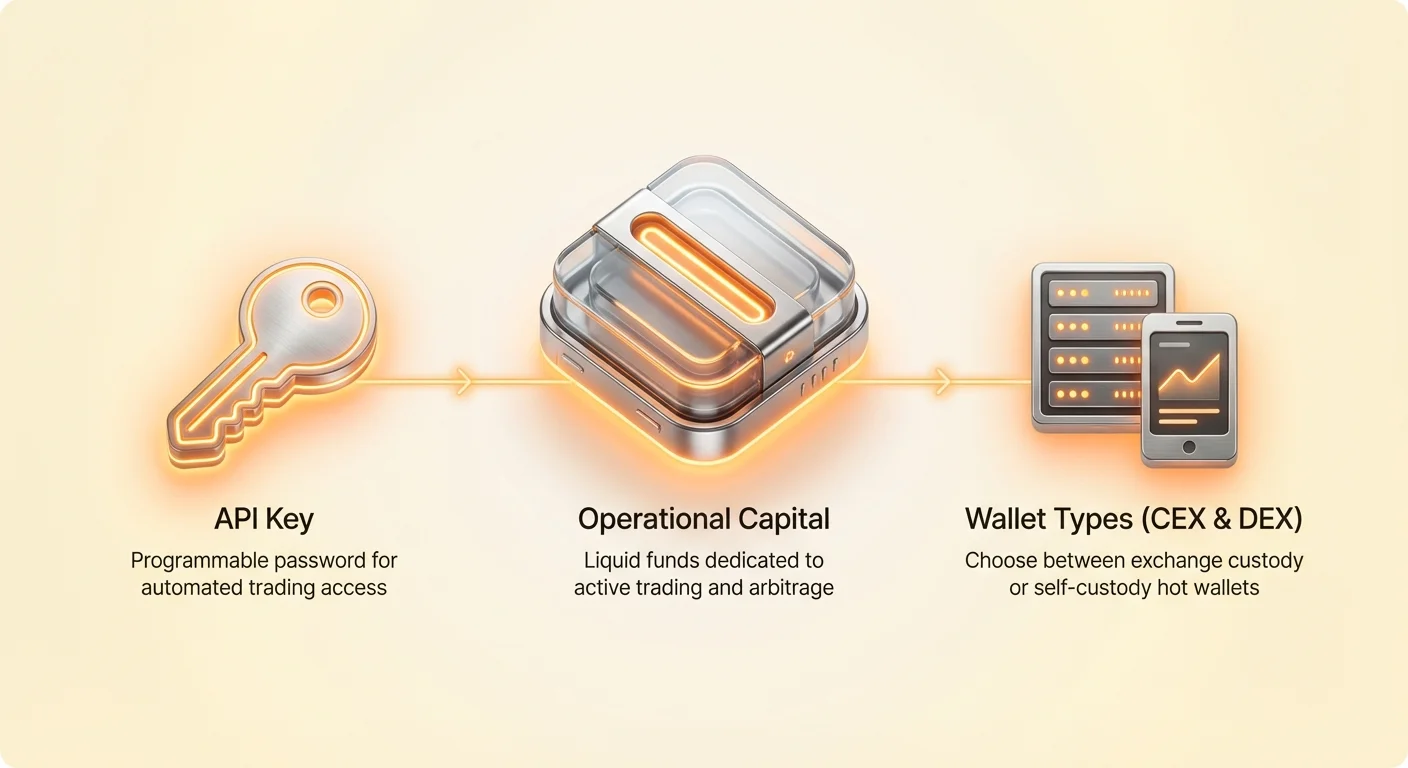
Operational Capital (The Spend): This is the smaller, highly liquid portion of funds dedicated specifically to trading, market making, or capturing arbitrage opportunities. This capital is housed in hot wallets or exchange accounts, prioritizing accessibility and speed over ultimate long-term security. Active traders must accept that this portion of their capital carries a higher risk profile.
Wallet Configuration for Active Trading
When selecting a wallet for active trading, the primary factor is the ecosystem in which you trade. Centralized exchange trading demands different tools than decentralized finance (DeFi) trading.
Centralized Exchange (CEX) Wallets
For the vast majority of high-volume trading and arbitrage, the wallet solution is the exchange’s internal custody system. While these are technically not "your" wallets (you don't hold the private keys), they offer instant, zero-latency transfers between trading pairs and immediate liquidity access.
The Speed Advantage: Because funds never leave the exchange environment, trades execute instantly on the exchange's internal ledger. This is the fastest possible configuration for active trading.
The Risk: Counterparty risk. If the exchange is hacked, becomes insolvent, or freezes withdrawals, your operational capital is at risk. For this reason, the funds held in CEX wallets must be minimized according to the "Operational Capital" rule.
Utilizing Dedicated Software (Hot) Wallets
For trading on Decentralized Exchanges (DEXs), accessing new DeFi protocols, or performing cross-chain arbitrage, you must use a self-custody hot wallet (mobile, desktop, or browser extension). These wallets provide the necessary interface to interact with smart contracts.
- Browser Extensions (e.g., MetaMask, Phantom): These are essential for connecting to web applications (DApps) and executing trades on DEXs like Uniswap or Orca. They offer speed and connectivity but must be kept extremely lightweight. Only a bare minimum of ETH, SOL, or other native tokens needed for gas fees should reside here, along with the operational tokens you intend to trade.
- Dedicated Desktop Wallets (e.g., Exodus, Electrum): These can be used for manual, larger trades where a direct PC interface is preferred. Because they run locally on your machine, they can offer slightly enhanced security over a browser extension, provided the PC is hardened against malware.
Crucial Best Practice: Never connect your primary, long-term self-custody wallet (the one holding your cold storage private keys) to a DeFi application. Use a completely separate, dedicated "burner" or operational hot wallet for all trading interactions.
The Strategy of Fund Separation: Implementing the Vault and Spend
A robust trading strategy requires a corresponding custodial strategy that shields the majority of assets from the volatility and risks inherent in active trading environments.
The 90/10 Rule and Scheduled Withdrawals
A common guideline adopted by professional traders is the 90/10 Rule: No more than 10% of your total crypto portfolio should ever be held in a hot wallet or on a centralized exchange at any given time.
When profits accrue in the operational hot wallet or CEX account, they must be systematically moved to cold storage.
- Establish Profit Thresholds: Set a dollar value threshold (e.g., $5,000). Once your operational funds exceed this limit due to successful trades, immediately initiate a withdrawal of the excess amount back to your hardware wallet.
- Automated Off-Ramping: If using trading bots, program the bot not just for profit-taking, but also for automated withdrawal to a predefined cold storage address once certain profit metrics are hit. This reduces manual intervention and ensures profits are secured instantly.
Dedicated Wallets for Specialized Trading
For advanced traders operating across multiple chains or asset classes (e.g., NFTs, tokens, leveraged positions), isolating funds further minimizes contagion risk.
| Trading Activity | Recommended Wallet Configuration | Primary Risk Mitigation |
|---|---|---|
| CEX HFT/Arbitrage | Exchange Sub-Accounts (API access only) | Limit API permissions to trading, disable withdrawal rights. |
| DeFi Spot Trading | Dedicated Browser Extension Wallet | If the DApp is exploited, only the operational funds are at risk. |
| Long-Term Staking/Yield | Separate Hardware Wallet (or dedicated hot wallet) | Isolate staking keys from trading keys to prevent malicious contract approval. |
Minimizing Latency: Synchronization, Speed, and Fees
Speed in trading doesn't just mean fast execution on an exchange; it also means efficient movement of funds onto or off of the exchange and rapid transaction processing on-chain.
Optimizing On-Chain Transaction Speed (Gas Wars)
For arbitrage opportunities that require on-chain movement (e.g., transferring tokens to a DEX to exploit a price difference), the speed of the transaction is determined by the gas fee you set and the network congestion.
- Understanding Mempool Priority: Before a transaction is confirmed, it waits in the mempool (memory pool). Miners or validators prioritize transactions with higher gas fees. Arbitrageurs must monitor the gas market (using tools like Etherscan's Gas Tracker) and be willing to pay a premium to ensure their transaction is included in the very next block.
- Using L2 and Faster Chains: High-frequency on-chain trading is increasingly difficult and expensive on base layers like Ethereum. Professional traders prioritize Layer 2 solutions (L2s) like Arbitrum, Optimism, or faster L1 chains like Solana or Avalanche, which offer near-instant settlement and significantly lower transaction costs.
- Wallet Node Connection: For self-custody wallets, connectivity matters. Ensure your wallet software is configured to use a reliable, fast RPC (Remote Procedure Call) endpoint. While running your own full node offers the highest security, it introduces latency. For trading, a trusted third-party RPC provider is generally necessary for speed.
Wallet Synchronization Speed Tests
While CEX wallets are always fast, self-custody software needs rapid synchronization. Before committing serious funds, test your chosen wallet configuration for speed:
- Test Deposit/Withdrawal Time: Time how long it takes to move a small amount of crypto from cold storage to your operational hot wallet, and then to your chosen exchange.
- Connectivity Check: Ensure your desktop or mobile wallet instantly updates balances. If you experience delays of more than a few seconds, switch to a more responsive wallet application or update your device/connection.
Mastering API Key Security for Automated Trading
The biggest security risk unique to automated traders and arbitrageurs is the API key. An API key is essentially a programmable password that allows external software (your bot or trading script) to execute commands on your exchange account without needing your username and password.
If an attacker gains access to your API key, they can potentially drain funds, execute malicious trades, or sabotage your strategy, depending on the key’s permissions.
Why API Keys are More Dangerous than Passwords
Unlike a password, which typically requires a second factor (2FA) for login, an active API key often grants immediate, automated access. If your bot’s server is compromised, the attacker has instant programmatic access to your funds.
API Key Security Best Practices (The Triad of Protection)
Professionalizing API key management requires three layers of protection: Minimization, Isolation, and Vaulting.
1. Minimizing Key Permissions (Principle of Least Privilege)
Always generate API keys with the absolute minimum required permissions:
- NEVER Enable Withdrawal Rights: If your bot or script is only meant to trade (buy/sell), do not grant it the permission to withdraw funds from the exchange. This is the single most important firewall. If the API key is stolen, the attacker can only move funds around internally, not steal them.
- Limit Read Access: If possible, only allow access to the specific accounts or trading pairs the bot uses.
- Avoid Main Account Keys: If the exchange allows, create dedicated sub-accounts solely for trading bots. Generate the API key from this sub-account.
2. Isolation through IP Whitelisting
IP whitelisting restricts which computers or servers can use the API key. This is a mandatory step for any secure automated trading operation.
- Definition: You tell the exchange, "Only allow API calls originating from this specific set of IP addresses."
- Implementation: If your bot runs on a dedicated Virtual Private Server (VPS) or cloud instance (like AWS or Digital Ocean), you must provide the exchange with the static IP address of that server. If an attacker steals the key but tries to use it from their home computer, the exchange will automatically reject the call.
- Local Use: If you run the bot locally, be sure your home internet provider gives you a static IP, or be prepared to update the whitelist frequently if your IP changes.
3. Secure Storage and Vaulting
API keys should be treated with the same reverence as private keys—they must be encrypted and stored securely.
- Avoid Plain Text: Never save API keys in simple text files or include them directly in the source code of your trading bot.
- Use Secret Managers/Vaults: Use professional security solutions like HashiCorp Vault, cloud-based secret managers (e.g., AWS Secrets Manager), or simple encrypted environment variables. These tools securely store the key and inject it into the bot’s memory only at runtime, ensuring the key is never sitting on the disk unencrypted.
- Key Rotation: Regularly delete old API keys and generate new ones (Key Rotation). This limits the window of opportunity for any key that might have been quietly compromised.
Strategy: Matching Wallet Type to Trading Style
The final step in professionalizing your setup is aligning your wallet architecture with your specific trading goals.
High-Volume Market Making and CEX Arbitrage
This strategy demands the highest speed and lowest fees, prioritizing exchange connectivity.
- Primary Tool: Centralized Exchange Wallets/Sub-Accounts.
- Security Protocol: Strict API IP whitelisting and zero withdrawal permissions.
- Fund Flow: Automated deposits (from cold storage to the CEX) only when the operational capital dips below a minimum threshold, and automated withdrawals of profit (from CEX to cold storage) when the ceiling threshold is hit.
Decentralized Exchange (DEX) & DeFi Interaction
This strategy requires self-custody and the ability to interact directly with smart contracts, prioritizing isolation and precise transaction management.
- Primary Tool: Dedicated Browser Extension Hot Wallet.
- Security Protocol: Isolate this wallet from all other holdings. Do not store large amounts of capital here. Use a transaction signing app (like a companion mobile app or a cheap hardware device) to sign significant swaps, even if the private key remains hot.
- Fund Flow: Transfer assets from cold storage directly to the hot wallet only immediately prior to the intended swap or farm deposit.
Emergency Access and Backup
Even in a speed-optimized environment, you need robust contingency plans.
- Backups: Ensure the seed phrase for every hot wallet is stored securely and separately from your cold storage backups. If your trading laptop fails, you need fast access to your operational funds.
- Exchange 2FA: Use hardware-based two-factor authentication (like YubiKey) for logging into centralized exchanges, but never connect the 2FA device to the machine running the trading bot. This separation ensures that even if the bot is compromised, physical access is still needed to log in and change settings or permissions.
Conclusion
Transitioning from a HODLer to an active trader requires a complete overhaul of your custodial strategy. The focus shifts from maximum long-term security to maximizing speed and accessibility for a defined, limited portion of your capital.
By strictly separating your storage capital (the Vault) from your operational capital (the Spend), implementing rigorous API key security—including IP whitelisting and revoking withdrawal rights—and choosing the right form factor (CEX wallet, dedicated software wallet) based on your trading venue, you can build a professional, efficient, and secure architecture for high-frequency crypto management. The key to successful active trading is speed, but the key to long-term success is managing the associated security risks with discipline and strategic isolation.