
As cryptocurrency networks grow in popularity, the demand for block space increases significantly. This surge in usage presents a fundamental challenge regarding scalability and cost efficiency. Blockchain networks like Ethereum operate on a decentralized ledger system where every transaction requires verification by validators or miners. When the network becomes congested with high volumes of activity, the competition to have transactions included in the next block intensifies. This dynamic directly impacts the fees users must pay, often making simple operations prohibitively expensive for the average participant.
To address these bottlenecks, the industry has developed scaling solutions known as Layer 2s. These technologies are designed to process transactions independently of the main network while still leveraging its security. By handling the heavy computational lifting off-chain, they aim to reduce congestion on the main layer. Two primary approaches have emerged as leaders in this space: Optimistic Rollups and Zero-Knowledge (ZK) Rollups. Understanding the technical and economic differences between these two methods is essential for users seeking to optimize their transaction costs and developers building the next generation of decentralized applications.
Understanding Network Transaction Costs
The Mechanics of Gas Fees
To comprehend the value of scaling solutions, one must first understand how fees are calculated on the main network. On blockchains like Ethereum, the unit used to measure the computational effort required to execute a transaction is called gas. Every operation, from a simple token transfer to a complex smart contract interaction, consumes a specific amount of gas. This consumption acts as a fee paid to validators for their resources.
The total cost of a transaction is derived from two factors: the gas limit and the gas price. The gas limit represents the maximum amount of computational units a user is willing to spend on a specific action. More complex operations require a higher limit. The gas price, denominated in gwei, fluctuates based on network demand. When many users compete for space in a block, they bid up the gas price to incentivize validators to prioritize their transactions.
Factors Influencing Complexity and Price
The complexity of a transaction is a primary determinant of its cost. A standard transfer of cryptocurrency from one wallet to another is relatively simple and requires a small amount of data. Consequently, it incurs a lower base fee. In contrast, interacting with decentralized finance (DeFi) protocols or minting Non-Fungible Tokens (NFTs) involves writing significant amounts of data to the blockchain. These actions require the Ethereum Virtual Machine to perform intricate calculations, driving up the gas requirement.
In periods of high network activity, this pricing model creates a barrier to entry. Users engaging in complex interactions, such as swapping tokens on a decentralized exchange, face significantly higher costs than those performing simple transfers. This economic reality drives the necessity for scaling solutions that can bundle these complex operations and settle them more efficiently. By moving the computation off the main chain, the burden on the base layer is reduced, leading to lower overall costs for the end user.
The Layered Architecture of Blockchain
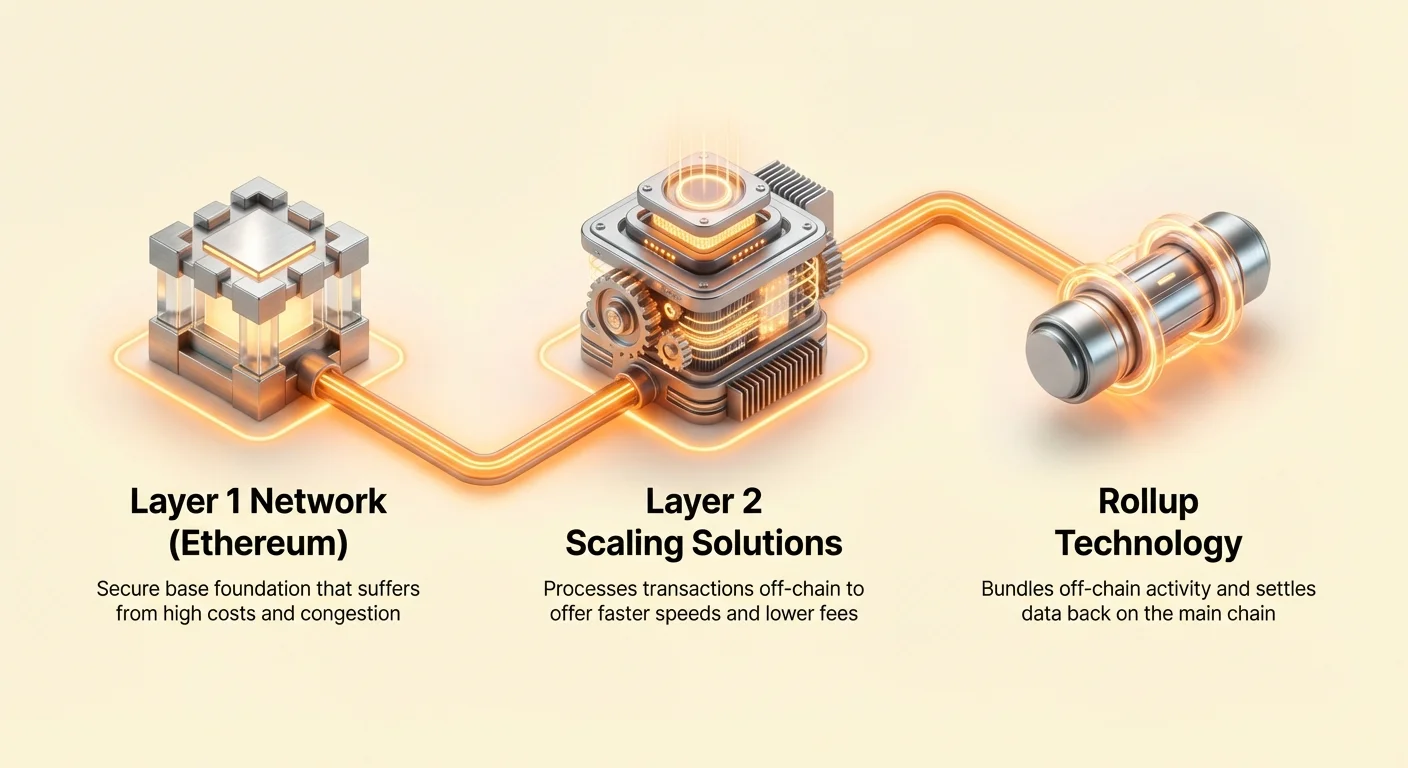
Blockchain technology is often categorized into different layers, each serving a specific function within the ecosystem. Layer 1 represents the base network, such as Bitcoin or Ethereum. These networks are responsible for the consensus mechanism, security, and final settlement of transactions. They act as the ultimate source of truth for the ledger. However, because they prioritize decentralization and security, they often face limitations regarding transaction throughput and speed.
Layer 2 solutions are built on top of these base layers to enhance scalability. They operate by processing transactions off-chain, meaning the computation happens outside the main network. Once a batch of transactions is processed, the validity and state changes are settled back on the Layer 1 blockchain. This architecture allows Layer 2s to benefit from the robust security of the base layer while offering significantly faster transaction speeds and lower fees. This relationship is critical for mass adoption, as it enables the network to handle thousands of transactions per second without clogging the main chain.
The Ethereum Virtual Machine Context
Execution and Computational Limits
The Ethereum Virtual Machine (EVM) is the engine that powers smart contracts on the Ethereum network. It is a Turing-complete virtual machine, capable of executing any computer program. When a developer deploys a decentralized application (dApp), the code is compiled into bytecode, which the EVM interprets and executes. This environment is isolated, or sandboxed, to ensure that malicious code cannot affect the broader network or other distinct contracts.
However, this powerful capability comes with constraints. The EVM can only process a limited number of transactions per second due to the decentralized nature of the network. Every node must verify every transaction, creating a bottleneck during peak usage. As more complex dApps are built, the strain on the EVM increases. This limitation is the primary driver for high gas fees, as users must pay a premium for the limited computational resources available in each block.
Compatibility and Standardization
The EVM has become a standard in the blockchain industry, extending its reach beyond just the Ethereum mainnet. Many scaling solutions and alternative blockchains are designed to be EVM-compatible. This means they can execute the same smart contracts and use the same tools as Ethereum. For developers, this compatibility is vital. It allows them to migrate their applications to cheaper, faster networks without rewriting their code base.
For users, EVM compatibility ensures a seamless experience when moving between Layer 1 and Layer 2. Wallets and interfaces remain consistent, regardless of the underlying network. This standardization is a key factor in the adoption of scaling solutions. By replicating the EVM environment off-chain, Rollups can process complex smart contract interactions efficiently while maintaining the familiar environment that the crypto ecosystem relies upon.
Deep Dive into Optimistic Rollups
The Validation Mechanism
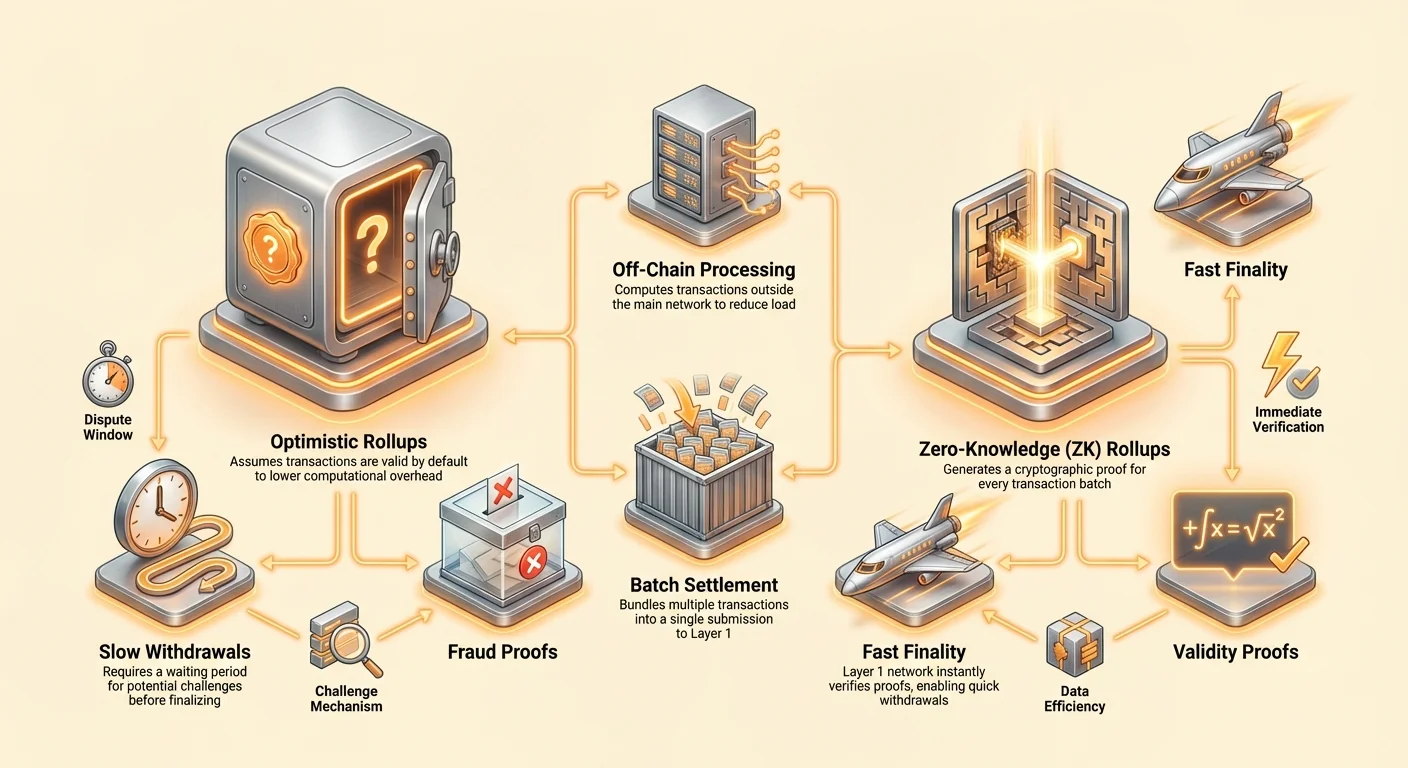
Optimistic Rollups are a type of Layer 2 scaling solution that operates on a presumption of validity. When transactions are processed on an Optimistic Rollup, the system assumes they are valid by default. They do not perform complex computation to verify every transaction upfront before posting data to the main chain. Instead, they process transactions off-chain and submit a summary of the data to the Layer 1 network.
To ensure security, these networks utilize a mechanism known as fraud proofs. There is a dispute window, typically lasting several days, during which validators can challenge the validity of a transaction bundle. If a fraudulent transaction is detected, the network rolls back the invalid state, and the malicious actor is penalized. This "optimistic" approach significantly reduces the computational load required for verification, resulting in lower transaction fees compared to the main chain.
Prominent Examples and Adoption
Several major platforms utilize Optimistic Rollup technology to scale Ethereum. Arbitrum is a leading example, designed to improve transaction throughput while reducing costs. It allows users to interact with smart contracts at a fraction of the price found on Layer 1. Similarly, Optimism functions as another prominent Optimistic Rollup, offering similar benefits of scalability and EVM compatibility.
These platforms have gained traction because they effectively balance cost reduction with ease of use. By assuming transactions are valid until proven otherwise, they avoid the heavy computational overhead associated with immediate verification. This efficiency makes them attractive for DeFi applications and high-frequency trading, where low latency and low fees are critical. The ecosystem for Optimistic Rollups continues to grow, supported by bridges that allow assets to move freely between the layers.
Deep Dive into Zero-Knowledge Rollups
The Mathematical Verification Approach
Zero-Knowledge (ZK) Rollups take a fundamentally different approach to validation compared to their optimistic counterparts. Instead of assuming transactions are valid, ZK Rollups generate a cryptographic proof for every batch of transactions processed off-chain. This proof, known as a validity proof, essentially certifies that the transactions are correct and follow the rules of the protocol.
This mathematical verification happens before the data is settled on the Layer 1 network. The ZK Rollup submits this proof along with the transaction data to the main chain. Because the proof guarantees the validity of the batch, there is no need for a dispute window. The Layer 1 network can instantly verify the proof, ensuring that the state changes are legitimate. This provides a higher level of immediate security and eliminates the delay associated with fraud-proof mechanisms.
Efficiency and Throughput Characteristics
ZK Rollups offer unique advantages in terms of data efficiency. Because the validity proof confirms the correctness of the transactions, the amount of data that needs to be stored on-chain is often reduced. This reduction in on-chain data can lead to significant cost savings in the long run, particularly for simpler transaction types.
Platforms like Polygon are actively integrating ZK technology to enhance their scalability. By combining off-chain processing with cryptographic validity proofs, these solutions aim to provide high throughput and lower fees. The complexity of generating these proofs requires significant computational power upfront, but the result is a highly efficient and secure settlement process. This technology is viewed by many as a robust long-term solution for blockchain scaling, offering a different balance of trade-offs compared to optimistic models.
Comparing Cost Efficiency and Performance
When analyzing the cost efficiency of these solutions, it is important to look at how they handle gas and data storage. Both Optimistic and ZK Rollups significantly reduce fees compared to Layer 1 by batching transactions. However, their distinct mechanisms lead to different cost profiles depending on the type of activity.
Optimistic Rollups generally have lower off-chain computational costs because they do not need to generate complex cryptographic proofs for every batch. However, they may require posting more data to the main chain to ensure that fraud proofs can be generated if necessary. ZK Rollups, conversely, have high computational costs off-chain to generate validity proofs but can optimize the data footprint on-chain.
The following table outlines the key comparative features:
| Feature | Optimistic Rollups | ZK Rollups |
|---|---|---|
| Validation Method | Assumes validity (Fraud Proofs) | Mathematical proof (Validity Proofs) |
| Withdrawal Time | Slow (requires dispute window) | Fast (verified immediately) |
| Computation Cost | Lower (minimal upfront work) | Higher (complex proof generation) |
For users, the choice often comes down to the specific application and the current state of the network. While both offer relief from high gas fees, the underlying technology dictates the speed of settlement and the potential throughput of the system.
Transaction Finality and Security
The Importance of Confirmations
In blockchain networks, the concept of confirmation is vital for security. A confirmation occurs when a block containing a transaction is added to the blockchain. As more blocks are added subsequently, the transaction becomes increasingly secure and immutable. On Layer 1 networks like Bitcoin and Ethereum, users often wait for multiple confirmations to ensure that a transaction is final and cannot be reversed.
For Layer 2 solutions, finality works slightly differently. While the transaction might be processed instantly on the Layer 2 network, the final settlement on Layer 1 depends on the rollup type. Optimistic Rollups have a delayed finality on Layer 1 due to the dispute period. The transaction is considered secure on the L2 quickly, but withdrawing funds to L1 takes time. ZK Rollups achieve Layer 1 finality faster because the validity proof is verified immediately upon submission.
Verifying Layer 2 Activity
Transparency remains a core tenet of crypto, regardless of the layer used. Blockchain explorers are essential tools that allow users to verify their transactions across these different networks. Just as there are explorers for Bitcoin and Ethereum, there are specific explorers for Arbitrum, Optimism, and Polygon. These tools function as search engines for the blockchain, indexing blocks, addresses, and transaction histories.
Users can utilize these explorers to check the status of their transfers, verify gas fees paid, and monitor the confirmations of their transactions. This visibility builds trust, ensuring that even though processing happens off-chain, the record remains public and verifiable. Whether using a fraud-proof model or a validity-proof model, the ability to independently audit the ledger is crucial for maintaining the decentralized ethos of the ecosystem.
Conclusion
The evolution of scaling solutions represents a critical maturity phase for blockchain technology. As networks like Ethereum continue to serve as the foundation for decentralized finance and applications, the need for efficient, low-cost transaction processing becomes non-negotiable. Both Optimistic and ZK Rollups offer viable paths forward, each addressing the limitations of the Ethereum Virtual Machine in unique ways. Optimistic Rollups leverage a trust-based model with verification mechanisms to lower computational overhead, while ZK Rollups utilize advanced cryptography to ensure immediate validity and data efficiency.
For the end user, the result is a more accessible and affordable ecosystem. The ability to interact with complex smart contracts without incurring prohibitive gas fees opens the door for wider adoption of Web3 technologies. As these Layer 2 platforms continue to refine their architectures, the distinction between layers will likely become seamless, providing a unified experience that retains the security of Layer 1 while delivering the speed of Layer 2.
Scaling solutions reduce costs by processing transactions off-chain and settling them in batches on the main secure network.