
Cryptocurrency markets are infamous for their volatility. Prices can swing wildly within a single day, driven by news cycles, economic shifts, or market sentiment. For many investors, this unpredictability creates a significant barrier to entry. The fear of buying at a peak or missing a bottom often leads to paralysis or emotional decision-making.
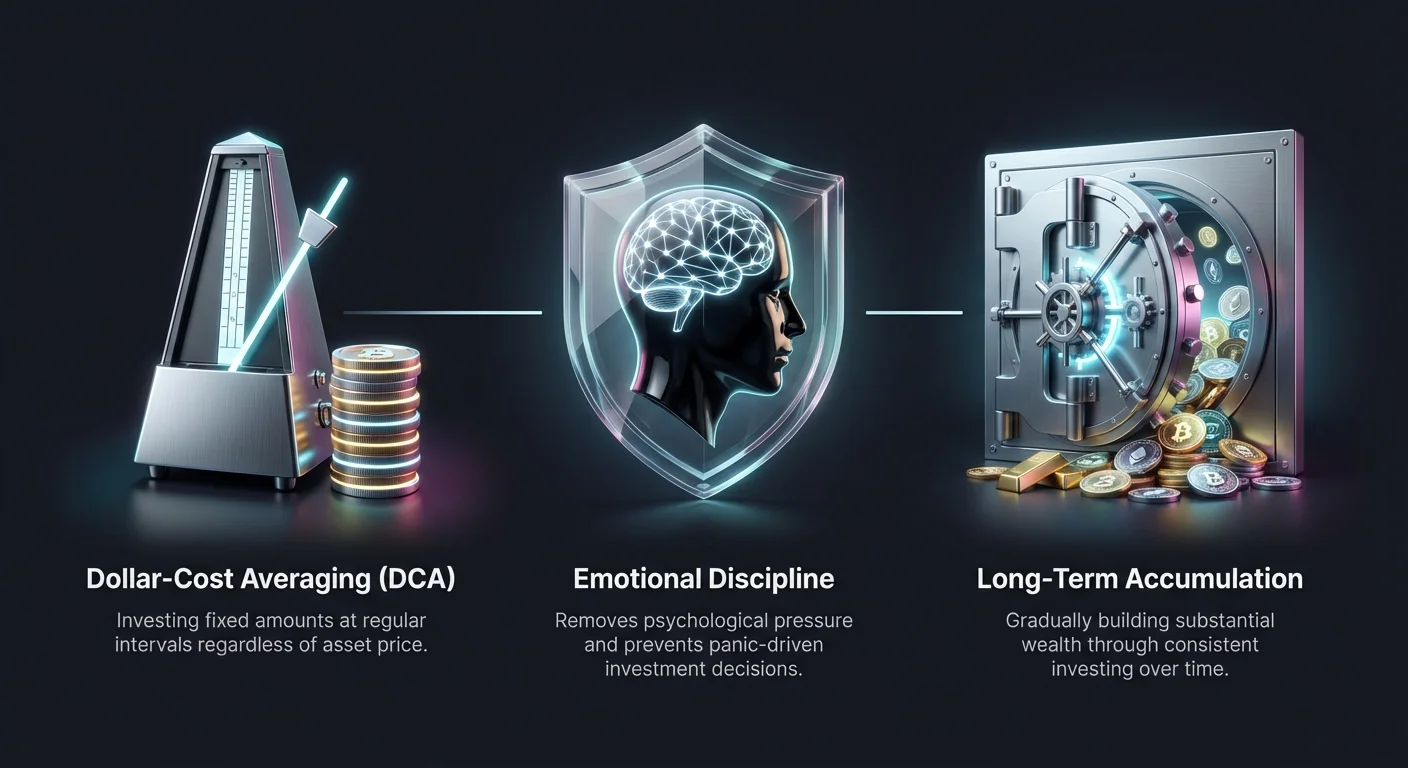
Dollar-cost averaging, commonly known as DCA, offers a solution to this psychological hurdle. It is an investment strategy designed to navigate rough market waters without requiring a crystal ball. Instead of attempting to time the market with a single large purchase, an investor divides their total capital into smaller, equal amounts.
These amounts are then invested at regular, predetermined intervals. This could be weekly, bi-weekly, or monthly. The schedule remains rigid regardless of the asset's price at that specific moment. When prices are high, the fixed amount buys fewer units. When prices are low, that same amount purchases more units. Over time, this approach lowers the average cost per unit compared to the asset's average market price.
While the concept is simple, modern crypto platforms allow for sophisticated applications of this strategy. Investors can now move beyond manual recurring buys into automated, yield-generating ecosystems. By understanding the mechanics of volatility and the tools available, one can transform DCA from a passive habit into a comprehensive wealth-building engine.
The Mechanics of Market Volatility
Volatility refers to the frequency and magnitude of price movements in a market. In traditional finance, high volatility is often seen as a risk to be avoided. In the cryptocurrency sector, however, it is a defining characteristic that presents both danger and opportunity. When volatility is high, prices change rapidly and unpredictably.
Understanding why crypto is more volatile than stocks or bonds is essential for mastering DCA. The first factor is market maturity. Cryptocurrencies are a relatively new asset class. They have not yet reached the stability seen in financial markets that have existed for centuries. The market is still in a phase of rapid price discovery.
Impact of Market Size and Liquidity
The second major factor driving volatility is market size. Despite its growth, the cryptocurrency market remains smaller than traditional global equity or commodity markets. In a smaller market, trades that would be considered insignificant in traditional finance can have an outsized impact.
Liquidity refers to how easily an asset can be bought or sold without affecting its price. When liquidity is lower, a large sell order can drive the price down significantly. Conversely, a large buy order can spike the price upward.
This sensitivity leads to the dramatic price swings often observed in Bitcoin and altcoins. For a lump-sum investor, this is terrifying. A purchase made on Tuesday could be down 10% by Wednesday. For a DCA investor, however, this volatility is simply part of the accumulation process.
Emotional Discipline and Optionality
Investing is often more about psychology than mathematics. The pressure to "buy low and sell high" causes stress and often leads to the opposite behavior. Investors often panic sell during downturns and buy in during hype cycles. DCA enforces discipline by removing the decision-making process from the equation.
By committing to a schedule, investors avoid the trap of emotional trading. They do not need to watch charts all day or react to every piece of news. This strategy also preserves optionality. By not deploying all capital at once, an investor retains cash on the sidelines. This flexibility allows them to adapt to changing life circumstances or new market opportunities without being fully exposed to a single entry price.
Analyzing DCA Performance Scenarios
To understand the strategic value of dollar-cost averaging, it helps to look at historical extremes. Critics often argue that lump-sum investing outperforms DCA in a "up only" market. While true mathematically, it assumes the investor knows exactly when the market will only go up. In reality, markets cycle.
Consider the scenario of "buying the top." This refers to purchasing an asset at its peak price right before a crash. If an investor put a lump sum into Bitcoin at the peak of the 2017 cycle, they would have faced a massive unrealized loss for years. It takes immense mental fortitude to hold through a 50% or 80% drawdown.
Mitigating Losses in Downturns
If that same investor had used a DCA strategy starting at the same peak, the outcome changes. By continuing to buy as the price collapsed, they would have acquired more Bitcoin at much lower prices. This lowers the average breakeven point.
Data suggests that in a bear market, a DCA strategy can turn a potential heavy loss into a modest profit or a much faster recovery. The investor accumulates the bulk of their portfolio during the "crypto winter," positioning them for maximum gains when the market eventually recovers.
Catching the Bottom
The opposite extreme is "catching the bottom." This is the dream of every trader: buying an asset at its absolute lowest price. If executed perfectly with a lump sum, this yields the highest possible return. However, identifying the true bottom is nearly impossible in real-time.
An investor waiting for the perfect bottom often misses it entirely. They watch the price rebound, waiting for a dip that never comes, and end up buying much higher. A DCA investor catches the bottom naturally. They buy through the decline, hit the bottom, and buy through the recovery. While the percentage gain might be lower than a perfect lump sum, the risk of missing the entry is eliminated.
Advanced DCA: Automating the Strategy
Manual DCA requires logging into an exchange every week or month to execute a trade. While effective, it introduces room for human error. Life gets busy, or an investor might hesitate if the market looks scary that day. Auto DCA solves this by utilizing the automated features offered by modern exchanges.
Auto DCA features allow users to set up recurring purchases that execute automatically. The funds can be drawn from a fiat balance on the exchange or directly from a linked bank account. This "set and forget" approach ensures that the investment plan is followed flawlessly.
Customizing Frequency and Assets
Most top-tier exchanges now offer granular control over these automated plans. Investors can choose intervals that align with their income streams, such as payday schedules. Options typically include daily, weekly, bi-weekly, or monthly purchases.
| Frequency | Best For | Advantage |
|---|---|---|
| Daily | High Volatility | Smoothest average price |
| Weekly | Salaried Employees | Matches typical cash flow |
| Monthly | Passive Investors | Low maintenance |
Furthermore, Auto DCA is not limited to Bitcoin. Investors can set up automated buys for Ethereum, stablecoins, or a basket of altcoins. This allows for the automated construction of a diversified portfolio over time without manual rebalancing.
The Role of Stablecoins
Strategic DCA often involves the use of stablecoins. Instead of pulling directly from a bank account, an investor might keep a reserve of USDC or USDT on an exchange. The Auto DCA system then draws from this stablecoin balance to purchase volatile assets.
This method offers two advantages. First, it reduces the number of bank transactions, which simplifies tracking for personal finance. Second, the stablecoin reserve can often earn interest while it waits to be deployed. This combats "cash drag," a common downside of holding cash for future investments.
Optimizing Infrastructure: Exchange Selection
Choosing the right platform is critical for a long-term DCA strategy. Not all exchanges are created equal, and fees can eat into returns over time. When executing hundreds of small transactions over several years, even a small difference in percentage fees compounds.
Investors should look for platforms that offer specific "recurring buy" fee structures or low maker/taker fees. Some exchanges charge a flat fee for small purchases, which is detrimental to DCA. For example, a $2 flat fee on a $20 purchase is a 10% loss immediately. Percentage-based fees are generally superior for this strategy.
Security Considerations
Since DCA is a long-term accumulation strategy, the security of the chosen platform is paramount. Users will be accumulating assets potentially for years. The exchange must have a robust track record. Key features to look for include two-factor authentication (2FA) and cold storage of client assets.
Cold storage means the majority of the exchange's funds are kept offline, away from potential hackers. Publicly traded exchanges or those with proof-of-reserves offer an additional layer of transparency. However, for significant amounts, many strategic investors eventually move their accumulated stack to personal hardware wallets.
Liquidity and Asset Variety
Liquidity ensures that the recurring buy orders are filled at the correct market price. On exchanges with low liquidity, the "spread" (the difference between buy and sell prices) can be high. This means the investor pays a premium for every purchase.
High liquidity platforms facilitate efficient trades even during market volatility. Additionally, the variety of supported assets matters for those looking to DCA into a broader portfolio. Access to major large-cap coins and select altcoins in one place simplifies the automation process.
Integrating Yield Generation
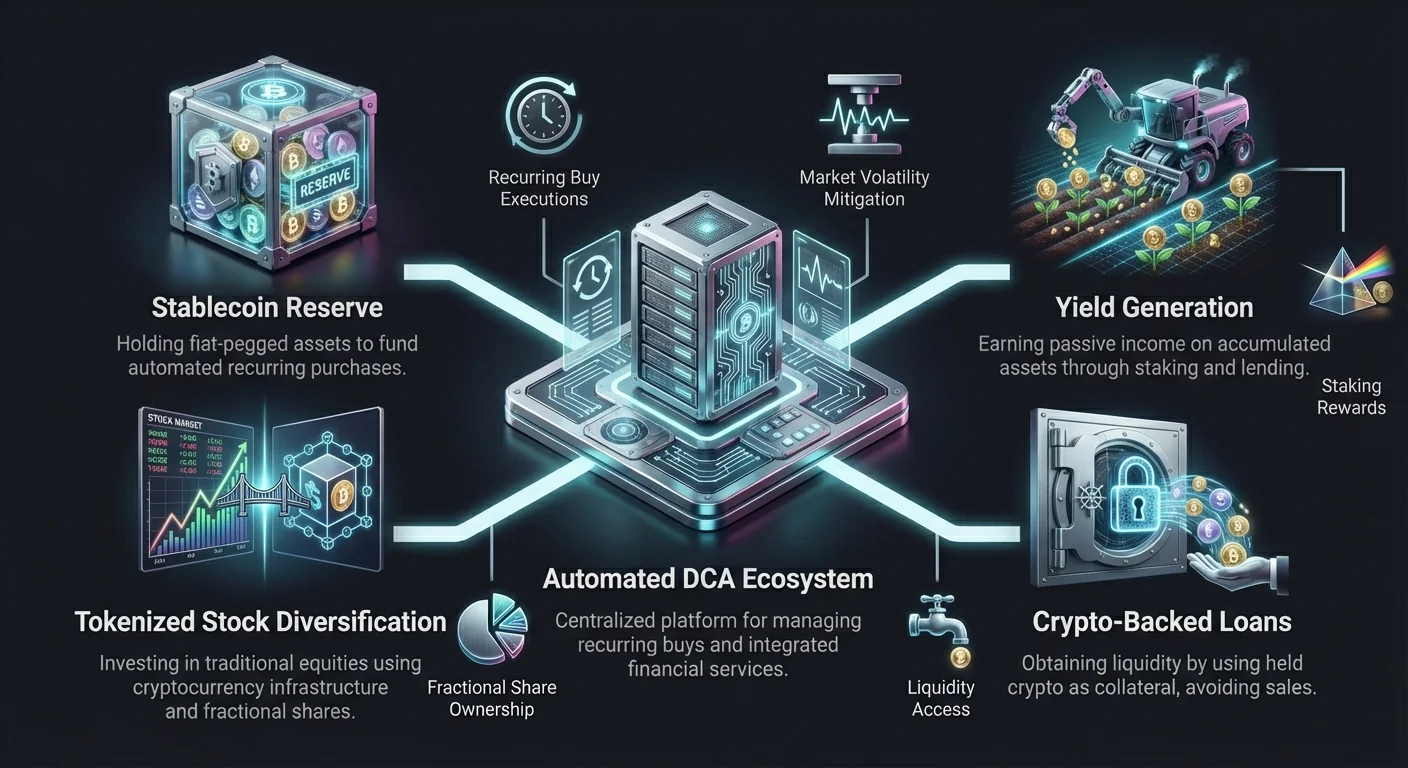
Strategic DCA goes beyond simply buying and holding. To maximize efficiency, the accumulated assets should be put to work. This is where staking and savings accounts come into play. Many exchanges offer "Earn" products that allow users to generate passive income on their holdings.
As the Auto DCA system buys assets, those assets can be automatically or manually moved into staking pools. This compounds the investment in two ways: the potential price appreciation of the asset and the accumulation of additional coins through interest.
Understanding Staking Rewards
Staking involves participating in the network security of Proof-of-Stake blockchains. In exchange for locking up tokens, the network provides rewards. Current rates vary significantly depending on the asset.
| Asset Class | Typical Yield | Risk Level |
|---|---|---|
| Stablecoins | 5% - 12% | Low/Medium |
| Ethereum | 3% - 5% | Medium |
| Altcoins | 5% - 15%+ | High |
For a DCA investor, these rewards act as a buffer. If the market drops, the yield helps offset the loss in value. If the market rises, the yield acts as a bonus multiplier.
CeFi vs. DeFi Savings
Investors can choose between Centralized Finance (CeFi) and Decentralized Finance (DeFi) for generating yield. CeFi platforms manage the technical aspects. The user simply deposits funds, and the exchange handles the lending or staking. This is user-friendly but involves counterparty risk—you must trust the platform.
DeFi protocols allow users to interact directly with smart contracts. This removes the middleman and often provides higher yields. However, it requires more technical knowledge and carries risks regarding smart contract bugs. A balanced strategic DCA plan might utilize both to spread risk.
Leveraging Assets with Crypto Loans
A common dilemma for long-term investors is the need for liquidity. Life expenses arise, and the temptation to sell a portion of the portfolio can be strong. Selling, however, interrupts the compounding effect of the DCA strategy and triggers taxable events.
Crypto lending platforms offer an alternative. Instead of selling, investors can use their accumulated crypto as collateral to obtain a loan. This allows access to cash (usually stablecoins or fiat) while retaining ownership of the underlying asset.
Loan-to-Value (LTV) Mechanics
The key metric in crypto loans is the Loan-to-Value (LTV) ratio. This represents the percentage of the collateral's value that is borrowed. For example, depositing $10,000 of Bitcoin to borrow $5,000 results in a 50% LTV.
Lower LTV ratios generally secure better interest rates and reduce the risk of liquidation. Liquidation occurs if the value of the collateral drops significantly, forcing the platform to sell the asset to cover the loan. Strategic investors keep LTV low to withstand market volatility without losing their holdings.
Tax Efficiency and Flexibility
One of the primary benefits of this strategy is tax efficiency. In many jurisdictions, taking out a loan is not a taxable event, whereas selling crypto for a profit is subject to capital gains tax. This allows the investor to monetize their gains without triggering a tax bill.
Furthermore, loans can be flexible. Some platforms offer terms with no fixed repayment schedule, as long as the collateral remains sufficient. This provides a safety valve for the DCA investor, ensuring they never have to panic sell their hard-earned stack to cover short-term bills.
Diversifying with Tokenized Stocks
Strategic DCA is not limited to native cryptocurrencies. The emergence of tokenized stocks allows investors to build a cross-asset portfolio using the same crypto infrastructure. Tokenized stocks are digital representations of shares in publicly traded companies like Tesla, Apple, or Amazon.
These tokens track the price of the real-world stock. By using a crypto exchange that supports these assets, an investor can apply the same Auto DCA logic to the stock market. This bridges the gap between traditional finance and the blockchain economy.
Fractional Ownership
A major advantage of tokenized stocks is fractional ownership. A single share of a high-performing tech company might cost hundreds of dollars. This makes it difficult for smaller investors to DCA effectively.
Tokenized versions allow for the purchase of fractions of a share. An investor can allocate exactly $50 per week to a specific stock, regardless of the share price. This ensures that every dollar of capital is utilized efficiently, adhering strictly to the DCA schedule.
24/7 Market Access
Traditional stock markets operate on rigid schedules, typically opening in the morning and closing in the afternoon, with weekends off. Crypto markets never sleep. Tokenized stocks on certain platforms can be traded 24/7.
This flexibility allows investors to react to global news instantly or simply execute their DCA strategies at times that are convenient for them, without being bound by Wall Street's opening bell. It consolidates wealth management into a single interface.
Addressing the Disadvantages
No strategy is flawless, and Strategic DCA has its downsides. The most cited is "cash drag." Because funds are held in cash (or stablecoins) waiting to be deployed, they are not participating in the market. In a fierce bull market, a lump sum investment at the start would mathematically outperform DCA.
However, this assumes the investor has the lump sum available immediately and has the risk tolerance to deploy it all. For most income earners, funds become available incrementally, making DCA the only practical option regardless of market conditions.
Transaction Costs
Another consideration is the accumulation of fees. Making 52 weekly purchases incurs 52 transaction fees. If the exchange charges high minimums or fixed fees, this can be expensive.
This is why selecting the right exchange is part of the strategy. Platforms with tiered fee structures or "zero fee" promotions for recurring buys can mitigate this issue. Investors must audit their fee structures regularly to ensure the cost of convenience isn't eroding their gains.
Lower Returns in Uptrends
DCA is a defensive strategy. It excels in volatile or bearish markets. In a market that goes consistently up with no pullbacks, DCA raises the average buy price with every purchase.
Strategic investors accept this trade-off. The slight reduction in potential maximum profit is the price paid for risk management and peace of mind. The goal of DCA is not to achieve the absolute highest theoretical return, but to achieve a reliable, stress-free return that prevents catastrophic loss.
Conclusion
Mastering strategic Dollar-Cost Averaging requires more than just setting up a recurring buy. It involves a holistic approach to portfolio management that integrates automation, yield generation, and liquidity planning. By understanding the nature of crypto volatility, investors can turn price swings from a source of anxiety into a mechanism for accumulation.
The integration of staking and lending turns a static pile of assets into a dynamic, working portfolio. Coupled with the ability to diversify into tokenized traditional assets, modern crypto exchanges provide a powerful toolkit for long-term wealth creation. The key lies in discipline, proper platform selection, and a commitment to the long game.
Consistency beats timing the market.