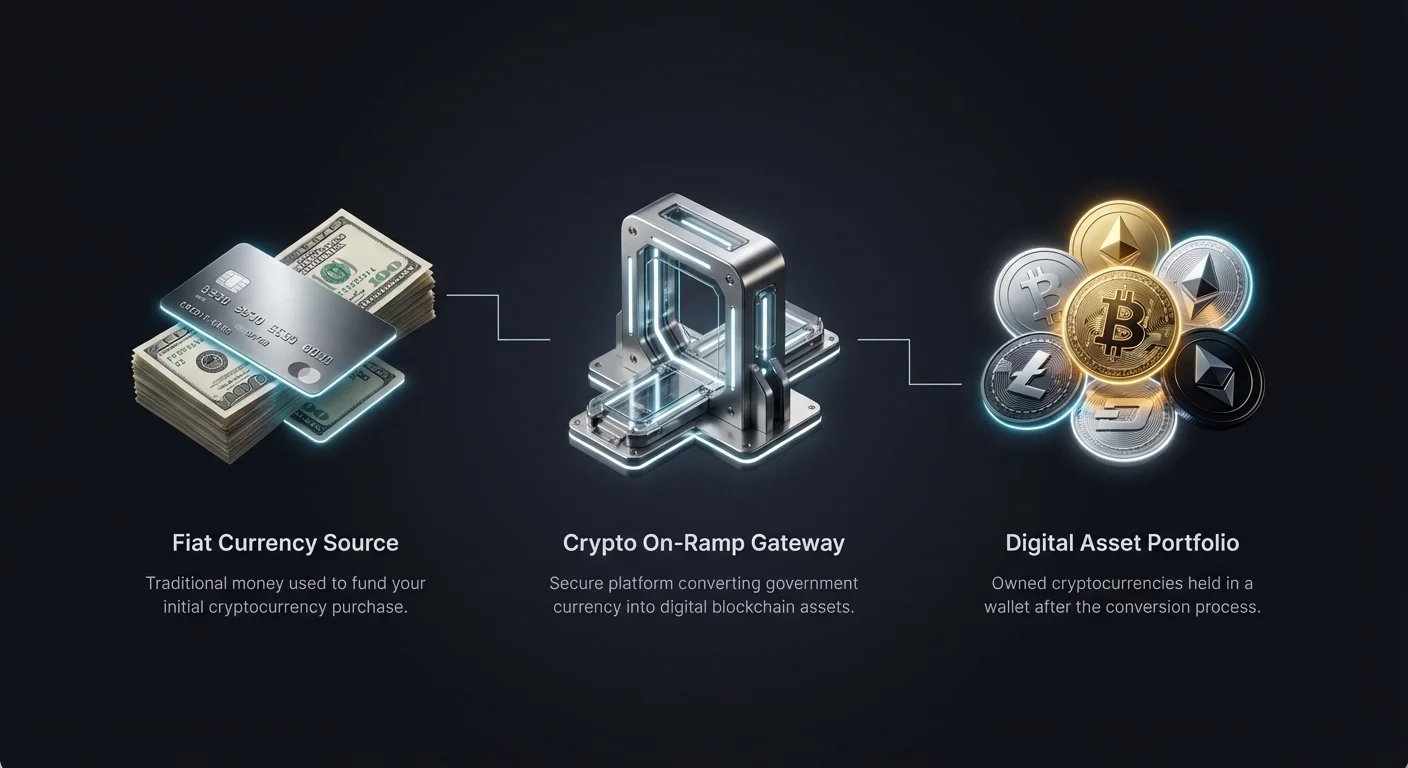
Entering the world of cryptocurrency can feel like stepping into a different universe. For newcomers, the terminology alone—blockchains, wallets, private keys, and gas fees—can be overwhelming. However, the most critical step in this journey is often the very first one: finding a reliable platform to convert traditional money into digital assets. This process is known as the "on-ramp."
On-ramps serve as the gateway between the traditional financial system, often referred to as fiat, and the decentralized economy. Choosing the right entry point is essential for a safe and stress-free experience. The market is filled with various types of exchanges and brokers, each catering to different needs and technical skill levels.
For a beginner, the priority is usually simplicity, security, and support. You need a platform that explains what you are buying, keeps your funds safe, and helps you if you get stuck. The complexity of the underlying technology should ideally be hidden behind a user-friendly interface.
This guide explores the landscape of cryptocurrency platforms designed for first-time buyers. It covers the different types of exchanges, how they operate, and the critical factors you must consider before making your first purchase. From fee structures to security protocols, understanding these elements ensures you start your crypto journey on solid ground.
Understanding the Crypto Exchange Landscape
A cryptocurrency exchange is a digital marketplace where you can buy, sell, or trade cryptocurrencies for other digital currency or traditional currency like US dollars or Euros. These platforms function somewhat like stock exchanges, but they operate 24/7 and deal exclusively in digital assets.
The ecosystem has evolved significantly since the early days of Bitcoin. Initially, buying crypto required technical know-how and dealing with obscure websites. Today, modern platforms offer sleek mobile apps and customer service comparable to traditional banks.
There isn't just one type of exchange. The market is segmented into centralized exchanges, decentralized platforms, brokerages, and peer-to-peer marketplaces. Each category offers distinct advantages and trade-offs regarding convenience, control, and cost.
Centralized Exchanges (CEX)
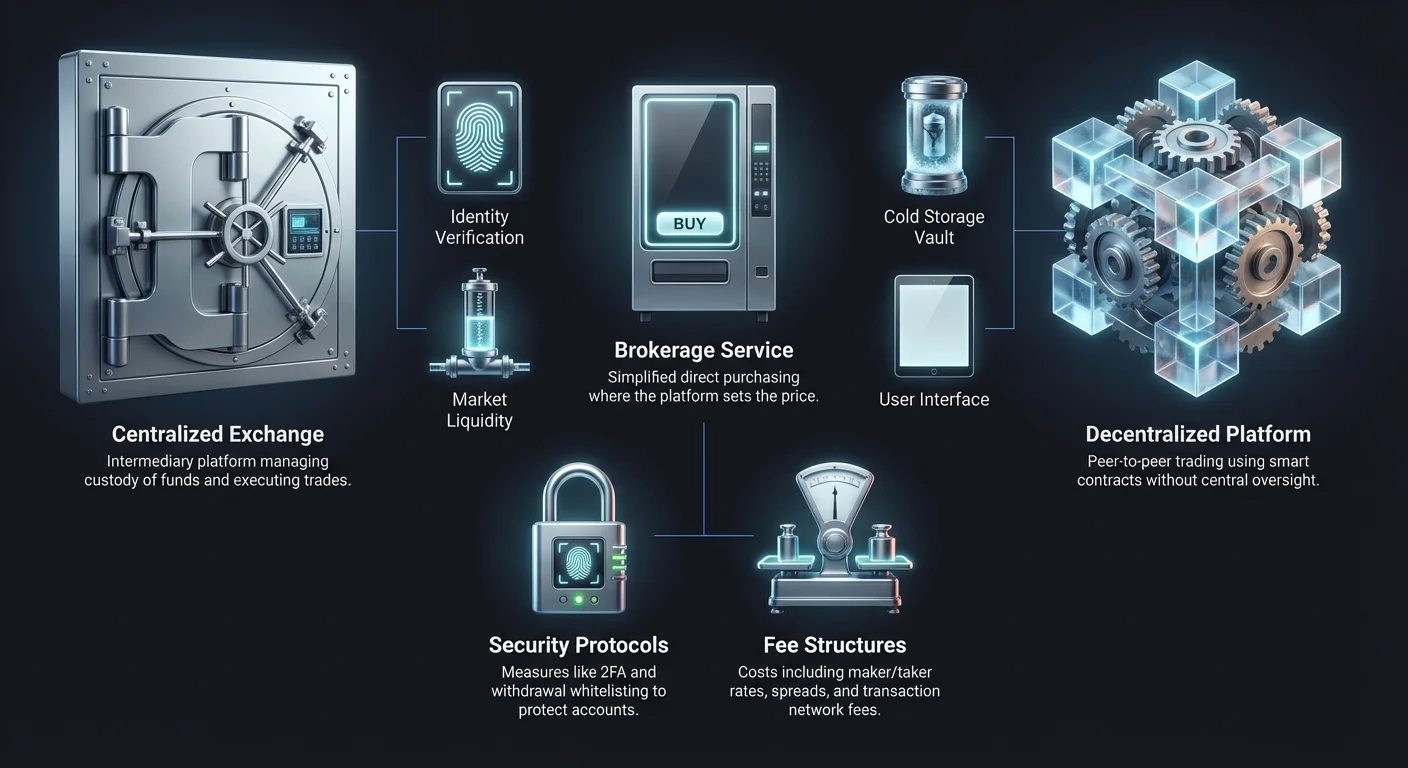
Centralized exchanges are the most common entry point for beginners. They function as intermediaries between buyers and sellers. When you use a centralized platform, you are trusting a third-party company to handle your money and execute trades on your behalf.
These platforms operate similarly to traditional banks or stock brokerages. You create an account, verify your identity, and deposit funds. The exchange holds custody of your assets, which means they store the private keys to the cryptocurrency wallets.
For beginners, this custodial model offers a significant safety net. If you lose your password, the exchange can help you recover your account. You do not need to worry about managing complex cryptographic keys or hardware wallets immediately.
Centralized exchanges typically offer the highest liquidity. Liquidity refers to the ease with which an asset can be bought or sold without affecting its price. High liquidity ensures that your trade executes instantly at a predictable market price.
Furthermore, these platforms usually provide the most polished user interfaces. They invest heavily in design to make buying Bitcoin or Ethereum as easy as shopping online. Features often include simple "buy/sell" buttons, clear portfolio charts, and integrated news feeds.
Decentralized Exchanges (DEX)
Decentralized exchanges represent the other end of the spectrum. Unlike their centralized counterparts, DEXs operate without a central authority. They rely on blockchain technology and smart contracts to facilitate trading directly between users.
In a DEX environment, you retain full control of your funds at all times. You trade directly from your personal digital wallet. The exchange never takes custody of your assets, which reduces the risk of a massive exchange hack resulting in lost user funds.
However, this autonomy comes with increased responsibility. If you lose access to your wallet or make a mistake during a transaction, there is no customer support team to assist you. Transactions are irreversible, and there is no "forgot password" feature for a private wallet.
For a first-time buyer, the learning curve on a DEX can be steep. You typically need to already own some cryptocurrency to pay for network transaction fees. Consequently, DEXs are often considered a second step rather than an initial on-ramp.
Despite the complexity, they offer unparalleled privacy and access to a wider variety of tokens. Centralized exchanges act as gatekeepers, listing only vetted assets. DEXs, being permissionless, often allow trading of newer or smaller projects before they hit major platforms.
Cryptocurrency Brokers
Cryptocurrency brokers are often confused with exchanges, but they operate differently. A broker acts as a middleman who sells you crypto directly. Instead of matching your buy order with another user's sell order, the broker sets a price and fills the order from their own inventory.
Brokerage platforms are designed for maximum simplicity. They strip away complex trading charts, order books, and market depth data. The experience is streamlined: you see a price, enter an amount, and click buy.
This convenience makes brokers incredibly attractive to absolute beginners. The interface is often cleaner and less intimidating than a full-featured exchange. The goal is to remove friction from the buying process.
The trade-off for this simplicity is often cost. Brokers may charge higher fees or include a "spread" in the price. The spread is the difference between the market price and the price the broker charges you. While the fees might be higher, the ease of use is often worth it for small, first-time purchases.
The Mechanics of Peer-to-Peer (P2P) Platforms
Peer-to-peer (P2P) exchanges offer a different approach by connecting buyers and sellers directly. Unlike a centralized exchange that uses an automated engine to match orders, a P2P platform functions more like a classifieds listing service.
Sellers post advertisements stating how much crypto they want to sell, the price, and the payment methods they accept. Buyers browse these listings and choose a seller that meets their criteria. The platform facilitates the connection but does not act as the counterparty.
The Role of Escrow Services
Trust is a major concern in P2P trading. To solve this, P2P platforms use escrow services. When a trade is initiated, the seller's cryptocurrency is locked in a secure digital vault controlled by the platform.
The buyer then sends the payment directly to the seller using the agreed-upon method, such as a bank transfer or PayPal. Once the seller confirms receipt of the money, the platform releases the crypto from escrow to the buyer.
This system protects both parties. The seller cannot run away with the crypto before sending payment, and the buyer cannot receive the crypto without paying. If a dispute arises, the platform's support team can intervene and review evidence of payment.
Privacy and Payment Flexibility
One of the primary benefits of P2P platforms is payment flexibility. Since you are paying an individual rather than a company, you can often use payment methods that centralized exchanges do not support. This might include local bank transfers, cash deposits, or specific e-wallets.
Privacy is another factor. While many P2P platforms now require identity verification, the direct nature of the trade can offer more privacy than centralized order books. You are interacting with another person rather than a central financial institution.
However, P2P trading can be slower and less convenient than using a centralized exchange. You have to wait for the other person to respond and confirm payment. Prices can also vary significantly between different sellers.
Evaluating Security Protocols
For a beginner, security should be the non-negotiable priority. The irreversible nature of cryptocurrency transactions makes the industry a target for hackers and scammers. A secure exchange acts as a fortress for your digital wealth.
Cold Storage vs. Hot Wallets
The most robust security measure an exchange can implement is cold storage. This involves keeping the vast majority of user funds in offline wallets that are not connected to the internet. By physically isolating these assets, they become immune to online hacking attempts.
Hot wallets, conversely, are connected to the internet to facilitate immediate withdrawals and trading. A safe exchange keeps only a small percentage of funds in hot wallets to maintain liquidity, while the rest remains in deep cold storage.
When researching a platform, look for information on their storage policies. Leading exchanges often state that they keep 98% or more of client assets in cold storage. This is a strong indicator of a security-first mindset.
User-Level Security Features
Beyond how the exchange stores money, you must look at the tools they give you to protect your account. Two-factor authentication (2FA) is the industry standard. It requires a second form of verification, such as a code from an app, in addition to your password.
The best platforms support hardware security keys and app-based authenticators rather than just SMS codes. SMS verification is vulnerable to SIM-swapping attacks, where a hacker tricks a phone carrier into transferring your phone number to their device.
Other vital security features include withdrawal whitelisting. This allows you to restrict withdrawals only to specific addresses you have pre-approved. If a hacker gains access to your account, they cannot send your funds to their own wallet.
Regulatory Compliance and Insurance
Regulation plays a complex but vital role in security. Exchanges that comply with local laws, such as Know Your Customer (KYC) and Anti-Money Laundering (AML) regulations, are generally safer. Compliance often compels the platform to maintain higher security standards and financial transparency.
Some platforms also carry insurance policies. These policies protect digital assets held in hot storage against theft or cybersecurity breaches. While this does not typically cover unauthorized access to your individual account due to a weak password, it protects against platform-wide failures.
For US-based users, some exchanges allow you to hold US dollars in accounts that are FDIC-insured. This insurance covers the cash in your account up to a certain limit, similar to a bank account, though it does not cover the cryptocurrency itself.
User Interface and Experience (UI/UX)
For a first-time buyer, a cluttered screen full of flashing numbers and complex charts is a major barrier. The user interface (UI) is the bridge between you and the blockchain. A good UI simplifies complex actions into intuitive steps.
Beginner-friendly platforms prioritize clarity. They use simple language rather than trader jargon. Instead of "limit order" and "market depth," you might see simple questions like "How much do you want to buy?" and "Pay with."
Mobile Accessibility
In 2025, mobile accessibility is paramount. The best platforms offer robust mobile applications that mirror the functionality of their desktop websites. These apps allow you to monitor your portfolio, execute trades, and manage security settings from your phone.
A high-quality mobile app should be secure, responsive, and easy to navigate. Features like biometric login (fingerprint or face ID) add both convenience and security. Mobile notifications can also keep you updated on price movements or the status of your deposits.
Educational Resources
The best platforms for beginners do more than facilitate trades; they educate their users. Look for exchanges that integrate learning into the experience. This might take the form of short articles, video tutorials, or glossaries explaining crypto terms.
Some platforms offer "learn and earn" programs. These initiatives reward you with small amounts of cryptocurrency for completing educational modules. This is an excellent way to dip your toe into the market without risking your own money.
Access to high-quality information helps you make better decisions. Whether it is understanding the difference between Bitcoin and Ethereum or learning how to secure your account, integrated education is a hallmark of a top-tier beginner exchange.
Fee Structures and Costs
Trading fees are an inevitable part of buying cryptocurrency. However, fee structures can be complex and vary significantly between platforms. Understanding what you are paying is crucial to maximizing your investment.
Maker and Taker Fees
Most centralized exchanges use a maker-taker fee model. This system distinguishes between orders that provide liquidity and those that take it away.
A "maker" is someone who places an order that does not fill immediately. For example, offering to buy Bitcoin at a price lower than the current market value. These orders sit in the order book, adding liquidity. Makers are often rewarded with lower fees.
A "taker" is someone who buys or sells immediately at the current market price. They "take" liquidity from the order book. Taker fees are generally higher. As a beginner using simple buy buttons, you are almost always acting as a taker.
Spread and Hidden Costs
Brokerage platforms and simplified buying interfaces often charge a "spread" instead of, or in addition to, a transaction fee. The spread is the margin between the market price and the price offered to the user.
For instance, if Bitcoin is trading at $50,000, a broker might sell it to you for $50,500. That $500 difference is the spread. While "zero fee" trading sounds appealing, a wide spread can sometimes be more expensive than a transparent percentage fee.
It is vital to compare the final cost. Look at the total amount of crypto you receive for a specific dollar amount across different platforms. This reveals the true cost of the transaction, including both fees and spreads.
Deposit and Withdrawal Fees
Getting money into and out of an exchange can also incur costs. Bank transfers are often free or cheap but may take days to process. Credit and debit card purchases are instant but usually come with high processing fees, sometimes exceeding 3%.
Withdrawal fees apply when moving crypto off the exchange to a private wallet. These fees cover the network cost of the blockchain transaction. Some exchanges charge a flat fee, while others adjust dynamically based on network congestion.
Before signing up, check the fee schedule for withdrawals. If you plan to move your assets to cold storage immediately—a recommended security practice—high withdrawal fees can significantly eat into small investments.
Payment Methods and Accessibility
The ease of funding your account is a major factor in choosing an exchange. The best platforms for beginners support a wide range of familiar payment methods. This reduces the friction of moving from the fiat world to the crypto world.
Traditional Banking Integration
Direct bank transfers (ACH or SEPA) are the standard for most exchanges. They are reliable and typically have the lowest fees. However, they are not always instant. You may have to wait a few days for funds to clear before you can withdraw your crypto.
Debit and credit cards offer speed. You can buy crypto instantly, which is useful if you want to catch a specific price. The downside is the cost. Card networks charge high processing fees, which the exchange passes on to you.
Some platforms also face restrictions from card issuers. Not all banks allow crypto purchases on credit cards. It is worth checking with your bank or the exchange's help center to see which cards are supported.
Digital Wallets and Third-Party Processors
Integration with digital wallets like PayPal, Apple Pay, and Google Pay is becoming increasingly common. These methods offer a high degree of convenience. If you already have payment details stored in your phone, you can buy crypto with a fingerprint scan.
PayPal, in particular, is a popular option for its speed and security. Some exchanges allow you to link your PayPal account for both deposits and withdrawals. This is useful for users who prefer not to link their main bank account directly to a crypto exchange.
However, be aware that fees for these convenient methods can be higher than standard bank transfers. Convenience almost always comes at a premium in the crypto market.
Step-by-Step: Your First Crypto Purchase
Once you have selected a platform, the process of buying your first cryptocurrency generally follows a standard path. Knowing what to expect can remove anxiety from the process.
Account Registration and Verification
The first step is signing up. You will provide an email address and create a secure password. Immediately after this, most reputable exchanges will require you to verify your identity.
This process, known as Know Your Customer (KYC), is a legal requirement in most jurisdictions. You will typically need to upload a photo of a government-issued ID, such as a driver's license or passport. You may also be asked to take a selfie to prove you match the ID.
Verification can take anywhere from a few minutes to a few days, depending on the platform's efficiency. While it might feel intrusive, this step protects the platform from illegal activity and adds a layer of security to your account.
Funding Your Account
With a verified account, you can deposit funds. Navigate to the "Deposit" or "Funds" section of the platform. Select your currency (e.g., USD, EUR) and your payment method.
Follow the on-screen instructions to authorize the transfer. If you are using a bank transfer, ensure you include any reference codes provided by the exchange. These codes ensure the money ends up in your specific user account.
For instant purchases using a card, you might skip the deposit step and go straight to buying. The platform will charge your card at the moment of purchase.
Executing the Trade
Now comes the actual purchase. On a beginner interface, this is simple. You select the cryptocurrency you want (e.g., Bitcoin). You enter the amount you want to spend (e.g., $100).
The interface will show you a preview of the transaction. This includes the current price, the fees, and the exact amount of crypto you will receive. Review this carefully.
Once you confirm, the trade executes. The fiat currency is deducted from your balance or charged to your card, and the cryptocurrency appears in your exchange wallet. You are now a crypto owner.
Post-Purchase Management
After buying, you have a choice. You can leave the funds on the exchange, or you can withdraw them. For small amounts intended for trading, leaving them on the exchange is convenient.
For larger amounts or long-term holding, withdrawing to a personal wallet is recommended. This gives you full control over the assets. To do this, you would navigate to the "Withdraw" section, enter your wallet address, and confirm the transfer.
Remember to double-check all addresses. Crypto transactions are irreversible. Sending funds to the wrong address usually results in permanent loss.
The Role of Customer Support
In the decentralized world of crypto, customer support is often the only lifeline when things go wrong. For beginners, the quality of support can define the entire experience.
Top-tier exchanges offer multiple channels of communication. Live chat is the most convenient for quick questions. Look for platforms that offer 24/7 support, as the crypto market never sleeps.
Email support is standard for more complex issues. The best platforms respond within 24 hours. Some exchanges also offer phone support, though this is rarer and often reserved for urgent security issues.
A comprehensive help center is also valuable. A well-organized library of articles and FAQs can help you solve common problems without waiting for an agent. This includes guides on how to reset 2FA, how to verify your identity, or how to understand transaction statuses.
Risks and Considerations
While exchanges strive to be safe, the crypto market carries inherent risks. Understanding these risks is the first step in mitigating them.
Market Volatility
The most immediate risk is price volatility. Cryptocurrency prices can swing wildly in short periods. It is not uncommon for an asset to lose or gain double-digit percentages in a single day.
Beginners should be prepared for this. Never invest money you cannot afford to lose. The value of your holdings will fluctuate, and you need the emotional resilience to ride out the dips without panic-selling.
Platform Risk
Platform risk refers to the possibility of the exchange itself failing. This could be due to a hack, mismanagement, or regulatory shutdown. While major exchanges are robust, history has shown that even large platforms can collapse.
This is why the mantra "not your keys, not your coins" exists. If the exchange holds your funds, you are technically an unsecured creditor. If the exchange goes bankrupt, you may not get your money back.
Mitigate this risk by diversifying where you keep your assets or by taking self-custody using a personal wallet.
Scams and Phishing
The user is often the weakest link in security. Scammers target new users with phishing emails that look like official communication from the exchange. They try to trick you into revealing your password or 2FA codes.
Always verify the URL of the website you are visiting. Bookmark the official login page. Never click on suspicious links in emails or text messages. Remember that legitimate support staff will never ask for your password or private keys.
Hybrid Exchanges: Bridging the Gap
A newer category of platforms, known as hybrid exchanges, attempts to offer the best of both worlds. They aim to combine the liquidity and usability of centralized exchanges with the security and privacy of decentralized ones.
Hybrid platforms often process trades off-chain to ensure speed, similar to a centralized engine. However, the settlement of the trade happens on the blockchain. This means users retain custody of their funds until the trade is executed.
For beginners, hybrid exchanges can be a good middle ground. They offer a safety net against exchange hacks since the exchange doesn't hold the bulk of user funds. However, they may still lack the polish and extensive customer support of major centralized giants.
As technology evolves, hybrid models are becoming more user-friendly. They represent a potential future where high performance does not require sacrificing custody of assets.
Important Features for Long-Term Success
As you move past your first purchase, other features of an exchange become important. The ability to grow with the platform is a key consideration.
Staking and Earning
Many exchanges now offer passive income opportunities. "Staking" involves locking up your cryptocurrency to support the operation of a blockchain network. In return, you earn rewards, similar to interest in a savings account.
Exchanges simplify this process significantly. Instead of managing technical staking nodes, you simply click a button. The exchange handles the technical side and distributes the rewards to you, taking a small cut as a fee.
This is a great way for beginners to grow their portfolio over time. Look for exchanges that offer clear, flexible staking options for the assets you plan to hold.
Recurring Buys and Automation
Consistency is often better than timing the market. Many beginner-friendly platforms offer "recurring buy" or "Auto-Invest" features. This allows you to set up an automatic purchase of a specific amount (e.g., $50) every week or month.
This strategy is known as Dollar Cost Averaging (DCA). It smooths out the volatility of your entry price. By automating this process, you remove the emotional stress of trying to buy at the "perfect" time.
Checking if an exchange supports recurring buys with your preferred payment method is a smart move for any long-term investor.
Final Thoughts on Selection
Selecting the right crypto platform is a personal choice. It depends on what you value most. Is it the absolute lowest fee? The highest security? Or the easiest interface?
For most beginners, the recommendation is to start with a reputable, regulated centralized exchange. The slight premium in fees is often worth the security, support, and ease of use. You are paying for a safer on-ramp.
As you gain experience, you can explore decentralized exchanges or other advanced platforms. You can open accounts on multiple exchanges to take advantage of different features. There is no need to lock yourself into a single provider forever.
Take your time. Research the options. Read reviews and check their security history. The crypto market is a marathon, not a sprint. Starting on a secure, user-friendly platform gives you the best chance of finishing the race.
| Feature | Centralized Exchange (CEX) | Decentralized Exchange (DEX) | Brokerage |
|---|---|---|---|
| Custody | Exchange holds funds | User holds funds | Broker holds funds |
| Ease of Use | High | Low to Medium | Very High |
| Fees | Medium | Low (plus network fees) | High (often in spread) |
| Verification | Required (KYC) | Usually None | Required (KYC) |
| Support | Yes | No | Yes |
| Speed | Fast | Variable | Fast |
Conclusion
Navigating the world of cryptocurrency exchanges does not have to be daunting. The industry has matured to the point where reliable, secure, and user-friendly options are available for everyone. Whether you prioritize the autonomy of a decentralized platform or the customer support of a centralized giant, there is an on-ramp that fits your needs.
The key is to start with a clear understanding of your own requirements. Focus on security first, transparency second, and ease of use third. Do not rush into the cheapest option if it compromises the safety of your funds. By taking the time to understand the mechanics of these platforms—from fees to custody—you empower yourself to make informed financial decisions.
The best exchange is the one that makes you feel confident, secure, and in control of your financial future.