
The journey from a whitepaper concept to a successful decentralized application (DApp) is long, complex, and highly capital-intensive. In the traditional financial world, startups rely on venture capital (VC) to grow, but the unique structure of Web3 projects—which often involves decentralized ownership, token distribution analysis, and global teams—requires specialized support.
For crypto founders looking for initial backing, and for institutional investors (known as Limited Partners, or LPs) seeking to deploy capital into the blockchain ecosystem, two primary structures exist to vet, nurture, and capitalize early-stage ideas: the Accelerator and the Incubator. While both serve the goal of fueling innovation, they operate on fundamentally different strategic mandates, time horizons, and deal structures.
Understanding the difference between a high-intensity, short-term crypto Accelerator (focused on market fit and speed) and a long-term, resource-rich Incubator (focused on concept validation and technical deep-build) is essential for anyone navigating the complex landscape of early-stage blockchain funding. This guide provides a detailed analysis of these two models, analyzing their strategic value for both the teams being funded and the investors providing the capital.
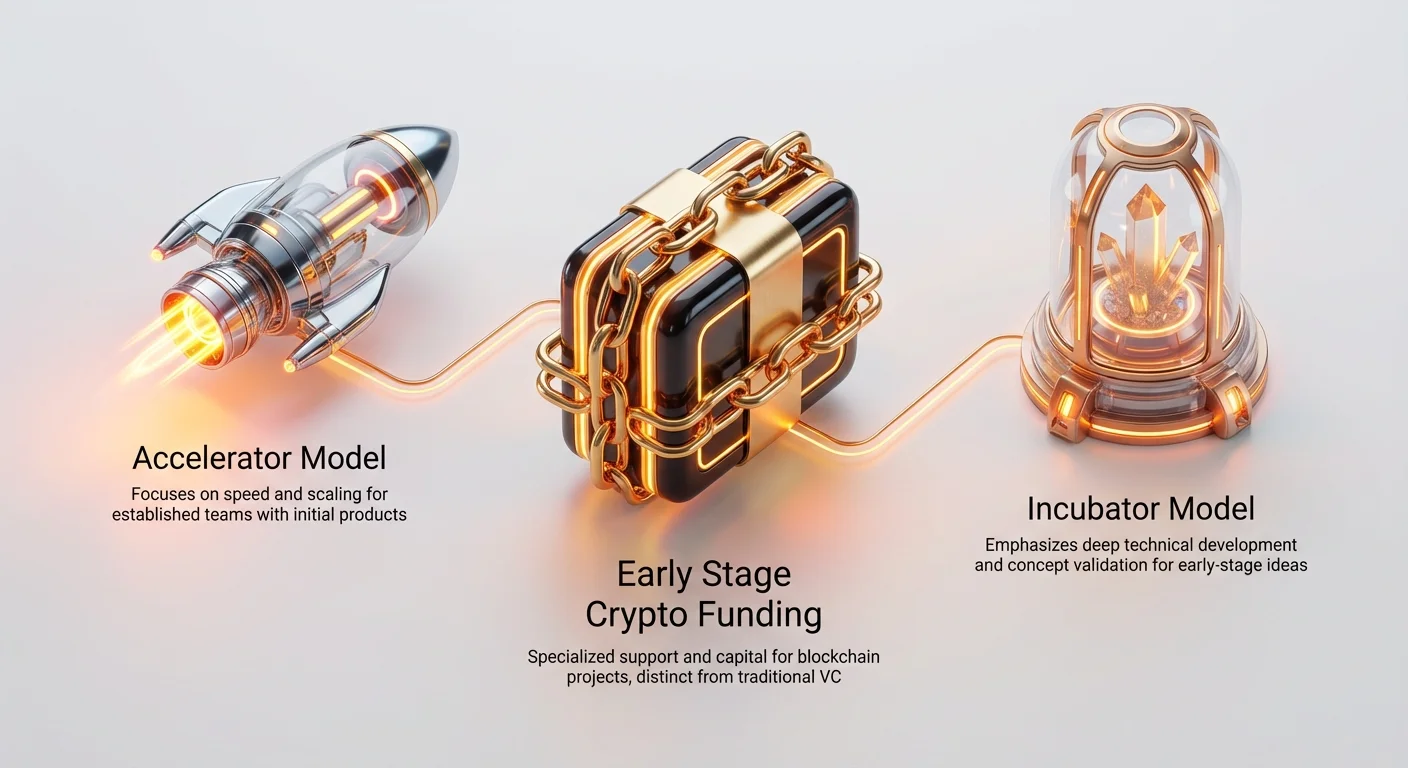
The Accelerator Model: Speed, Structure, and Scaling
The crypto accelerator model is designed to take a promising, established team with an initial product concept (or minimum viable product, MVP) and aggressively prepare them for large-scale market entry, adoption, and subsequent institutional fundraising. Accelerators operate like a highly structured boot camp.
1. Curriculum Structure and Duration
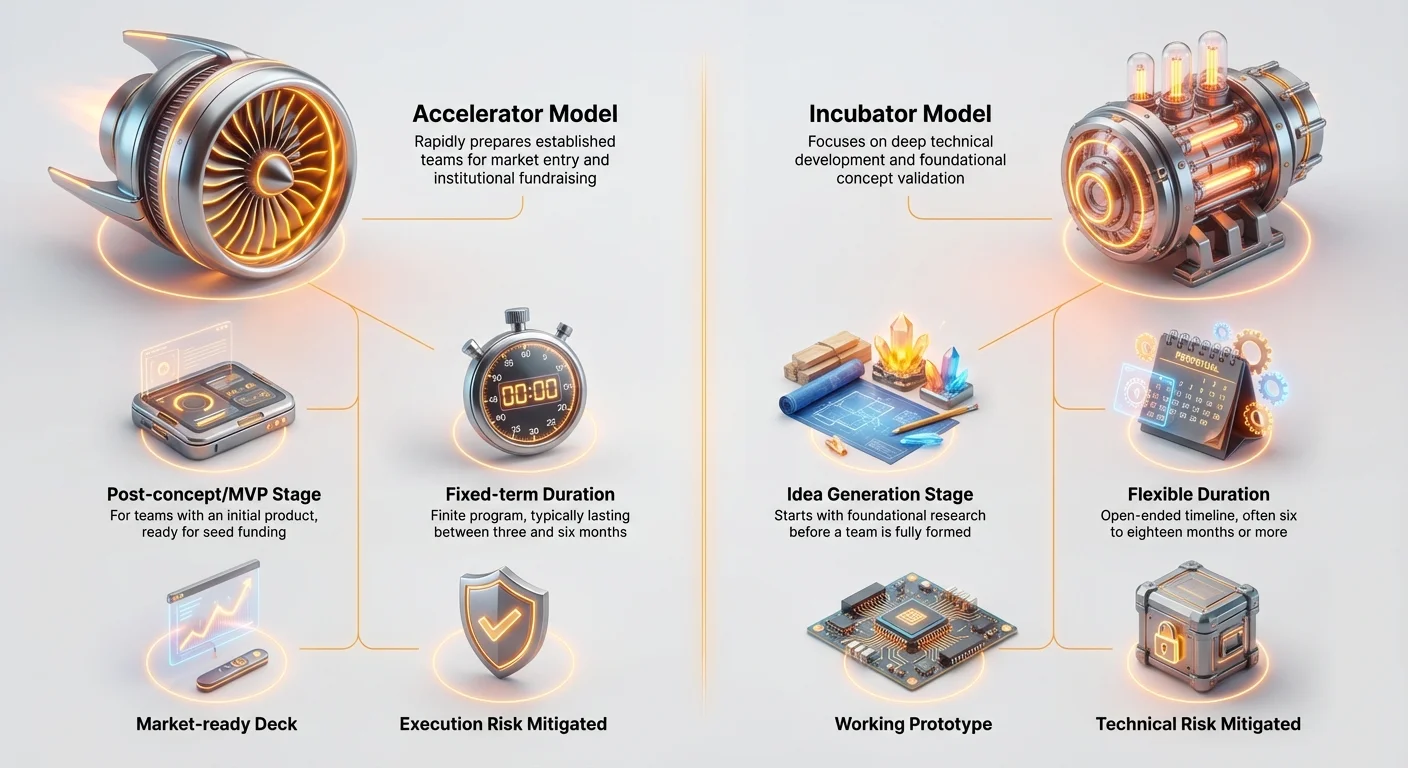
Accelerators are defined by their finite, fixed-term nature, typically lasting between three and six months. Projects are accepted into "cohorts"—groups of startups that proceed through the program together.
The curriculum is intense and broad, focused heavily on business scaling rather than fundamental technical development. Key areas of focus include:
- Mentorship and Network Building: Weekly sessions with successful entrepreneurs, core protocol developers, and key VCs. The primary value here is the network, which facilitates partnerships and future funding rounds.
- Go-to-Market Strategy: Refining marketing plans, community building strategies, and clarifying the project’s unique value proposition.
- Legal and Compliance: Guidance on jurisdiction selection, corporate structuring, and initial token economics (tokenomics).
- Demo Day: The program culminates in a public or private "Demo Day," where the cohort presents its progress to a curated audience of potential investors, signaling their readiness for seed or Series A funding.
2. Strategic Value Proposition for Founders
For founders, joining an accelerator provides instant credibility and compresses years of potential learning into a few highly focused months.
The primary strategic advantages include:
- Validation: Being accepted into a prestigious accelerator (like Binance Labs, Techstars, or specialized crypto programs) serves as a powerful signal of quality to the wider investment community. It signifies that the project has passed initial institutional due diligence.
- Rapid Feedback Loop: The short duration forces teams to iterate quickly and achieve product-market fit under pressure. They are pushed to test assumptions and pivot rapidly if necessary.
- Capital Injection: Accelerators provide immediate, standardized seed capital (often between $100,000 and $500,000) in exchange for a small, predefined amount of equity or token allocation (typically 5% to 10%).
3. Strategic Value for Limited Partners (LPs)
Investors who place capital into a fund that runs an accelerator model are seeking efficiency and risk management.
- Deal Flow Filter: LPs rely on the accelerator staff to perform initial rigorous screening and due diligence on hundreds of applicants. The accelerator acts as a high-quality filter, ensuring the LP only sees vetted projects with viable teams.
- De-risking through Cohort Vetting: The accelerator process provides real-time performance data. By the time of Demo Day, LPs have tangible evidence of a team’s execution capability and market feedback, significantly lowering the risk compared to investing in a cold seed round.
- Faster Capital Deployment and Turnover: Since accelerators focus on projects that are already structured and ready to scale, the time between initial investment and a subsequent Series A or token launch (liquidity event) is relatively shorter, allowing the LP fund to see returns faster.
The Incubator Model: Deep Build and Concept Validation
In contrast to the accelerator’s focus on speed, the crypto incubator model emphasizes deep, often technical, development and the foundational validation of a concept before a team is fully formed or external capital is sought. Incubators operate like research and development (R&D) labs.
1. Structure and Operational Mandate
Incubators are highly flexible, and often do not adhere to fixed timelines or cohorts. The project length is dictated by the complexity of the foundational build. Many incubators are run directly by large foundational protocols (e.g., the Ethereum Foundation, Solana Ventures) or corporate entities looking to expand their ecosystem.
Key characteristics include:
- Hands-On Technical Support: Incubators provide heavy, day-to-day technical involvement. They often supply the initial engineering talent, legal framework, and even the core concept itself, seeking to fill a specific perceived gap in the market or protocol ecosystem.
- Pre-Team Concept: Incubators often start with just an idea. They find the right talent after the concept is validated, sometimes hiring internal staff specifically to lead the incubated project.
- Resource Allocation: Projects receive dedicated physical workspace, computing resources, and access to internal tooling of the parent organization. Funding is deployed iteratively based on milestones rather than in a single lump sum.
2. Strategic Value Proposition for Founders (or Core Developers)
For developers and potential founders, the incubator is the best place to start if the idea is highly technical, highly novel, or requires deep integration with a parent protocol that already controls significant technical infrastructure.
- Minimized Initial Risk: The incubator environment shields the nascent team from immediate market pressure and fundraising demands. They can focus purely on technical execution and concept validation without worrying about pitch decks or investor outreach.
- Full Access to Ecosystem IP: If the incubator is run by a major protocol (like Polkadot or Avalanche), the incubated project gains unparalleled access to the protocol’s core development team, technical architecture, and internal testing environments.
- Stronger Initial Foundation: By providing legal and compliance resources from day one, projects can structure their tokenomics and governing documents correctly under expert supervision, preventing costly restructuring later.
3. Strategic Value for Parent Entities and LPs
When an investor (LP) or parent entity (e.g., a centralized exchange or Layer-1 Foundation) funds an incubator, their motivations are often strategic and long-term, not just financial.
- Ecosystem Control and Growth: The parent entity can steer development to ensure critical infrastructure components (or dApps) are built that benefit the entire ecosystem, maintaining competitive advantage.
- IP Ownership and Retention: Because the incubator is involved from the earliest stage, the parent entity often retains a larger portion of initial equity or token allocation compared to an accelerator, potentially including a claim on the underlying Intellectual Property (IP) developed during the incubation phase.
- Talent Scouting: Incubators serve as an excellent mechanism for the parent entity to identify and recruit high-caliber technical talent who excel at product development.
Key Structural Differences: A Strategic Analysis
The difference between an accelerator and an incubator is not just semantic; it dictates the investment thesis, the sourcing methodology, and the risk profile for investors.
| Feature | Crypto Accelerator Model | Crypto Incubator Model |
|---|---|---|
| Stage Focus | Post-concept/MVP; Pre-Seed/Seed ready | Idea generation; Foundational research |
| Duration | Fixed-term (3-6 months) | Flexible, Open-ended (6-18 months typically) |
| Program Type | Structured, cohort-based, education-focused | Highly flexible, project-specific, development-focused |
| Key Output | Market-ready pitch deck, scalable roadmap, seed fundability | Technical validation, working prototype, strong core code |
| Funding Size | Standardized, smaller initial investment | Variable, milestone-based disbursements |
| Primary Risk Mitigated | Team execution risk and market fit risk | Technical and concept validation risk |
1. Investment Thesis: Viability vs. Necessity
The core strategic difference lies in the investment philosophy:
- Accelerator Thesis (Viability): The goal is to rapidly find market validation. The investment thesis assumes the project can succeed if given the right guidance and connections. The accelerator seeks to maximize the number of viable projects ready for Series A funding. Success is measured by the valuation increase at Demo Day and subsequent external funding rounds.
- Incubator Thesis (Necessity): The goal is often to solve a critical, internal problem for the parent entity or the underlying protocol. The investment thesis focuses on ensuring a specific piece of technology needs to be built for the ecosystem to thrive. Success is measured by the technical stability of the resultant protocol and its integration value.
2. Equity vs. Token Allocation and Deal Mechanics
How capital is exchanged for ownership varies significantly:
Accelerator Deal Structure: Standardized and Convertible
Accelerators typically use standardized legal instruments, like a Simple Agreement for Future Equity (SAFE) or Simple Agreement for Future Tokens (SAFT). The deal is transactional: in exchange for $X capital, the accelerator receives Y% of the future company or Z tokens at a discounted or predefined future valuation.
- For Founders: This predictable structure minimizes legal haggling and allows founders to focus on execution.
- For LPs: The standardized terms provide rapid deployment capability and clear vesting schedules, simplifying portfolio management.
Incubator Deal Structure: Custom and Highly Dilutive (Initially)
Incubators, particularly those managed by centralized entities, may not even establish a separate legal entity or token allocation until the technical proof-of-concept is complete. When allocation does occur, it is often less standardized.
- For Founders: Founders may face more initial dilution because the incubator provided not just capital, but the concept and the entire initial team (often resulting in 15% to 25% allocation to the parent entity). However, this high dilution is compensated by the reduced personal financial risk and the deep resources provided.
- For Parent Entities: The high initial allocation ensures control over strategic direction and safeguards the investment if the project becomes critically important to the ecosystem.
3. Deal Sourcing Strategies
The method used to find projects impacts the diversity and maturity of the resulting portfolio:
- Accelerator Sourcing (Broad Funnel): Accelerators cast a wide net, relying on high-volume, public application processes. This allows them to discover truly novel, globally diverse teams. Their due diligence focuses heavily on team dynamics, historical execution track record, and initial traction metrics.
- Incubator Sourcing (Targeted Recruitment): Incubators often source deals through Request for Proposals (RFPs) or by identifying successful talent (hackathon winners, core community contributors) and actively recruiting them to lead an internal project. Due diligence centers on technical expertise and alignment with the parent entity’s long-term roadmap.
Capitalization, Compliance, and Tax Considerations
For sophisticated investors, the operational aspects—specifically how these models handle regulatory compliance and initial financial structuring—are as important as the concept itself.
1. The Importance of Early Legal and Jurisdiction Selection
A crucial stage for any early-stage crypto project is defining its legal structure and primary operating jurisdiction. This decision profoundly impacts tax liabilities and regulatory exposure.
- Accelerators and Compliance: Because accelerators prioritize speed and preparing the project for external investment, they often require projects to establish a legal entity (e.g., in the Cayman Islands, Singapore, or Switzerland) within the first month. The accelerator provides guidance on finding compliant legal counsel but expects the founding team to execute the filing quickly. This upfront establishment is critical for defining the tax status of future token sales or equity distributions.
- Incubators and Compliance: Incubators often allow the project to operate under the parent entity's legal and financial umbrella during the R&D phase. This delays the need for the founding team to hire costly legal and accounting services, but the team must eventually "spin out" into its own entity. This spin-out process must be managed carefully to ensure clear IP transfer and avoid accidental tax liabilities for the parent company.
2. Tax Reporting in Decentralized Structures
Compliance platforms have simplified crypto tax reporting for individuals, but early-stage funding still presents complex challenges for corporate structures, particularly regarding token vesting and phantom income.
- Token Vesting Schedules: Both models rely heavily on token vesting schedules (tokens are released over time, usually 3-4 years, to incentivize long-term commitment). Proper accounting must be established early to track when tokens are earned, when they are taxed, and how they are valued upon distribution.
- Accelerator Advantage: Due to the standardized deal structure (often using SAFEs/SAFTs), the accelerator portfolio often benefits from cleaner, easier-to-audit records, simplifying subsequent due diligence by institutional funds.
- Incubator Complexity: If an incubator provides internal salaries, resources, and grants before formal token allocation, the project must meticulously track these non-cash inputs to properly value the initial cost basis of the project, which affects capital gains calculations later. Utilizing specialized crypto tax and accounting services from the beginning is non-negotiable for both models to manage compliance accurately.
3. Investor Due Diligence on the Fund Manager
When an LP invests in a crypto VC fund, they are essentially betting on the fund manager's ability to execute one of these two models successfully.
- Due Diligence for Accelerator Funds: LPs should scrutinize the fund manager’s network (who are the mentors?), the exit track record of previous cohorts, and the manager’s ability to successfully guide projects through Series A or token liquidity events.
- Due Diligence for Incubator Funds: LPs must assess the technical depth of the fund manager’s team and their integration strategy with the parent protocol. Success here hinges on technical risk assessment, not market risk assessment. The LP must trust the fund manager’s vision for the ecosystem’s long-term technical needs.
Conclusion: Choosing the Right Launchpad
For founders, the choice between an Accelerator and an Incubator is determined by the maturity of the idea and the immediate needs of the team:
- Choose the Accelerator: If you have a solid team, an MVP, and clarity on your target market, but lack institutional connections and need rapid scalability and business mentorship.
- Choose the Incubator: If your idea is highly technical, requires foundational R&D, and needs deep resource support from a major protocol or entity before being exposed to market pressures.
For institutional investors, the choice reflects the desired risk and control profile:
- Back an Accelerator Fund: If you seek diversified, faster-turnover deal flow and rely on a cohort-based screening mechanism to vet projects focused on market scalability.
- Back an Incubator Fund: If you seek strategic, long-term control over specific technical ecosystem development, are comfortable with longer lock-up periods, and prioritize technical validation over immediate market viability.
Both accelerators and incubators are vital engines driving early-stage blockchain innovation. By serving distinct stages of development—from raw concept to market-ready product—they ensure that capital flows efficiently, mitigating different types of risk across the decentralized finance landscape.