
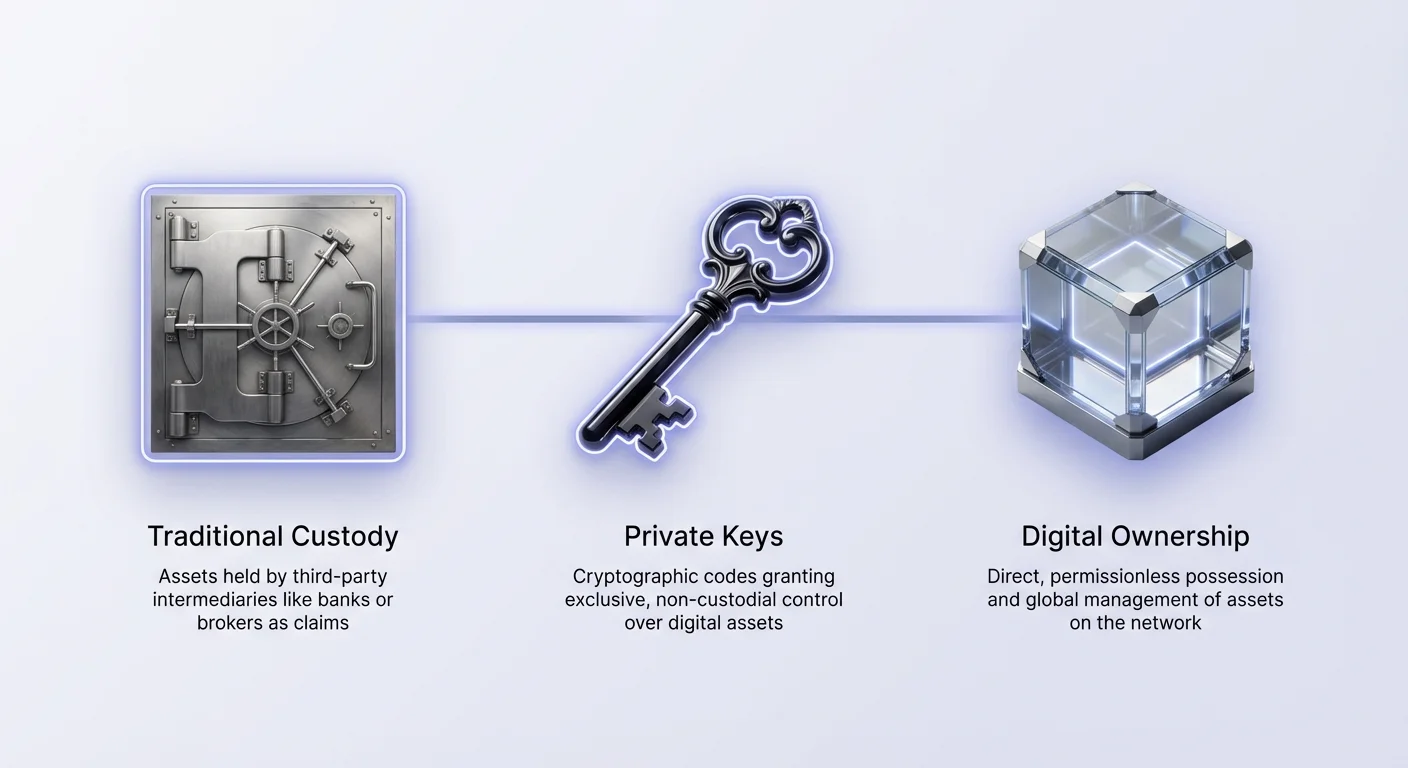
The Shift to Digital Ownership
The transition from traditional finance to the cryptocurrency ecosystem represents more than just a change in technology. It marks a fundamental shift in how individuals perceive and handle ownership. In the legacy financial world, assets are rarely held directly by the owner. When you purchase a stock or hold money in a bank account, you are essentially holding a claim or an IOU. A third party, such as a bank or a broker, stands between you and your wealth. This intermediary acts as a custodian, managing the ledger and approving your interactions with your own funds.
Cryptocurrency, specifically Ethereum, introduces a model built on non-custodial and permissionless principles. This technology allows users to take true possession of digital assets in a way that was previously reserved for physical cash. Because these assets exist on a digital network, they can be managed globally at the speed of the internet. However, this freedom brings the responsibility of self-custody. Understanding how to set up and manage an Ethereum wallet is the first step toward participating in this decentralized economy.
Taking control of your financial identity requires new tools. Unlike a physical leather wallet that holds cards and cash, an Ethereum wallet is software that manages the keys to your funds. This software acts as your interface to the blockchain network. It allows you to view balances, sign transactions, and interact with decentralized applications without asking for authorization from a centralized entity.
Permissionless Systems vs. Traditional Custodians
The distinction between custodial and non-custodial models is critical for new users to understand The Spectrum of Custody Risks. In the traditional custodial model, accounting practices can be opaque. Users are exposed to the risk of the custodian going bankrupt or mismanaging funds. Furthermore, the custodian has the power to freeze accounts, delay withdrawals, or deny transactions entirely. You must ask for permission to move your own assets.
In contrast, a self-custodial Ethereum wallet eliminates the middleman. You have full control over your assets 24 hours a day, seven days a week. There is no need to request approval to send a transaction, and no third party can confiscate your funds as long as you secure your private keys. This setup mirrors holding physical cash but extends the utility to complex digital interactions.
The Role of Digital Wallets
Digital wallets serve as the bridge between the user and the Ethereum network. While centralized exchanges are a popular entry point for buying ether (ETH), they often retain control of the assets. They hold the keys, meaning the user only has a claim to the funds displayed on the screen. This exposes the user to platform risks, such as hacking incidents or insolvency.
To truly utilize the Ethereum network, moving funds to a self-custodial wallet is necessary. These applications store the cryptographic information needed to access and move funds on the blockchain. When you install a self-custodial wallet app on your mobile device or computer, the software automatically generates the necessary accounts. This grants you immediate ability to receive, store, and interact with DApps without a registration process or credit check.
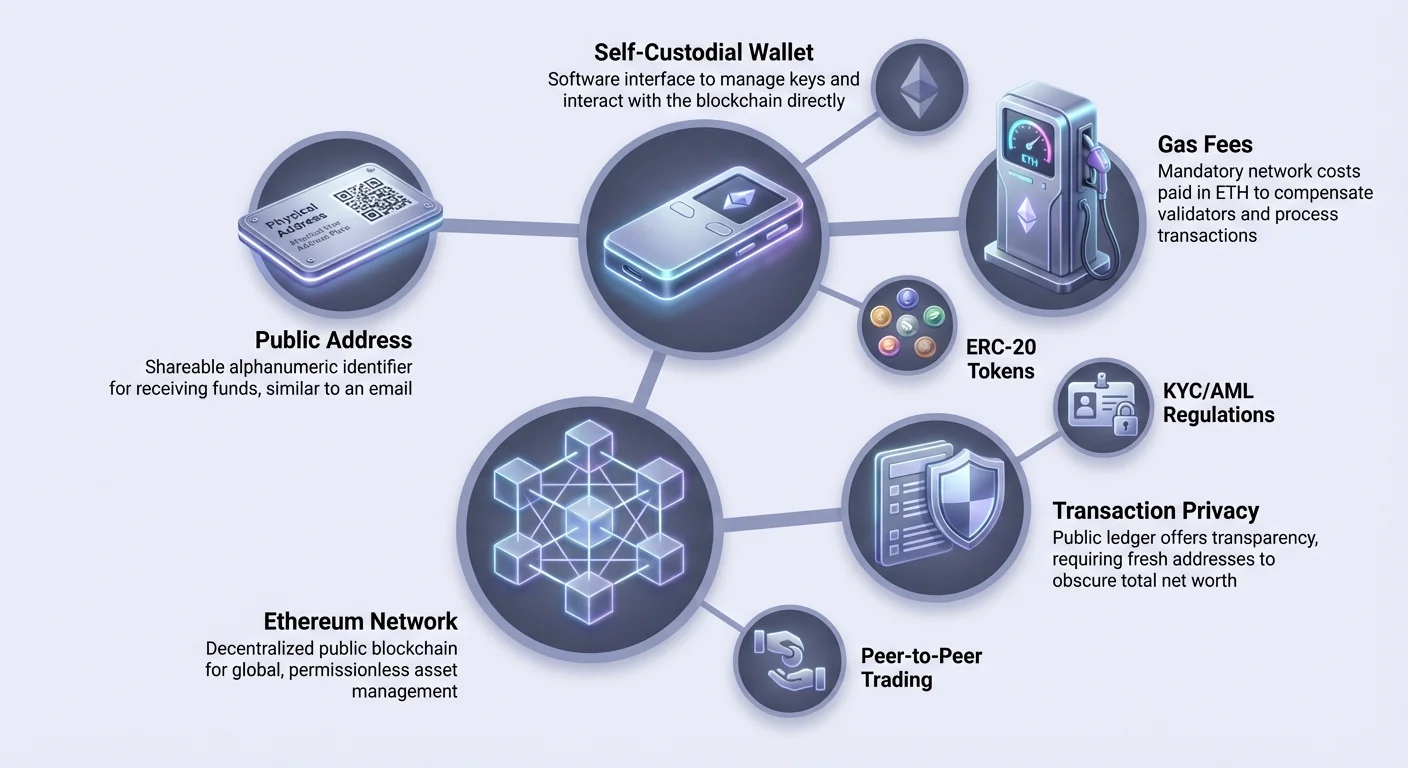
Navigating Ethereum Addresses and Privacy
Once a wallet is established, the primary identifier you will interact with is the Ethereum address. This address functions similarly to a bank account number or an email address for crypto. It is the destination you provide to others so they can send you funds. A typical Ethereum address appears as a long string of alphanumeric characters, always starting with "0x". For example, it might look like 0xab41b92c6d43f4b7a670b65479f5bb809646602e.
Locating this address within your wallet interface is usually straightforward. Most wallet applications display it prominently or hide it behind a "Receive" button. To share it, users can copy the text string to their clipboard or show a QR code. The QR code is particularly useful for in-person transactions, as the sender can scan it with their device to autofill the destination field, eliminating the risk of typing errors.
Public Ledgers and Personal Privacy
Safety is a common concern when sharing wallet addresses. It is generally safe to provide your Ethereum address to friends, family, or business associates. A malicious actor cannot steal funds simply by knowing your address; they would also need the private key associated with it. However, the Ethereum network operates on a public blockchain, which has implications for privacy and traceability.
Because the ledger is public, anyone who knows your specific address can view its entire history. By pasting the address into a block explorer, an observer can see your current balance and every transaction you have ever executed. This transparency is a feature of the network, ensuring trust and verification without a central authority.
To maintain privacy, it is often recommended to use fresh addresses for different transactions. Many modern wallets allow users to create an unlimited number of new addresses or sub-wallets at the touch of a button. This helps segregate funds and obscures your total net worth from casual observers.
Organizing Your Assets
Advanced wallet management involves using different addresses for different purposes. A single wallet application can manage multiple distinct addresses, allowing for better organization. For instance, a user might create one specific wallet address labeled "Savings" for long-term holding and another labeled "Daily Spending" for regular interactions.
Each of these wallets operates independently on the network, even if they are managed by the same app on your phone. This separation can also assist in tracking specific income streams or managing different types of assets. Since Ethereum supports various tokens beyond just ETH, a single address can hold a diverse portfolio of digital assets.
| Feature | Self-Custodial Wallet | Custodial Exchange |
|---|---|---|
| Control | You hold the keys | Exchange holds keys |
| Privacy | High (Pseudo-anonymous) | Low (KYC required) |
| Access | 24/7 Permissionless | Subject to approval |
Funding Your Self-Custodial Wallet
Before you can interact with the network, your wallet requires ether (ETH). There are several avenues to acquire ETH, each with its own set of advantages and trade-offs. For many, the most direct method is purchasing through a digital wallet provider that offers integrated buying services. This allows you to buy ETH using traditional payment methods like credit cards and have the coins deposited directly into your self-custodial address.
Alternatively, users often utilize centralized exchanges. This involves creating an account with a third-party platform, verifying your identity, and purchasing ETH. Once the purchase is complete, the ETH sits in the exchange's custodial wallet. To take full control, you must initiate a withdrawal from the exchange to your personal wallet address. This step is crucial for mitigating the counterparty risks associated with leaving funds on a centralized platform, known as CEX to Self-Custody Migration.
Identity Verification Standards
When purchasing ETH with government-issued currency, you will almost always encounter regulatory requirements. These are known as Know-Your-Customer (KYC) and Anti-Money-Laundering (AML) regulations. Whether you use a direct buy option in a wallet app or a centralized exchange, you will likely need to provide identification documents.
This process usually involves submitting a photo of a driver's license or passport and possibly a facial scan. While this removes the anonymity of the initial purchase, it is a standard legal requirement for platforms bridging the gap between fiat currency and cryptocurrency. Peer-to-peer marketplaces are another option, where buyers interact directly with sellers, potentially offering different payment methods and privacy levels.
Escrow and Peer-to-Peer Safety
For those seeking alternative buying methods, peer-to-peer (P2P) platforms facilitate trades between individuals. In this scenario, a buyer searches for listings based on their preferred payment method and the seller's reputation. To ensure safety, the platform typically locks the seller's ETH in an escrow account.
The buyer then sends the agreed payment directly to the seller. Once the seller confirms receipt of the funds, the ETH is released from escrow directly to the buyer's wallet. This method relies on a reputation system and the technical security of the escrow smart contract rather than a centralized broker holding the inventory.
Understanding Network Fees and Gas
Every transaction on the Ethereum network requires a fee. These fees are paid in ether (ETH) and are commonly referred to as "gas." Mastering Gas Fees is essential because it compensates the network validators who process transactions and secure the blockchain. Without a balance of ETH in your wallet, you cannot send tokens, mint NFTs, or interact with decentralized applications, even if you have other tokens in your account.
The cost of a transaction is not fixed. It fluctuates based on market forces and network congestion. When many people are trying to use the network simultaneously, the demand for block space increases, driving up the price of gas. Conversely, during periods of low activity, fees tend to decrease.
The Components of a Transaction Fee
Following the EIP-1559 upgrade, Ethereum transaction fees are split into two distinct parts: the base fee and the priority fee. The base fee is a mandatory cost determined by the network's current traffic levels. Crucially, this base fee is "burned," meaning it is permanently removed from the circulating supply of ETH. This mechanism connects network usage directly to the economic scarcity of the asset.
The second component is the priority fee, often called a tip. This is an optional additional amount paid directly to the validators. By adding a higher tip, a user can incentivize validators to prioritize their transaction over others. This is particularly useful during moments of extreme congestion when users need their transactions confirmed urgently.
Calculating Complexity and Cost
The total fee you pay is also determined by the complexity of the action you are performing. In the Ethereum ecosystem, different actions require different amounts of computational data. A simple transfer of ETH from one person to another is a relatively small transaction in terms of data. Therefore, it consumes the least amount of gas.
More complex interactions require more data and computational power. For example, interacting with a smart contract, swapping tokens on a decentralized exchange, or minting a Non-Fungible Token (NFT) involves more code execution. As the complexity increases, the amount of gas required rises, leading to a higher total transaction cost. Fees are typically denominated in "gwei," which is a smaller unit of ether (0.000000001 ETH), making it easier to quantify these small values.
Executing and Tracking Transactions
Sending ETH is a deliberate process that requires accuracy. To initiate a transfer, you must choose the amount to send and input the destination address. Modern wallets provide several input methods to reduce errors, such as pasting from a clipboard, scanning a QR code, or selecting from a saved address book. Some recipients may use human-readable aliases (like name.eth), which the wallet can resolve to the underlying hexadecimal address.
Before finalizing the transaction, it is vital to review the details. Once a transaction is broadcast to the blockchain, it cannot be reversed or canceled. The wallet interface will typically display a summary, including the destination, the amount, and the estimated network fee. Users often have the option to customize this fee, choosing between slow, average, or fast confirmation times based on how much gas they are willing to pay.
Monitoring Transaction Status
After sending funds, the transaction enters a pending state. It is broadcast to the network specifically to be included in the next available block. Wallets usually provide a link to a "transaction hash" or ID. This unique string allows you to track the status of the payment on a public block explorer.
On the explorer, you can see real-time updates, including when the transaction is picked up by a validator and confirmed. A confirmed status means the data has been permanently recorded on the blockchain. Most services consider a transaction final after a certain number of block confirmations, ensuring the security of the transfer.
Expanding Utility with Tokens
While ETH is the native currency used for fees, the Ethereum network supports a vast array of other digital assets. These are primarily known as ERC-20 tokens. These tokens live on the Ethereum blockchain and are stored in the same Ethereum wallet address as your ETH.
This standard allows for the creation of stablecoins (like USDT or USDC), governance tokens, and various utility assets. Your wallet can manage these distinct assets side-by-side. However, it is important to remember that sending an ERC-20 token still requires ETH to pay for the gas fee. You cannot pay the network fee using the token you are sending; you must always maintain a small balance of ETH for operational costs.
Conclusion
Adopting a self-custodial approach to Ethereum fundamentally changes your relationship with money. It moves you from a passive reliance on banking institutions to an active role in managing your own assets. This shift grants you the power to transact globally and permissionlessly, free from arbitrary account freezes or third-party oversight. However, it also places the burden of security entirely on your shoulders.
Mastering the basics of wallet creation, address management, and gas fees creates a solid foundation for exploring the wider Web3 ecosystem. Whether you are holding assets for the long term or interacting with decentralized finance applications, the principles of self-custody remain the same. You are the sole guardian of your keys and, by extension, your financial future.
Your private keys are the only proof of ownership; never share them with anyone.