
Imagine a powerful, sophisticated machine that can execute complex financial agreements—a smart contract. This machine is incredibly secure, robust, and lives on an immutable blockchain. However, this machine suffers from one major flaw: it is completely isolated from the outside world. It cannot access the weather, stock market prices, or the results of a sporting event.
In the world of decentralized finance (DeFi), isolation is a catastrophic limitation. A lending protocol needs to know the current price of Ethereum to liquidate an undercollateralized loan. A decentralized insurance product needs to know if a hurricane actually hit to pay out a claim. Without accurate, timely, and trustworthy external data, smart contracts are useless beyond basic token transfers.
This necessity creates what is known as the Oracle Problem. A blockchain is trustless and secure because it is deterministic; it only relies on data that everyone agrees on, already contained within the chain. Introducing external data fundamentally reintroduces the need for trust. Blockchain Oracles are the essential infrastructure designed to bridge this gap, acting as secure, decentralized messengers that bring off-chain reality onto the chain, ensuring the integrity and functionality of the entire DeFi ecosystem.
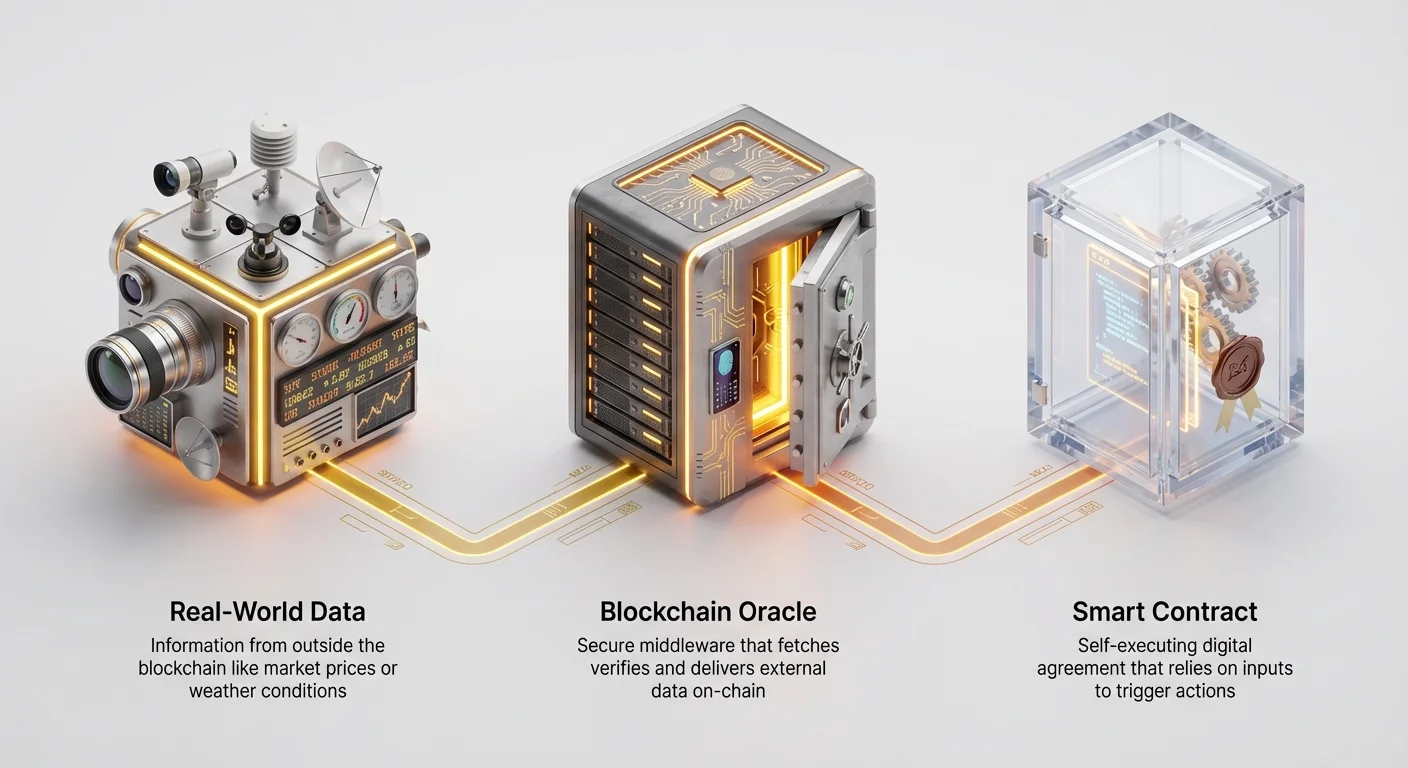
The Oracle Problem: Why Blockchains Need External Eyes
To understand the solution, we must first deeply understand the problem. Blockchain networks achieve unparalleled network security by being self-contained and deterministic. Every node processes the same information and arrives at the exact same conclusion, regardless of location or time.
The Smart Contract Sandbox
Think of a smart contract as living inside a protective, digitally isolated sandbox. It is highly secure, but it is deliberately cut off from the global internet (the real world) to prevent data manipulation that could lead to consensus failure.
When we talk about "on-chain" data, we mean information that is inherent to the blockchain itself—like transaction history, block height, and token balances. This data is easy for the smart contract to verify.
"Off-chain" data, conversely, is everything else: the current price of Bitcoin, election results, temperature readings, or information from traditional web servers. If a smart contract tried to access this external data directly, it would have to query a specific server. What if that server lied? Or went down? Different nodes validating the transaction would receive different answers, destroying the fundamental consensus mechanism that secures the blockchain. The contract execution would no longer be deterministic.
Defining a Blockchain Oracle
A Blockchain Oracle is a middleware layer—a specialized service that retrieves real-world data, verifies its authenticity, and submits it onto the blockchain for smart contracts to consume.
It is crucial to understand that the Oracle itself is not the data source; it is the secure mechanism responsible for transferring and validating the data. The Oracle’s primary function is to transform unverifiable off-chain information into a cryptographically secured on-chain input, allowing the smart contract to execute confidently and securely. Without this trusted connection, the vast majority of real-world use cases for smart contracts—especially in finance, insurance, and supply chain logistics—simply wouldn't be possible.
The Critical Role in Decentralized Finance (DeFi)
In DeFi, Oracles are the lifeblood. The reliability of decentralized applications (dApps) depends almost entirely on the reliability of their data feeds.
Key DeFi Use Cases reliant on Oracles:
- Lending and Borrowing Protocols: Protocols like Aave or Compound require precise, real-time cryptocurrency prices to calculate the value of collateral. If the Oracle feed for ETH freezes or is manipulated, borrowers could be unfairly liquidated, or the protocol could face bad debt if collateral value drops without notification.
- Stablecoins: Algorithmic stablecoins sometimes rely on Oracles to track the value of the underlying assets they are pegged to, ensuring they maintain their dollar parity.
- Derivatives and Prediction Markets: These contracts pay out based on external events, whether it’s the closing price of a stock on a specific date or the outcome of a political election. Oracles must feed the decisive result to finalize the contract.
Solving the Trust Barrier: Centralized vs. Decentralized Oracles
The core engineering challenge for any Oracle solution is this: If the entire point of the blockchain is to eliminate trusted intermediaries, how can we trust the single point that delivers the external data? The solution lies in minimizing reliance on any single entity.
Centralized Oracles: Speed and Risk
A centralized Oracle relies on a single entity or data provider to fetch and submit information.
Pros:
- Speed: Data can be delivered quickly and cheaply since only one transaction is required.
- Simplicity: Easier to deploy and manage.
Cons (The Security Trade-off):
- Single Point of Failure: If the operator is malicious, goes offline, or is hacked, the entire smart contract relying on that data becomes compromised.
- Data Tampering: The centralized entity can manipulate the data feed to their advantage.
While centralized Oracles exist for niche applications where risk tolerance is high, they fundamentally undermine the decentralized ethos of the blockchain ecosystem. They replace institutional trust (banks) with vendor trust (the Oracle provider), which is often unacceptable for mission-critical DeFi protocols.
Decentralized Oracle Networks (DONs): Achieving Consensus
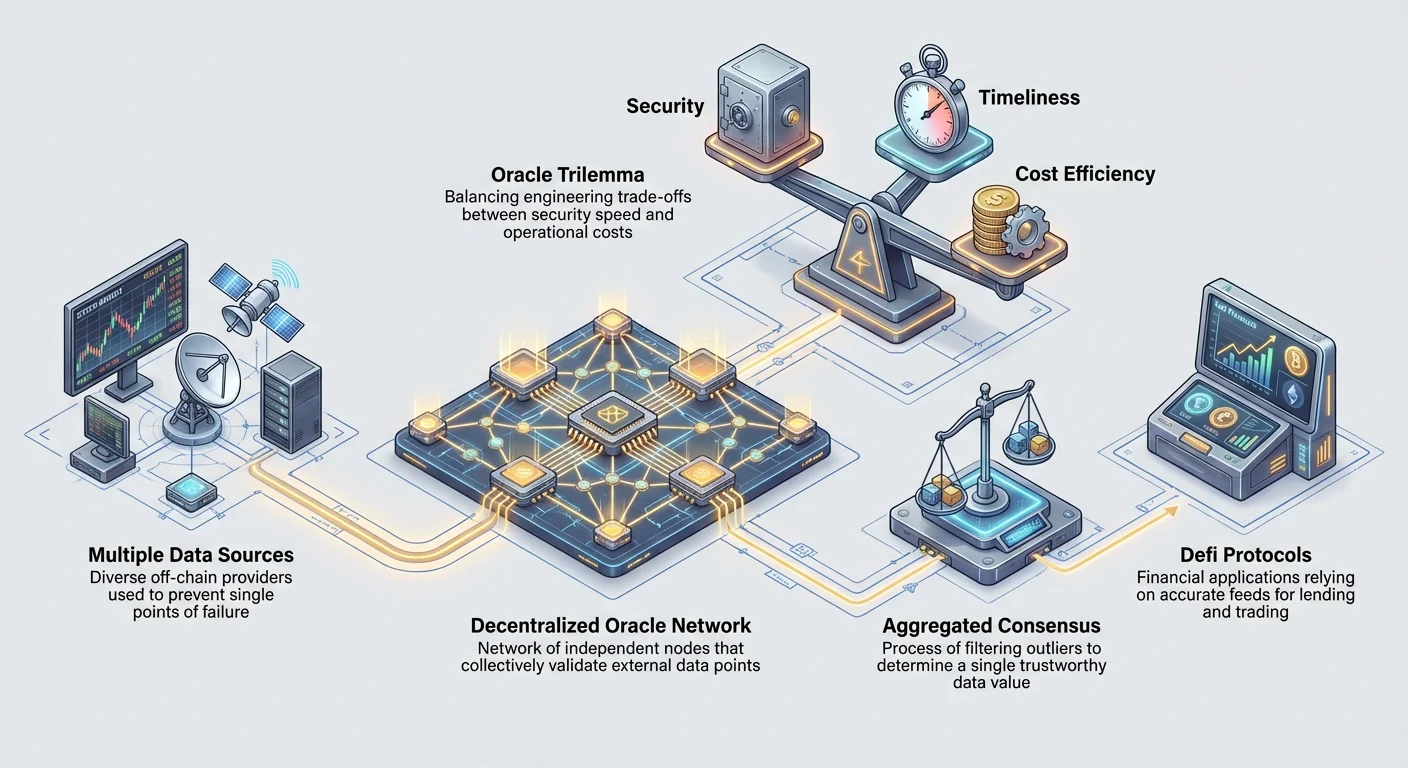
A Decentralized Oracle Network (DON) is the industry standard for securing high-value contracts. Instead of relying on one data source or one messenger, a DON relies on a network of independent Oracle nodes to collectively source, validate, and deliver data.
Here is how the consensus process works:
- Request: A smart contract requests a specific piece of data (e.g., the BTC/USD price).
- Sourcing: The request is broadcast to many independent Oracle nodes in the DON.
- Aggregation: Each node fetches data from multiple high-quality, segregated off-chain sources (e.g., various crypto exchanges).
- Consensus: The network aggregates all the individual responses, discarding outliers, and calculating a median or weighted average.
- Submission: Only the final, agreed-upon consensus data point is submitted to the blockchain in a single, verified transaction.
By requiring consensus across multiple nodes and multiple data sources, DONs drastically increase the cost and complexity required for a malicious actor to tamper with the data, thereby securing the dependent smart contract.
The Mechanism: How Data Goes On-Chain
The submission mechanism must be efficient. Data doesn't simply appear on the blockchain; it must be submitted via a transaction, which incurs gas costs.
The method of data delivery is usually one of two types:
- Request-and-Response (Query-Based): The smart contract initiates the request, paying for the transaction fees required for the Oracle network to retrieve and submit the answer back. This is common for less time-sensitive data or unique inquiries.
- Publish-and-Subscribe (Data Feeds): The Oracle network proactively updates the data on the blockchain at set intervals (e.g., every minute or whenever the price deviation exceeds 0.5%). This is essential for high-frequency pricing data required by DeFi protocols, ensuring up-to-date collateral valuation.
The Oracle Trilemma: Navigating Engineering Trade-offs
Just as the foundational Blockchain Trilemma pits Decentralization, Security, and Scalability against each other, Oracles face their own set of unavoidable engineering trade-offs, often termed the Oracle Trilemma. These forces include Data Security/Quality, Cost, and Timeliness.
A developer must balance these three variables, understanding that maximizing one often requires sacrificing another.
Security vs. Timeliness
The most secure data is the one validated by the largest number of independent sources. However, gathering data from 20 different exchanges, having 15 nodes confirm the average, and then submitting the consensus takes time.
- Prioritizing Security: Requires more nodes, more data sources, and longer aggregation periods, leading to slower updates. This is suitable for data that doesn't change rapidly (e.g., quarterly interest rates).
- Prioritizing Timeliness (Speed): Requires fewer nodes (or even one) and fast submission. This is highly risky. In the volatile crypto world, a one-minute delay in a price feed can lead to devastating liquidation cascades, where protocols act on outdated pricing, known as a Time Lag Attack.
Cost vs. Decentralization
Data delivery is a paid service; every Oracle node must be compensated for the computation, data subscription fees, and gas fees incurred during the on-chain submission process.
- Prioritizing Cost: Using a centralized Oracle or a DON with very few nodes is cheap because fewer transaction fees are paid. However, this dramatically reduces decentralization and increases security risk.
- Prioritizing Decentralization (Security): Using a vast network of 50+ independent nodes pulling from 100+ sources is incredibly robust, but the cumulative cost of paying all those nodes and paying the gas fees to submit their aggregated data can become substantial, especially during network congestion.
Protocols must pay for the level of security they require. High-value DeFi platforms dealing with billions in assets must prioritize decentralization and security, accepting the higher operational cost.
Comparing Trade-offs: The Importance of Context
The ideal Oracle solution is context-dependent:
| Context | Oracle Priority | Trade-off Accepted |
|---|---|---|
| Lending Protocol | High Security, High Timeliness | High Cost (Must afford frequent, robust updates) |
| NFT Floor Price Tracker | High Decentralization, Low Timeliness | Slower updates accepted (price movement is less frequent) |
| Internal Treasury Management | Low Decentralization, Low Cost | Higher Centralized Risk accepted (lower stakes) |
The Oracle Trilemma highlights that the security of a smart contract is directly tied to the economic sustainability of its data feed. If the Oracle is cheap, it's likely centralized or slow, making the contract vulnerable.
Advanced Oracle Applications and Types
As the complexity of DeFi has grown, so too has the need for Oracles that can do more than just relay simple price feeds. The latest generation of Oracles handle complex computation and integrate novel technologies to maintain trust.
Computation Oracles and Off-Chain Logic
Traditional price Oracles simply report a number (e.g., "ETH is $3,000"). Computation Oracles, sometimes called decentralized services, execute complex calculations off-chain and only submit the secure result to the blockchain.
Why this is necessary:
- Gas Efficiency: Running complex calculations (like calculating mortgage collateral ratios, complex bond pricing, or running machine learning algorithms) on-chain is prohibitively expensive due to high gas fees and the limited processing capacity of the blockchain.
- Access to Large Data Sets: Calculations might require accessing massive data sets (big data) that could never fit on a blockchain block.
The Computation Oracle executes the necessary logic off-chain, verifies the integrity of the process through cryptographic proofs or consensus, and then posts only the final, verifiable output back to the smart contract, saving significant time and cost.
Input and Output Oracles (Connecting to the Real World)
Oracles are not only necessary for bringing data into the blockchain (Input Oracles) but also for relaying instructions out to the real world (Output Oracles).
- Input Oracles (Most Common): Provide data necessary for contract execution (e.g., price feeds, weather data).
- Output Oracles: Enable smart contracts to trigger external actions. For example, once a smart contract verifies that a specific milestone has been reached in a supply chain, an Output Oracle can send a message to a traditional web server to initiate a physical bank transfer or unlock a smart lock.
This bi-directional capability is essential for connecting Web3's secure logic to the physical infrastructure of Web2, completing the automation loop.
Bridging Trust with TEEs (Trusted Execution Environments)
One innovative solution to verify data integrity without relying solely on decentralized consensus is the use of Trusted Execution Environments (TEEs).
A TEE is a secure, isolated area within a processor (hardware) that ensures any code running inside it is guaranteed to be untampered with and that the data being processed remains confidential.
When Oracle nodes operate within TEEs:
- Data Confidentiality: The TEE can prove that the data was retrieved securely, without interference from the node operator itself.
- Process Integrity: The TEE can cryptographically attest that the calculations performed on the data (e.g., averaging the prices) were executed exactly as programmed, without malicious alteration.
This hardware-level security provides an additional, robust layer of trust, especially useful for handling sensitive data where privacy or absolute integrity is non-negotiable.
The Cost of Failure: Attack Vectors and Security Concerns
The Oracle layer is arguably the most critical and vulnerable point in the DeFi security stack. A faulty Oracle can lead to catastrophic losses, regardless of how secure the underlying smart contract code is.
Data Manipulation (Data Poisoning)
This attack involves intentionally feeding false or manipulated information to the smart contract.
Example Scenario: An attacker controls a sufficient number of nodes in a small, less-decentralized Oracle network. They instruct these nodes to report an extremely high price for an illiquid asset they hold as collateral. The lending protocol, receiving this malicious consensus, believes the collateral is safe and allows the attacker to borrow massive amounts of stablecoins against the inflated value. The attacker then repays the Oracle nodes and vanishes, leaving the protocol with worthless collateral.
This emphasizes why diversity—of nodes, data sources, and aggregation methods—is the primary defense mechanism for Oracle security.
Single Points of Failure (Centralized Risk)
Even decentralized protocols sometimes rely on centralized or secondary data feeds for certain niche assets. If the Oracle that controls this specific feed fails or is compromised, the failure can cascade.
In high-profile security incidents, losses often trace back not to a flaw in the core smart contract logic, but to the assumption that the data provided by a centralized source was infallible. The principle of decentralization must extend to the data feeds themselves to ensure true security.
Time Lag Attacks (Flash Loan Exploits)
Time lag attacks exploit the difference between when an Oracle updates the price on the blockchain and the true, real-time market price. These attacks are frequently combined with flash loans—large, uncollateralized loans that must be repaid within a single transaction block.
- The Attack: An attacker takes a flash loan.
- Manipulation: They use a small amount of the loan to temporarily crash the price of Asset X on a small, centralized exchange used as an Oracle source.
- Exploitation: The Oracle updates the low, manipulated price on the chain.
- Profit: The attacker uses the momentarily low Oracle price to buy or liquidate assets at a massive discount on the DeFi protocol.
- Repayment: The flash loan is repaid, and the attacker walks away with the profit.
Decentralized Oracle Networks mitigate this by pulling data from dozens of volume-weighted sources, making it prohibitively expensive for an attacker to manipulate the price across enough venues to trick the aggregated feed.
Best Practices for Users and Developers
For users interacting with DeFi and for developers building new protocols, understanding the Oracle infrastructure is paramount to assessing risk.
Auditing Data Source Diversity
If you are using a dApp, always ask: Which Oracle network does this application rely on, and how diverse are its data sources?
A robust Oracle network should be transparent about the number of independent nodes running the service, the number of distinct data exchanges or APIs they pull from, and the methodology used for aggregation (e.g., median, volume-weighted average). High-quality Oracle services will provide public documentation detailing their security guarantees and operational procedures.
Understanding the Cost of Security
For developers, choosing an Oracle is not merely a technical decision; it is an economic decision that determines the security budget of the protocol. Choosing a cheaper, less decentralized solution may save thousands in gas fees over a year, but it exposes the protocol to millions (or billions) in loss potential.
Protocols must prioritize data security and reliability over small efficiency gains, ensuring that the DON's economic cost of submission remains lower than the economic cost an attacker would need to pay to successfully corrupt the data feed. This economic security threshold is the ultimate defense layer provided by robust decentralized Oracles.
Conclusion
Blockchain Oracles are the invisible, yet indispensable, infrastructure that transforms immutable smart contracts from closed-off sandboxes into functional applications capable of interacting with the real world. By solving the Oracle Problem—the challenge of securely and trustlessly importing external data—Decentralized Oracle Networks have become the fundamental security backbone of the entire DeFi ecosystem.
Oracles secure billions of dollars in digital assets daily. As Web3 continues to evolve, expanding into areas like decentralized identity, gaming, and real-world asset tokenization, the complexity and criticality of the Oracle layer will only increase. Understanding the engineering trade-offs inherent in the Oracle Trilemma and recognizing the necessity of decentralized data feeds is essential for anyone seeking to navigate the future of decentralized technology securely.