
Досліджуючи світ цифрових активів, концепція «self-custody» — бути своїм власним банком — є центральною. Однак покладаючись на єдину секретну фразу (приватний ключ вашого гаманця), створюється масивна єдина точка відмови. Якщо цей ключ втрачено, вкрадено або скомпрометовано, кошти зникають назавжди.
Для окремих осіб цей ризик керується ретельними практиками безпеки. Але що відбувається, коли криптовалюта зберігається не однією особою, а бізнесом, сімейним трастом чи громадською організацією? У цих ситуаціях посиленої безпеки недостатньо; потрібні примусові правила, перевірки та баланси.
Саме тут багатопідписний (multi-sig) гаманець перетворюється з функції безпеки на потужний інструмент керування. Багатопідписні гаманці вирішують проблему єдиної точки відмови, вимагаючи схвалення від кількох сторін перед тим, як кошти можуть бути переміщені. Вони дозволяють групам встановлювати чіткі правила фінансового контролю, забезпечуючи спільну відповідальність, запобігаючи одностороннім діям та структуруючи складні моделі довіри для керування значним колективним багатством.
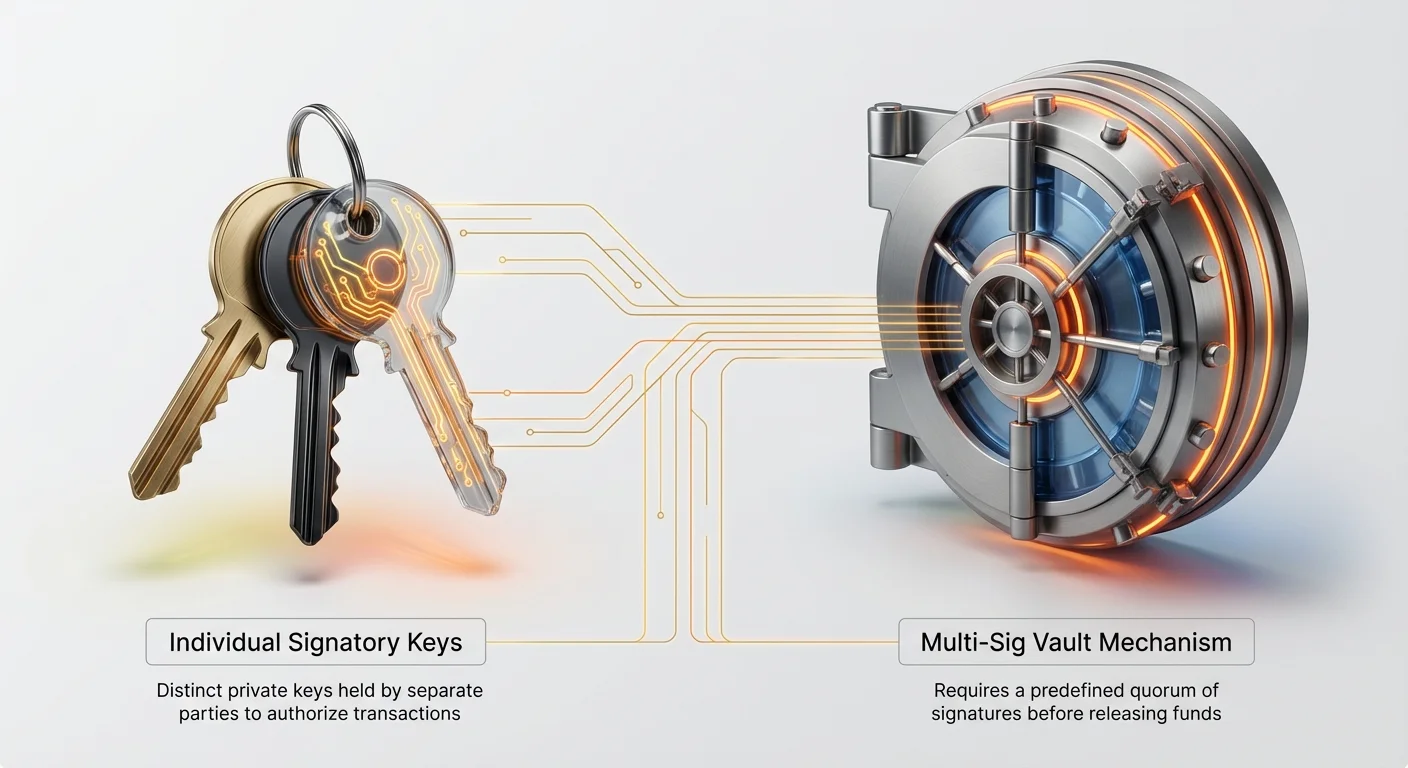
I. Foundations: Moving Beyond the Single-Key Wallet
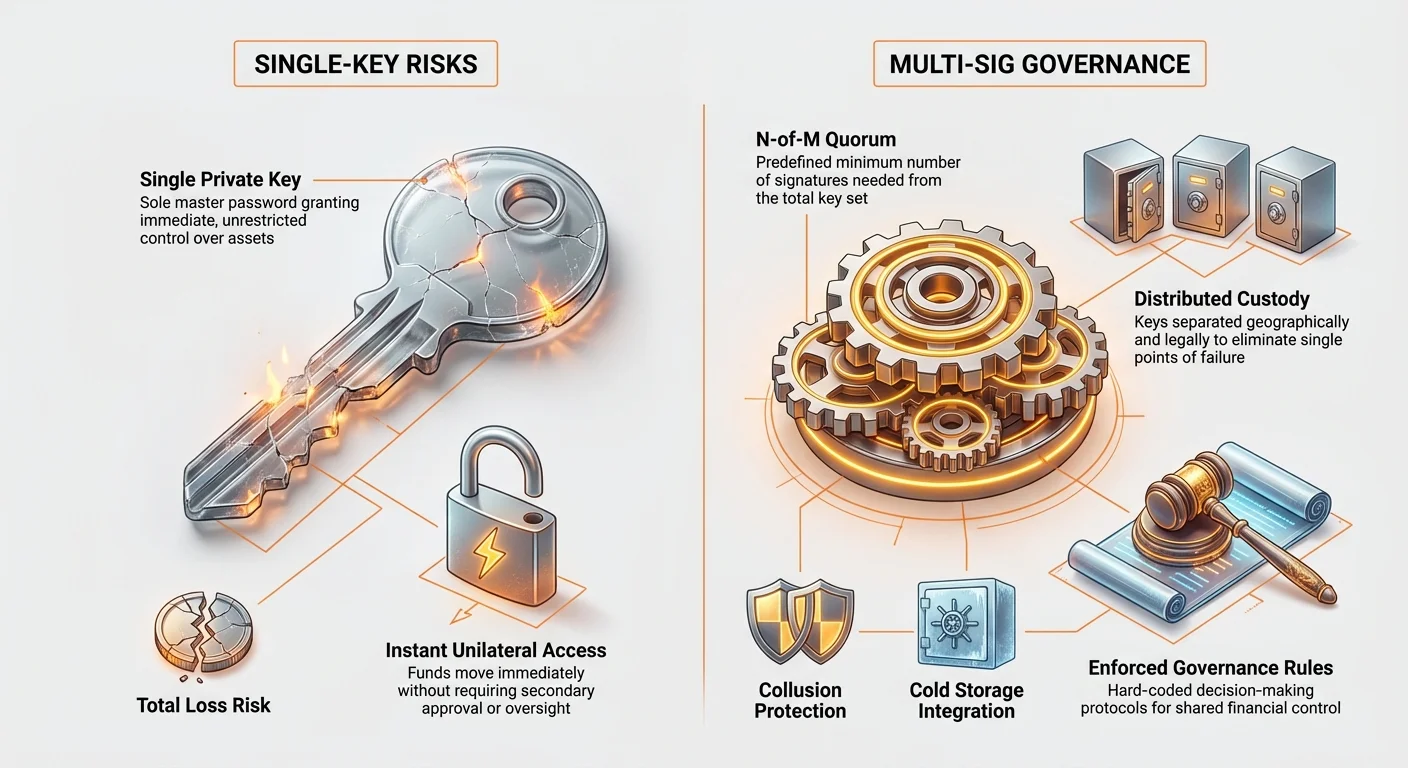
To understand the power of multi-sig, we must first recognize the structure of a standard crypto wallet. Most personal wallets are based on a single private key. This key acts as the master password, and anyone who possesses it can authorize any transaction instantly.
Multi-signature technology fundamentally changes this model. Instead of relying on one master key, a multi-sig wallet is defined by a specific set of rules written into the blockchain's smart contract.
The Mechanism of N-of-M Signature Schemes
A multi-signature scheme is often described using the formula "N-of-M."
- M (Maximum Keys): This represents the total number of private keys registered to control the wallet. These keys are held by separate individuals, devices, or entities (the custodians).
- N (Required Keys): This represents the minimum number of signatures (approvals) required from the M keys to authorize and execute a transaction.
For example, in a 3-of-5 multi-sig setup:
- M = 5 (There are five people/devices holding keys).
- N = 3 (Any three of those five people must sign the transaction for it to be valid and sent).
If only two people sign, the transaction remains unauthorized and pending. If four people sign, the transaction proceeds successfully, but only three signatures were necessary.
This architecture offers two immediate benefits: enhanced security (a hacker needs multiple keys, not just one) and enhanced governance (no single person can drain the funds).
Contrasting Security: Single-Key vs. Multi-Sig
| Feature | Single-Key Wallet (Standard) | Multi-Sig Wallet (N-of-M) |
|---|---|---|
| Control | Absolute control by one person/device. | Shared control distributed among several parties. |
| Security Risk | Single Point of Failure (SPOF). Key loss = funds lost; Key compromise = funds stolen. | Eliminates SPOF. Requires collusion or multiple simultaneous compromises. |
| Governance | None (funds move instantly upon the owner's command). | Formal, predefined governance rules (quorum required for action). |
| Best Used For | Everyday spending, small amounts, high-frequency transactions. | Organizational treasuries, cold storage for large sums, inheritance planning. |
Advanced Security Layer: Cold-Storage Multisig
For organizations managing vast amounts of crypto, the multi-sig structure is often paired with cold storage (keys kept offline, typically on hardware wallets).
A common enterprise setup might involve a 4-of-7 scheme where:
- Keys 1, 2, and 3 are held by key executives or directors.
- Key 4 is held by a designated legal counsel.
- Key 5 is held in a corporate safety deposit box (as an offline backup).
- Keys 6 and 7 are held geographically separate in different locations.
To move funds, four parties must physically retrieve their keys, assemble, and sign the transaction. This high friction level makes moving funds difficult for unauthorized parties while still providing redundancy if one or two key holders are unavailable (e.g., Keys 6 and 7 are unavailable, but 1, 2, 3, and 4 are present).
II. Multi-Signature as a Governance Framework
In traditional finance, governance relies on corporate charters, board resolutions, and legal contracts. In the decentralized world, multi-signature wallets allow these rules to be hard-coded into the asset itself. This is the essence of multi-signature wallet governance.
Governance, in this context, means establishing clear rules for decision-making regarding shared financial assets.
Defining Quorum Requirements and Trust Models
The ratio chosen for the N-of-M scheme is the core of your governance model. It dictates the level of trust, speed, and decentralization required for any action.
1. Majority Quorum (High Security, Balanced Trust)
This is the most common model, typically requiring more than half the keys to sign (e.g., 3-of-5 or 5-of-9).
- Utility: Ensures that a small, disgruntled minority cannot freeze the organization's funds, but also prevents any single person or small group from acting unilaterally. It necessitates consensus among the most active members.
- Example: A business board with 7 members uses a 4-of-7 multi-sig. This means four members (a simple majority) must agree to authorize the quarterly payroll payment or a major investment.
2. Supermajority Quorum (High Friction, Maximum Consensus)
This model requires a very high percentage of keys (e.g., 5-of-6 or 9-of-10).
- Utility: Best for extremely sensitive decisions, such as dissolving the organization, changing the entire multi-sig structure, or moving reserve funds. The high friction makes day-to-day operations slower but protects against swift, radical changes.
- Example: A community treasury managed by a Decentralized Autonomous Organization (DAO) might use a 9-of-10 scheme for moving the main capital reserves, ensuring near-unanimous agreement from the core management team.
3. Low Quorum (High Availability, Trust in a Few)
This model requires a small number of keys (e.g., 2-of-5 or 3-of-10).
- Utility: Prioritizes operational efficiency and rapid response. It assumes a higher level of trust among the key holders.
- Example: A non-profit organization might use a 2-of-5 setup for their operational funds, allowing the Treasurer and one other board member to quickly approve emergency aid disbursements without waiting for the full board.
Case Study: Managing a Corporate Treasury
For businesses holding crypto (from large public companies to small startups), multi-sig is essential for fiduciary duty and internal control.
Scenario: TechCorp Holdings (3-of-5 Scheme)
TechCorp decides to hold a portion of its corporate reserves in Bitcoin, managed by five key personnel:
- Key 1: CEO (Strategic oversight)
- Key 2: CFO (Financial authorization)
- Key 3: Head of Security (Technical custodian)
- Key 4: Head of Legal (Compliance and governance)
- Key 5: Independent Auditor (External check)
Governance Policy: A 3-of-5 scheme is implemented.
- Routine Spending (e.g., paying a vendor): Requires the CFO (Key 2), the Head of Security (Key 3), and one other party (Key 1 or Key 4) to sign. The Auditor (Key 5) remains inactive unless a dispute arises.
- Major Investments (e.g., buying more BTC): Requires the CEO (Key 1), the CFO (Key 2), and the Head of Legal (Key 4) to sign, ensuring strategic, financial, and legal due diligence.
- Key Loss/Replacement: If the Head of Security loses their hardware wallet (Key 3), the remaining four parties (1, 2, 4, 5) can execute a 3-of-4 transaction to migrate funds to a new 3-of-5 wallet, replacing Key 3 with a new signatory or device.
This structure enforces separation of duties, ensuring that the person controlling the tech (Key 3) cannot authorize spending alone, and the person authorizing spending (Key 2) cannot unilaterally move the funds without technical and strategic approval.
III. Practical Use Cases for Shared Crypto Wallet Utility
The governance flexibility provided by multi-sig makes it the superior choice for any scenario involving shared ownership, delayed access, or significant value that requires redundant protection.
1. Family Wealth and Inheritance Planning
Traditional inheritance planning for digital assets is notoriously difficult due to the fragility of seed phrases. If the account holder dies without providing the key, the funds may be inaccessible forever. Multi-sig creates a digital trust.
Scenario: The Digital Family Trust (2-of-3 Scheme)
A parent wants to ensure their children access the assets upon their passing, but also wants to maintain full control while alive.
- Key A: The Parent (Held on a primary device, typically the active key).
- Key B: The Child 1 (Held offline, securely stored, but known to the child).
- Key C: The Child 2 (Held offline, securely stored, but known to the child).
Governance Policy (2-of-3):
- While the Parent is Alive: The Parent uses Key A and Key B (or Key C) to move funds, maintaining full control.
- Upon the Parent's Death: Key A becomes permanently unavailable. The Parent's designated successor (often the executor or a lawyer) provides access to the secure physical locations of Key B and Key C. Since the two children possess the remaining necessary keys, they meet the 2-of-3 quorum requirement and can move the funds into a new, single-key wallet.
This method avoids relying on a single executor who must be trusted completely, ensuring shared access among heirs only when the primary key is permanently offline.
2. Safeguarding Personal Cold Storage
Even for individuals, multi-sig can dramatically increase security over a standard single-key hardware wallet. This shifts the security focus from protecting one secret phrase to managing the location and availability of several independent keys.
Scenario: The Distributed Personal Vault (2-of-3 Scheme)
A high-net-worth individual holds their long-term savings in a multi-sig vault.
- Key 1: Primary Hardware Wallet (Stored in the home safe).
- Key 2: Secondary Hardware Wallet (Stored in a geographically separate bank vault).
- Key 3: Mobile/Signing Key (A lightly protected key used primarily for confirming transactions, held on a mobile device or virtual server, used as the operational key).
To authorize a transaction, the user must combine Key 3 (for operational convenience) with either Key 1 or Key 2 (for security/verification). If Key 1 is lost in a fire, the user still has Key 2 and Key 3 to recover the funds. This provides powerful redundancy against physical disaster or theft.
3. Decentralized Autonomous Organizations (DAOs) and Community Funds
Multi-sig wallets are the foundational banking mechanism for most early DAOs and decentralized communities before they transition to more complex smart contract-based treasuries.
A DAO needs to pay developers, cover legal expenses, or distribute community grants. Multi-sig enables the elected or appointed council members to manage the treasury transparently.
Scenario: DAO Community Fund (5-of-9 Scheme)
Nine core contributors are elected to manage the fund. The 5-of-9 structure ensures that four members cannot unilaterally divert funds, and five members must actively participate to authorize spending. This forces debate and consensus for every outgoing transaction, reinforcing the decentralized nature of the community’s financial decisions.
IV. Designing Effective Multi-Sig Strategies
Implementing a multi-sig wallet requires thoughtful planning that balances security needs (high N) with operational reality (low M and reasonable N). The design process involves assessing organizational structure, risk appetite, and contingency plans.
Balancing Risk Tolerance vs. Operational Efficiency
The number of signatures required (N) directly correlates to operational friction. More required signatures mean greater security but slower transaction times.
| Scheme | Operational Profile | Trade-Off |
|---|---|---|
| 2-of-3 | High operational efficiency, quick transactions. | Low redundancy. If one key is compromised, or two key holders fall out of communication, the funds may be at risk or locked. |
| 3-of-5 | Balanced security and moderate efficiency. | Good redundancy (can lose two keys and still operate). Standard for small businesses and trusts. |
| 5-of-8 | High security, low operational speed. | Requires high coordination. Excellent for large, strategic reserve funds where transactions are infrequent. |
Actionable Tip: Always determine the quorum based on the velocity of the funds being managed. Use a high-friction scheme (e.g., 5-of-7) for long-term reserves and a lower-friction scheme (e.g., 2-of-3) for operational spending (if permissible by the organization's risk tolerance).
Strategic Separation of Keys
The resilience of a multi-sig setup depends entirely on the independence of the keys. If all keys are stored in the same physical location or controlled by parties subject to the same legal jurisdiction, the security benefit is diminished.
1. Geographic Separation
Keys should be stored in different cities, countries, or secure facilities (e.g., a bank vault, a remote office, a trusted attorney’s safe). This protects against single-location physical disasters (fire, flood, theft).
2. Legal Separation
If keys are held by individuals in different legal entities (e.g., CEO, independent counsel, corporate auditor), it complicates coercion. If a legal authority compels one key holder to sign, they still require cooperation from individuals under a different legal framework.
3. Technical Separation
Keys should be stored on different types of hardware and software. Avoid putting all M keys on the same brand of hardware wallet or managing all M keys from the same server architecture. Diversity mitigates against a potential software vulnerability in a single product line.
Incorporating Emergency Keys and Recovery Agents
For maximum resilience, some organizations designate specific keys that are only used in case of key loss or custodian unavailability.
- The Contingency Key (The M-key): In a 3-of-5 scheme, Key 5 might be designated the "contingency key." It is never used in routine operations. It is stored in the most secure location possible (e.g., encrypted on a stainless steel plate in a geographically separate vault). Its sole purpose is to sign a recovery transaction if one of the primary signers (Keys 1, 2, 3, or 4) loses access.
- The Recovery Agent: This is a trusted third party, often an attorney or a specialized escrow service, whose only duty is to safely store the key and confirm its release upon the verification of predetermined conditions (e.g., death certificates, notarized key loss declarations). The Recovery Agent should only hold a key, never the quorum majority.
V. Пом’якшення ризиків: Розуміння станів відмови багатопідпису
Хоча багатопідпис усуває єдину точку відмови, притаманну стандартним гаманцям, він вводить нові складні ризики, пов’язані з координацією, вразливостями смарт-контрактів та політикою ключів. Розпізнавання цих потенційних станів відмови multisig є критичним для безпечної реалізації.
1. Ризик недосяжності (Відмова N)
Найпоширеніший стан відмови — неможливість набрати необхідні N підписів через втрату ключа чи недоступність кастодіана.
- Втрата ключа: Якщо занадто багато ключів (M - N + 1) назавжди втрачено чи знищено, гаманець стає «крипто-чорною дірою». Решта ключів недостатньо для кворуму, і активи стають назавжди заблокованими та невратними.
- Пом’якшення: Реалізуйте високу надмірність (велика різниця між M та N, наприклад, 3-of-7, що дозволяє втратити чотири ключі). Завжди підтримуйте надзвичайно безпечні резервні копії seed-фраз для M ключів, навіть якщо основний пристрій знищено.
- Недоступність кастодіана: Якщо утримувачі ключів стають недосяжними (хвороба, подорож, конфлікт, юридичні проблеми), транзакції можуть зупинитися. Хоча кошти не втрачені, вони стають неліквідними.
- Пом’якшення: Визначте чітких замінників чи альтернатив у статуті керування організації. Забезпечте, щоб підписанти були географічно та часово розподілені (наприклад, підписанти в різних часових поясах для покриття 24/7).
2. Ризик змови (Відмова довіри)
Багатопідпис вимагає довіри до схеми, тобто довіри, що необхідна кількість утримувачів ключів (N) не змовиться, щоб обдурити меншість.
Якщо троє осіб у схемі 3-of-5 таємно скоординуються, вони можуть перемістити всі кошти без відома чи схвалення інших двох утримувачів ключів. Це навмисна особливість дизайну — керування припускає, що необхідний кворум (N) представляє легітимну волю організації.
- Пом’якшення: Вибір утримувачів ключів повинен базуватися на справжньому розподілі обов’язків в організації. Ніколи не призначайте кворум (N) людям, які безпосередньо підпорядковуються одному менеджеру чи є пов’язаними сторонами, якщо мета спеціально спадщина чи спільна власність. Забезпечте, щоб підписанти мали конфліктуючі стимули (наприклад, один — внутрішній аудитор, один — операційний директор).
3. Ризик смарт-контракту та платформи
На відміну від одноключових гаманців, які покладаються переважно на криптографію базового блокчейну, багатопідписні гаманці зазвичай керуються смарт-контрактом (особливо на платформах на кшталт Ethereum чи за допомогою спеціалізованих рішень Bitcoin multi-sig).
Якщо базовий смарт-контракт має помилку або інтерфейсна платформа, використана для створення багатопідписного гаманця, дає збій, кошти можуть бути оголені чи заблоковані.
- Пом’якшення: Використовуйте лише встановлені, ретельно аудитовані платформи та смарт-контракти багатопідпису. Перевірте, що платформа має відкритий код, який можна незалежно переглянути. Перед розміщенням значних коштів проводьте малі тестові транзакції та перевірте, що параметри багатопідпису (N та M) правильно розгорнуті на блокчейні.
4. Втрата даних керування ключами
Налаштування багатопідпису включає не лише ключі; воно також включає адміністративні дані, необхідні для взаємодії з гаманцем (наприклад, адресу гаманця, файл конфігурації гаманця та список публічних ключів M). Якщо організація втратить цю інформацію, решта приватних ключів може бути недостатньою для правильної реконструкції інтерфейсу гаманця для підпису транзакцій.
- Пом’якшення: Стосуйтеся даних конфігурації гаманця (які перелічують публічні ключі M та необхідний N) як критичного документа з резервними копіями, окремо від приватних seed-фраз. Ці дані дозволяють налаштувати новий інтерфейс, якщо основний операційний інструмент дає збій.
Висновок: Багатопідпис як майбутнє спільного утримання
Технологія багатопідпису підносить зберігання активів від технічної проблеми до складного організаційного рішення. Вона виходить за межі концепції простого індивідуального контролю та вводить суворе, автоматизоване керування в децентралізований світ.
Для новачків у крипто, що керують великими сумами, багатопідпис є суттєвим інструментом для зменшення особистого ризику. Для бізнесів, громад та сімей це основний механізм для встановлення внутрішніх контролів, забезпечення fiduciary відповідальності та гарантування спільної фінансової корисності. Вимагаючи кілька ключів для будь-якої дії, схеми багатопідпису змушують до консенсусу, надають вирішальну надмірність проти відмови та формально структурують моделі довіри, необхідні для безпечного та стійкого керування колективним цифровим багатством.
Проектуючи рішення багатопідпису, ключ — припинити думати про безпеку виключно в термінах криптографії та почати думати в термінах людей, процедур та політики. Схема N-of-M — це не просто математична формула; це конституція вашої організації для спільного фінансового суверенітету.