
The NFL betting landscape has shifted dramatically over the last decade. While the spread and total remain the kings of volume, the smartest money - and the most recreational fun - has migrated toward the player prop market. For those familiar with Fantasy Football, NFL props serve as the perfect bridge into sports betting, allowing you to monetize your knowledge of individual player usage, offensive schemes, and defensive matchups without needing to predict the final score of the game.
However, transitioning from casual betting to profitable prop trading requires a shift in mindset. You aren't just betting on Patrick Mahomes to be "good"; you are betting against a specific mathematical number set by an algorithm.
This guide explores the intermediate and advanced strategies for betting on the "Big Three" of NFL player props: Touchdowns, Yards, and Receptions. We will break down how to identify market inefficiencies, how to correlate data with game scripts, and how to utilize crypto sportsbooks to maximize your edge.
Why Player Props Offer More Value Than Spreads
Before diving into specific markets, it is vital to understand why professional bettors love props. The NFL point spread and total markets are the most efficient markets in the world. Billions of dollars shape those lines, meaning it is incredibly difficult to find a mathematical edge against the house.
Player props are different. A sportsbook might have to set lines for 30+ players per game across multiple categories (yards, receptions, attempts, TDs). That is hundreds of lines per game. Even the best oddsmakers cannot keep every single one of those lines "sharp."
- Information Asymmetry: You might know that the starting Left Tackle is injured, which ruins the run game for the RB. The sportsbook's algorithm might not adjust the RB's rushing yardage prop fast enough.
- Lower Limits: Because props are softer, books take less money on them. This is where crypto sportsbooks shine; they often allow for higher volume and faster liquidity than traditional fiat books.
- The Fantasy Bias: The public tends to bet the "Over." They want to see players succeed. This often inflates the lines on star players, creating value on "Unders" or on lesser-known players.
The High-Variance Market: Touchdown Props
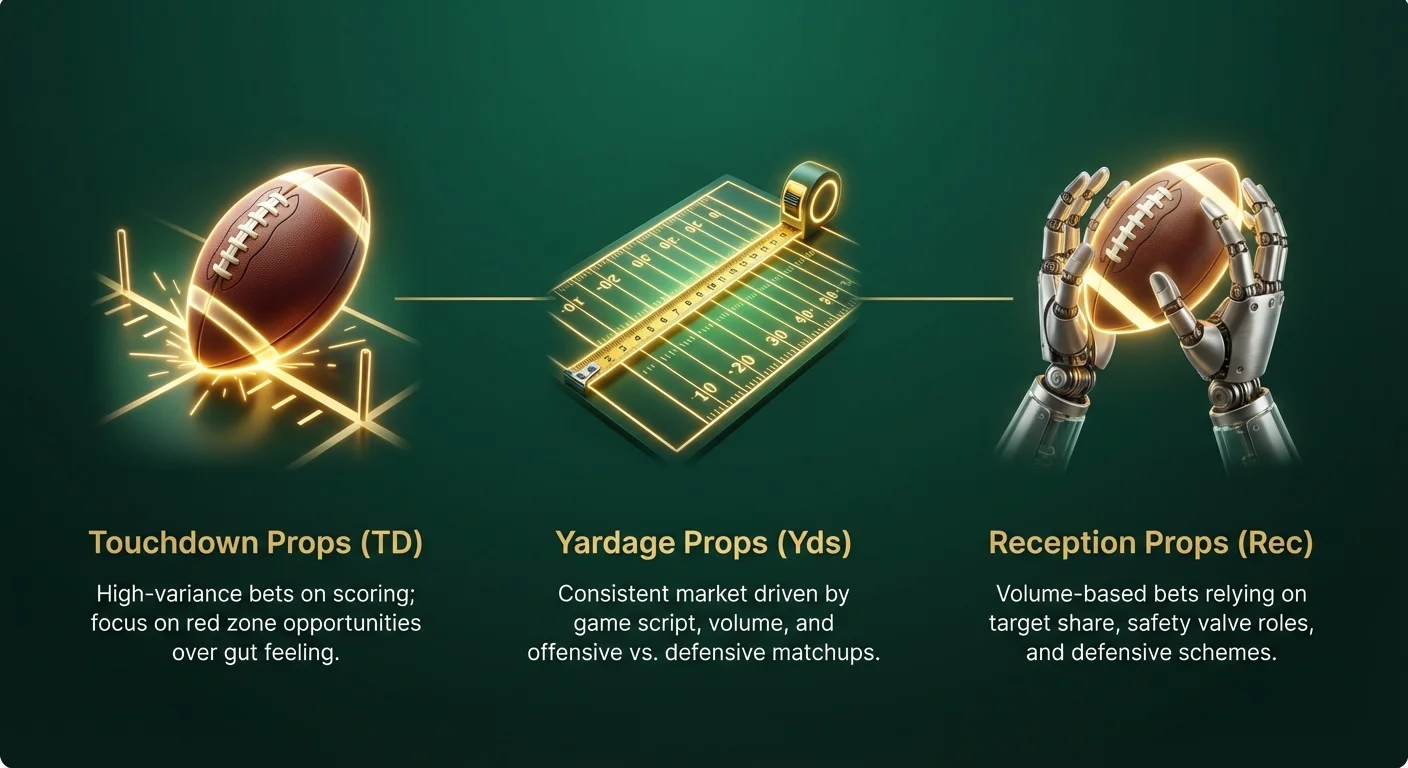
Touchdown props are the most popular exotic bets in the NFL. They are easy to root for and offer high payouts. However, they are also extremely volatile.
1. Anytime Touchdown Scorer (ATD)
This is a wager on a player to carry or catch the ball in the end zone.
- Crucial Rule: generally, for Quarterbacks, this only counts rushing or receiving touchdowns. Passing touchdowns are a separate market.
Strategy for ATD:
Do not bet based on "gut feeling." Bet based on Red Zone Opportunity. You want players who get touches inside the 20-yard line (RZ) and, more specifically, inside the 10-yard line (Green Zone).
- The RB "Plodder": Look for running backs on teams with good offenses who are used strictly for goal-line work. They may only get 30 yards in a game, but if they get the ball at the 1-yard line, the TD counts the same.
- Tight End value: In the Red Zone, the field shrinks. Speed matters less, and size/height matters more. Tight Ends often see their target share double inside the 10-yard line compared to the rest of the field.
2. First Touchdown Scorer (FTS)
This is a bet on who scores the very first TD of the game. The odds are juicy (usually +500 to +3000), but the variance is massive.
Strategy for FTS:
Analyze "Scripted Plays." NFL coaches usually script their first 15 plays of the game.
- Look at which player a team targets on their opening drive over the last 4 weeks.
- Some teams prefer to establish the run early (Bet the RB).
- Some teams like to take a deep shot immediately (Bet the WR1).
Touchdown Probability vs. Implied Odds
To be a winning intermediate bettor, you must convert odds to probability.
| Odds | Implied Probability | When to Bet |
|---|---|---|
| -110 | 52.4% | Elite RBs with high volume (e.g., McCaffrey) |
| +150 | 40.0% | WR1s in high-total games |
| +300 | 25.0% | TEs or WR2s with RZ targets |
| +700 | 12.5% | Dart throws (Backups, Gadget players) |
Tip: If you believe a player has a 50% chance to score, and the crypto book is offering +120 (45.4%), that is a positive expected value (+EV) bet.
The Grinder's Market: Yardage Betting
While touchdowns are exciting, yardage betting (Rushing, Receiving, Passing) is more consistent and easier to project mathematically. This is where the bulk of your bankroll should live.
1. Rushing Yards
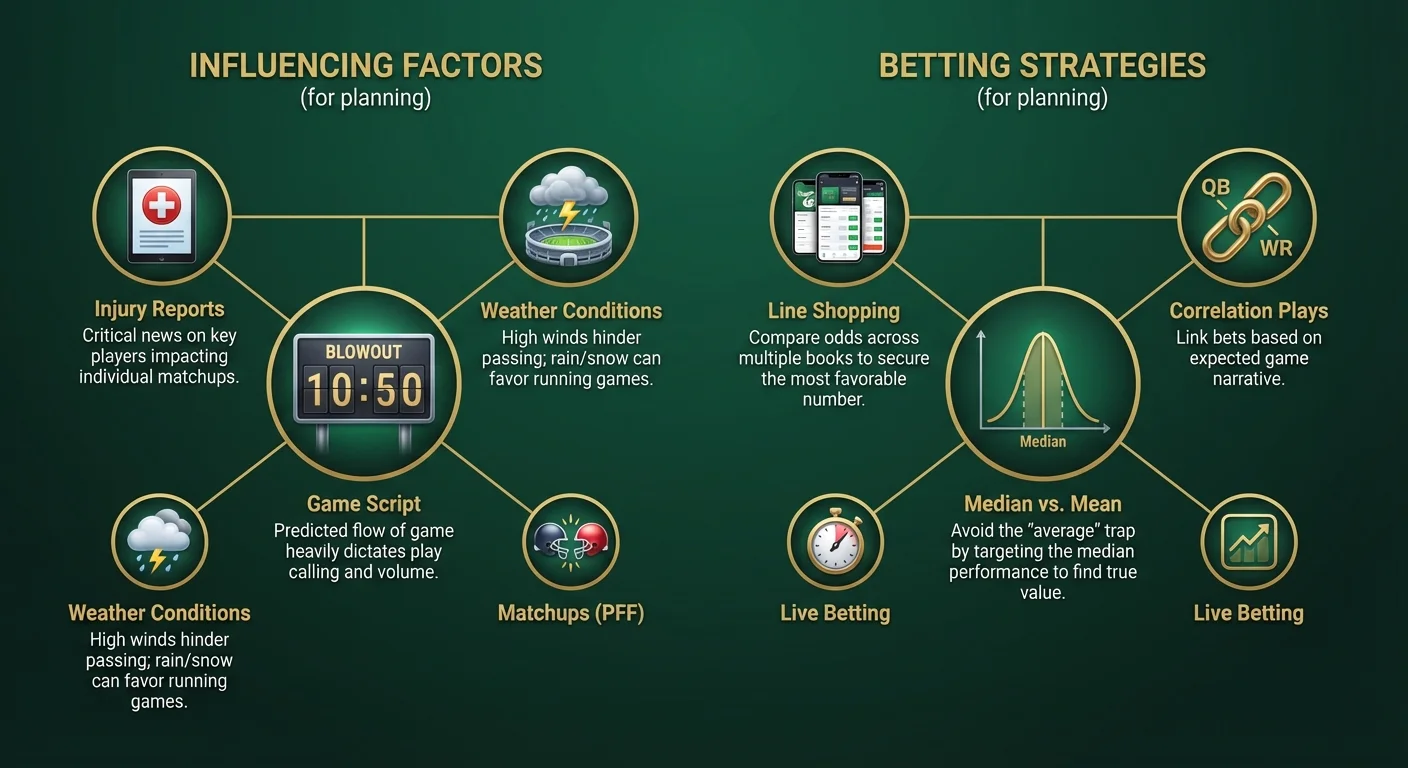
Rushing props are heavily correlated with Game Script.
- The Favorite Strategy: If a team is favored by 7+ points, they are likely to be leading in the 4th quarter. Teams with the lead run the ball to drain the clock. Look for the "Over" on the RB1 for heavy favorites.
- The Underdog Strategy: If a team is a heavy underdog, they may abandon the run early to play catch-up. Look for value on the "Under" for RBs on teams expected to lose big.
- O-Line vs. D-Line: Check PFF (Pro Football Focus) or similar rankings for Offensive Line vs. Defensive Line matchups. An elite RB behind a battered offensive line facing a top-tier run defense is a prime "Under" candidate.
2. Receiving Yards
Receiving props are volatile because one long 50-yard catch can cash an "Over" in seconds.
- Volume is King: Do not bet overs on "boom or bust" deep threats unless the number is very low. Look for players with a high Target Share. A receiver getting 10 targets for 8 yards average depth of target (ADOT) is a safer bet than a guy getting 3 targets with a 20-yard ADOT.
- Man vs. Zone Defense:
- Against Man Coverage: Elite route runners and mobile QBs thrive.
- Against Zone Coverage: TEs and Slot WRs (who find the soft spots in the zone) tend to rack up yards.
- Garbage Time: Receiving yards count the same whether the game is tied or your team is down by 30. Bad teams often produce passing yardage leaders because they are constantly throwing to catch up.
3. Median vs. Mean (The Trap)
This is the most important concept for intermediate bettors.
- The Mean (Average): Total yards divided by games played. One 200-yard game skews this number high.
- The Median: The middle number.
- The Trap: Sportsbooks usually set lines closer to the Median. The public looks at the Average and thinks the line is too low.
- Example: Player X has yardage totals of: 10, 10, 10, 10, 160.
- Average: 40 yards per game.
- Median: 10 yards per game.
- Line: 25.5 yards.
- Analysis: The public sees the 40 average and hammers the Over. The smart bettor realizes he went under this number in 80% of games and bets the Under.
The Correlation Play: Receptions
Receptions props are distinct from yardage because they rely purely on volume, not efficiency. A screen pass for -2 yards still counts as a reception.
PPR (Points Per Reception) Mentalities
In the betting world, we look for "Safety Valves."
- Blitz Heavy Defenses: If an opposing defense blitzes at a high rate, the Quarterback will not have time for deep routes. He will dump the ball off to the Running Back or Tight End.
- Strategy: Bet the "Over" on RB/TE receptions against blitz-heavy teams.
- The WR Screen Game: Some offenses treat short passes as an extension of the run game. Identify teams that use bubble screens frequently; their WRs often have high reception floors even if their yardage is low.
The Crypto Advantage in Prop Betting
Using crypto sportsbooks creates distinct advantages for the prop bettor compared to traditional fiat sites.
1. Speed and Live Betting
Prop markets shift rapidly. If a starting WR pulls a hamstring in the first quarter, the live lines for the WR2 will adjust in minutes. Crypto transactions (especially on networks like Solana or Litecoin) are near-instant. You can top up your account and fire on a live prop before the drive ends.
2. Avoiding Limits
If you are successful at beating prop markets, traditional books will limit your wager size (e.g., allowing you to only bet $10 max). Many crypto-native sportsbooks operate with a higher risk tolerance and anonymity, allowing you to maintain your edge longer without being "limited" or banned.
3. Withdrawal Efficiency
After a successful Sunday of prop betting, waiting 3-5 business days for a bank transfer is outdated. Crypto withdrawals are processed in minutes or hours, giving you immediate access to your liquidity.
Practical Strategy: Your Weekly Research Workflow
To succeed at NFL props, you need a routine. Here is a suggested workflow for the intermediate bettor:
- Tuesday/Wednesday: Check the opening lines. Compare them to your projections. If you see a massive discrepancy (e.g., Book has 45.5 yards, you project 60), bet it early.
- Thursday (Injury Report): The most critical day.
- If a starting Cornerback is out, upgrade the opposing WR1.
- If a starting Offensive Lineman is out, downgrade the RB.
- Friday (Weather Check):
- Wind is the enemy of passing props. Sustained winds over 15-20 mph kill deep balls and Overs.
- Rain/Snow actually favors the offense (specifically running) because defenders struggle to react and cut on slippery surfaces. Do not blindly bet Unders just because of rain.
- Sunday Morning (Line Shopping):
- Open multiple crypto sportsbooks.
- Book A might have Travis Kelce over 68.5 yards at -110.
- Book B might have Travis Kelce over 65.5 yards at -110.
- Those 3 yards are massive. Always take the better number.
Summary: Key Takeaways for Prop Betting
- Focus on Opportunity: Volume (targets/carries) is more predictive than efficiency (yards per carry).
- Understand the Narrative: Is the game a blowout or a shootout? Correlate your props to the expected game script.
- Beware the Average: Check the median performance to avoid skewed data traps.
- Shop the Lines: Use the flexibility of crypto to keep funds on multiple books and grab the best number.
- Embrace the Under: It is uncomfortable to root for failure, but "Unders" cash more often in the long run because injuries and game flow often limit production unexpectedly.
NFL props turn every play into a sweat and every yard into a potential profit. By moving away from "who will win" and focusing on "how they will play," you open yourself up to the most inefficient and potentially lucrative markets in sports betting.