
Kapag unang pumasok ka sa mundo ng crypto, mabilis mong matututunan ang pinakamahalagang panuntunan: "Not your keys, not your crypto." Ang panuntunang ito ay nagbibigay-diin sa kahalagahan ng pagmamay-ari at pagprotekta sa iyong private keys, na ang mga kriptograpikong lihim na nagpapatunay ng pagmamay-ari sa iyong mga pondo at awtorisasyon ng mga transaksyon.
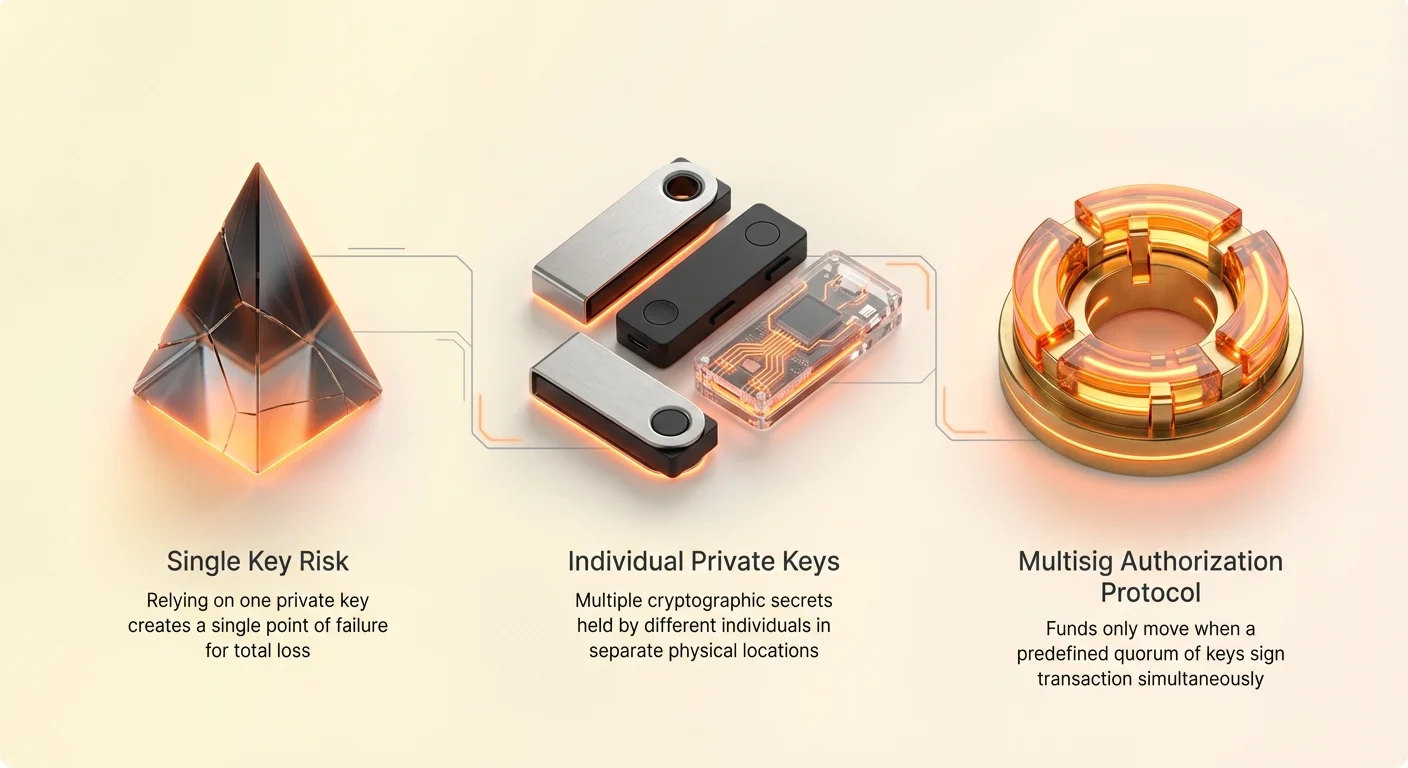
Para sa mga indibidwal, ang pagprotekta sa single key na ito ay madalas na nangangahulugan ng paggamit ng hardware wallet—isang napakaepektibong hakbang sa seguridad na kilala bilang cold storage. Gayunpaman, para sa mga negosyo, grupo, malalaking treasury, o kahit mga sopistikadong indibidwal na nagpaplano para sa hinaharap, ang paggalugad sa isang single key na naka-store sa isang lokasyon ay nagpapakita ng hindi katanggap-tanggap na panganib. Kung mawala, magnanakaw, o ma-compromise ang key na iyon, mawawala agad ang buong pondo.
Dito lumalabas ang konsepto ng Multisignature (Multisig) wallet. Ang Multisig ay isang advanced na mekanismo sa seguridad na dinisenyo upang alisin ang single point of failure na natural sa standard (single-signature) wallets. Binabago nito ang paradigm mula sa pangangailangan ng isang key upang buksan ang vault patungo sa pangangailangan ng combination ng mga key, na hawak ng magkakahiwalay na indibidwal, upang aprubahan ang anumang aksyon. Nagbibigay ang gabunging ito ng definitive, comprehensive na overview ng multisig technology, na sumasaklaw sa technical setup nito, strategic application, at mahalagang papel sa pagkamit ng tunay na self-sovereignty at shared control sa digital assets.
The Basics of Multisignature Wallets
A multisignature wallet is simply a type of cryptocurrency address that requires multiple private keys to authorize a transaction, rather than just one. Think of it like a safety deposit box in a bank that requires two separate keys, held by two different people, to open.
Private Keys, Public Keys, and the Single Point of Failure
Before diving into multisig, it’s essential to review how standard wallets work:
- The Private Key: This is the ultimate secret. It is a long string of characters (often represented by a 12- or 24-word seed phrase) that gives you the mathematical power to spend your cryptocurrency. If anyone gets this key, they control your funds.
- The Public Key/Address: This is the receiving address everyone sees (like your account number). It is mathematically derived from your private key but cannot be used to spend funds.
In a standard setup, if a hacker gains access to your private key (the single signature), they can drain your entire wallet instantly. This is the single point of failure that multisig is designed to eliminate.
How Multisig Solves the Problem of Loss and Theft
Multisig fundamentally changes the spending requirement. Instead of one signature proving ownership, the blockchain is programmed to only accept transactions that contain, for example, two out of three authorized signatures.
Protection Against Theft (External Threat): If a malicious actor compromises one key holder's computer or hardware wallet, they still cannot move the funds because they lack the necessary second (or third) signature from another key holder.
Protection Against Loss (Internal Threat): If one key holder loses their hardware device or forgets their seed phrase, the group can still recover or move the funds using the remaining keys.
Multisig ensures no single person (or single compromised device) has unilateral control, demanding cooperation and distribution of trust.
Multisig vs. MPC (Multi-Party Computation)
As security solutions evolve, a related concept called Multi-Party Computation (MPC) often appears alongside multisig. While both aim for shared control, they achieve it differently:
| Feature | Multisig (M-of-N) | MPC (Threshold Signature) |
|---|---|---|
| Technology | On-chain protocol requiring separate, full signatures from key holders. | Off-chain cryptographic process that creates a single signature from shared "key shards." |
| Transparency | The wallet address is visibly multisig on the blockchain. | The resulting transaction looks like a standard single-signature transaction on the blockchain. |
| Key Status | Each key holder possesses a full, stand-alone private key. | Key holders possess fragments or "shards" of a key; no single party holds the full key. |
| Complexity | Generally simpler, more established, and widely supported. | More complex cryptographic implementation, often required for corporate custody solutions. |
While MPC is growing rapidly for institutional use, Multisig remains the gold standard for robust, transparent, and self-custodied group governance and treasury management due to its relative simplicity and long track record.
Understanding M-of-N Security Schemes
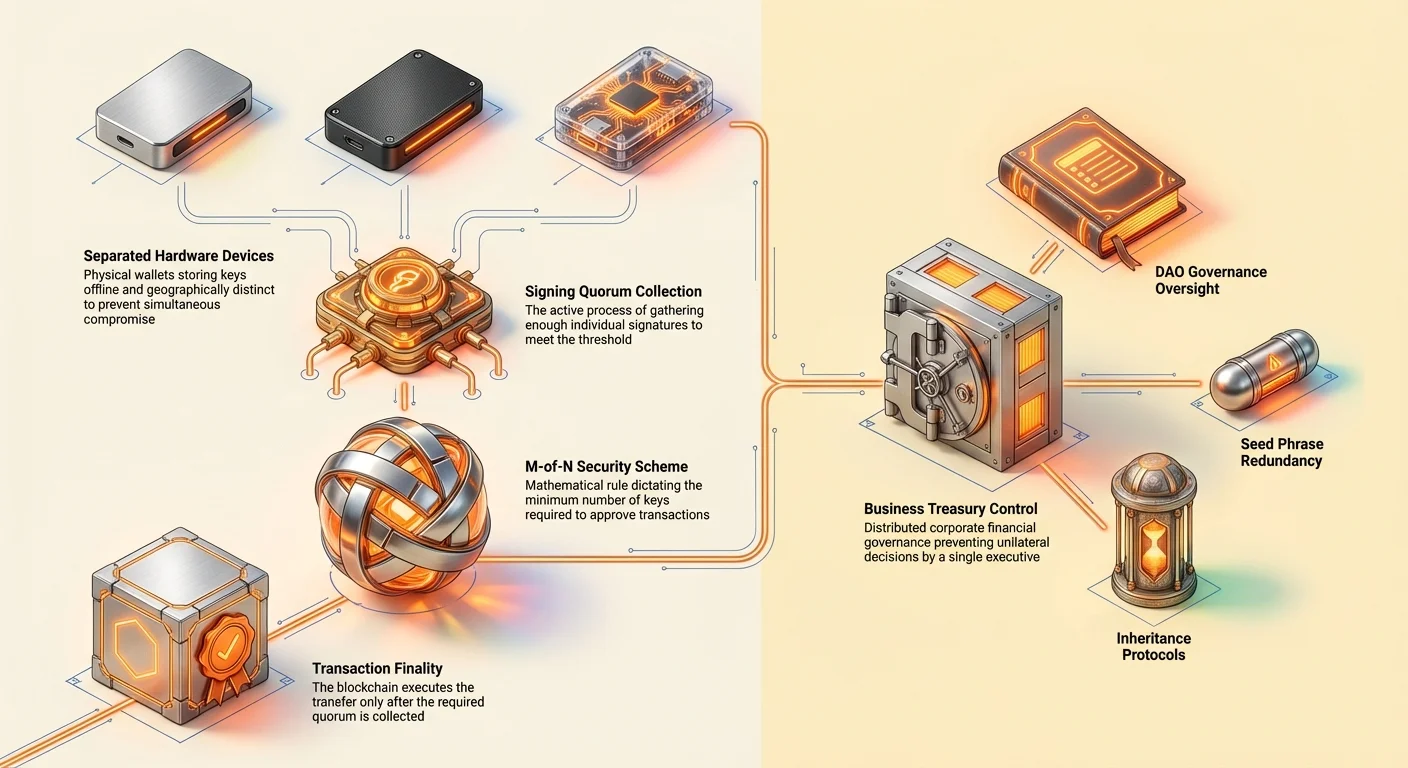
The core mechanic of any multisig wallet is the M-of-N scheme. This is the mathematical formula that dictates how many keys are required out of the total number of keys created to approve a transaction.
Defining M and N (Quorum and Key Holders)
- N (Total Key Holders): This is the total number of private keys associated with the multisig address. This determines the maximum possible security backup.
- M (The Quorum): This is the minimum number of keys required to sign and execute a transaction. This is the threshold for action.
The relationship between M and N is critical because it defines the wallet’s vulnerability profile and operational efficiency. The required signatures (M) must be collected before the transaction is broadcast to the network.
Common Configurations and Their Applications
Choosing the right M-of-N scheme depends entirely on the purpose, the level of trust among participants, and the need for operational speed.
1. The 2-of-3 Setup (High Security, High Reliability)
- Configuration: Requires 2 signatures out of 3 total keys.
- Use Cases: Small business treasuries, couples managing joint funds, or enhanced personal security.
- Why it works:
- Security: One key (or one key holder) can be compromised without losing funds.
- Reliability: One key can be lost without rendering the funds inaccessible.
In a 2-of-3 setup for a small business, Key 1 might be held by the CEO, Key 2 by the CFO, and Key 3 might be held by a corporate lawyer or stored securely off-site as a backup (an "emergency key"). Any two can authorize spending.
2. The 3-of-5 Setup (Shared Governance, Robust Backup)
- Configuration: Requires 3 signatures out of 5 total keys.
- Use Cases: Medium-to-large business treasuries, board management, or Decentralized Autonomous Organizations (DAOs).
- Why it works: This setup offers much greater resilience against collusion. If 1 or 2 keys are compromised, the funds are safe. If 1 or 2 key holders become unavailable (vacation, illness, death), the remaining 3 can still operate.
3. The 1-of-2 Setup (Dangerous but Necessary)
- Configuration: Requires 1 signature out of 2 total keys.
- Use Cases: Generally discouraged for security, but sometimes used in contracts where two parties are fighting over funds (Escrow).
- Why it works (in limited scenarios): It provides a way for either party to unilaterally release the funds. This is a low-security, high-flexibility option, not suitable for treasury management.
4. The N-of-N Setup (The Ultimate Trust Model)
- Configuration: Requires ALL signatures out of the total keys (e.g., 3-of-3).
- Use Cases: Highly specialized, high-trust scenarios where every single participant must approve every single transaction.
- Why it works: Provides absolute security against non-consensus spending. However, if any single key holder is unavailable, the funds are locked forever—making this scheme extremely difficult to manage operationally.
Risk Assessment and Scheme Selection
When deciding on M and N, you must balance two competing risks:
| Risk Profile | Description | Recommended M-of-N |
|---|---|---|
| Operational Risk (The Locking Risk): | The risk that you cannot gather enough signatures (M) because keys are lost or key holders are unavailable. | Choose a lower M (e.g., 2-of-5). |
| Collusion Risk (The Theft Risk): | The risk that the minimum number of key holders (M) conspire to steal the funds. | Choose a higher M (e.g., 4-of-5). |
Rule of Thumb: Always ensure $M$ is high enough to prevent a conspiracy among a small faction, but low enough to allow for continued operations even if one or two key holders are incapacitated or lose their keys. For most groups, a 2-of-3 or 3-of-5 scheme offers the optimal balance.
Gabay Paso-paso: Pag-set up ng Multisig Wallet
Ang pagtatayo ng multisig wallet ay nangangailangan ng maingat na pagpaplano, madalas na kinabibilangan ng maraming hardware device at mga interface ng software. Ang prosesong ito ay sadyang komplikado, dahil ang seguridad nito ay umaasa sa redundancy at paghihiwalay ng mga key.
Mga Paunang Kinakailangan at Paghahanda ng Key
Bago lumikha ng multisig contract sa blockchain, kailangan mong gumawa ng mga pangunahing key.
1. Pagkuha ng Hardware Wallet
Bawat key sa M-of-N scheme ay dapat i-generate at i-store sa magkahiwalay na, nakalaang hardware wallet (hal., Trezor, Ledger). Ito ay nagbibigay ng tunay na seguridad ng cold storage, na nangangahulugang hindi kailanman nakaka-touch ng private key ang isang device na konektado sa internet.
- Hakbang: Bumili ng $N$ magkahiwalay na hardware wallet (hal., tatlong wallet para sa 2-of-3 setup).
2. Pagbuo at Paghihiwalay ng Seed Phrase
Bawat hardware wallet ay dapat i-set up nang independiyente upang gumawa ng sariling natatanging seed phrase.
- Hakbang: Isulat ang bawat seed phrase nang tumpak. Mahalaga, ang mga seed phrase na ito ay dapat iimbak sa pisikal na magkahiwalay, heograpikal na magkaibang lokasyon. Kung dalawang key ang kailangan, tiyakin na hindi naka-iimbak ang kanilang mga recovery phrase sa parehong safe.
3. Pagtalaga ng Responsibilidad sa Key
Pormal na magtalaga ng bawat private key (at ang kaukulang hardware device) sa tiyak na key holder. Ang pagtatalagang ito ay dapat idokumento at mapagkasunduan ng grupo.
Pagpili at Pakikipag-ugnayan sa Software Interface
Ang multisig wallet mismo ay hindi pisikal na device; ito ay isang smart contract address sa blockchain na nauunawaan ang M-of-N rule. Upang makipag-ugnayan sa contract na ito, kailangan mo ng espesyalisadong software.
Para sa Bitcoin, karaniwang desktop interface ay kinabibilangan ng Sparrow Wallet o Electrum. Para sa Ethereum at magkakaugnay na chain (na madalas na namamahala ng business treasury at DeFi), ang Gnosis Safe (ngayon ay Safe) ang pamantasan sa industriya.
Pase ng Setup: Paglikha ng Contract
- I-input ang Public Key: Ang itinalagang setup interface (hal., Gnosis Safe web app) ay magpapaalala sa mga key holder na i-input ang public key o address na nagmumula sa kanilang hardware wallet.
- I-define ang M at N: Tinutukoy ng user ang kabuuang bilang ng owner (N) at ang kailangang confirmation (M).
- I-deploy ang Contract: Inilalathala ng software ang multisig smart contract sa blockchain. Ang contract na ito ngayon ay ang iyong multisig wallet address.
Kapag na-deploy na, ang mga pondo ay dapat ipadala sa bagong, natatanging multisig address na ito. Lamang kapag dumating ang pondo sa address na ito ay sila'y protektado ng M-of-N rule.
Proseso ng Pag-sign at Execution
Kapag nagpasya ang grupo na gumawa ng transaksyon (hal., pagpapadala ng 5 BTC sa vendor), ang proseso ay sumusunod sa mahigpit na daloy:
1. Proposal at Initiation
Isang key holder ang nagsisimula ng proposal ng transaksyon gamit ang software interface. Tinutukoy ng proposal ang halaga, ang address ng tatanggap, at ang network fee. Ang transaksyon ay ginawa ngunit nananatiling hindi na-sign.
2. Pagsusuri at Pag-sign
Nakikita ng lahat ng N key holder ang proposal. Bawat key holder ay nagko-connect ng kanilang hardware wallet sa kanilang interface (na nakakonekta sa multisig software) at sinusuri ang mga detalye ng proposed transaction.
- Kung naaprubahan ang transaksyon, gumagamit ang key holder ng kanilang hardware wallet upang gumawa ng kanilang natatanging cryptographic signature para sa partikular na transaksyong iyon at ipinapasa ang signature sa multisig contract.
3. Naabot ang Quorum (Execution)
Pinapanood ng multisig contract ang paparating na signature. Sa sandaling maabot ng bilang ng signature ang M (ang quorum), awtomatikong binubuo ng contract ang mga signature na iyon at ipinapasa ang finalized, awtorisadong transaksyon sa blockchain para sa agad na execution.
4. Pagkabigo sa Pag-abot ng Quorum
Kung nabigo ang transaksyon na maabot ang M signature sa loob ng itinalagang panahon, nag-e-expire ang proposal o nananatiling pending nang walang hanggan. Nananatiling nakalock ang pondo sa multisig address hanggang maipon ang kailangang bilang ng signature.
Strategic Use Cases for Multisignature Technology
Multisig is not just a high-tech way to secure funds; it is a powerful tool for governance, risk mitigation, and systematic control. Its primary applications lie in managing large assets where distributed responsibility is mandatory.
1. Secure Business Treasury Management (The Primary Use Case)
For any company holding significant crypto reserves, security means removing unilateral control.
Centralized Control vs. Distributed Control
In a traditional company structure, the CEO or CFO might have access to the single wallet key. This creates "key-person risk"—the risk of the funds being lost due to one person’s error, malice, or unavailability.
A multisig wallet ensures that financial decisions are always collaborative:
- Expense Approval: For example, a 3-of-5 setup might involve the CEO, CFO, COO, Head of Legal, and an External Auditor. Any transaction requires consensus from three senior leaders, preventing any one person from making unauthorized transfers.
- Operational Continuity: If the CEO is traveling or incapacitated, the business can continue to pay bills and manage funds without interruption, provided the quorum (M) can still be met by the available signers.
Handling Employee Turnover and Separation
Multisig provides a clean framework for managing key access during personnel changes. When a key holder leaves the company, the remaining key holders can initiate a transaction to migrate all funds from the old M-of-N contract to a new M-of-N contract that excludes the departing employee’s public key. This procedure ensures a clean cut-off of access without relying on the integrity of the former employee.
2. Decentralized Autonomous Organizations (DAOs) and Governance
DAOs use smart contracts to automate governance, but large treasury movements often require human oversight. Multisig wallets, particularly those implemented via platforms like Gnosis Safe, are the foundational infrastructure for DAO treasury management.
- Community Oversight: While proposals might be voted on by thousands of token holders, the actual execution of spending funds (e.g., funding a new development team) is typically handled by a core group of elected multisig signers (often 5-of-7 or 7-of-9).
- Trustless Execution: This ensures that even if the DAO is attacked by a governance-manipulation scheme, the treasury funds cannot be moved without the explicit, secure, and physically separated signatures of the elected core team.
3. Advanced Personal Security and Inheritance Planning
For high-net-worth individuals, multisig is an unparalleled tool for managing personal security risks and ensuring smooth wealth transfer after death.
Reducing Personal Kidnapping Risk
In rare but serious situations, an attacker might attempt to coerce a single key holder into signing a large transaction. With multisig, this becomes impossible. The attacker would need to coerce multiple, geographically separated key holders simultaneously, dramatically increasing the operational difficulty and risk of the attack.
Secure Inheritance Planning (The "Dead Man's Switch")
One of the greatest challenges of self-custody is ensuring loved ones can access funds upon the owner's death without risking early access or theft. Multisig provides a structured solution:
The Setup (e.g., 2-of-3):
- Key 1: Held by the owner (kept in secure cold storage).
- Key 2: Held by a trusted third party, such as an estate lawyer or specialized fiduciary custodian.
- Key 3: Held by the primary heir (stored in a safe or separate location).
During Life: The owner and the lawyer/fiduciary (Keys 1 and 2) can easily transact 2-of-3, keeping the heir’s key dormant and safe.
After Death: Upon presentation of a death certificate, the lawyer/fiduciary (Key 2) and the heir (Key 3) can now coordinate the 2-of-3 signatures to unlock the funds and transfer them to the heir’s new address.
This setup prevents the heir from accessing the funds prematurely while the owner is alive, but guarantees access when the owner is deceased, fulfilling the inheritance plan without compromising the security of the funds during the owner's lifetime.
Mga Pinakamahusay na Gawi sa Seguridad at Mga Tip sa Pamamahala
Ang pagpapatupad ng multisig ay ang unang hakbang lamang. Ang tamang pamamahala, pag-aalaga sa mga key, at pagpaplano ng muling pagbawi mula sa sakuna ay mahalaga upang mapanatili ang integridad ng eskema ng M-of-N sa paglipas ng panahon.
Heograpikal na Pamamahagi ng Mga Key
Ang pangunahing layunin ng multisig ay ang paghihiwalay ng mga key. Ang paghihiwalay na ito ay dapat pisikal at heograpikal.
- Iwasan ang Centralization: Huwag mag-imbak ng maraming seed phrase sa iisang pisikal na lokasyon (hal., dalawang seed phrase sa isang safe). Kung nabigong ang lokasyong iyon (sunog, baha, pagnanakaw), mawawala agad ang benepisyo ng seguridad ng multisig.
- Internasyonal na Pagkalat: Para sa napakalaking mga pondo o mataas na pusta na personal na assets, isaalang-alang ang pamamahagi ng mga key sa iba't ibang bansa o kontinente. Ito ay nagpoprotekta laban sa lokal na pampulitikang mga panganib o pisikal na mga sakuna.
Pagsusuri ng Wallet: Ang "Fire Drill"
Maraming organisasyon ang nagse-set up ng komplikadong multisig wallets ngunit hindi kailanman sinusuri ang mga pamamaraan ng recovery hanggang dumating ang krisis. Ito ay malubhang pagkakamali. Dapat mong suriin nang regular na lahat ng key holders ay makakapirma at makakagalaw ng mga pondo nang matagumpay.
- Taunang Pagsusuri: Hindi bababa sa isang beses bawat taon, simulan ang maliit, simbolikong transaksyon (hal., pagpapadala ng $10 na halaga ng crypto sa isang tinukoy na test address).
- Pinahihirangang Pakikilahok: Ipagalab ang lahat ng key holders (M) na makilahok sa pagpirma ng test transaction. Ito ay nagsisiguro na ang kanilang hardware wallets, software setups, at mga paraan ng pag-access sa key ay gumagana pa rin.
- Simulasyon ng Nawalang Key: Ipatakbo ang panloob na scenario kung saan ipapalagay na nawala ang isang key. Makakapag-abot pa ba ang natitirang $N-1$ key holders ng M quorum at magpatupad ng recovery transaction sa bagong address? Idokumento ang mga kinakailangang hakbang.
Pag-ikot ng Key at Pagsusuri
Ang mga indibidwal na kasangkot sa key signing, ang mga hardware device na ginamit, at ang mga software interface sa ilalim ay dapat sumailalim sa regular na pagsusuri.
- Audit ng Signer: Isagawa ang mga periodic na background check o muling pagtatantya ng mga antas ng tiwala para sa lahat ng key holders. Kung nagbago nang malaki ang papel o kalagayan ng isang key holder, isaalang-alang ang paglipat ng mga pondo sa bagong multisig contract na hindi kasama ang indibidwal na iyon.
- Audit ng Hardware: Kung na-expose ang isang hardware wallet device sa pisikal na panganib (hal., dinala sa eroplano, nakumpiska, o hinawakan ng isang tao sa labas ng grupo), ituring na compromised ito at palitan ang kaukulang public key sa bagong multisig contract.
- Regular na Pagsusuri ng Seed Phrase: Habang hindi dapat digitalin ang seed phrase, suriin ang pisikal na storage container para sa integridad (damage mula sa tubig, buong mga security seal) nang regular.
Pagpigil sa "Dust Attacks" at Phishing
Dahil bawat key holder ay dapat suriin at pumirma ng transaksyon, ang proseso ng pagsusuri ay dapat metikuloso. Minsan gumagamit ang mga hacker ng "dust attacks" o phishing attempts.
- Sapilitan ang Verification: Sa pagsusuri ng proposal ng transaksyon, dapat suriin ng mga key holder ang bawat detalye: ang halaga, ang network fee, at, pinakakritikal, ang destination address. Huwag kailanman magpalagay na tama ang interface; laging suriin ang destination address sa pamamagitan ng pangalawang, pinagkakatiwalaang channel ng komunikasyon (hal., verbal na pagkukumpirma ng address sa recipient).
- Gumamit ng Whitelists: Maraming multisig platform ang nagbibigay-daan sa pag-setup ng "whitelists"—mga naaprubahang address nang maaga (tulad ng kilalang mga exchange withdrawal address o vendor address). Ito ay nagpapabilis sa mga karaniwang transaksyon at binabawasan ang panganib ng aksidenteng misspending.
Pagpili ng Tagapagbigay ng Solusyon sa Multisig
Habang ang pinagbabatayan na kriptograpiya ng Bitcoin multisig (P2SH) ay naka-standardize, ang karanasan ng gumagamit at hanay ng mga tampok ay nag-iiba-iba nang malaki depende sa software platform o serbisyo na pipiliin mo.
Paghahambing ng Mga Tampok ng Platform
Ang pagpili ng tagapagbigay ay karaniwang nakadepende sa blockchain na ginagamit (Bitcoin vs. EVM chains) at sa antas ng operational control na kailangan.
| Uri ng Platform | Pangunahing Blockchain(s) | Mga Pangunahing Tampok | Pinakangangkop Para sa |
|---|---|---|---|
| Gnosis Safe (Safe) | Ethereum, Polygon, Avalanche, etc. (EVM chains) | Lubos na maprograma, sumusuporta sa NFTs, interaksyon sa DeFi, mapapersonalize na kontrol sa access. | DAOs, mga pondo ng DeFi, mga negosyo sa Web3 na nangangailangan ng komplikadong interaksyon. |
| Sparrow Wallet | Bitcoin | Desktop na aplikasyon, mahusay na pagsasama sa iba't ibang hardware wallets (PSBT standard), lubos na transparent at nakatuon lamang sa seguridad ng Bitcoin. | Mga maksimalista ng Bitcoin, indibidwal na pangmatagalang imbakan ng Bitcoin, mataas na ligtas na mga negosyo sa Bitcoin. |
| Electrum | Bitcoin | Ligero, mas matandang pamantayan para sa Bitcoin multisig, sadaptuno at madaling gamitin na desktop client. | Mga gumagamit na humahanap ng simplicity at mahusay na naitatag na kasaysayan sa Bitcoin. |
| Mga Serbisyo ng Tagapag-ingat | Multi-chain | Pinamumunuan na mga serbisyo, madalas na kasama ang MPC, insurance, at pagsunod sa regulasyon. | Mga institusyong pinansyal, reguladong mga entidad na korporasyon, at mga kumpanya na nangangailangan ng komplikadong pagsunod. |
Open-Source vs. Proprietary Solutions
Ang komunidad ng crypto ay karaniwang pabor sa mga solusyong open-source para sa security infrastructure, at ito ay lalo na totoo para sa multisig.
Mga Kalamangan ng Open-Source
Mga platform tulad ng Gnosis Safe at Sparrow Wallet ay open-source, na nangangahulugang ang kanilang code ay makikita ng publiko at maaaring i-audit.
- Tiwala Sa Pamamagitan ng Beripikasyon: Sinuman ay maaaring suriin ang code upang tiyakin na walang backdoors, nakatagong bayarin, o vulnerabilities. Ang kalinawan na ito ay mahalaga kapag ipinagkakatiwala ang malalaking halaga ng pera sa smart contract o software client.
- Suporta ng Komunidad: Ang mga bugs at isyu sa seguridad ay madalas na natatagpuan at naayos nang mabilis ng pandaigdig na komunidad ng mga developer.
Mga Isinasaalang-alang sa Proprietary
Habang ang ilang mga solusyon sa corporate multisig at custody ay proprietary (closed source), madalas silang mag-alok ng mga tampok tulad ng corporate liability insurance, regulatory reporting, at maayos na pagsasama sa legacy banking systems.
Kung pipiliin ang proprietary solution, ang organisasyon ay dapat magsagawa ng matinding due diligence sa mga security certifications ng vendor, insurance policies, at third-party audit reports, dahil hindi nila maaaring suriin nang direkta ang source code. Para sa self-custody at maximum self-sovereignty, open-source ay lubos na inirerekomenda.
Conclusion
Ang multisignature technology ay malaking leap forward sa digital asset security, na nagbabago ng risk profile mula sa single, high-stakes target patungo sa distributed governance system. Ito ang kinakailangang tulay sa pagitan ng personal self-custody at institutional responsibility.
Sa pamamagitan ng pag-implement ng well-designed M-of-N scheme, pagse-secure ng mga key sa cold storage sa magkahiwalay na lokasyon, at pagtatayo ng clear operational procedures para sa signing at recovery, halos mae-eliminate ng mga grupo ang risk ng catastrophic loss dahil sa theft, key compromise, o unavailability ng key holder.
Para sa mga negosyo at sophisticated users na nagmamaneho ng high-value assets, ang multisig ay hindi na optional feature—ito ay fundamental requirement para sa pagbuo ng resilience at trust sa decentralized economy. Ang pag-master ng setup at strategic use ng multisig wallets ay crucial step sa roadmap patungo sa tunay na digital self-sovereignty.