
Decentralized finance, often referred to as DeFi, represents a fundamental shift in how financial products are structured and accessed. At its core, this ecosystem is not merely a new interface for traditional banking but a complete reconstruction of financial infrastructure. The system relies on decentralized networks to host financial products, removing the need for centralized intermediaries like banks or brokerages. Instead of human managers and physical branches, DeFi utilizes code to automate complex processes.
The primary innovation driving this sector is the ability to automate financial transactions through software rather than human intervention. This shift allows for a transparent and verifiable system where the rules are defined by code. Users can engage in borrowing, lending, trading, and derivatives markets directly through their digital wallets. This creates a permissionless environment where anyone with an internet connection can participate.
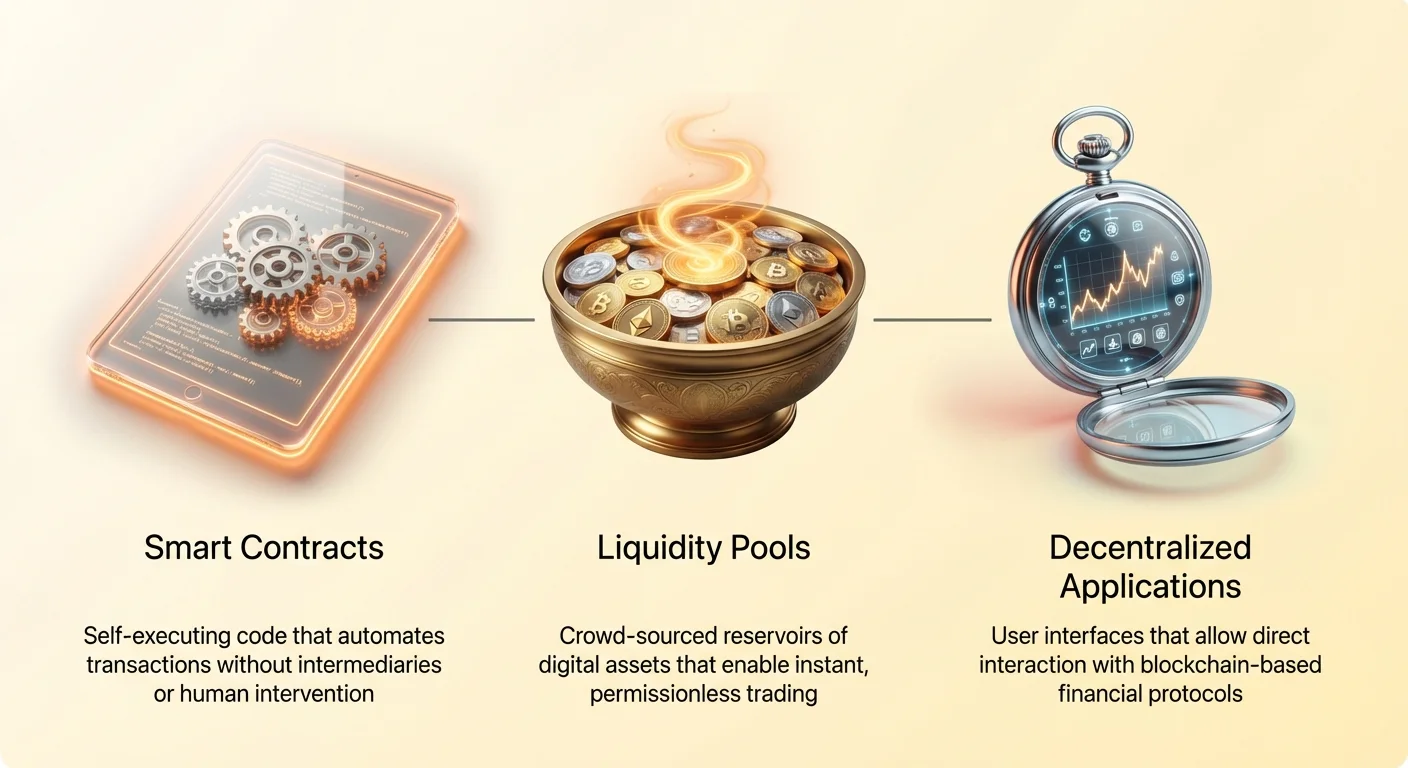
By removing the administrative overhead associated with traditional finance, this automated approach has the potential to reduce costs and distribute profits more equitably among participants. The engine driving this efficiency is a combination of smart contracts, liquidity pools, and decentralized applications. These components work in unison to create a financial system that operates continuously and autonomously.
The Architecture of Automation
To understand how decentralized finance operates, one must first grasp the underlying technology of smart contracts. These are not contracts in the legal sense but rather computer programs stored on a blockchain. They execute specific actions automatically when pre-defined conditions are met.
The Digital Agreement Mechanism
A smart contract functions like a digital vending machine. In a traditional transaction, a lawyer or escrow agent might be required to ensure both parties fulfill their obligations. In the blockchain environment, the smart contract takes over this role. It holds funds or assets and only releases them when the specific rules written into the code are satisfied. This process is deterministic, meaning the outcome is always the same given the same inputs.
For example, a simple smart contract could be programmed to function as a trust fund. If a user sends cryptocurrency to the contract's address, the code could automatically divide that amount into twelve equal parts. It could then release one portion to a designated recipient every month. This entire process happens without a third-party manager, relying entirely on the logic deployed to the network.
Trustless Execution
The term "trustless" is frequently used to describe this dynamic. It does not mean the system is untrustworthy. Rather, it means users do not need to trust a central authority or the counterparty to behave honestly. The validity of the transaction and the execution of the agreement are guaranteed by the network itself. Because the code is stored on a decentralized network, it is transparent and verifiable by anyone.
This contrasts sharply with centralized cloud computing. While centralized services may offer lower costs or higher speeds, they require users to trust the provider's security and integrity. Decentralized networks prioritize security and transparency, ensuring that the execution of contracts is public and immutable. This makes them particularly suitable for handling valuable assets and financial agreements where trust is paramount.
Liquidity Pools and Decentralized Exchanges
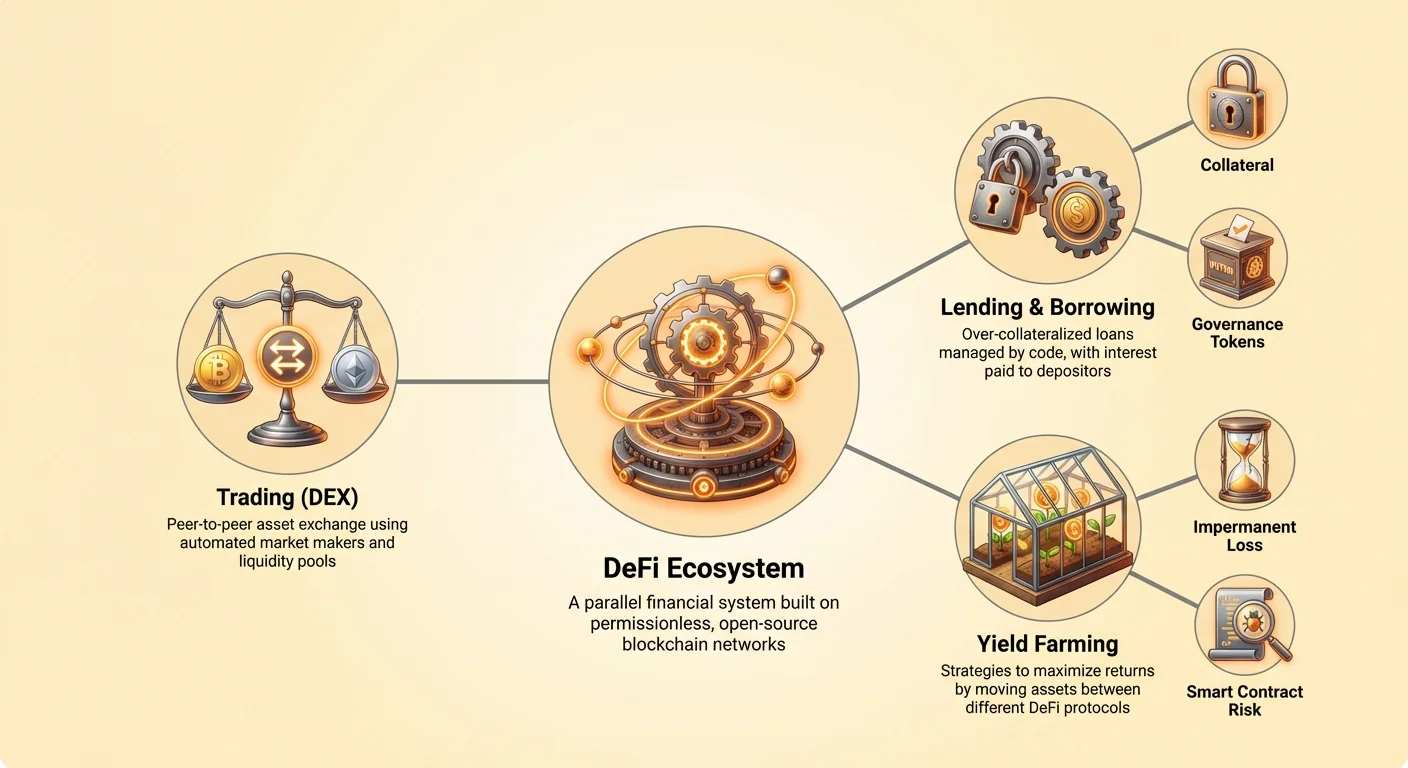
One of the most prominent applications of this technology is the decentralized exchange, or DEX. These platforms allow users to trade digital assets without handing custody over to a centralized service provider. In traditional finance, exchanges rely on order books and professional market makers to ensure there is always a buyer for every seller. DeFi takes a different approach by utilizing "crowd-sourced" Liquidity 101 liquidity.
The Role of Liquidity Providers
For a decentralized exchange to function effectively, it requires deep liquidity. Without a central entity to provide this, the protocol incentivizes users to step in. Individuals can deposit their assets into smart contracts, effectively pooling their capital with others to create a reservoir of funds available for trading. These participants are known as What are Liquidity Pools providers.
When a trader swaps one asset for another on the platform, they interact with this pool rather than a specific counterparty. The smart contracts manage the exchange transparently based on the ratio of assets in the pool. This mechanism ensures that trades can happen instantly without waiting for a matching order from another user.
Incentivizing Participation
The system is designed to reward those who provide the capital necessary for it to function. Liquidity providers typically earn a percentage of the fees generated from trades that occur within their pool. In this way, the protocol distributes the revenue back to the community that supports it.
This structure transforms the role of the average user. Anyone with a wallet address can contribute capital and earn yield, effectively acting as a bank or market maker. This democratization of market making is a key feature of the DeFi ecosystem. It aligns the incentives of the platform creators with the users, as both benefit from increased liquidity and trading volume.
| Feature | Centralized Exchange | Decentralized Exchange (DEX) |
|---|---|---|
| Custody | Exchange holds assets | User holds assets (Self-custody) |
| Liquidity Source | Market Makers / Order Book | Liquidity Pools (Crowd-sourced) |
| Access | KYC / Permissioned | Permissionless / Global |
Automated Lending and Borrowing
Beyond trading, smart contracts have revolutionized the lending market. In the traditional world, obtaining a loan involves credit checks, applications, and approval from a loan officer. DeFi protocols automate this entire process through code, creating a system that is both faster and more accessible.
Collateral and Risk Management
Smart contract-based lending manages risk through strict collateralization rules. Since there are no credit scores or identity checks, the system relies on assets to secure loans. For instance, a user might deposit a specific cryptocurrency into a smart contract to serve as collateral for a loan in a different asset, such as a stablecoin pegged to the US Dollar. Decentralized Lending and Borrowing
To minimize the risk of default, these contracts often require over-collateralization. A common ratio might be 2:1, meaning a user must deposit value worth twice the amount they wish to borrow. If a user deposits collateral worth $2,000, they might only be permitted to borrow $1,000 against it. This buffer protects the lender—in this case, the pool of other users—from market volatility.
The Mechanism of Liquidation
The smart contract constantly monitors the value of the collateral relative to the borrowed amount. If the market value of the collateral drops below a certain threshold, the contract acts immediately to protect the protocol. It may require the borrower to add more collateral or repay the loan.
If the borrower fails to act, the contract will automatically liquidate the collateral. This means the system sells the deposited assets to cover the debt, ensuring the liquidity pool remains solvent. This process is harsh but efficient. It removes human emotion and negotiation from the equation, relying strictly on mathematical ratios to maintain system stability. Because these rules are transparent and hard-coded, borrowers know exactly what triggers a liquidation event before they enter the agreement.
The Interface: Decentralized Applications
While smart contracts and liquidity pools form the backend infrastructure, users interact with these systems through Decentralized Applications, or dApps. A dApp combines the smart contract logic with a user interface, making it possible for non-technical users to access DeFi services.
Components of a dApp
Most dApps consist of three primary elements:
- Smart Contracts: The backend logic that defines the rules and executes transactions.
- Blockchain: The decentralized ledger that records the state and history of all interactions.
- Tokens: The digital assets used to pay for network fees ("gas") or participate in the application's economy.
DApps are distinct from standard web applications because they operate on a peer-to-peer network. No single entity controls the server or the data. This architecture provides significant resistance to censorship. Since the backend code runs on a public blockchain, it is difficult for any government or corporation to shut down the application or restrict access to it.
Transparency and Fairness
The open-source nature of dApps allows for a level of verification that is impossible in centralized systems. Consider a digital game involving dice. In a traditional online casino, the player must trust that the house isn't manipulating the results. In a decentralized version, the code determining the random number generation and the payout logic is visible on the blockchain.
Users or auditors can inspect the contract to verify that the "house edge" is exactly what is advertised and that the game is provably fair. This transparency extends to financial applications as well. Users can verify exactly how yield is calculated or how fees are distributed, ensuring the platform operates as promised without hidden manipulations.
Incentives and Governance
To attract the necessary liquidity and users, many DeFi protocols utilize distinct incentive mechanisms. One of the most common methods is the "airdrop." This involves distributing tokens to users who meet specific criteria, such as providing liquidity or using the platform during a certain period.
Catalyzing Liquidity
Airdrops serve as a powerful tool to bootstrap a network. By giving early adopters a stake in the project, protocols can solve the "cold start" problem where a platform needs users to have value, but needs value to attract users. A famous example occurred with a major decentralized exchange that faced competition from a rival platform attempting to drain its liquidity.
To defend its position and reward its loyal user base, the exchange airdropped governance tokens to any wallet that had previously interacted with its contracts. This instantly distributed ownership of the protocol to its users. The move not only retained liquidity but also incentivized thousands of new users to explore the ecosystem in hopes of future rewards.
Token Utility and Governance
The tokens distributed through these mechanisms often carry governance rights. In a decentralized system, there is no CEO or board of directors making unilateral decisions. Instead, token holders often vote on key changes to the protocol. This might include adjusting fee structures, adding new liquidity pools, or allocating funds from the project's treasury. Governance Tokens Explained
This model aligns the interests of the users with the success of the platform. Since the community owns a portion of the protocol, they are incentivized to contribute to its growth and stability. It transforms passive customers into active stakeholders who have a voice in the future direction of the financial infrastructure they utilize.
Navigating Risks in DeFi
While the automated nature of DeFi offers numerous efficiencies, it also introduces specific risks that differ from traditional finance. The reliance on code means that the system is only as secure as the programming that drives it.
Smart Contract Vulnerabilities
The "trustless" environment assumes the code functions exactly as intended. However, software can contain bugs. If a developer makes an error in the smart contract logic, hackers may be able to exploit it to drain funds from the protocol. Unlike traditional banking, where fraudulent transactions can sometimes be reversed, blockchain transactions are immutable. Once funds are stolen via an exploit, they are often irretrievable.
To mitigate this, reputable projects undergo rigorous audits by third-party security firms. These auditors review the code to identify potential weaknesses before the contract is deployed. However, even audited contracts can harbor undiscovered vulnerabilities. Users must be aware that depositing funds into a smart contract always carries a degree of technical risk.
The Danger of Phishing
The open nature of Web3 also opens avenues for social engineering attacks. A common threat is the "phishing dApp." In this scenario, attackers create a website that looks identical to a legitimate DeFi platform. If a user connects their wallet to this fake site, they may unknowingly grant permission for the attacker to access their funds.
Unlike a banking login which might require two-factor authentication, a wallet signature can sometimes grant broad access to assets. Verifying the URL and checking for security certificates are critical habits for DeFi users. The responsibility for security falls entirely on the individual, as there is no customer support department to contact if a mistake is made. The Ultimate DeFi Security Checklist
Malicious Projects
The permissionless nature of DeFi means that anyone can create a project. This freedom allows for innovation but also enables bad actors to deploy malicious contracts. A "rug pull" occurs when developers create a project, attract liquidity from users with promises of high yields, and then exploit a backdoor in the code to steal the funds.
In other cases, the developers may simply hold a large supply of the project's tokens and sell them all at once, crashing the price. Researching the team behind a project, checking for audits, and looking for "locked" liquidity are essential steps for due diligence. The lack of regulation means that users must be their own risk managers.
Conclusion
The engine room of decentralized finance is built on a foundation of code, transparency, and community participation. Automated Market Makers and liquidity pools have replaced the need for centralized intermediaries, allowing for a financial system that is open to anyone with a digital wallet. By utilizing smart contracts, these protocols automate the complex processes of trading and lending, creating a more efficient and equitable market structure.
However, this new frontier requires a shift in mindset. The removal of middlemen brings distinct advantages in speed and cost but places the burden of security and responsibility squarely on the user. Understanding the mechanics of smart contracts, the incentives of liquidity provision, and the reality of technical risks is essential for anyone navigating this ecosystem. As the technology matures, the battle-testing of open-source code continues to strengthen the infrastructure of this digital economy.
Financial freedom in DeFi requires understanding that code is law, and you are the sole custodian of your assets.