
สกุลเงินดิจิทัลมักถูกอธิบายด้วยศัพท์เทคนิคที่ซับซ้อน เช่น อัลกอริทึมแฮช ฟังก์ชันเข้ารหัส และสมุดบัญชีกระจายศูนย์ แม้ว่าส่วนประกอบทางเทคนิคเหล่านี้จะจำเป็น แต่天才ที่แท้จริงของเทคโนโลยีพื้นฐานของ Bitcoin คือ Proof of Work (PoW) อยู่ที่หลักการทางเศรษฐกิจและยุทธศาสตร์ที่มันบังคับใช้ ไม่ใช่ตัวโค้ดเอง
Proof of Work คือกลไกฉันทามติที่ทำให้เครือข่ายกระจายศูนย์ เช่น Bitcoin คงความปลอดภัย ความซื่อสัตย์ และป้องกันการปลอมแปลงได้โดยไม่ต้องพึ่งพาอำนาจกลาง มันเป็นวิธีแก้ปัญหาอันชาญฉลาดสำหรับปัญหาคลาสสิกทางวิทยาการคอมพิวเตอร์ที่เรียกว่าปัญหานายพลไบแซนไทน์ (BGP) โดยแก้ปัญหาเรื่องความเชื่อถือและการประสานงานผ่านการใช้พลังงานที่วัดได้และมีต้นทุนสูง
การวิเคราะห์นี้ก้าวข้ามนิยามทางเทคนิคแบบง่าย ๆ ของ PoW เราจะสำรวจว่ากลไกนี้ทำหน้าที่เป็นตัวยับยั้งทางเศรษฐกิจอย่างไร—วิธีที่รับประกันว่านักแสดงที่มีเหตุผลจะถูกจูงใจให้เล่นตามกฎเสมอ โดยบังคับให้ผู้เข้าร่วมทุ่มทรัพยากรในโลกจริง (ไฟฟ้าและฮาร์ดแวร์) เพื่อรักษาความปลอดภัยของสมุดบัญชีดิจิทัล PoW จึงยึดโลกที่จับต้องไม่ได้ของสกุลเงินดิจิทัลไว้กับขีดจำกัดทางกายภาพของพลังงาน สร้างการรับประกันความปลอดภัยที่ไม่มีใครเทียบได้
The Fundamental Problem: Achieving Consensus in a Distrustful Network (The Need for PoW)
Before we can understand how Proof of Work functions, we must first appreciate the monumental challenge it was designed to overcome: achieving perfect, verifiable agreement among thousands of anonymous, distributed parties who have no reason to trust one another.
This challenge breaks down into two primary issues: the technical problem of double-spending and the strategic problem of fault tolerance (the Byzantine Generals Problem).
The Double-Spend Conundrum
In the traditional centralized financial system (like banks), transferring money is trivial because a trusted third party (the bank) verifies and logs all transactions. If you try to spend the same $10 twice, the bank simply checks your balance and rejects the second attempt.
Digital currency, however, presents a unique difficulty: digital information is easy to copy. If I have a digital file representing $10, I can copy and paste that file infinitely, spending the same money many times over. This is the "double-spend problem."
In a distributed, peer-to-peer network where there is no central ledger keeper, we need a mechanism that definitively proves that a specific amount of money has been spent only once, and that all participants agree on the order in which transactions occurred. PoW forces nodes to dedicate real resources to ordering transactions, making it prohibitively expensive to insert a fraudulent, double-spent transaction into the verified history.
The Byzantine Generals Problem (BGP)
The technical challenge of double-spending is closely related to a deeper strategic dilemma formalized in computer science: the Byzantine Generals Problem.
Imagine a group of Byzantine generals surrounding an enemy city. They must agree on a unified plan of attack (e.g., "Attack at Dawn") or retreat ("Retreat Immediately"). If some generals attack while others retreat, they will all fail. The challenge is that the generals are separated by distance and rely on messengers to communicate. Crucially, some of the generals may be traitors (Byzantine faults) who deliberately send false messages to sow confusion and ensure the entire campaign fails.
How can the loyal generals achieve consensus and guarantee that everyone executes the same plan, even if they suspect up to one-third of their colleagues are lying?
In the context of a cryptocurrency network:
| BGP Analogy | Bitcoin Network Equivalent |
|---|---|
| Generals | Individual Nodes/Computers |
| Traitors (Faults) | Malicious Nodes attempting to double-spend |
| The City | The Shared Ledger or Transaction History |
| The Plan | The Order and Validity of Transactions (the next Block) |
| The Messenger | The Internet/Network Propagation |
The BGP shows that achieving consensus in an untrustworthy environment is incredibly difficult. PoW is Bitcoin’s elegant solution: it doesn't try to identify the traitors, but rather makes the act of being a traitor so costly that it is economically irrational.
การแก้ปัญหานายพลไบแซนไทน์ด้วยการยับยั้งทางเศรษฐกิจ
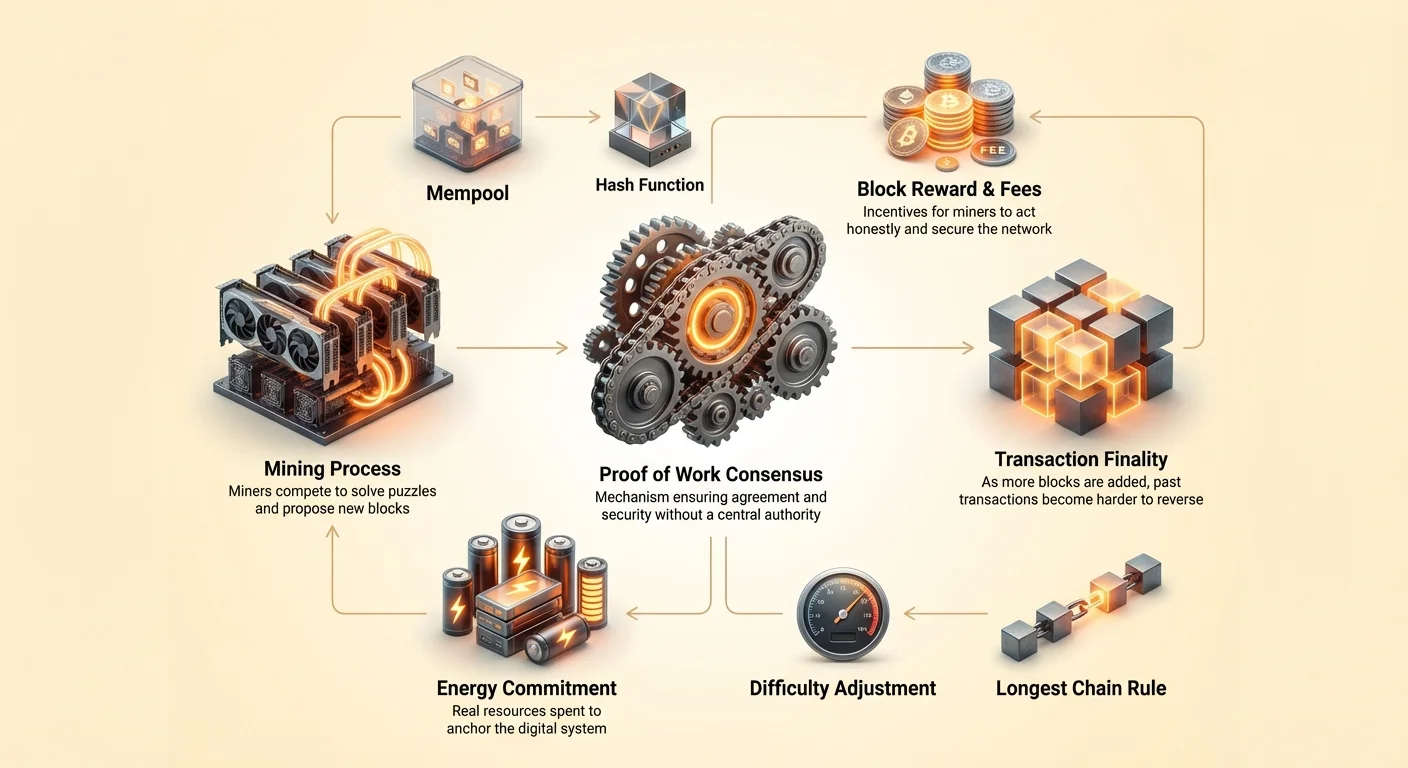
Proof of Work แก้ปัญหา BGP โดยการนำองค์ประกอบทางเศรษฐกิจมาสู่กระบวนการสื่อสาร แทนที่จะไว้วางใจทูต (หรือโหนด) นายพลจะกำหนดให้ทูตทำหน้าที่ที่ต้องใช้ต้นทุน สามารถยืนยันได้ และไม่สามารถนำกลับมาใช้ใหม่ก่อนที่ข้อความของพวกเขาจะได้รับการยอมรับ
การเปลี่ยนจากความไว้วางใจไปสู่ต้นทุน (นวัตกรรมของ PoW)
โมเดลความปลอดภัยแบบดั้งเดิมพึ่งพาอัตลักษณ์ (KYC รหัสผ่าน) หรือความไว้วางใจ (ธนาคารกลาง) PoW เปลี่ยนโมเดลความปลอดภัยจากพื้นฐาน การไว้วางใจอัตลักษณ์ ไปเป็น การไว้วางใจการมุ่งมั่นทางเศรษฐกิจที่ยืนยันได้
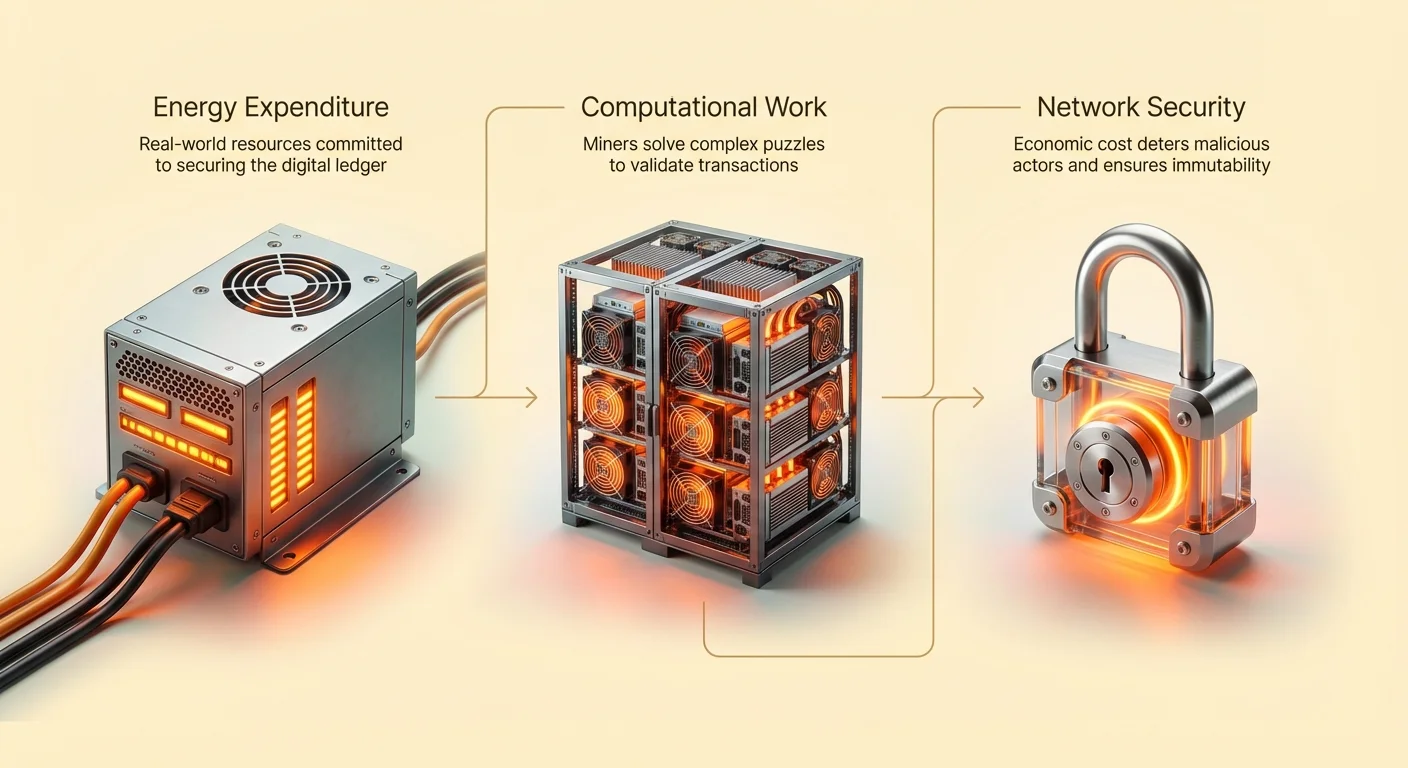
แนวคิดหลักนั้นเรียบง่าย: หากคุณต้องการให้เครือข่ายยอมรับบล็อกธุรกรรมที่คุณเสนอว่าเป็นความจริง คุณต้องพิสูจน์ว่าคุณใช้พลังประมวลผลและพลังงานในปริมาณมาก—"งาน" นั้น
งานนี้ทำผ่านกระบวนการที่เรียกว่า การขุด ผู้ขุดแข่งขันกันอย่างดุเดือดเพื่อแก้ปริศนาคริปโตกราฟิกเฉพาะที่ต้องใช้การเดาด้วยกำลังดิบ เมื่อผู้ขุดพบคำตอบ พวกเขาจะได้เสนอบล็อกที่ถูกต้องถัดไปให้เครือข่าย และได้รับรางวัลสำหรับความพยายามของพวกเขา
เพราะการค้นหาคำตอบต้องใช้การใช้พลังงานจริงที่วัดได้ PoW เปลี่ยนสมุดบัญชีธุรกรรมให้เป็นสิ่งที่ยึดติดกับฟิสิกส์และเศรษฐศาสตร์อย่างแท้จริง
สัญญาณที่มีต้นทุน: พลังงานเป็นการมุ่งมั่น
ทำไมการบริโภคพลังงาน—การเผาไหม้ไฟฟ้าตามตัวอักษร—ถึงเป็นศูนย์กลางของความปลอดภัย? เพราะพลังงานนั้นขาดแคลน มีต้นทุน และปลอมแปลงไม่ได้
- ความเปลี่ยนแปลงไม่ได้: เมื่อพลังงานถูกใช้ไปและพบคำตอบแล้ว "การพิสูจน์" นั้นจะถูกกระจายไปยังเครือข่าย ทุกโหนดสามารถยืนยันความถูกต้องของการพิสูจน์ได้ทันทีโดยไม่ต้องใช้พลังงานซ้ำ
- การยับยั้ง: หากนายพลที่เป็นอันตราย (ผู้ขุด) ต้องการโกงและแทรกบล็อกที่ทุจริต (การใช้จ่ายสองครั้ง) พวกเขาจะต้องทำกระบวนการที่มีต้นทุนทั้งหมดซ้ำ นอกจากนี้ เพื่อเปลี่ยนแปลงอดีต (เขียนบล็อกเชนใหม่) พวกเขาจะต้องแซงหน้าส่วนใหญ่ที่ซื่อสัตย์โดยการแก้บล็อกใหม่ต่อเนื่องเร็วกว่าทุกคนรวมกัน
- ความสิ้นสุด: ยิ่งบล็อกอยู่ในบล็อกเชนนานเท่าไหร่ พลังงานที่ถูกใช้ ทับซ้อนมัน (เมื่อบล็อกถัดไปถูกลิงก์กับมัน) ก็ยิ่งมากขึ้น การมุ่งมั่นนี้ทำให้ธุรกรรมเก่ามีต้นทุนสูงขึ้นแบบทวีคูณในการเขียนทับใหม่ แรงโน้มถ่วงทางเศรษฐกิจนี้ให้ความสิ้นสุดของธุรกรรม
โดยบังคับให้ผู้เข้าร่วมเครือข่ายจ่ายภาษีพลังงานในโลกจริง PoW รับประกันว่าการเข้าร่วมอย่างซื่อสัตย์จะทำกำไรได้มากกว่าการพยายามโจมตีอย่างท่วมท้น
Anatomy of Proof of Work: Hashing and the Difficulty Target
To execute this economic deterrence strategy, PoW relies on a precise technical mechanism involving cryptographic hashing and a continually adjusting difficulty level.
The Role of the Cryptographic Hash Function
The backbone of PoW is the cryptographic hash function (Bitcoin uses SHA-256). A hash function is an algorithm that takes an input of any size (text, images, transaction data) and outputs a fixed-length string of characters (the hash).
Crucially, cryptographic hashes have three key properties:
- Deterministic: The same input always produces the exact same output hash.
- Irreversible (One-Way): It is mathematically impossible to determine the input simply by looking at the output hash.
- Avalanche Effect: Even the smallest change to the input data (e.g., changing one comma in a transaction list) results in a completely different, unpredictable output hash.
In mining, the miner bundles all pending transactions (from the Mempool—the waiting area for transactions), along with the previous block’s hash, and a random guess number called the nonce. The entire package is run through SHA-256 to generate the new block's hash.
The Race to Zero: Solving the Block Puzzle
The core of the "work" is a guessing game. The network does not require just any hash; it requires a hash that meets a specific difficulty target. This target is always defined by requiring the hash to begin with a certain number of zeroes (e.g., 0000000000000000001a...).
Finding a hash that starts with the required number of zeroes is mathematically just as hard as guessing a specific lottery number—it is pure chance. Since you cannot reverse-engineer the required input (due to the one-way nature of the hash function), the only way to find a compliant hash is to change the input data slightly (by changing the nonce) and try again.
Miners use specialized hardware (ASICs) to execute trillions of these guesses per second, hoping that one of their attempts yields a hash that satisfies the current difficulty target. The first miner globally to find this solution wins the right to propose the new block and collect the block reward (subsidy plus fees).
The Difficulty Adjustment: Maintaining the 10-Minute Rhythm
If the difficulty remained static, the time it takes to find a block would decrease rapidly as technology improves and more powerful miners join the network. This would destroy the reliable rhythm Bitcoin needs to maintain consensus.
To counter this, the Bitcoin network automatically adjusts the difficulty of the puzzle every 2016 blocks (roughly every two weeks).
The purpose of the Difficulty Adjustment is to ensure that, no matter how much hashing power (hashrate) is applied to the network, a new block is found, on average, every 10 minutes.
- If blocks are found faster than 10 minutes: The difficulty increases (requiring more leading zeroes).
- If blocks are found slower than 10 minutes: The difficulty decreases (requiring fewer leading zeroes).
This mechanism makes the economic cost to participate extremely adaptive. The barrier to entry for securing the network is dynamically adjusted, ensuring that the expense required to generate a new block remains consistently high, thereby maintaining the integrity of the economic deterrence model.
คริปโตอีโคนอมิกส์: สิ่งจูงใจและการรับประกันความปลอดภัย
Proof of Work ได้รับการสนับสนุนโดยการประยุกต์ใช้คริปโตอีโคนอมิกส์ที่ยอดเยี่ยม—การผสานคริปโตกราฟีและสิ่งจูงใจทางเศรษฐกิจเพื่อรักษาความปลอดภัยของระบบกระจายศูนย์ PoW ทำงานเพราะผู้เข้าร่วมมีเหตุผลทางเศรษฐกิจ พวกเขาดำเนินการตามผลประโยชน์ส่วนตัว และกฎของระบบรับประกันว่าพฤติกรรมซื่อสัตย์คือกลยุทธ์ที่ทำกำไรที่สุด
ทำไมผู้ขุดถึงใช้เงิน: เงินอุดหนุนบล็อกและค่าธรรมเนียมธุรกรรม
ผู้ขุดไม่ได้ขับเคลื่อนด้วยจิตวิญญาณสาธารณูปโภค พวกเขาดำเนินธุรกิจที่มีต้นทุนปฏิบัติการมหาศาล (ไฟฟ้า ฮาร์ดแวร์ การทำความเย็น) พวกเขาเข้าร่วมเฉพาะเพราะได้รับรางวัลจากเครือข่าย รางวัลนี้มีสองส่วน:
- เงินอุดหนุนบล็อก: นี่คือรางวัลหลักสำหรับการสร้างบล็อกใหม่ที่ถูกต้อง เงินอุดหนุนนี้ (จ่ายด้วยสกุลเงินดิจิทัลพื้นเมือง เช่น BTC) จะลดลงครึ่งหนึ่งประมาณทุกสี่ปีในเหตุการณ์ที่เรียกว่า "halving" ณ ปี 2024 เงินอุดหนุนนี้เป็นตัวขับเคลื่อนหลักของความทำกำไร
- ค่าธรรมเนียมธุรกรรม: ผู้ขุดรวมธุรกรรมที่รออยู่ที่พวกเขาเลือกเข้าในบล็อกที่พบใหม่ สำหรับธุรกรรมแต่ละรายการ ผู้ส่งจ่ายค่าธรรมเนียมเล็กน้อยให้ผู้ขุด
เมื่อเงินอุดหนุนบล็อกลดลงทุกสี่ปี ค่าธรรมเนียมธุรกรรมจะกลายเป็นส่วนสำคัญมากขึ้นในโมเดลรายได้ของผู้ขุด รับประกันความปลอดภัยเครือข่ายระยะยาวยังคงใช้งานได้แม้เงินอุดหนุนจะหมดสิ้นไป รางวัลรวม (เงินอุดหนุน + ค่าธรรมเนียม) ต้องเกินต้นทุนปฏิบัติการของผู้ขุดเสมอเพื่อรักษาฟังก์ชันความปลอดภัยของ PoW
ต้นทุนทางเศรษฐกิจของการโจมตี 51%
การรับประกันความปลอดภัยหลักของ PoW คือความยืดหยุ่นต่อ การโจมตี 51% ซึ่งเป็นสถานการณ์ที่หน่วยงานเดียวหรือกลุ่มที่ประสานงานควบคุมแฮชเรทรวมของเครือข่ายมากกว่า 50%
หากผู้โจมตีบรรลุเสียงข้างมาก 51% พวกเขาอาจ:
- ย้อนธุรกรรม: โดยเฉพาะใช้จ่ายสองครั้งเหรียญของตัวเอง
- หยุดธุรกรรม: ป้องกันธุรกรรมที่ถูกต้องจากการยืนยัน
อย่างไรก็ตาม การควบคุม 51% ของเครือข่ายต้องใช้การลงทุนทุนมหาศาล พวกเขาจะต้องซื้อฮาร์ดแวร์มากขึ้น ใช้ไฟฟ้ามากขึ้น และจัดการโครงสร้างพื้นฐานมากกว่าส่วนที่เหลือของโลกทั้งหมดรวมกัน
ความเป็นจริงทางเศรษฐกิจคือ ต้นทุนในการได้มาและรักษา 51% ของพลังประมวลผลเครือข่ายสูงกว่าผลประโยชน์ที่อาจได้จากการโกง หากผู้โจมตีใช้จ่ายสองครั้งสำเร็จ พวกเขาจะลดมูลค่าสกุลเงินที่พวกเขาถือและพึ่งพาเพื่อกำไรไปพร้อมกัน ทำให้การโจมตีพ่ายแพ้ทางการเงิน เกมทฤษฎีกำหนดว่าชนะทางที่ทำกำไรที่สุดของผู้โจมตีคือการเข้าร่วมอย่างซื่อสัตย์และเก็บรางวัลบล็อก แทนการพยายามโจมตีที่ทำลายเครือข่ายและมีต้นทุนสูง
เกมทฤษฎีของความซื่อสัตย์
PoW สร้างบนสมมติฐานว่าผู้ขุดเป็นนักแสดงทางเศรษฐกิจที่มีเหตุผล นี่นำไปสู่จุดสมดุลที่มั่นคงหลายจุดตามเกมทฤษฎี:
- การเสริมแรงเชิงบวก: โครงสร้างปัจจุบันให้รางวัลผู้ขุดซื่อสัตย์ด้วยการจ่ายที่รับประกันและกำหนดเวลา (รางวัลบล็อก)
- การเสริมแรงเชิงลบ: หากผู้ขุดพยายามรวมธุรกรรมที่ไม่ถูกต้องหรือเสนอบล็อกที่ทุจริต เครือข่ายที่ซื่อสัตย์ที่เหลือ (49% หรือมากกว่า) จะปฏิเสธบล็อกนั้น ผู้ขุดที่เป็นอันตรายจะสูญเสียพลังงานที่ใช้ เวลาที่เสียไป และรางวัลที่หวัง
- การแก้ไขตัวเอง: หากผู้ขุดคนหนึ่งเริ่มหลุดจากแนว พันธมิตรทางเศรษฐกิจสำหรับผู้ขุดอื่น ๆ คือการรักษาเชนที่ยาวที่สุดและถูกต้อง—เชนที่จะทำเงินให้พวกเขามากที่สุด—บังคับให้ผู้โจมตีไปสู่เส้นทางที่ไม่ทำกำไร
ระบบนี้รับประกันว่าความปลอดภัยของเครือข่ายไม่ได้รักษาโดยจุดสูงสุดทางศีลธรรม แต่ด้วยตรรกะเย็นชาและแข็งกร้าวของผลประโยชน์ทางการเงินส่วนตัว
ค่าธรรมเนียมเครือข่ายและลำดับความสำคัญธุรกรรม: การตัดสินใจของผู้ขุด
ในขณะที่เงินอุดหนุนบล็อกเป็นส่วนประกอบสำคัญของความปลอดภัย ค่าธรรมเนียมธุรกรรมมีบทบาทสำคัญในการจัดการกระแสเครือข่ายและจูงใจผู้ขุดให้ประมวลผลธุรกรรมอย่างมีประสิทธิภาพ ค่าธรรมเนียมคือราคาที่จ่ายสำหรับพื้นที่บล็อกที่ขาดแคลน
บทบาทของ Mempool และขีดจำกัดขนาดบล็อก
ทุกครั้งที่ธุรกรรมถูกส่งแต่ยังไม่ยืนยัน มันจะรออยู่ใน Mempool (Memory Pool) ซึ่ง本质上是ห้องรอสำหรับธุรกรรมที่รออยู่ทั้งหมดทั่วเครือข่ายโลก
บล็อก Bitcoin มีขีดจำกัดขนาด เมื่อผู้ขุดพบคำตอบของปริศนา พวกเขาต้องรวบรวมบล็อกใหม่ที่มีธุรกรรมจาก Mempool อย่างรวดเร็ว เพราะขนาดบล็อกถูกจำกัด ผู้ขุดไม่สามารถรวมธุรกรรมที่รออยู่ทุกอันได้ โดยเฉพาะในช่วงที่ความต้องการสูง
ขีดจำกัดบล็อกที่บังคับโดยกฎของ PoW สร้างความขาดแคลน ความขาดแคลนนี้จำเป็นต้องมีตลาดสำหรับลำดับความสำคัญการยืนยัน—ตลาดค่าธรรมเนียมธุรกรรม
การจ่ายเพื่อความเร็วการยืนยัน (ค่าธรรมเนียมธุรกรรมทำงานอย่างไร)
เมื่อคุณส่งธุรกรรม คุณแนบค่าธรรมเนียม ค่าธรรมเนียมนี้ไม่ใช่ค่าธรรมเนียมคงที่ มันคือการเสนอราคาแบบไดนามิกที่คุณวางไว้เพื่อจูงใจผู้ขุดให้รวมธุรกรรมของคุณในบล็อกถัดไป
ผู้ขุดเป็นนักแสดงทางเศรษฐกิจที่มีเหตุผล พวกเขาจะจัดลำดับความสำคัญธุรกรรมที่ให้ผลตอบแทนสูงสุด พวกเขาจะเลือกธุรกรรมจาก Mempool ที่เสนออัตราค่าธรรมเนียมสูงสุด (วัดด้วย satoshis ต่อไบต์เสมือน หรือ sat/vB) จนกว่าบล็อกของพวกเขาจะเต็ม
ดังนั้น ค่าธรรมเนียมจึงกำหนดไม่ใช่แค่ ว่า ธุรกรรมของคุณจะถูกยืนยันหรือไม่ แต่ ว่าด้วยความเร็วใด
| กลยุทธ์ค่าธรรมเนียม | ความเร็วการยืนยัน | ความเสี่ยง/ผลตอบแทน |
|---|---|---|
| การเสนอราคาสูง | โดยทั่วไปถูกยืนยันในบล็อกถัดไปทันที (10 นาทีหรือน้อยกว่า) | ความสิ้นสุดธุรกรรมเร็วขึ้น ค่าใช้จ่ายสูงขึ้น |
| การเสนอราคากลาง | ถูกยืนยันภายในไม่กี่ชั่วโมง ขึ้นอยู่กับความแออัดของเครือข่าย | ค่าใช้จ่ายปานกลาง เวลารอที่ยอมรับได้ |
| การเสนอราคาต่ำ | อาจรอหลายชั่วโมงหรือหลายวัน อาจถูกดรอปจาก Mempool | ค่าใช้จ่ายต่ำสุด ความเสี่ยงสูงของความล่าช้าหรือส่งใหม่ |
การเสนอราคาค่าธรรมเนียมและพลวัตตลาด
พลวัตนี้รับประกันว่าระบบธุรกรรมยังคงต้านทานการเซ็นเซอร์ แต่ยังมีประสิทธิภาพทางเศรษฐกิจด้วย
- การจัดสรรแบบกระจายศูนย์: ไม่มีหน่วยงานกลางกำหนดว่าใครได้พื้นที่บล็อก ตลาดตัดสินจากความเต็มใจที่จะจ่าย
- การจัดแนวสิ่งจูงใจ: ค่าธรรมเนียมธุรกรรมรับประกันว่าแม้เงินอุดหนุนบล็อกจะลดลงในอนาคต ผู้ขุดจะยังคงถูกจูงใจอย่างหนักเพื่อรักษาความปลอดภัยเครือข่ายและประมวลผลธุรกรรมที่มีมูลค่าทางเศรษฐกิจสูงสุดอย่างมีประสิทธิภาพ
- การเสริมความปลอดภัย: ค่าธรรมเนียมสูงในช่วงความต้องการสูงยังเพิ่มรางวัลรวมจากการขุด ยกระดับเกณฑ์ต้นทุนสำหรับการเปิดตัวการโจมตี 51% เพิ่มอีกชั้นให้การรับประกันความปลอดภัยของ PoW
Comparing PoW to Alternatives and Criticisms
While Proof of Work is the most time-tested and robust decentralized consensus mechanism, it is not the only one. Understanding its unique characteristics requires briefly examining alternatives and addressing its primary criticisms.
PoW vs. Proof of Stake (PoS): A Security Model Comparison
The most common alternative to PoW is Proof of Stake (PoS), now used by Ethereum and many other networks. The primary difference lies in the definition of "commitment":
| Feature | Proof of Work (PoW) | Proof of Stake (PoS) |
|---|---|---|
| Commitment | Real-world energy expenditure (Cost of mining hardware and electricity). | Locking up digital assets (Staking the native cryptocurrency). |
| Consensus Driver | Computational brute force and cost of electricity. | Economic penalties (slashing) and capital ownership. |
| Barrier to Attack | The cost of acquiring 51% of global hashing power. | The cost of acquiring 51% of the total staked currency. |
| Economic Anchor | Physics/Energy. | The value of the staked token itself. |
PoW secures the network by anchoring it to a costly, external resource (energy). PoS secures the network by anchoring it to an internal resource (the asset itself). While PoS is often viewed as more energy-efficient, PoW advocates argue that the external commitment provided by energy provides a far superior and less flexible security guarantee against malicious actors.
Addressing Energy Consumption Criticisms
The most frequent and often cited criticism of Proof of Work is its immense energy consumption. Detractors view the energy expenditure as wasteful; however, proponents of PoW argue that this high energy cost is not a bug—it is the central, non-negotiable feature that provides Bitcoin’s security guarantee.
- Security Guarantee Cost: The high energy cost is the "price" the network pays for guaranteed finality, censorship resistance, and immutability. If PoW required zero cost, it would require zero commitment and could be trivially attacked. The costliness is what solves the Byzantine Generals Problem.
- Verifiability: Energy consumption is a highly measurable, objective, and auditable cost. This makes the security of the network quantifiable (via the hashrate).
- Economic Context: When viewed globally, Bitcoin’s energy usage competes with less productive uses of energy (like running servers for online gaming or operating traditional data centers). Furthermore, many mining operations are moving toward utilizing renewable or stranded energy sources that would otherwise be wasted, optimizing global energy grids.
In the context of the Byzantine Generals Problem, the energy expenditure represents the mandatory tax paid by all loyal generals to prove they are following the agreed-upon plan and to deter any traitors from gaining power. Without this mandatory commitment, the system would collapse into distrust and failure.
สรุป
Proof of Work เป็นมากกว่ากระบวนการทางเทคนิคสำหรับสร้างสกุลเงินดิจิทัล มันคือกรอบทางเศรษฐกิจและเกมทฤษฎีที่แก้ปัญหาพื้นฐานของความไว้วางใจในโลกดิจิทัลกระจายศูนย์
โดยบังคับให้ผู้เข้าร่วมใช้พลังงานที่ต้องใช้ต้นทุนและขาดแคลน—ทรัพยากรทางกายภาพ—PoW ยึดสมุดบัญชีดิจิทัลไว้กับโลกจริงอย่างสำเร็จ การใช้จ่ายนี้ทำหน้าที่เป็นการมุ่งมั่นทางเศรษฐกิจที่ปลอมแปลงไม่ได้ รับประกันว่าพฤติกรรมซื่อสัตย์คือเส้นทางที่ทำกำไรที่สุดสำหรับนักแสดงที่มีเหตุผลเสมอ
กลไกฉันทามติ Proof of Work คือวิธีแก้ปัญหาแบบบังคับตัวเองของ Bitcoin ต่อปัญหานายพลไบแซนไทน์ ให้การรับประกันความปลอดภัยและความเปลี่ยนแปลงไม่ได้ที่ไม่มีใครเทียบ ซึ่งเป็นพื้นฐานของอธิปไตยดิจิทัลที่แท้จริง เมื่อเครือข่ายเติบโต การเปลี่ยนจากรางวัลแบบเงินอุดหนุนไปสู่ค่าธรรมเนียมธุรกรรมรับประกันว่าการยับยั้งทางเศรษฐกิจที่จำเป็นยังคงแข็งแกร่ง รักษาพื้นฐานของเศรษฐกิจดิจิทัลใหม่เป็นเวลาหลายทศวรรษข้างหน้า