
The Ethereum network represents one of the most significant experiments in distributed computing history. Since its inception, it has aimed to serve as a world computer that is open to all. However, achieving this vision requires overcoming substantial technical hurdles. The roadmap for Ethereum is not a simple straight line but a series of interconnected upgrades designed to improve specific aspects of the system.
These upgrades are often categorized into distinct phases that rhyme: The Merge, The Surge, The Scourge, The Verge, The Purge, and The Splurge. Each phase addresses a critical component of the network's architecture. The goal is to solve the complex problems associated with decentralized networks while maintaining security.
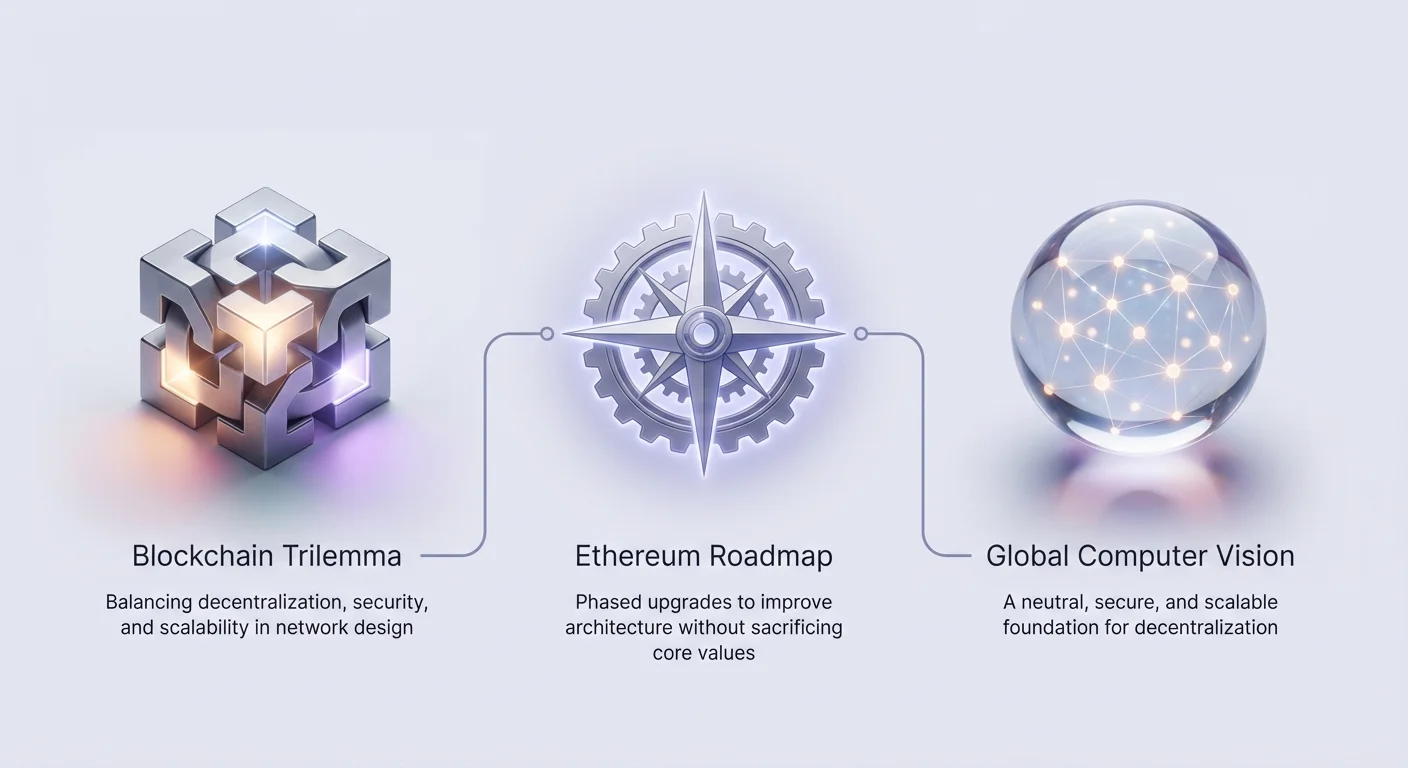
Central to this evolution is the concept of the "blockchain trilemma." This theory suggests that a decentralized network can only optimize for two of three primary features: decentralization, security, and scalability. Ethereum originally prioritized security and decentralization, which often resulted in network congestion and high fees during periods of high demand.
The roadmap is an attempt to solve this trilemma. By implementing these upgrades, the network aims to become scalable enough to handle global demand without sacrificing its core values. The transition involves fundamental changes to both the economic and technical structure of the blockchain.
The Foundation: Understanding The Merge
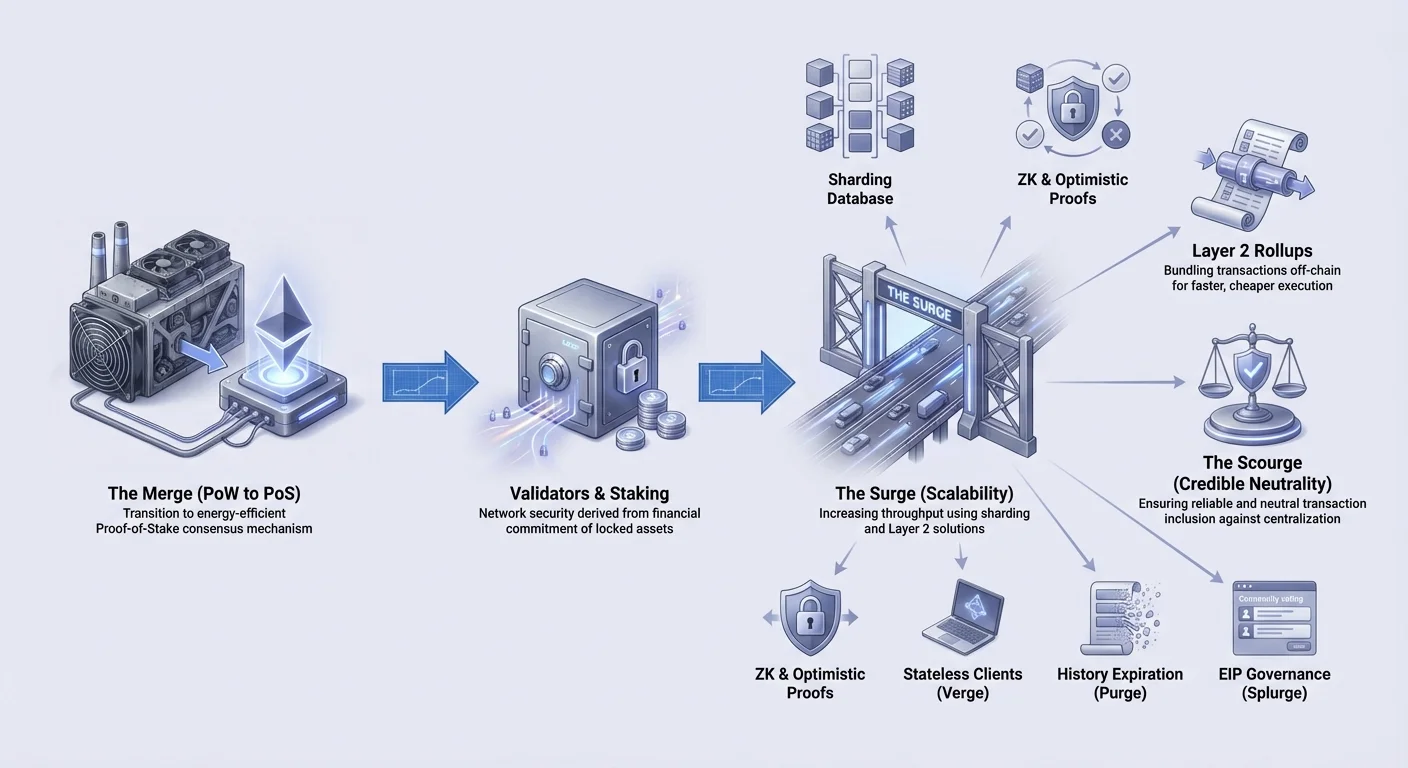
The most significant upgrade in Ethereum's history was known as The Merge. Completed in September 2022, this event marked the transition from the original Proof-of-Work (PoW) consensus mechanism to Proof-of-Stake (PoS). This shift was necessary to reduce the network's energy consumption and lay the groundwork for future scalability upgrades.
Before The Merge, Ethereum relied on miners to secure the network. These participants operated energy-intensive hardware to solve complex mathematical puzzles. This system, while secure, consumed vast amounts of electricity. The transition to Proof-of-Stake replaced miners with validators, who secure the network by locking up capital rather than burning energy.
Mechanics of Proof-of-Stake
In the Proof-of-Stake system, network security is derived from financial commitment rather than computational power. Participants, known as validators, stake their cryptocurrency by sending it to a specific smart contract. This staked asset acts as a security deposit or collateral that guarantees their honest behavior.
The protocol selects validators at random to propose new blocks. Once a validator proposes a block, other validators verify the data to ensure it adheres to the network rules. If the block is valid, it is added to the chain, and the validators are rewarded with newly minted cryptocurrency and transaction fees. This system aligns the financial incentives of the operators with the health of the network.
Benefits and Security Improvements
The primary advantage of this transition was the dramatic reduction in energy usage. Estimates suggest that the switch to Proof-of-Stake reduced Ethereum's energy consumption by over 99 percent. This removed a major barrier to institutional adoption and environmental sustainability.
Beyond energy efficiency, the new system introduced distinct security properties. In a Proof-of-Work system, attacking the network requires 51 percent of the hashing power. In Proof-of-Stake, an attacker would need to acquire a majority of the staked assets. This creates a high economic barrier to malicious behavior. Additionally, the protocol includes a mechanism called slashing. If a validator acts maliciously or violates protocol rules, their staked assets can be forfeited entirely or in part.
The Surge: Achieving Massive Scalability
With the consensus mechanism updated, the focus shifts to "The Surge." This phase targets scalability. The objective is to increase the transaction throughput of the network to support thousands of transactions per second. The primary technologies driving this phase are sharding and Layer 2 scaling solutions.
Scalability is critical because the main network, or Layer 1, has a limited capacity. It can typically process only a specific number of transactions per day. When demand exceeds this capacity, users compete to have their transactions included in the next block. This competition drives up gas fees, pricing out smaller users and limiting the utility of decentralized applications.
The Role of Sharding
Sharding is a technique designed to partition the network's database into smaller, more manageable pieces called shards. In a traditional blockchain, every node must process and store every transaction. This requirement ensures security but severely limits speed. Sharding changes this dynamic by distributing the data processing responsibility.
Under a sharded system, validators are assigned to specific shards. Each shard operates somewhat like a separate blockchain with its own state and transaction history. However, unlike independent blockchains, shards communicate and coordinate through the main chain. This allows the network to process many blocks simultaneously rather than consecutively. The initial implementation of sharding focuses on data availability, which enhances the efficiency of Layer 2 rollups.
Layer 2 Solutions and Rollups
Layer 2 solutions are protocols built on top of the Ethereum mainnet. They handle transaction execution off-chain while relying on the main network for security and final settlement. By moving the heavy lifting away from Layer 1, these solutions offer faster speeds and significantly lower costs.
Rollups are currently the most promising Layer 2 technology. They work by bundling hundreds of transactions into a single batch. This batch is processed on the second layer, and only the compressed data is posted back to the main Ethereum blockchain. There are two primary types of rollups: Optimistic rollups and Zero-Knowledge (ZK) rollups.
| Rollup Type | Validation Method | Pros | Cons |
|---|---|---|---|
| Optimistic | Assumes validity by default | EVM compatible, easier to build | Long withdrawal times (7 days) |
| ZK Rollup | Mathematical validity proof | Instant finality, high security | High computational cost, complex |
Optimistic Versus Zero-Knowledge
Optimistic rollups assume that transactions are valid by default. They do not perform computation on the main chain unless someone challenges a transaction. If a challenge occurs, the network verifies the data. This method is compatible with existing Ethereum smart contracts but requires a withdrawal delay to allow time for challenges.
Zero-Knowledge rollups take a different approach. They generate a cryptographic proof that verifies the validity of the transaction batch. This proof is submitted to the main chain. Since the validity is mathematically proven upfront, there is no need for a challenge period. This allows for faster withdrawals. However, the technology is more complex to implement and requires significant computational resources to generate the proofs.
The Scourge: Obezbeđivanje kredibilne neutralnosti
Kako mreža skalira, pojavljuju se novi rizici u pogledu centralizacije i cenzure. „The Scourge“ se odnosi na stavke putokaza posvećene obezbeđivanju pouzdanog i neutralnog uključivanja transakcija. Ova faza obrađuje zabrinutost da sofisticirani akteri mogu dobiti previše kontrole nad mrežom.
Ključni princip upravljanja Ethereumom je „kredibilna neutralnost“. To znači da mehanizam ne treba da diskriminiše za ili protiv bilo koje specifične osobe. Dizajn mora tretirati sve pošteno. Međutim, ekonomske sile u sistemu Proof-of-Stake mogu dovesti do centralizacije. Kritičari tvrde da jer veći ulagači zarađuju više nagrada, „bogatiji postaju još bogatiji“. Ova koncentracija bogatstva teoretski može dovesti do koncentracije moći.
Suočavanje sa centralizacijom validatora
Barijera za ulazak u postavljanje validator noda može uticati na decentralizaciju mreže. Ako pokretanje validator noda zahteva skup hardver ili ogromne količine ETH, samo bogate entitete mogu učestvovati. Ovo smanjuje raznovrsnost mreže.
Štaviše, rast specijalizovanih servisa poput liquid staking pool-ova doveo je do toga da velike količine uloga kontrolišu samo nekoliko entiteta. Iako ovi servisi staking čine pristupačnim korisnicima sa manjim kapitalom, uvode potencijalnu tačku kvara. Ako jedan entitet kontroliše veliki procenat uloga mreže, potencijalno može uticati na upravljanje ili redosled transakcija.
Da se ovo bekropi, putokaz uključuje nadogradnje koje obezbeđuju da proizvodnja blokova ostane raspodeljena. Cilj je razdvajanje uloge izgradnje blokova od uloge njihovog predlaganja. Ovo razdvajanje sprečava bilo kog pojedinačnog validatora da cenzuriše transakcije ili izvlači prekomernu vrednost od korisnika.
The Verge and The Purge: Managing Data and History
The long-term health of the blockchain depends on its ability to remain accessible to independent operators. "The Verge" and "The Purge" focus on efficiency, specifically regarding node operation and historical data management.
For a blockchain to be truly decentralized, individuals must be able to verify the ledger themselves. This is done by running a "node." A node is a computer that runs the Ethereum software and validates transactions. If the hardware requirements for running a node become too high, fewer people will do it. This leads to reliance on centralized service providers like Infura, which creates vulnerability.
The Verge: Reducing Verification Costs
The Verge aims to introduce "stateless clients" or Verkle trees. Currently, verifying a block requires access to a large portion of the blockchain's state. As the network grows, this state becomes larger, requiring more RAM and faster SSDs.
The upgrades in this phase will allow nodes to verify blocks without storing the entire state of the network on their hard drives. By reducing the data requirements, it becomes feasible for users to run nodes on consumer-grade hardware, such as mobile phones or basic laptops. This lowers the barrier to entry and increases the resilience of the network.
The Purge: Eliminating Historical Bloat
The Ethereum blockchain carries the weight of its entire history. The Purge involves cleaning up old network history to simplify the protocol. Currently, running a full archival node requires downloading terabytes of data. This history includes every transaction ever executed since the genesis block.
While maintaining a complete history is important for auditing, it is not strictly necessary for validating new transactions. The Purge seeks to implement mechanisms where nodes can expire old history. This means nodes would stop storing data that is older than a certain timeframe, such as one year.
This reduction in storage requirements prevents the network from becoming too heavy. It ensures that new nodes can sync with the network quickly. By managing the accumulation of technical debt, the protocol remains agile and easier to maintain for developers and users alike.
The Splurge: Upravljanje i buduće usavršavanje
Poslednja kategorija, „The Splurge“, deluje kao sveobuhvatna za neophodne ali raznovrsne nadogradnje. Ovo su poboljšanja koja rešavaju manje probleme, poboljšavaju korisničko iskustvo i usavršavaju ekonomski model. Takođe obuhvata kontinuiranu evoluciju upravljanja Ethereumom.
Ethereum nije statički protokol. Zahteva stalne promene da popravi bagove i odgovori na tržišne uslove. Ova evolucija se upravlja preko Ethereum Improvement Proposals (EIP). Pojedinci ili timovi pišu predloge, koji se zatim raspravljaju u zajednici. Ovaj proces se oslanja na „grubi konsenzus“ među akterima, uključujući rudare, operatere nodova i developere.
Ekonomska poboljšanja i EIP-1559
Jedan glavni primer ekonomske nadogradnje koja se uklapa u ovu kategoriju je EIP-1559. Implementirana pre The Merge, ova nadogradnja je preoblikovala tržište naknada. Uvela je baznu naknadu koja se sagoreva (uništava) sa svakom transakcijom. Ova promena je učinila naknade za transakcije predvidivijim za korisnike.
Nadogradnje poput ovih su ključne za dugoročnu održivost imetka. Sagorevanjem ETH, protokol uvodi deflacioni pritisak koji protivteži izdavanju novih tokena validatorima. Buduće nadogradnje „Splurge“ mogu se fokusirati na Account Abstraction, što bi upravljanje kripto novčanicima učinilo lakim kao korišćenje tradicionalne bankarske aplikacije.
Izazov decentralizovanog upravljanja
Upravljanje u decentralizovanom sistemu je inherentno političko. Za razliku od privatne kompanije, nema CEO-a koji donosi unilateralne odluke. Promene moraju biti dobrovoljno usvojene od hiljada nezavisnih nodova koji pokreću softver.
Ovaj proces može biti spor i kontroverzan. Na primer, zajednica mora balansirati progresivizam (brze promene za poboljšanje mreže) sa konzervativizmom (održavanje stabilnosti i minimiziranje rizika). Ethereum kultura generalno favorizuje progresivni pristup za rešavanje trilemme. Međutim, obezbeđivanje da ove promene odražavaju vrednosti šire zajednice zahteva stalnu budnost i aktivno učešće svih aktera.
Zaključak
Putokaz od The Merge do The Splurge predstavlja sveobuhvatan plan za sazrevanje Ethereum mreže. Prelaskom na Proof-of-Stake, protokol je rešio probleme potrošnje energije. Kroz šardiranje i Layer 2 rollupe, cilja da reši krizu skalabilnosti koja je istorijski mučila blockchainove sa velikim potraživanjem.
Istovremeno, fokus na efikasnost nodova i upravljanje istorijskim podacima obezbeđuje da mreža ostane decentralizovana. Snižavanje hardverskih barijera za validatore i operatere nodova štiti sistem od centralizovane kontrole. Iako je tehnologija kompleksna, krajnji cilj je jednostavan: izgraditi neutralnu, bezbednu i skalabilnu osnovu za digitalnu budućnost.
Nadogradnje Ethereuma imaju za cilj stvaranje brzog, bezbednog globalnog računara koji svako može koristiti i efikasno verifikovati.