
The history of human trade is fundamentally a story of adaptation. For thousands of years, civilization has sought better ways to store, measure, and exchange value. This journey began with simple barter systems, where individuals exchanged goods directly. However, this early model suffered from the "double coincidence of wants." For a trade to happen, both parties had to desire exactly what the other possessed.
To solve this friction, societies moved toward commodity money. Items with intrinsic value, such as seashells or precious metals, became the standard. Gold emerged as the enduring champion of this era due to its specific properties. It was rare, durable, divisible, and difficult to counterfeit. These physical attributes allowed gold to serve as a reliable store of value that did not depend on any central authority for its worth.
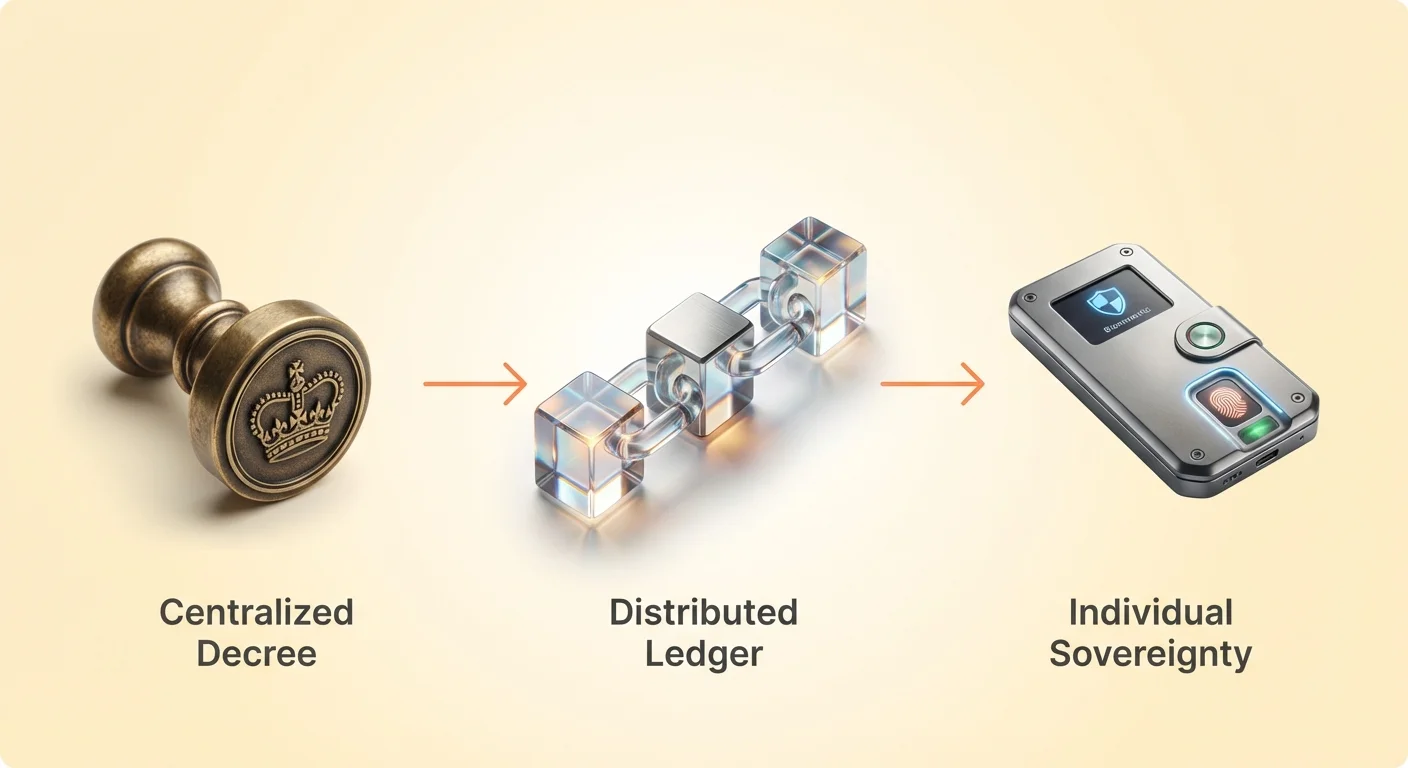
As economies grew more complex, carrying heavy metals became impractical. This necessity gave birth to representative money, such as paper certificates backed by gold in a vault. Eventually, this evolved into the fiat currency system used globally today. Fiat money is not backed by physical commodities. Instead, its value is derived from government decree and public trust in the issuing state’s economic stability.
While fiat currency solved portability issues, it introduced a new vulnerability: centralization. In a fiat system, currency is issued and controlled by central banks. Citizens are effectively forced to use the money of their nation, and the value of that money can be diluted through inflation. Furthermore, the ability to transact relies entirely on a network of intermediaries, such as commercial banks and payment processors.
This reliance on intermediaries created a system where financial sovereignty is conditional. A bank account does not strictly hold "your" money; it holds a claim to money that the bank owes you. If the institution fails, or if a government orders a freeze on assets, that claim can be denied. This realization birthed the philosophy behind uncensorable finance and the rise of cryptocurrency.
The Core Philosophy of Uncensorable Finance
The concept of uncensorable finance is rooted in the idea that financial access should be permissionless. In the traditional banking world, participation is a privilege granted by institutions. In the realm of decentralized assets, participation is a right derived from the software itself. This shift is often described as moving from a "trust-based" model to a "verification-based" model.
Cryptocurrency operates on an opt-in basis. Unlike national currencies, which are mandated by law, digital assets like Bitcoin are controlled by the consensus of their users. It represents a voluntary network of participants who agree to a specific set of protocol rules. No one is forced to use it, but those who do gain access to a system that operates without a central administrator.
At the heart of this philosophy is censorship resistance. In a financial context, censorship refers to the suppression of economic activity. This can take many forms, such as preventing a transaction from occurring, confiscating funds, or freezing an account. Censorship resistance is the technical capacity of a network to prevent these interferences, ensuring that valid transactions are processed regardless of the sender, receiver, or purpose.
The Three Pillars of Resistance
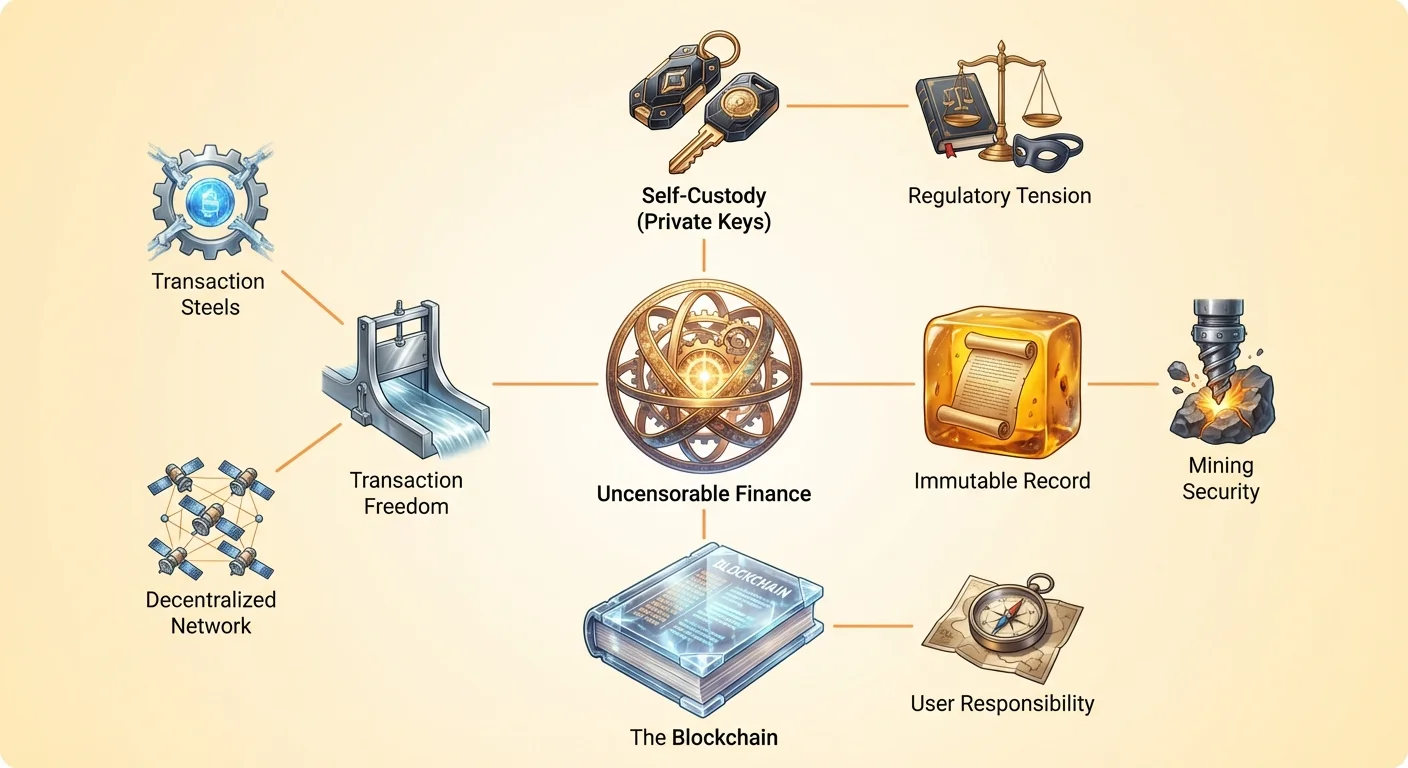
To understand how uncensorable finance works, one must examine the three pillars that define it. These pillars distinguish sovereign digital assets from digital fiat or traditional banking databases.
The first pillar is the freedom to transact. This ensures that no third party can prevent a user from sending or receiving assets. In a centralized system, a bank can decline a transaction based on internal policy or government pressure. In a decentralized blockchain, if a transaction follows the mathematical rules of the protocol and includes the necessary fee, it is processed. The network does not judge the moral or political weight of the transfer; it simply executes code.
The second pillar is the freedom from confiscation. In traditional finance, assets held by custodians can be seized. Governments or legal entities can order a bank to drain an account. With self-custodial cryptocurrencies, the user holds the "private keys"—cryptographic passwords necessary to move funds. Without these keys, the funds cannot be moved by anyone, not even the creators of the system. This makes confiscation extremely difficult without physical coercion.
The third pillar is the immutability of transactions. Once a transaction is confirmed and added to the blockchain, it acts as a permanent digital record. It cannot be reversed, deleted, or altered. This prevents the retroactive cancellation of payments, a common occurrence in credit card networks and banking systems. Immutability ensures that history remains transparent and tamper-proof.
The Technology of Sovereignty
The mechanism that enables these freedoms is the blockchain. A blockchain is a distributed ledger that records transactions across a global network of computers. Unlike a bank's database, which is stored on private servers controlled by a single company, a blockchain is duplicated on thousands of independent nodes.
This decentralized structure makes the network resistant to single points of failure. There is no "head" to cut off. If one node goes offline or is seized, the rest of the network continues to operate without interruption. This durability is critical for maintaining a financial system that cannot be shut down by any single entity or government.
Security is maintained through cryptography and consensus mechanisms. In systems like Bitcoin, "miners" expend energy and computational power to solve complex mathematical problems. This process secures the network and validates blocks of transactions. To alter the record, an attacker would need to overwhelm the combined computing power of the entire global network, a feat that is economically and physically impractical.
The Spectrum of Decentralization
It is crucial to understand that not all digital assets offer the same level of censorship resistance. This quality exists on a spectrum. The level of resistance depends on the network architecture, the distribution of nodes, and the governance model of the specific cryptocurrency.
At one end of the spectrum lies Bitcoin. It is widely considered the most censorship-resistant asset due to its massive, globally distributed network and its "headless" nature. There is no CEO of Bitcoin, no marketing department, and no central office to subpoena. The rules are enforced by code and the social consensus of its users.
On the other end of the spectrum are centralized blockchains and permissioned ledgers. Some networks sacrifice decentralization to achieve higher transaction speeds or lower costs. These networks may be controlled by a consortium of validators or a single development company. While they utilize blockchain technology, they may retain the ability to freeze funds or reverse transactions, making them less resistant to external pressure.
| Feature | Decentralized Network (e.g., Bitcoin) | Centralized Network (e.g., Bank/Some Chains) |
|---|---|---|
| Control | Distributed across global users | Central authority or consortium |
| Access | Permissionless (anyone can join) | Permissioned (requires approval) |
| Reversibility | Immutable (permanent) | Reversible by authority |
The Role of Intermediaries and Custody
The philosophy of uncensorable finance places a heavy emphasis on self-custody. This is often summarized by the popular mantra: "Not your keys, not your coins."
In the cryptocurrency ecosystem, wallets are tools for interacting with the blockchain. They generate the cryptographic keys that prove ownership of assets. These wallets fall into two primary categories: custodial and self-custodial.
Custodial wallets are similar to traditional bank accounts. The service provider holds the private keys and manages the funds on behalf of the user. While this offers convenience—such as easy password recovery—it reintroduces counterparty risk. If the exchange goes bankrupt or halts withdrawals, the user loses access to their assets. This scenario mirrors the "bank run" risk of the traditional financial world.
Self-custodial wallets allow the user to retain full control. The private keys are stored locally on the user’s device or on a hardware wallet. This method aligns with the ethos of sovereignty, as it removes the need to trust a third party. However, it also places the burden of security entirely on the individual. If a user loses their keys, there is no customer support line to restore access.
Stablecoins: A Bridge with Trade-offs
As the crypto ecosystem evolved, a demand emerged for assets that lacked the volatility of traditional cryptocurrencies like Bitcoin. This led to the creation of stablecoins—digital tokens pegged to the value of stable assets, most commonly the US dollar. Stablecoins allow traders to lock in value without exiting the cryptocurrency ecosystem.
However, stablecoins present a philosophical paradox. While they operate on decentralized public blockchains, the most popular stablecoins are issued by centralized companies. To maintain the peg, these issuers hold reserves of fiat currency and equivalents.
This centralization means that the issuers of popular stablecoins have the power to blacklist addresses and freeze funds at the smart contract level. If a law enforcement agency requests a freeze, the issuer can comply, effectively rendering the tokens in a specific wallet useless. While stablecoins offer the utility of digital dollars and faster settlement, they do not possess the same censorship-resistant properties as Bitcoin.
Decentralized stablecoins attempt to solve this by using algorithmic mechanisms or crypto-collateral instead of fiat reserves. These protocols aim to maintain stability without a central administrator. However, these models have faced significant challenges regarding capital efficiency and stability during periods of extreme market volatility.
The Conflict of Privacy and Regulation
The push for uncensorable finance often collides with established regulatory frameworks, specifically Know Your Customer (KYC) and Anti-Money Laundering (AML) laws. These regulations require financial institutions to verify the identity of their clients to prevent illicit activities.
In the traditional system, financial privacy is limited. Banks monitor transactions and report suspicious activity. In the crypto space, the transparency of the blockchain adds another layer of complexity. Public blockchains record every transaction openly. While user identities are pseudonymized (represented by alphanumeric strings), they are not strictly anonymous. If a real-world identity is linked to a wallet address, the entire transaction history of that user becomes visible.
KYC regulations apply to most centralized cryptocurrency exchanges. To buy crypto with fiat currency, users typically must provide government ID and proof of address. This links their on-chain activity to their physical identity. While this helps prevent crime, it creates a tension with the ideal of privacy.
Privacy is a critical component of sovereignty. Without privacy, true censorship resistance is difficult to maintain. If an authority can easily identify the owner of funds, they can apply pressure on the individual, even if they cannot technologically freeze the funds on the network. This has led to the development of privacy-focused wallets and coins, though these tools often face intense regulatory scrutiny.
Tokens and the Expansion of Value
The philosophy of decentralized ownership extends beyond simple currency. The invention of the token has allowed for the representation of various forms of value on the blockchain. Tokens can represent ownership in a project, access to a service, or even rights to physical assets.
Utility tokens grant holders access to specific applications or services within a blockchain ecosystem. They function similarly to digital coupons or arcade tokens but are tradeable on open markets. Governance tokens take this a step further by allowing holders to vote on changes to the protocol. This distributes decision-making power to the community rather than concentrating it in a boardroom.
Non-Fungible Tokens (NFTs) introduced the concept of unique digital ownership. Unlike cryptocurrencies, which are interchangeable, NFTs are distinct. They can represent digital art, collectibles, or proof of ownership for real-world assets like real estate. This technology eliminates the need for intermediaries in proving authenticity and ownership history, further empowering individuals to control their assets directly.
Financial Sovereignty in Practice
The practical implications of uncensorable finance are profound, particularly in regions suffering from economic instability or authoritarianism. In nations with high inflation, citizens often watch their purchasing power evaporate due to government mismanagement. Capital controls may prevent them from converting their local currency into foreign assets or moving their wealth abroad.
Cryptocurrencies offer an escape valve. Because they exist on the internet, they ignore national borders. A citizen in a hyperinflationary economy can convert their savings into a digital asset that is not subject to their government's monetary policy. This acts as a hedge against inflation and a tool for preserving wealth.
Furthermore, in scenarios where banking systems collapse or limit withdrawals, self-custodial assets remain accessible. During a bank run, depositors line up hoping to withdraw cash that may not exist. A holder of cryptocurrency, essentially being their own bank, does not face this liquidity crisis. As long as the internet functions, they can access and transfer their wealth.
The Role of Mining in Security
The security that underpins this entire philosophy relies heavily on the process of mining (in Proof-of-Work systems) or validating (in Proof-of-Stake systems). Mining is not just about creating new coins; it is the mechanism that orders transactions and secures the history of the ledger.
Miners compete to solve cryptographic puzzles. The energy and hardware investment required to participate acts as a barrier to entry for attackers. This is often referred to as "physical" security for a digital asset. To reverse a transaction, an attacker would need to redo the work of the miners, requiring an immense amount of energy.
This connection to physical resources anchors the digital system in reality. It ensures that the cost of attacking the network is prohibitively high. This economic game theory is what keeps the network honest without requiring a central policeman. It aligns the incentives of the participants: it is more profitable to secure the network and earn rewards than it is to attack it.
Navigating the Risks
Embracing financial sovereignty requires acknowledging the inherent risks. The removal of intermediaries means the removal of safety nets. There is no fraud department to call if funds are sent to the wrong address. There is no insurance policy if a private key is lost.
The volatility of the crypto markets also poses a challenge to its use as a short-term store of value. While long-term trends may show growth, daily price swings can be severe. This volatility is a natural characteristic of a nascent, free market that is still discovering its fair value.
Smart contract risk is another consideration. In decentralized finance (DeFi) applications, users interact with automated code. If that code contains a bug or an exploit, funds can be lost. Unlike a bank robbery where the bank is insured, a DeFi hack often results in a total loss for the depositor.
The Future of Digital Ownership
The trajectory of uncensorable finance points toward a world where individuals have greater control over their economic destiny. As technology improves, the user experience of self-custody is becoming more intuitive, lowering the barrier to entry for non-technical users.
Innovations in scaling solutions are addressing the issues of speed and cost, making decentralized networks viable for daily commerce rather than just settlement layers. Layer 2 solutions, for example, process transactions off the main blockchain to increase throughput while inheriting the security of the base layer.
The integration of real-world assets (RWAs) into the blockchain promises to modernize traditional finance. By tokenizing stocks, bonds, and real estate, these markets can gain the benefits of 24/7 trading, instant settlement, and global accessibility. However, integrating these regulated assets will require finding a balance between compliance and the permissionless nature of the technology.
Conclusion
The philosophy of uncensorable finance represents a fundamental shift in how society views money and value. It challenges the historical norm where financial access is a privilege granted by authorities. Instead, it proposes a system where economic participation is a right guaranteed by code. By leveraging blockchain technology, cryptography, and decentralized networks, it offers a path toward true financial sovereignty.
This shift places immense power and responsibility in the hands of the individual. It requires a willingness to learn new tools and accept the risks of self-custody. Yet, for many, the ability to transact freely, store value independently, and opt out of failing monetary systems is a liberty worth the effort. As the digital age progresses, the tools of uncensorable finance will likely become essential components of personal freedom.
True ownership means possessing assets that no authority can freeze, seize, or censor without your cryptographic consent.