
Understanding the flow of digital assets across decentralized networks is a fundamental skill for any cryptocurrency participant. Unlike traditional banking systems where transactions occur behind closed doors, blockchain technology operates on a philosophy of radical transparency. Every movement of value, every smart contract interaction, and every fee paid is recorded on a public ledger that is accessible to anyone with an internet connection. This transparency ensures that the system remains trustless and verifiable without reliance on central intermediaries. This is the core principle behind the Architecture of Digital Freedom.
To navigate this open ecosystem, users rely on specialized tools designed to interpret raw blockchain data. These tools transform complex cryptographic strings into human-readable information. They allow individuals to track the status of their funds in real-time and verify that counterparties have fulfilled their obligations. Without these monitoring capabilities, the decentralized nature of cryptocurrency would be opaque and difficult to trust.
Mastering these tools requires understanding the lifecycle of a transaction. From the moment a transfer is broadcast to the network to the point where it is irreversibly etched into the blockchain history, various factors influence its speed and cost. Network congestion, fee markets, and consensus mechanisms all play critical roles in how traffic moves through these digital highways. By learning to monitor this traffic, users can optimize their interactions, save on fees, and avoid the frustration of stuck or pending transactions.
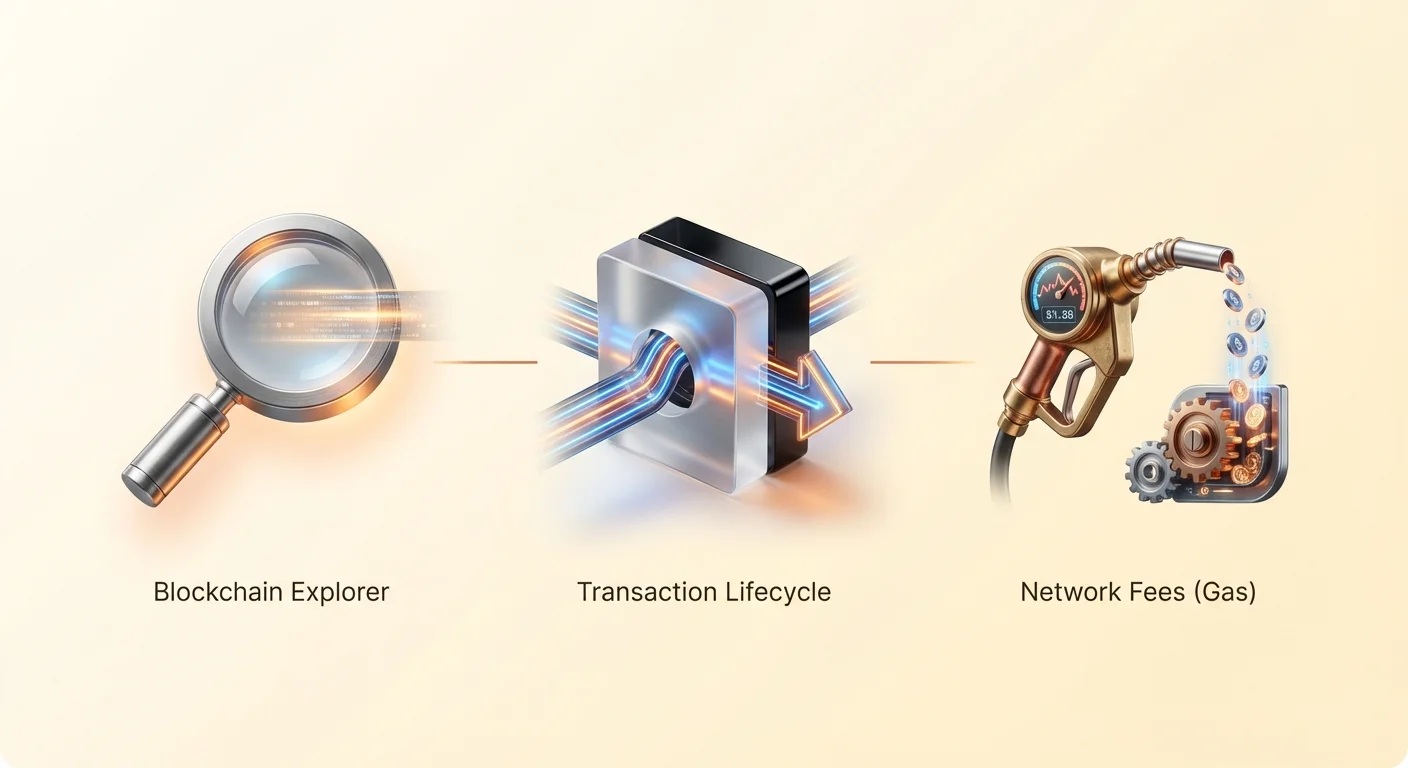
The Role of Blockchain Explorers
A blockchain explorer functions as a search engine specifically designed for a blockchain network. Just as web search engines index the internet to make websites findable, block explorers index the blockchain to make transaction data accessible. They provide a direct window into the shared ledger maintained by the network's nodes. This tool is essential for verifying the "state" of the blockchain, which includes the current balances of addresses and the history of all operations.
Indexing the Public Ledger
The core function of an explorer is to retrieve raw data from the blockchain and organize it into a format that users can understand. The blockchain itself is a chain of blocks containing transaction records, similar to pages in a digital accounting book. The explorer pulls this data continuously, updating in real-time as new blocks are mined or validated.
This indexing process ensures that history is preserved and searchable. Users can input specific data points to locate exactly what they are looking for within the massive history of the network. Without this interface, a user would need to run a full node and query the database using command-line code to check a simple balance. Explorers democratize access to this technical data, bridging the gap between code and user experience.
Key Search Functions
Blockchain explorers offer a variety of search capabilities that serve different needs for investors, developers, and casual users. The most common use is searching for a specific transaction ID (TXID) to check its status. This confirms whether funds have been sent, if they are still pending, or if the transfer has failed.
Users can also search by wallet address. This reveals the current holding of cryptocurrency in that specific wallet and a chronological list of all incoming and outgoing transfers. This feature is vital for transparency, allowing anyone to verify the reserves of a project or track the movement of funds from known entities.
| Feature | Function | User Benefit |
|---|---|---|
| Transaction Search | Lookup by TXID | Verify payment status and fees |
| Address Lookup | Search by wallet address | View balances and history |
| Block Feed | View latest blocks | Monitor network health and speed |
Decoding Transaction Confirmations
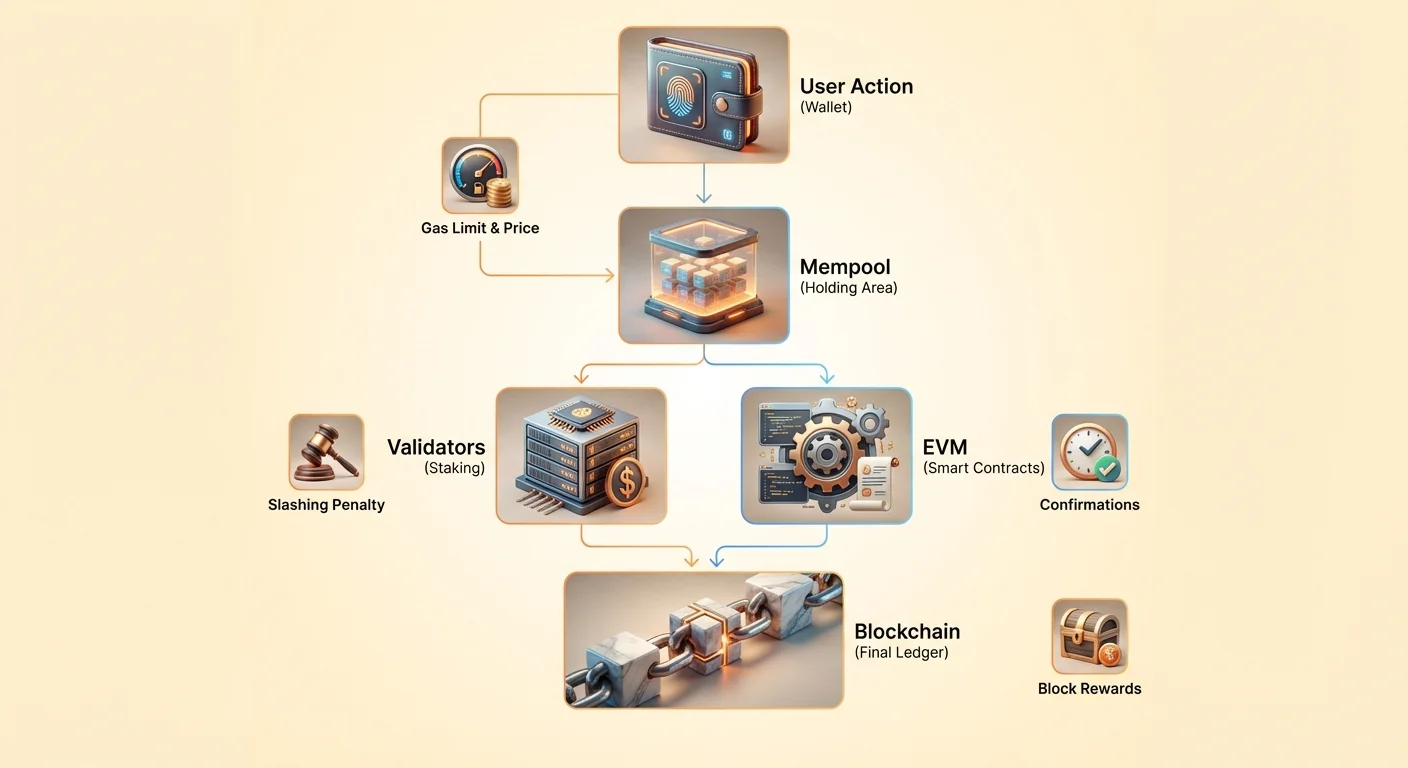
A transaction is not instantaneous in the world of blockchain. When funds are sent, the transaction enters a holding area often referred to as the holding area often referred to as the mempool (memory pool) where it waits to be picked up by a miner or validator. The transition from this waiting state to a finalized state is measured in "confirmations." Understanding this metric is crucial for security and for knowing when a payment is truly complete.
From Unconfirmed to Finalized
A confirmation occurs when a transaction is included in a block and that block is added to the blockchain. This represents the network's acceptance of the transfer. Initially, a transaction has zero confirmations. Once included in a newly mined block, it has one confirmation.
As subsequent blocks are added to the chain on top of that first block, the confirmation count increases. For example, if a transaction is in block X, and the network mines block X+1, the transaction now has two confirmations. This stacking effect makes the transaction increasingly difficult to reverse. The more blocks that are built on top of the transaction, the deeper it is buried in the ledger, and the more secure it becomes against potential network attacks or reorganization attempts.
Security Thresholds
Different networks and businesses have varying standards for what they consider "final." Because blockchain history is immutable only after sufficient work has been done, recipients often wait for multiple confirmations before releasing goods or crediting deposits.
For Bitcoin, a transaction is typically considered secure after six confirmations. This generally takes about one hour. Ethereum, which has faster block times, usually requires a higher number of confirmations, often around 30, to achieve a similar level of security assurance. Businesses such as exchanges establish these thresholds to prevent "double-spending," a type of fraud where an actor attempts to spend the same coins twice before the network reaches consensus.
Network Fees and Congestion
Network fees, often called transaction fees, are the costs associated with processing transfers on a blockchain. These fees are not arbitrary; they act as incentives for the miners and validators who maintain the network's integrity. The fee amount is dynamic and fluctuates based on the current supply of block space and the demand from users wanting to transact.
Fee Determinants
On smart contract-enabled blockchains, fees are determined by computational complexity, data size, and urgency. A transaction that requires more data to execute takes up more space in a block. Since block space is limited, larger transactions naturally command higher fees. This is similar to shipping a package; a larger, heavier box costs more to send than a standard envelope.
Urgency is the second major factor. When many users want to transact simultaneously, they compete for the limited space in the next block. Users who need their transactions processed immediately can attach a higher fee to incentivize miners to prioritize their request. This creates a competitive marketplace where the price of inclusion rises during periods of high activity and falls when the network is quiet.
The Cost of Complexity
Not all blockchain interactions are created equal. A simple transfer of cryptocurrency from one person to another is relatively standard and incurs a lower base fee because it requires minimal computational power. However, interactions involving decentralized applications (dApps) are more complex.
| Transaction Type | Complexity Level | Relative Cost |
|---|---|---|
| Standard Transfer | Low | Lowest Fee |
| DEX Token Swap | Medium | Medium Fee |
| NFT Minting | High | Highest Fee |
Operations like swapping tokens on a decentralized exchange (DEX) involve interacting with smart contracts. The network must calculate exchange rates, update liquidity pools, and execute the swap logic. This requires more computational resources than a simple send. Minting a Non-Fungible Token (NFT) is even more expensive, as it involves writing significant new data to the blockchain to create a unique asset.
Understanding Ethereum Gas
In the Ethereum ecosystem, the concept of network fees is defined as "gas." Gas is the unit of computation that measures the amount of computational effort required to execute specific operations on the network. Just as a car requires fuel to drive a certain distance, Ethereum transactions require gas to complete their journey through the Ethereum Virtual Machine (EVM).
Computational Effort and Pricing
Every operation on Ethereum consumes a fixed amount of gas units. A simple ETH transfer might use 21,000 gas units, while a complex smart contract interaction could use hundreds of thousands. However, the cost of that gas varies based on market conditions.
The total fee a user pays is the result of the "Gas Limit" multiplied by the "Gas Price." The Gas Limit is the maximum amount of fuel the user is willing to consume, ensuring the transaction doesn't run indefinitely. The Gas Price is the cost per unit of gas, usually denominated in "gwei" (a tiny fraction of ETH). When the network is busy, the price per unit of gas increases, raising the total transaction cost even if the computational effort remains the same.
The Impact of EIP-1559
Ethereum's fee market underwent a significant shift with the implementation of EIP-1559. This upgrade introduced a "base fee" mechanism to make pricing more predictable. The base fee is a mandatory cost determined by the saturation of the previous block. This fee is burned, or permanently removed from circulation, rather than paid to miners.
To prioritize a transaction, users now add a "priority fee" or "tip" on top of the base fee. This tip goes directly to the validator. This system helps users better estimate costs, as the base fee adjusts dynamically but predictably based on congestion. While it does not necessarily lower fees during peak times, it provides transparency regarding the minimum cost required to get a transaction included in the next block.
The EVM and Smart Contract Interactions
The Ethereum Virtual Machine (EVM) is the engine that powers the EVM Execution Layer of smart contracts. It is a Turing-complete virtual environment, meaning it can theoretically execute any computer program given enough resources. The EVM is what differentiates programmable blockchains from simple payment networks, enabling the creation of decentralized applications (dApps).
Executing Bytecode
When a developer writes a smart contract, it is compiled into bytecode, a low-level machine language that the EVM can interpret. When a user interacts with a dApp, they are essentially sending a transaction that triggers this bytecode. The EVM processes these instructions in a sandboxed environment, which isolates the code from the rest of the network to prevent security failures from spreading.
This execution process is what generates the demand for gas. Every line of bytecode requires a specific amount of computational work. The EVM tracks this usage meticulously. If a user's provided gas limit is insufficient to cover the computational steps required by the contract, the EVM halts the operation. The transaction fails, and the gas used up to that point is consumed, but the state of the blockchain reverts as if the transaction never happened.
Resource Consumption
The flexibility of the EVM comes with resource costs. Because every node in the network must execute the same transactions to maintain consensus, heavy computations are expensive. This prevents malicious actors from spamming the network with infinite loops or overly complex programs that could stall the system.
This architecture explains why fees spike during popular NFT mints or periods of high DeFi activity. Thousands of users are simultaneously asking the EVM to execute complex logic. Since the EVM has a finite capacity for how much computation it can process per block, the price for these resources skyrockets. EVM-compatible chains like BNB Smart Chain or Polygon use this same architecture but often with different parameters to increase throughput or lower costs.
Layer Architecture and Traffic Flow
Blockchain technology is organized into layers, each serving a specific function in the hierarchy of the network. Understanding these layers helps explain how traffic is managed and where scalability solutions are implemented. The relationship between the base security layer and the application layers determines the efficiency of the entire ecosystem.
The Base Layer Bottleneck
Layer 1 (L1) refers to the main blockchain architecture, such as Bitcoin or Ethereum. This layer is responsible for security, consensus, and final settlement of transactions. L1 networks prioritize decentralization and security above all else. Consequently, they often face scalability limitations, leading to bottlenecks when traffic volume exceeds the network's processing capacity.
When L1 becomes congested, transaction speeds slow down and fees rise. This is an inherent trade-off in the "blockchain trilemma," where it is difficult to achieve scalability, security, and decentralization simultaneously. To address this, developers have built additional layers on top of the base foundation to handle the heavy lifting of transaction throughput.
Off-Chain Scaling Solutions
Layer 2 (L2) solutions are protocols built on top of Layer 1 to increase efficiency. They operate by processing transactions off the main chain and then bundling them together to settle on Layer 1. This reduces the data load on the main network. Examples include Comparing rollups on Ethereum or the Lightning Network on Bitcoin.
By moving traffic to Layer 2, users can enjoy faster transaction speeds and significantly lower fees while still benefiting from the security of the main Layer 1 blockchain. Layer 3 (L3) refers to the application layer where the user interface and dApps reside. These applications effectively route traffic through L2s and L1s, creating a seamless experience for the user who may not even realize which layer is processing their request.
Consensus Mechanisms and Validation
The processing of network traffic is ultimately handled by the consensus mechanism, the system that ensures all participants agree on the state of the ledger. In modern blockchains, Proof of Stake (PoS) has become a dominant model, replacing the energy-intensive mining of Proof of Work (PoW) in many networks.
Validator Responsibilities
In a PoS system, validators replace miners. These are individuals or entities chosen to propose new blocks and verify the transactions within them. The selection process is often based on the amount of cryptocurrency they have "staked" or locked up as collateral. This financial commitment acts as a guarantee of good behavior.
Validators listen for broadcast transactions, validate that the sender has sufficient funds, and ensure the transaction adheres to protocol rules. Once a block of valid transactions is proposed, other validators attest to its accuracy. If consensus is reached, the block is added to the chain, and the traffic is officially processed.
Staking and Security
The security of the traffic flow relies on the economic incentives of staking. If a validator attempts to approve fraudulent transactions or attack the network, they face the penalty of "slashing," where a portion of their staked assets is confiscated. This creates a strong deterrent against malicious behavior.
This system allows for greater scalability compared to traditional mining. Because validation does not require solving arbitrary mathematical puzzles, the energy consumption is minimal. Additionally, the barriers to entry can be lower, allowing more participants to secure the network. This distribution of power helps ensure that traffic is processed neutrally and without censorship.
Practical Fee Management
For the average user, navigating network fees is about balancing cost against speed. Most modern cryptocurrency wallets simplify this process by estimating fees automatically, but understanding the underlying mechanics allows for better decision-making. Self-custodial wallets typically offer more control over these settings compared to centralized exchanges.
Setting Priorities
Wallets often present fee options in tiers such as "Eco," "Fast," and "Fastest." The "Eco" or slow setting attaches a lower fee to the transaction. This signals to validators that the user is willing to wait. In times of low congestion, even a low fee might be processed quickly. However, during busy periods, an "Eco" transaction might sit in the mempool for hours.
"Fastest" settings attach a premium fee, pushing the transaction to the front of the line. This is essential for time-sensitive activities, such as closing a loan position to avoid liquidation or buying a highly anticipated NFT. Users should choose the setting that matches the urgency of their specific transaction.
Timing the Market
Advanced users can check the current state of the network using gas trackers or blockchain explorers before sending funds. Network activity is rarely constant; it flows in waves based on global time zones and market events.
| Strategy | Description | Benefit |
|---|---|---|
| Off-Peak Transacting | Sending during weekends or nights | Lower fees |
| Gas Trackers | Using tools to view current prices | Accurate fee estimation |
| Custom Nonce | Advanced tech to replace stuck txs | Unsticking pending funds |
By observing these patterns, a user can time their non-urgent transfers for periods of low activity, significantly reducing costs. For example, executing complex smart contract interactions on weekends often costs less than during the midweek rush. This proactive monitoring converts passive data into actionable savings.
Conclusion
Monitoring network traffic is an essential practice for anyone engaging with blockchain technology. By utilizing blockchain explorers, users gain the ability to verify the status of their funds and ensure that transactions are proceeding as expected. Understanding the mechanics of confirmations helps manage expectations regarding settlement times, providing assurance that a transfer is final and secure against reversal.
Furthermore, comprehending the economics of network fees and gas usage empowers users to transact more efficiently. Whether it involves choosing the right time to execute a complex smart contract or selecting an appropriate fee tier in a wallet, this knowledge translates directly to cost savings. As blockchain ecosystems evolve with multi-layer scaling solutions and new consensus mechanisms, the ability to read and interpret this data will remain a cornerstone of digital asset literacy.
Transparency is the currency of trust in the decentralized world.