
A maioria dos jogadores de blackjack passa a vida olhando para o feltro, obcecados por um único adversário: o dealer. Eles memorizam tabelas, contam baralhos e sofrem com a virada de uma carta, tudo em um esforço para reduzir a margem da casa (house edge). No entanto, a ascensão dos cassinos de cryptocurrency popularizou uma fera totalmente diferente: o Blackjack Tournament.
Em um torneio, o dealer é apenas um mecanismo para gerar resultados. Seus verdadeiros oponentes são os outros jogadores no ranking (leaderboard). Isso envolve uma mudança fundamental na psicologia. Você não está mais tentando acumular um lucro de longo prazo contra uma margem matemática; você está tentando durar mais, apostar mais e superar adversários humanos para reivindicar o prêmio total.
Quer você esteja participando de um evento de alto valor de inscrição (buy-in) ou competindo em uma corrida semanal de apostas (wager race) em sua plataforma crypto favorita, as estratégias necessárias para subir no ranking são muito diferentes daquelas usadas em um jogo a dinheiro padrão (cash game). Este guia irá levá-lo através da mecânica do jogo de torneio, dos ajustes necessários às suas tabelas de Estratégia Básica e da arte da "aposta contrariana" exigida para conquistar o primeiro lugar.
A Mudança de Paradigma: Cash Games vs. Tournaments
Para ter sucesso em um torneio, você deve primeiro desaprender um pouco da disciplina exigida para os cash games. Em uma sessão padrão, a preservação de fichas e a minimização de perdas são primordiais. Em um torneio, as fichas são simplesmente munição. Elas não têm valor monetário fora da competição; seu único valor reside na sua capacidade de classificá-lo mais alto do que o Jogador B.
Aqui está a diferença fundamental na abordagem:
| Característica | Estratégia de Cash Game | Estratégia de Torneio |
|---|---|---|
| Objetivo Principal | Ganhar dinheiro do casino. | Terminar com mais fichas do que os oponentes. |
| Tolerância ao Risco | Baixa a Média (proteger a banca). | Alta (riscos calculados são necessários). |
| Oponente | O Dealer (A Casa). | Outros Jogadores (O Campo). |
| Dimensionamento da Aposta | Consistente, baseado no gerenciamento da banca. | Variável, baseado na posição do ranking. |
| Estratégia Básica | Seguir estritamente para minimizar a margem da casa. | Desviar frequentemente para criar variância. |
Os Dois Tipos de Crypto Tournaments
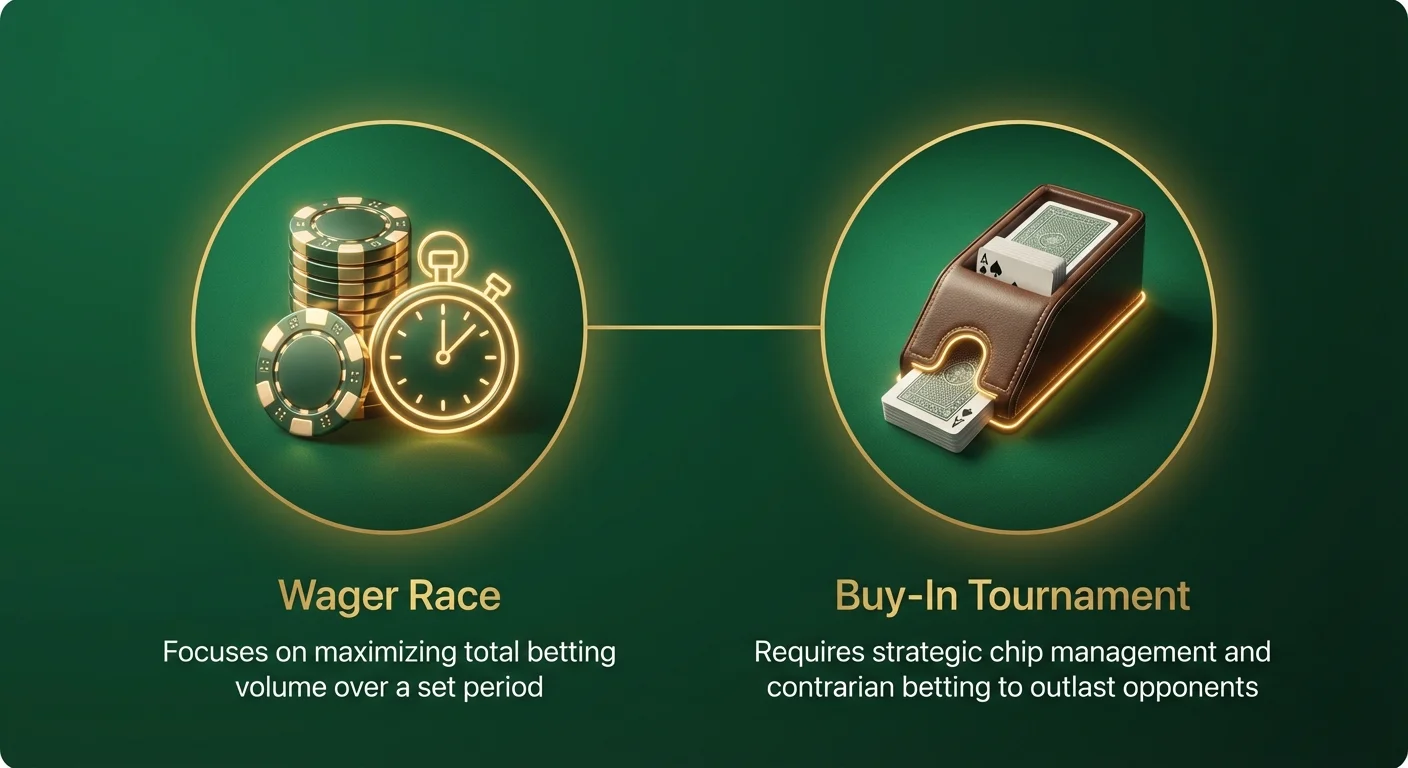
Nas plataformas de apostas crypto, você geralmente encontrará dois formatos distintos. Saber qual deles você está jogando é crucial, pois as estratégias são opostas.
1. A Corrida de Apostas (Wager Race - Baseada em Volume)
Este é o formato mais comum no espaço crypto. O casino configura um ranking onde a classificação é determinada pelo volume total wagered (apostado) em um período específico (24 horas, uma semana ou um mês).
- O Objetivo: Bet (Apostar) o máximo possível sem perder toda a sua bankroll (banca).
- A Estratégia: Jogo de alta velocidade, estratégias de break-even (ponto de equilíbrio) e gerenciamento de "churn" (rotatividade).
2. O Torneio de Buy-In / Stack (Baseado em Habilidade)
Este formato imita torneios tradicionais em casinos físicos. Você paga uma entry fee (taxa de entrada) (em Bitcoin, Ethereum, etc.) e recebe uma quantia definida de "tournament chips" (fichas de torneio). Você joga um set number of hands (número definido de mãos) ou por uma set duration (duração estabelecida).
- O Objetivo: Ter a highest chip stack (maior pilha de fichas) quando o timer (cronômetro) terminar ou hands run out (as mãos acabarem).
- A Estratégia: Consciência da posição, contrarian betting (apostas contrarianas) e end-game aggression (agressão no final do jogo).
Dominando a Wager Race: The Grind (A Rotina)
Wager races são um teste de endurance (resistência) e bankroll management para ativos voláteis. Se o top prize (prêmio máximo) for 1 BTC, você precisa calcular quanta "expected loss" (perda esperada) (EV) pode stomach (suportar) para chase (perseguir) esse prize (prêmio).
Eficiência e The House Edge (A Margem da Casa)
Em uma wager race, você quer cycle (rodar) seu money (dinheiro) o máximo de vezes possível. Se você deposita $1,000, você não quer just bet (apenas apostar) $1,000; você quer bet (apostar) essa mesma stack (pilha) over and over again (repetidamente) until (até que) it totals $100,000 in volume.
Para fazer isso, você must play (deve jogar) a variation of blackjack (variação de blackjack) com a lowest possible House Edge (HE) (menor Margem da Casa possível).
- Avoid 6:5 Payouts: (Evite Pagamentos de 6:5:) As noted (Conforme observado) in standard game rules (nas regras de jogo padrão), a 6:5 payout on blackjack (pagamento de 6:5 no blackjack) increases the house edge by roughly 1.39%. In a wager race, this will drain your bankroll too fast. Always find a table paying 3:2.
- Rule Hunting: (Caça às Regras:) Look for "Dealer Stands on Soft 17" (Procure por "Dealer Para no 17 Suave") and "Double Down on Any Two Cards" (e "Dobrar em Quaisquer Duas Cartas"). Every 0.1% of edge matters when you are wagering thousands of hands.
The "Churn" Strategy (A Estratégia de "Rotatividade")
To maximize volume (Para maximizar o volume), you need low volatility (você precisa de baixa volatilidade). You aren't trying to hit a massive jackpot (Você não está tentando acertar um jackpot enorme); you are trying to stay alive (você está tentando se manter vivo).
- Flat Betting: (Aposta Fixa:) Bet the same amount every hand. This reduces the volatility. The Paroli System (Modified): While the Martingale strategy is dangerous (one bad streak wipes you out), a mild Paroli system can help. Increase your bet only when playing with "house money" (winnings). This allows you to increase wagering volume without dipping deeper into your deposit.
- Speed is King: (Velocidade é Soberana:) Use the "Auto-Bet" features and "Instant Deal" options common on crypto platforms. Turn off animations. You are playing for volume, not immersion.
Mastering the Buy-In Tournament: The Strategy
This is where the true skill of blackjack comes into play. In a buy-in tournament (or a format where the highest profit wins), you are engaging in psychological warfare.
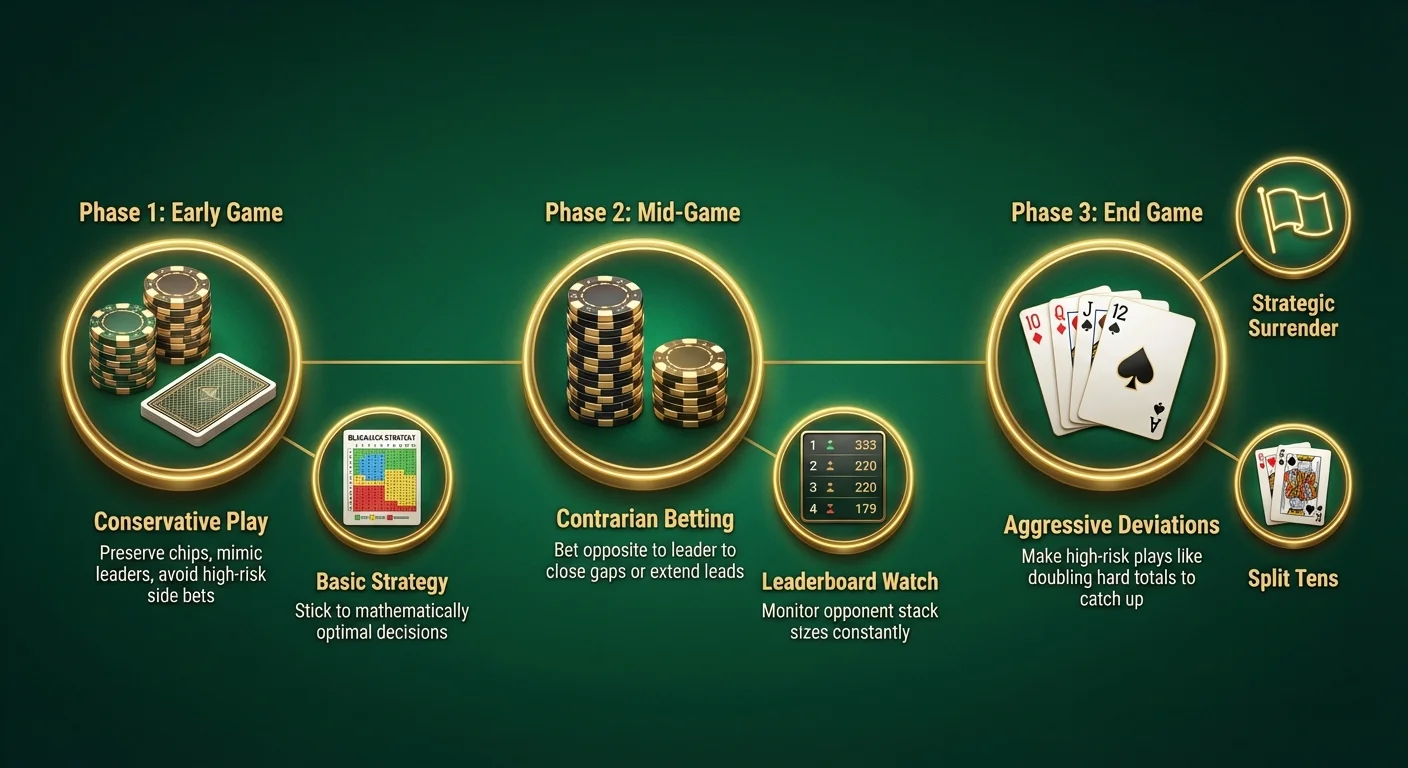
Phase 1: The Early Game (Treading Water - Mantendo a Posição)
In the early rounds of a tournament, you cannot win, but you can certainly lose.
- Mimicry: (Mimetismo:) Identify the table leaders. If they are betting conservative amounts, you should generally do the same. Your goal here is to maintain your stack relative to the average.
- Conservative Basic Strategy: (Estratégia Básica Conservadora:) Stick to the charts. Do not make wild deviations yet. Play by the book (hit 16 against a 7, stand on 12 against a 6).
- Preserve Options: (Preserve as Opções:) Do not waste chips on analyzing the risk of side bets or insurance. These have high house edges and will bleed your stack dry before the crucial rounds.
Phase 2: The Mid-Game (The Pivot - O Pivô)
Once the field begins to thin out, you must start watching the leaderboard religiously. This is where Contrarian Betting (Aposta Contrariana) becomes your primary weapon.
What is Contrarian Betting?
Simply put: Do the opposite of the leader.
- If the Leader Bets High: You bet low.
- Why? If the dealer flips a winning hand, the leader takes a massive hit, while you suffer a minor scratch, effectively closing the gap. If the dealer loses, the leader extends their lead, but you are still in the game. You are banking on the leader losing.
- If the Leader Bets Low: You bet high.
- Why? This is your chance to catch up. If you win and the leader wins, you gain ground because your bet was larger. If you win and the leader loses, you swing the momentum massively.
Phase 3: The End Game (The Kill Shot - O Golpe Final)
The final few hands of a tournament are pure chaos. Logic regarding "Basic Strategy" often goes out the window. You must calculate exactly how many chips you need to overtake the leader, and make plays that would be considered insanity in a cash game.
Desvios Situacionais
Em um cash game, you would never double down on a Hard 12 against a Dealer 2. In a tournament, if it is the last hand and you have 500 chips while the leader has 1,100, a standard win isn't enough. You must double down to get to 1,000 and hope the dealer busts or you catch a low card, combined with the leader losing.
Common End-Game Deviations: (Desvios Comuns no Final do Jogo:)
- Doubling Hard Totals: (Dobrar Totais Duros:) Doubling on 12, 13, or even higher if you desperately need 2x chips to win.
- Splitting Tens: (Dividir Dez:) In cash games, this is a cardinal sin. In tournaments, if you need to turn one losing hand into two potential winning hands to catch a leader, you split those Kings (ou 10s) without hesitation.
- Surrender as a Shield: (Surrender como Escudo:) If you have taken the lead on the final hand, and you see the closest competitor has busted or has a weak hand, you can Surrender (render-se). Giving up half your bet might guarantee you lock in a chip count higher than your opponent's remaining stack.
Navigating Crypto-Specific Features (Navegando em Recursos Específicos Cripto)
Crypto blackjack tournaments offer unique features that traditional online casinos often lack. Leveraging these can give you an edge.
Provably Fair Verifiability (Verificabilidade Provably Fair)
When playing high-stakes tournaments, trust is essential. Many crypto blackjack games utilize Provably Fair algorithms. This allows you to verify the randomness of the shuffle after the hand. While this doesn't help you predict the next card, it ensures that the tournament isn't rigged to force a specific outcome (like a dealer sudden-death blackjack streak).
Immediate Payouts and Re-buys (Pagamentos Imediatos e Re-buys)
Crypto transactions are fast. In "Re-buy" tournaments, where you can buy back in if you bust, the speed of Bitcoin or Litecoin deposits means you can reload your stack instantly.
- Strategy Tip: If the tournament allows unlimited re-buys for the first hour, play hyper-aggressively (Max Bet every hand). If you bust, you re-buy. If you hit a lucky streak, you build a massive stack that conservative players can't catch. Once the re-buy period ends, switch to conservative defense.
The "Bet Behind" Mechanic (A Mecânica "Bet Behind")
Some live dealer crypto tournaments allow you to "Bet Behind" (Apostar Atrás) other players. If you have been eliminated but notice a player is on a statistically improbable "hot streak" (or is simply playing excellent tournament strategy), you can wager on their hand. This is a way to hedge your own tournament entry fees.
Advanced Tactics: Managing the Button (Táticas Avançadas: Gerenciando o Botão)
In land-based tournaments, a "First Base" (primeiro a agir) and "Third Base" (último a agir) button rotates. In online crypto tournaments, this is often automated or simulated.
Knowing when you act relative to your opponents is the single most important factor in betting strategy.
- Acting Last is the Advantage: If you act after your opponents, you can see how much they have bet. You can calculate the exact amount needed to beat them.
- Acting First is the Disadvantage: You are betting in the dark. In this scenario, you usually want to bet an amount that gives you options - typically a medium-sized bet that leaves you enough chips to double down if necessary.
The "Rule of 2.5" (A "Regra de 2.5")
When trying to catch a leader, a good rule of thumb for your bet size is:
(Pilha do Líder - Sua Pilha) / 2 = Aposta Mínima
However, to be safe and account for the leader winning their hand, aggressive players use the Rule of 2.5: You need to bet enough that a 2.5x payout (a Blackjack) or a Double Down win vaults you past them.
Psychological Traps to Avoid (Armadilhas Psicológicas a Evitar)
Even experienced card counters can fail in tournaments because they cannot switch off their "Cash Game" brain.
1. The Insurance Trap (A Armadilha do Seguro)
In cash games, insurance is a sucker bet with a high house edge. In tournaments, Insurance is a strategic tool.
- Scenario: (Cenário:) You are the chip leader on the final hand. You have a "made hand" (e.g., 20). The dealer shows an Ace.
- The Play: (A Jogada:) You take insurance. You don't care about the mathematical value of the insurance bet; you care about protecting your lead. If the dealer has Blackjack, your main bet loses, but the insurance pays out, keeping your chip stack steady and locking out opponents who needed you to crash.
2. Ignoring the "Push" (Ignorando o "Empate")
In European Blackjack rules (common in crypto casinos), the dealer does not take a hole card. If the dealer eventually draws to Blackjack, players lose their total bets (including splits and doubles). However, in American rules, if the dealer has a hole card Blackjack, it's revealed immediately.
- The Impact: Be very careful aggressively splitting or doubling against a Dealer Ace or 10 in European formats. If they pull a Blackjack at the end of the round, you lose multiple bets, which can be catastrophic for your leaderboard position.
3. Playing for "Efficiency" rather than "Victory" (Jogar por "Eficiência" em vez de "Vitória")
Winning a tournament often requires making mathematically "bad" bets. Standing on 16 against a 10 is the correct move if the player chasing you has already busted and you just need to survive the hand to win the prize. Do not be afraid to look like a novice to the other players; you are playing the scoreboard, not the cards.
Summary: Key Takeaways for the Leaderboard Climber (Resumo: Principais Lições para o Escalador do Ranking)
Transitioning from a casual player to a tournament shark requires practice and a cold, calculated approach to risk.
- Identify the Format: Is it a volume race (Grind) or a chip stack battle (Skill)? Adjust accordingly.
- Volume Races: Minimize volatility. Stick to 3:2 tables, flat bet, and use speed to your advantage.
- Chip Tournaments: Play the player, not the dealer. Use contrarian betting to close gaps or extend leads.
- Embrace Risk: In the final rounds, be prepared to double down on hard hands, split tens, or take insurance if the math of the leaderboard dictates it.
- Watch the Rules: Verify if you are playing European (no hole card) or American rules, as this dictates how aggressively you can bet against a dealer's strong up-card.
Blackjack is usually a solitary pursuit, but tournaments turn it into a spectator sport where the last player standing takes all. By shifting your focus from the cards to the chip counts, you can stop just playing the game and start playing to win. Good luck, and may the variance be ever in your favor.