Iškreipto (biased) ruletės rato žavesys yra bene labiausiai romantizuota sąvoka azartinių lošimų istorijoje. Pasakojimai apie aštriaregius žaidėjus, pastebėjusius nedidelį rotoriaus svyravimą ar nudilusį skiriamąjį barjerą prie skaičiaus 7, kurie vėliau "sulaužė banką" Monte Karle, jau daugiau nei šimtmetį kursto pranašumą turinčių žaidėjų svajones.
Šiuolaikiniam kripto azartinių lošimų entuziastui, vis dėlto, viskas gerokai pasikeitė. Nesvarbu, ar žaidžiate prie aukštos klasės Live Dealer stalo, transliuojamo į jūsų įrenginį, ar naudojatės Provably Fair skaitmenine sąsaja, žaidimo fizika pasikeitė.
Šiame vadove nagrinėjama ratų fizikos istorija, rato iškrypimo mechanika ir griežta šiuolaikinio kazino saugumo realybė. Išnagrinėsime, kodėl ratų "chronometravimas" yra beveik išnykusi meno forma ir kaip pramonė, ypač kripto kazino sektorius, pakeitė fizinį pasitikėjimą kriptografiniu patvirtinimu.
Iškreipto rato mechanika: kaip tai veikia
Norint suprasti, kodėl iškreipti ratai kadaise buvo Šventasis Gralis lošėjams, reikia suprasti fizinę ruletės rato konstrukciją. Standartinis ratas yra precizinis instrumentas, tačiau praeityje tai buvo tiesiog gerai pagamintas medžio ir metalo gabalas, pavaldus entropijos dėsniams.
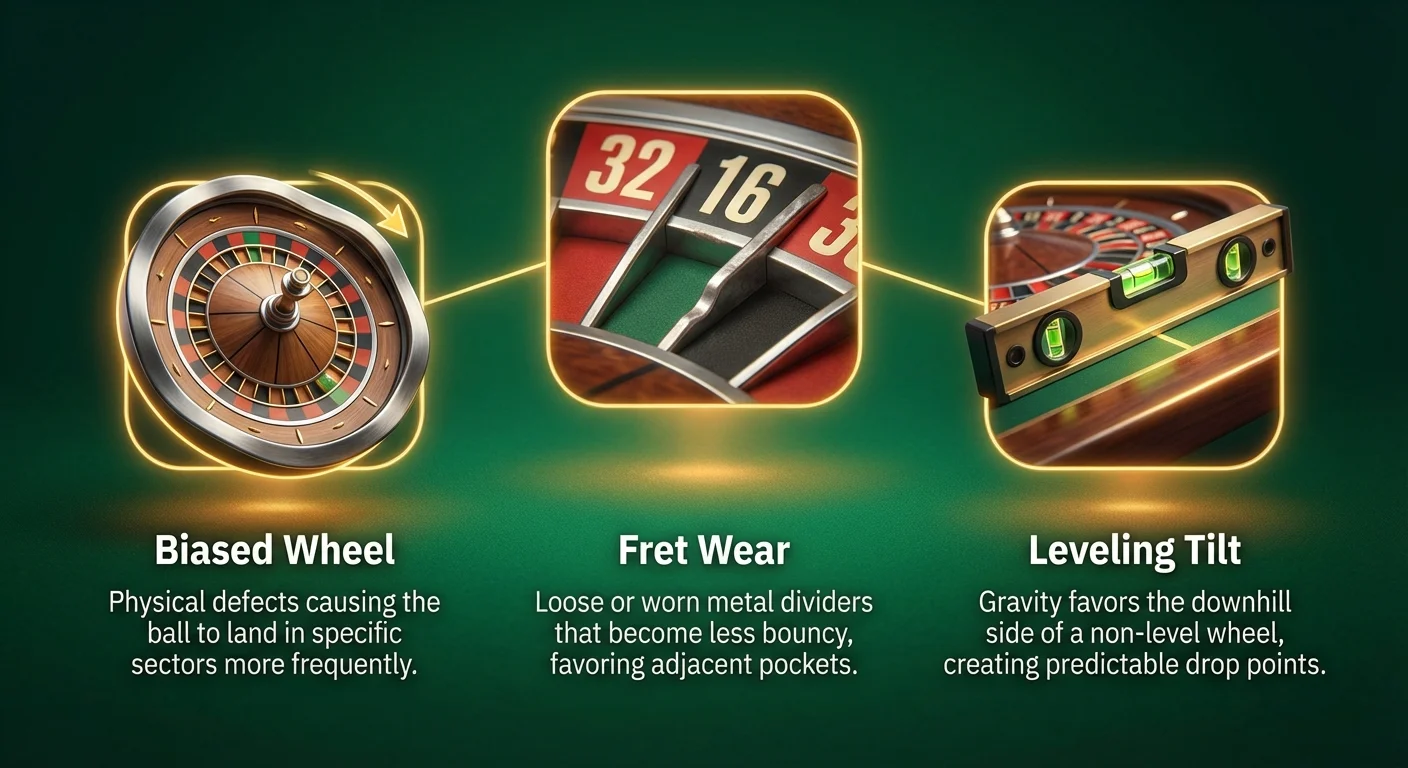
"Iškrypimas" atsiranda, kai fizinis defektas priverčia rutuliuką nukristi į tam tikrą skaičių arba sektorių (skaičių grupę) dažniau, nei rodo statistinė tikimybė. Visiškai atsitiktiniame žaidime kiekvienas skaičius turi vienodą 1 iš 37 (European) arba 1 iš 38 (American) tikimybę laimėti.
Fiziniai trūkumai
Istoriškai rato iškrypimus sukeldavo viena iš keturių pagrindinių fizinių gedimų priežasčių:
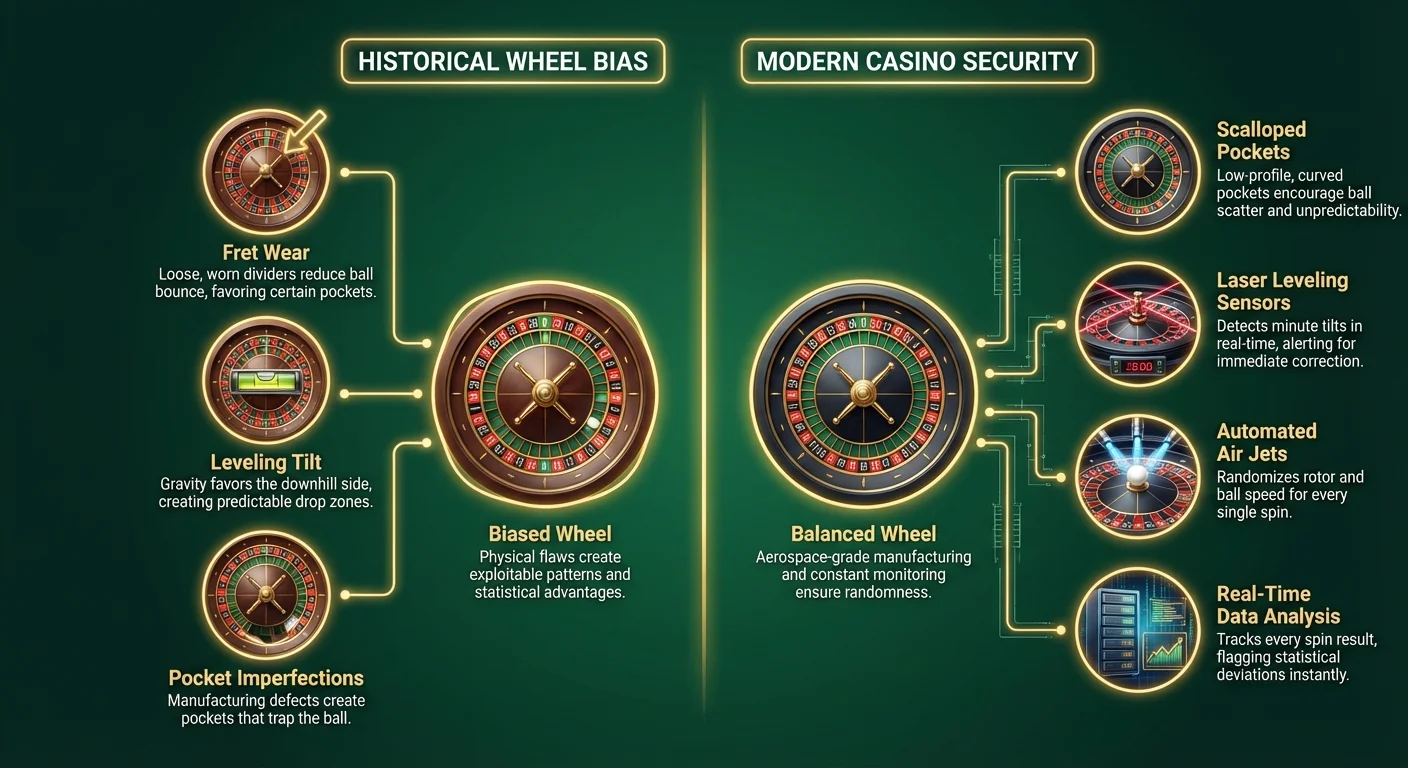
- Fret Wear (Skiriamųjų barjerų nusidėvėjimas): Skiriamieji barjerai (frets) yra metaliniai skirtukai tarp skaičių kišenėlių. Senesniuose ratuose kai kurie barjerai atsilaisvindavo arba nusidėvėdavo, tapdami mažiau "spyruokliuojantys" nei kiti. Jei barjeras aplink Red 9 yra "negyvas," mažiau tikėtina, kad rutuliukas iššoks iš tos kišenėlės, taip padidindamas pataikymo rodiklį.
- Pocket Depth and Shape (Kišenėlės gylis ir forma): Gamybos neatitikimai kartais lėmė, kad viena kišenėlė būdavo be galo gilesnė ar platesnė už kitas, veikdama kaip vakuumas rutuliukui.
- The Track and Friction (Takelis ir trintis): Rutuliuko takelyje (išoriniame rate, kuriuo sukasi rutuliukas) gali atsirasti nusidėvėjusių vietų arba susikaupusių nešvarumų. Jei trintis padidėja tam tikrame takelio taške, rutuliukas greičiau nukris būtent toje koordinatėje.
- Leveling (Išlyginimas) (Posvyris): Tai buvo dažniausiai išnaudojama priežastis. Jei ratas nėra idealiai išlygintas, gravitacija palankiai veiks "nuokalnės" pusę. Rutuliukas bus linkęs nukristi nuo takelio į rotorių tame pačiame fiziniame dubens taške.
Iškrypimo matematika
Jums nereikia didelio nukrypimo, kad įveiktumėte Kazino pranašumą (House Edge).
- European House Edge: 2.70%
- American House Edge: 5.26%
Jei numatoma, kad tam tikras skaičius European rate iškris kartą per 37 sukimus, bet fizinis defektas priverčia jį iškristi kartą per 30 sukimų, žaidėjas turi didžiulį statistinį pranašumą (maždaug 18% edge prieš kazino).
Auksinis rato chronometravimo amžius
"Rato Chronometravimas" (Wheel Clocking) yra praktika, kai įrašomi tūkstančiai sukimų, siekiant nustatyti šiuos iškrypimus. XIX a. pabaigoje ir maždaug pirmoje XX a. pusėje tai buvo perspektyvi, nors ir varginanti, strategija.
Žymiausias pavyzdys yra Joseph Jagger, kuris 1873 m. pasamdė klerkus užrašyti rezultatus Beaux-Arts Casino Monte Karle. Jis rado ratą, kuriame devyni konkretūs skaičiai iškrisdavo dažniau dėl mechaninio įbrėžimo. Jis laimėjo milijonus (šiuolaikiniu ekvivalentu) prieš tai, kai kazino pertvarkė ratus, taip nutraukdami jo seriją.
1990-aisiais komandos, tokios kaip chaotiška Gonzalo Garcia-Pelayo šeima Ispanijoje, naudojo kompiuterius tūkstančiams sukimų analizuoti, išnaudodamos faktą, kad kazino lėtai prižiūrėjo savo įrangą.
Kodėl tai veikė tada
Šiuo laikotarpiu ratai dažnai buvo gaminami iš medžio, kuris plečiasi ir traukiasi dėl drėgmės ir temperatūros. Guoliai buvo mažiau sudėtingi, o išlyginimas buvo atliekamas paprastais gulsčiukais. Kazino rėmėsi rankiniu stebėjimu, o ne duomenų analize, kad pastebėtų nuostolius.
Šiuolaikinė realybė: atsitiktinumo inžinerija
Jei šiandien žaidžiate gerai žinomame kripto kazino, ypač tame, kuriame vyksta Live Dealer žaidimai iš tokių tiekėjų kaip Evolution ar Pragmatic Play, susiduriate su technologija, turinčia daugiau bendro su aerospace komponentu nei su 19-ojo amžiaus lošimo ratu.
Pramonė veiksmingai paskelbė karą rato iškrypimui XX a. pradžioje. Štai kaip šiuolaikinės technologijos neutralizavo fizinį išnaudojimą.
1. The Starburst ir banguotos kišenėlės
Tradiciniai ratai turėjo aukštus skiriamuosius barjerus (dividers). Šiuolaikiniai ratai, ypač pagaminti TCS John Huxley ar Cammegh, dažnai naudoja "banguotas" (scalloped) kišenėles. Skirtukai yra žemo profilio arba jų visai nėra (lenktos kišenėlės). Tai skatina rutuliuką išsisklaidyti. Tai padidina "išsisklaidymo" atstumą, o tai reiškia, kad kur rutuliukas nukrenta nuo track, turi mažiau sąsajų su jo nusileidimo vieta.
2. Automatinė priežiūra ir išlyginimas lazeriu
Šiuolaikiniai live studio ratai yra aprūpinti jutikliais, kurie aptinka tilt iki laipsnio dalies. Jei ratas pasislenka, sistema nedelsdama įspėja pit boss. Jūs negalite išnaudoti tilt, kurį kompiuteris pataiso dar nespėjus išgerti kavos.
3. Katapulta ir oro srovės
Automatizuotoje live roulette (kur yra real wheel, bet nėra dealer), rutuliukas paleidžiamas oro srovėmis. Šių srovių slėgis atsitiktinai parenkamas kompiuteriniu algoritmu. Tai keičia rotoriaus speed ir ball speed kiekvienam single spin, todėl "rhythm betting" ar visual ballistics tampa impossible.
4. Duomenų analizė realiuoju laiku
Tai yra ultimate killer rato iškrypimo. Senais laikais kazino žinojo, kad ratas buvo biased tik after jie prarado pinigus. Today, the software running the Live Casino interface tracks every single result in real-time.
- Slenkstis: Jei skaičius 0 hits 4 times in 20 spins, the software flags it as a standard variance.
- Pavojaus signalas: Jei skaičius 0 shows a statistical deviation over 1,000 spins that exceeds the standard deviation curve, the wheel is automatically flagged for inspection. The wheel is swapped out long before a player can detect the pattern with the naked eye.
Live Dealer vs. RNG: kripto kazino kontekstas
Naršydami CryptoGambling.com ieškodami vietų žaisti, paprastai susidursite su dviem ruletės tipais: Live Dealer ir RNG (Digital). Fizika – ir strategijos – kiekvienam tipui taikomos skirtingai.
Live Dealer Ruletė
Šie žaidimai stream iš studios in Riga, Malta, or Asia. They use real physical wheels.
- Iškrypimo potencialas: Extremely Low.
- Kodėl: These wheels are in constant use, spinning 24/7. They are rotated daily to ensure even wear. The betting windows are short, preventing players from using complex prediction software.
- Verdiktas: While "real," these are the most scrutinized wheels in history. Betting on bias here is a fast way to lose your bankroll.
Digital RNG Roulette & Provably Fair
This is where the "physics" discussion ends, and the "code" discussion begins. In digital roulette, there is no wheel, no ball, and no gravity. There is only a Random Number Generator (RNG).
Tačiau kripto kazino siūlo a distinct advantage here called Provably Fair technology.
"Tobulas" ratas
In a physical casino, you trust the regulations. In a crypto casino, you trust the math. Provably Fair algorithms allow you to verify the fairness of the spin after it happens.
- Server Seed: Generated by the casino (hidden).
- Client Seed: Generated by your browser or chosen by you.
- Nonce: The transaction number.
These are hashed together to produce the result. Because you control the Client Seed, the casino cannot pre-determine the outcome to make you lose. This is the digital equivalent of a wheel that never warps, never tilts, and has zero friction. It is statistically perfect.
Išplėstinė strategija: ką daryti, jei nerandate iškrypimo?
Since we have established that finding a biased wheel in 2024 is nearly impossible, the advanced player must shift focus from exploiting defects to optimizing odds.
The "bias" you should be looking for is not in the wheel, but in the Ruleset.
1. Stalo pasirinkimo iškrypimas
The single most effective adjustment a player can make is avoiding the American Wheel. The presence of the "00" pocket is a mathematical tax on the player with no added benefit.
| Wheel Type | Pockets | Zeros | House Edge |
|---|---|---|---|
| American | 38 | 0, 00 | 5.26% |
| European | 37 | 0 | 2.70% |
| French | 37 | 0 | 1.35% (on even money bets) |
Patarimas: In crypto casinos, French Roulette is often hidden in the "Table Games" or "High Limit" sections. Always search for it specifically. The La Partage rule means if the ball lands on Zero, you get half your even-money bet back. This cuts the house edge in half.
2. Kintamumo valdymas, o ne numatymas
You cannot predict the number, but you can predict the volatility.
- High Volatility (Didelis kintamumas): Straight-up bets (Pays 35:1). Long losing streaks, massive spikes in profit.
- Low Volatility (Mažas kintamumas): Even money bets (Red/Black, High/Low). Smooth equity curve, slow bleed due to house edge.
Sektorių statymai (The Racetrack):
Many advanced players use the "Racetrack" on European layouts. This allows you to bet on sections of the physical wheel, a remnant of the old bias strategies.
- Voisins du Zéro (Neighbors of Zero): Covers 17 numbers around the zero.
- Tiers du Cylindre (Thirds of the Wheel): Covers the 12 numbers opposite the zero.
- Orphelins (Našlaičiai): The two slices of numbers not covered by the above.
While this doesn't overcome the house edge, it allows you to bet on "physical zones" of the wheel rather than numerical order, which mimics the feel of bias play without requiring a defect.
3. Lošėjo klaidos supratimas
The death of wheel bias means that independent events remain independent.
Just because Red has hit 10 times in a row does not mean Black is "due." On a biased wheel, Red hitting 10 times might mean Red is physically favored. On a modern balanced wheel, it is just a statistical anomaly.
Strategies like Martingale or D'Alembert:Šios sistemos (doubling bets after losses) are often sold as ways to beat the wheel. They are not. They are bankroll management techniques that trade small frequent wins for the risk of a catastrophic loss (hitting the table limit).
- Martingale: Double bet after loss.
- D'Alembert: Increase bet by 1 unit after loss, decrease by 1 after win.
Use these cautiously. In the absence of wheel bias, no betting pattern can mathematically alter the House Edge.
Praktiniai patarimai kripto ruletės žaidėjams
Jei žaidžiate CryptoGambling.com partners, here is your checklist for the best experience:
- Patikrinkite tiekėją: For Live Dealer, stick to Evolution, Playtech, or Pragmatic Live. They are audited and ensure the game is free of "rigging," even if it means you can't find a biased wheel.
- Verify the RTP: Digital crypto roulette games should clearly state an RTP (Return to Player) of 97.30% (European). If it's lower, you are playing a sub-par game.
- Greitis yra svarbus: If you are testing a system, use "Speed Roulette" or "Instant Roulette" formats. The faster spin times allow you to play more hands per hour, though this also exposes your bankroll to the house edge faster - manage your funds accordingly.
- Naudokite Bitcoin/Stablecoins aukštiems limitams: One advantage of crypto casinos is the ability to place larger bets than fiat casinos. If you are playing a progressive system like Martingale, the higher table limits in BTC games give you more "breathing room" before capping out.
Santrauka: Žaidimo evoliucija
The era of the biased wheel is essentially over. The combination of aerospace-grade manufacturing, laser sensors, and real-time algorithmic monitoring has purified the game of roulette.
- Istorinis iškrypimas: Relied on wood warping and loose frets.
- Šiuolaikinis saugumas: Scalloped pockets, variable rotor speeds, and automated leveling make physical prediction impossible.
- Kripto pasienis: Provably Fair technology replaces physical scrutiny with cryptographic certainty.
For the modern player, this is not bad news. It means the game is fairer than it has ever been. Your focus should shift from hunting for non-existent defects to mastering bankroll management, selecting the French/European rulesets, and enjoying the entertainment value of the spin. The wheel may no longer be broken, but the thrill of the game remains intact.