
The Engine Room of the Blockchain
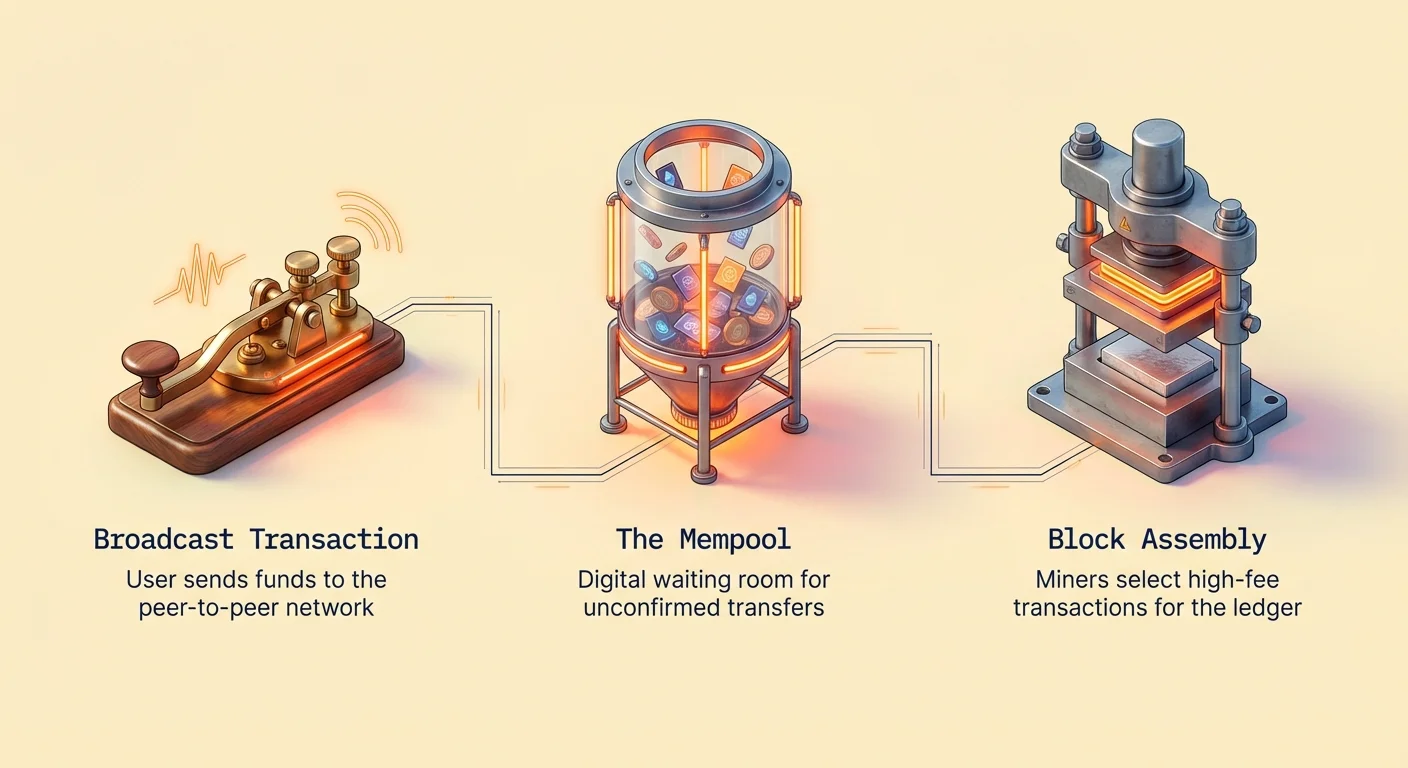
Every valid Bitcoin transaction begins its journey in a digital waiting room known as the mempool. Short for "memory pool," this mechanism is fundamental to how the network processes value transfers. It acts as a clearinghouse where unconfirmed transactions reside before they are selected for final settlement on the ledger. Understanding the mempool is essential for anyone wishing to transact efficiently on the network.
Contrary to popular belief, there is no single, centralized mempool in the sky. Instead, every node on the Bitcoin network maintains its own version of the mempool. When a user broadcasts a transaction, it propagates across this peer-to-peer network. Each node receives the data, validates it against protocol rules, and adds it to its local memory pool.
Because propagation takes time and nodes have different configuration settings, mempools can vary slightly from one node to another. However, they generally converge to represent the collective demand for block space at any given moment. This distributed architecture ensures that no single point of failure exists in the transaction queuing process.
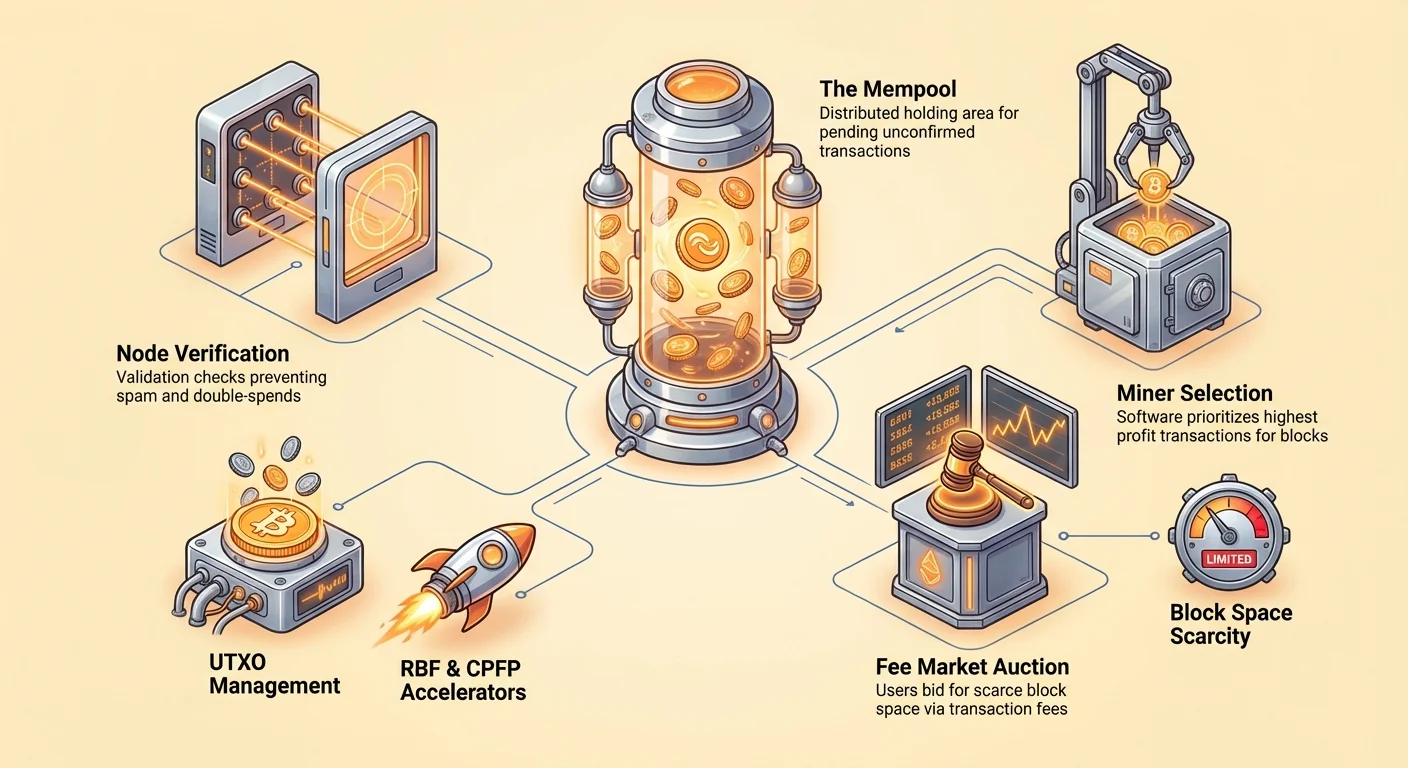
The mempool represents the supply and demand dynamics of the network in real-time. The "supply" is the limited space available in each new block, mined approximately every ten minutes. The "demand" is the constant stream of new transactions entering the network. When demand exceeds supply, a backlog forms. This backlog transforms the mempool from a simple queue into a competitive auction house.
The Role of Node Verification
Before a transaction even enters a node's mempool, it must pass a series of checks. Nodes act as the gatekeepers of the network. They independently verify that the digital signatures are correct and that the inputs being spent have not been used before. This prevents the "double-spend" problem at the entry level.
If a transaction violates any protocol rule, the node rejects it immediately. It will not relay the invalid data to other peers. This filtration system protects the network from spam and ensures that miners only receive valid candidates for the next block. Only after passing these rigorous checks does the transaction sit in the RAM of the node, waiting for a miner to pick it up.
Memory Limits and Eviction
Nodes are physical computers with finite resources. They cannot store an infinite number of unconfirmed transactions. Default settings usually cap the mempool size (often around 300 MB). When network congestion is extreme and the mempool hits this cap, nodes must decide which transactions to keep and which to drop.
The decision is economic. Nodes will typically evict transactions with the lowest fees to make room for higher-paying ones. This creates a "minimum relay fee" that fluctuates based on network load. If a user sets a fee too low during these periods, their transaction might be purged from mempools entirely. It effectively disappears until it is rebroadcast with a higher fee or the network congestion clears.
The Economics of Block Space
The core economic constraint in Bitcoin is block size. The protocol limits the amount of data that can be included in a single block. This limit creates scarcity. Without scarcity, there would be no need for a fee market, and spam attacks could bloat the ledger indefinitely. This constraint forces users to bid for inclusion.
When you pay a transaction fee, you are not paying for the value of the funds being sent. You are paying for the data space that your transaction occupies on the blockchain. This is a crucial distinction. Sending $10 million might cost less than sending $10, depending on the data structure of the transaction.
Measuring Cost in Satoshis per Byte
In the physical world, shipping costs are often determined by weight or volume. In the Bitcoin network, the "weight" is measured in bytes (or virtual bytes). Fees are calculated in satoshis per byte (sat/vB). A satoshi is the smallest unit of Bitcoin, representing one hundred millionth of a coin.
The total fee you pay is the size of your transaction multiplied by the current market rate for block space. If the current rate is 50 sat/vB and your transaction is 200 bytes, you pay 10,000 satoshis. If the network is quiet, the rate might drop to 1 sat/vB, costing you only 200 satoshis for the same transaction.
The Impact of Inputs and Outputs
The size of a transaction is determined by its complexity. A simple transaction has one input (the source of funds) and two outputs (the destination and the change back to the sender). This consumes a standard amount of data. However, not all transactions are simple.
If you have received many small payments over time—for example, mining rewards or small business earnings—your wallet holds many distinct "notes" or UTXOs (Unspent Transaction Outputs). To send a large amount, your wallet must bundle these digital notes together. Each input adds data to the transaction.
A transaction combining 50 inputs will be significantly larger than one using a single input. Consequently, it will require a much higher fee to be processed, even if the total value being sent is identical. This is why "dust"—tiny amounts of Bitcoin—can sometimes become unspendable. The cost to include the input data might exceed the value of the Bitcoin itself.
The Miner's Selection Algorithm
Miners are the entities that assemble transactions from the mempool into blocks. They are rational economic actors motivated by profit. Their revenue comes from two sources: the fixed block subsidy (newly minted coins) and the variable transaction fees collected from the block.
When a miner constructs a block template, they do not pick transactions randomly. They use software that organizes the mempool to maximize total revenue. They sort available transactions by their fee rate (sat/vB), placing the highest bids at the top of the list.
The Auction Dynamic
This process functions exactly like a blind auction. When you broadcast a transaction, you are placing a bid for the next available train leaving the station. If there are only 2,000 seats on the train (block) and 10,000 people waiting in the station (mempool), only the top 2,000 bidders will board.
The "clearing price" is the fee rate of the last transaction included in the block. If you bid below this rate, you are left in the mempool for the next round. During periods of intense activity, the clearing price rises rapidly. Users desperate for confirmation increase their fees, pushing the bottom threshold higher.
Fee Estimation Challenges
Wallets attempt to estimate the appropriate fee by analyzing the current state of the mempool. They look at the backlog and the fees paid in recent blocks. However, this is an estimation, not a guarantee. Network conditions can change in seconds.
A sudden influx of transactions can occur immediately after you broadcast a payment. What looked like a competitive fee one minute might be insufficient the next. This volatility makes fee estimation one of the more complex aspects of user experience in crypto. Users must balance the urgency of their transaction against the cost they are willing to pay.
| Fee Priority | Target Confirmation | Risk Factor | Cost Relative to Market |
|---|---|---|---|
| High Priority | Next Block (~10 min) | Low risk of delay | Premium price |
| Standard | 3 Blocks (~30 min) | Moderate variance | Market average |
| Low Priority | 6+ Blocks (>60 min) | High risk of stall | Discounted |
Managing Congestion and Stuck Transactions
There are scenarios where a transaction remains unconfirmed for hours or even days. This usually happens when a user sets a fee that becomes too low relative to a spiking market. The transaction sits in the mempool, constantly outbid by newer, higher-fee transactions.
Technically, these funds are not "lost." They remain in the sender's wallet control, merely locked in a pending state. Eventually, one of two things happens. The network congestion clears, allowing miners to pick up lower-fee items, or the transaction is evicted from mempools after a certain timeout period (often two weeks).
Accelerating Transactions
Users facing delays have options to speed up the process. One method is "Replace-by-Fee" (RBF). This protocol feature allows a sender to broadcast a new version of the same transaction but with a higher fee. Nodes recognize this as an update to the pending transfer and replace the old entry in the mempool.
Another method is "Child Pays for Parent" (CPFP). If you are the recipient of a stuck transaction, you can spend those unconfirmed funds in a new transaction to yourself. By attaching a very high fee to this second transaction, you incentivize miners. To claim the high fee from the second transaction (the child), the miner must also process the first transaction (the parent).
Transaction Accelerators
Third-party services known as transaction accelerators also exist. These services often have direct relationships with mining pools. Users pay a premium directly to the accelerator service. In exchange, the service notifies partner mining pools to prioritize the specific transaction ID, bypassing the standard mempool sorting algorithms.
This is essentially a side-channel payment. It is useful when a transaction does not have RBF enabled or the user cannot utilize CPFP. However, it introduces a reliance on third parties and often comes with significant costs compared to native protocol solutions.
UTXO Management Strategies
Efficient use of the mempool requires understanding Unspent Transaction Outputs (UTXOs). Every transaction consumes UTXOs and creates new ones. The number of UTXOs in a wallet directly impacts future fees. A wallet that receives frequent small payments will accumulate a "heavy" footprint.
Smart users practice UTXO consolidation. This involves sending all small inputs to oneself in a single transaction during periods of low network fees (often on weekends or late at night). This action merges the many small coins into one larger coin.
By consolidating when fees are cheap (e.g., 5 sat/vB), the user prepares their wallet for future high-fee environments. When they later need to send an urgent payment during a fee spike (e.g., 100 sat/vB), they will only need to process one input instead of fifty. This forward-thinking strategy can save significant amounts of money over time.
Dust Attacks and Cleanup
"Dusting" refers to the receipt of tiny amounts of crypto that are worth less than the cost to spend them. Sometimes this is accidental; other times it is malicious tracking behavior. Spending this dust increases transaction size and costs.
Most modern wallets offer coin control features. This allows users to manually select which UTXOs to spend and which to ignore. By freezing dust UTXOs, users prevent their wallets from automatically including them in transactions, thereby keeping efficiency high and costs low.
The Role of Script Complexity
Bitcoin uses a scripting language to define spending conditions. The complexity of this script affects the size of the transaction. A standard "Pay to Public Key Hash" (P2PKH) transaction has a predictable size. However, more complex transactions require more data.
Multi-signature wallets, which require approvals from multiple parties (e.g., 2-of-3 signatures), involve larger scripts. The transaction must contain multiple digital signatures and public keys. This added security comes with a linear increase in fee costs.
SegWit and Taproot
Upgrades to the Bitcoin protocol have introduced efficiencies. Segregated Witness (SegWit) changed how data is weighed. It separates the signature data (witness) from the transaction data. This allows witness data to be discounted in fee calculations, effectively making SegWit transactions cheaper than legacy ones.
The Taproot upgrade further improved this. It allows complex smart contracts and multi-signature transactions to look like standard single-signature transactions on the blockchain. This not only improves privacy but also reduces the data size for complex operations, lowering the burden on the fee market.
Long-Term Security Budget
The dynamics of the mempool and fee market are critical for the long-term survival of the network. Currently, miners are compensated primarily by the block subsidy—the new coins minted in every block. However, this subsidy is halved approximately every four years.
As the subsidy declines, transaction fees must replace it to maintain the "security budget." The security budget is the total revenue available to miners. If this revenue drops too low, miners may turn off their machines. This would lower the network hashrate, potentially making the system more vulnerable to attacks.
The Transition to a Fee-Based Model
Satoshi Nakamoto designed the system to transition from inflation-based security to fee-based security. In this future model, the competition for block space becomes the primary engine funding the network's defense. High demand for block space ensures high fees, which keeps miners profitable and the network secure.
This economic reality suggests that empty mempools are not ideal for the long term. A healthy, consistent backlog of transactions provides the revenue stability miners need to invest in hardware and energy. The mempool thus serves as the economic bridge to Bitcoin’s future sustainability.
Impact of Layer 2 Solutions
Scalability solutions like the Lightning Network fundamentally alter mempool dynamics. These Layer 2 protocols allow users to transact off-chain. They open a payment channel with a single on-chain transaction and can then perform thousands of transfers instantly with near-zero fees.
These off-chain transactions do not touch the mempool or the blockchain until the channel is closed. This reduces the load on the main network for small, coffee-shop-style payments. It reserves the scarce, expensive block space for high-value settlements and channel management.
Balancing Mainnet Pressure
As Layer 2 adoption grows, the nature of transactions in the Bitcoin mempool will shift. We will see fewer small individual payments and more large batch settlements. This increases the efficiency of the block space.
However, Layer 2 networks still rely on the main chain for security. Opening and closing channels requires on-chain transactions. If the main mempool becomes permanently congested with prohibitive fees, it could make onboarding to Layer 2 expensive. This interdependence creates a complex feedback loop between the layers.
Hashrate and Confirmation Speed
The speed at which the mempool clears is also dependent on the network's hashrate. The protocol targets a 10-minute block interval. However, this is a statistical average, not a precise timer.
If the global hashrate drops significantly—perhaps due to a regional blackout or regulatory ban—blocks will be found more slowly. Instead of 10 minutes, blocks might take 12 or 15 minutes until the next difficulty adjustment.
Difficulty Adjustments
The difficulty adjustment mechanism resets the mining target every 2,016 blocks (roughly two weeks). If blocks are being found too slowly, the difficulty drops, making it easier to mine. If they are found too quickly, difficulty rises.
During periods where hashrate drops but difficulty hasn't yet adjusted, the mempool can fill up rapidly. The supply of block space decreases (fewer blocks per hour) while demand remains constant. This forces fees upward as users fight for the reduced capacity. Conversely, rising hashrate can clear the mempool faster than expected, temporarily lowering fees.
Privacy Implications of the Mempool
The mempool is a public broadcast system. When a transaction is sitting in the mempool, it is visible to the entire world before it is confirmed. This transparency allows for analysis and surveillance.
Observers can track the propagation of a transaction to attempt to identify the originating IP address. While sophisticated nodes use privacy networks like Tor, the mempool remains a rich source of data for chain analysis firms.
Front-Running Risks
In some blockchain ecosystems, the visibility of unconfirmed transactions allows for "front-running." This is where a miner or bot sees a pending transaction and inserts their own transaction with a higher fee to get confirmed first, often to profit from market movements.
While less common in simple Bitcoin transfers compared to smart contract platforms, the concept remains relevant. The mempool is a "dark forest" where information is public but intent can be obscured. Users concerned with privacy must be aware that their financial intent is broadcast globally the moment they hit send.
Conclusion
The mempool is far more than a simple queue; it is a complex economic marketplace where space is auctioned to the highest bidder. It serves as the critical buffer between immediate user demand and the fixed supply of the blockchain's ledger. The dynamics within this digital waiting room determine the cost and speed of every transfer, directly influencing the user experience.
As the network matures and block subsidies diminish, the mempool's role in securing the network becomes paramount. It transforms user fees into miner revenue, ensuring the continued protection of the immutable ledger. Understanding how to navigate this fee market—through timing, consolidation, and efficient wallet management—is a vital skill for the modern digital asset user.
Competitive fees are the price paid for the security and immutability of a decentralized financial network.