
Bitcoin is often described as digital gold, implying a static and immutable nature. However, the software that powers the Bitcoin network is a living protocol that undergoes maintenance, bug fixes, and upgrades. Unlike centralized software development where a company CEO or product manager dictates features, Bitcoin relies on a decentralized network of participants to agree on changes. This process is deliberate, slow, and heavily biased toward the status quo to ensure the security of billions of dollars in value.
The evolution of the protocol is not governed by a formal voting system or a single authority. Instead, it operates through a unique combination of technical documentation, peer review, and community consensus. Understanding how an idea moves from a simple discussion on a mailing list to a globally activated code change reveals the resilience of the Bitcoin network. It highlights a system designed to resist capture by any single group, whether they are developers, miners, or corporate interests.
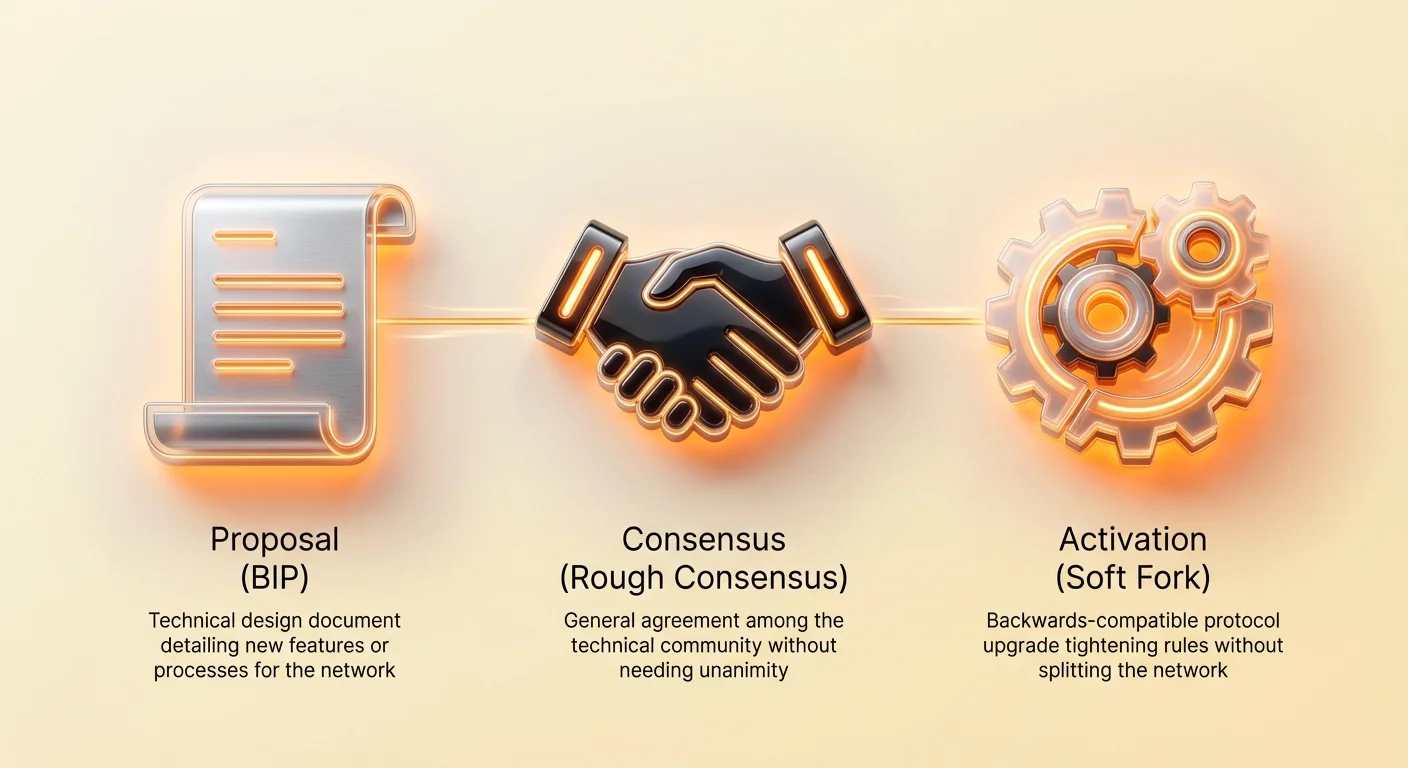
At the heart of this evolutionary process is the Bitcoin Improvement Proposal, or BIP. This is the primary mechanism for proposing new features, collecting community input on an issue, and documenting design decisions. A BIP is not a binding vote, but rather a technical design document. It provides information to the Bitcoin community or describes a new feature for Bitcoin or its processes.
The Bitcoin Improvement Proposal Framework
To understand how Bitcoin changes, one must first understand the standardization process. The BIP system is heavily influenced by the Python Enhancement Proposal (PEP) process. It serves as a formal way to introduce changes to the codebase or the surrounding ecosystem. Anyone can write a BIP, but getting it accepted and implemented is a rigorous gauntlet that few proposals survive.
Defining a BIP
A BIP is essentially a technical paper. It offers a concise technical specification of the feature and a rationale for the feature. The author is responsible for building consensus within the community and documenting dissenting opinions. There are three main types of BIPs. Standards Track BIPs describe any change that affects most or all Bitcoin implementations, such as a change to the network protocol or a change in block or transaction validity rules.
Informational BIPs describe a Bitcoin design issue, or provide general guidelines or information to the Bitcoin community, but do not propose a new feature. Process BIPs describe a process surrounding Bitcoin, or propose a change to (or an event in) a process. The vast majority of the public attention goes to Standards Track BIPs, as these are the proposals that alter the consensus rules of the network.
The Lifecycle of a Proposal
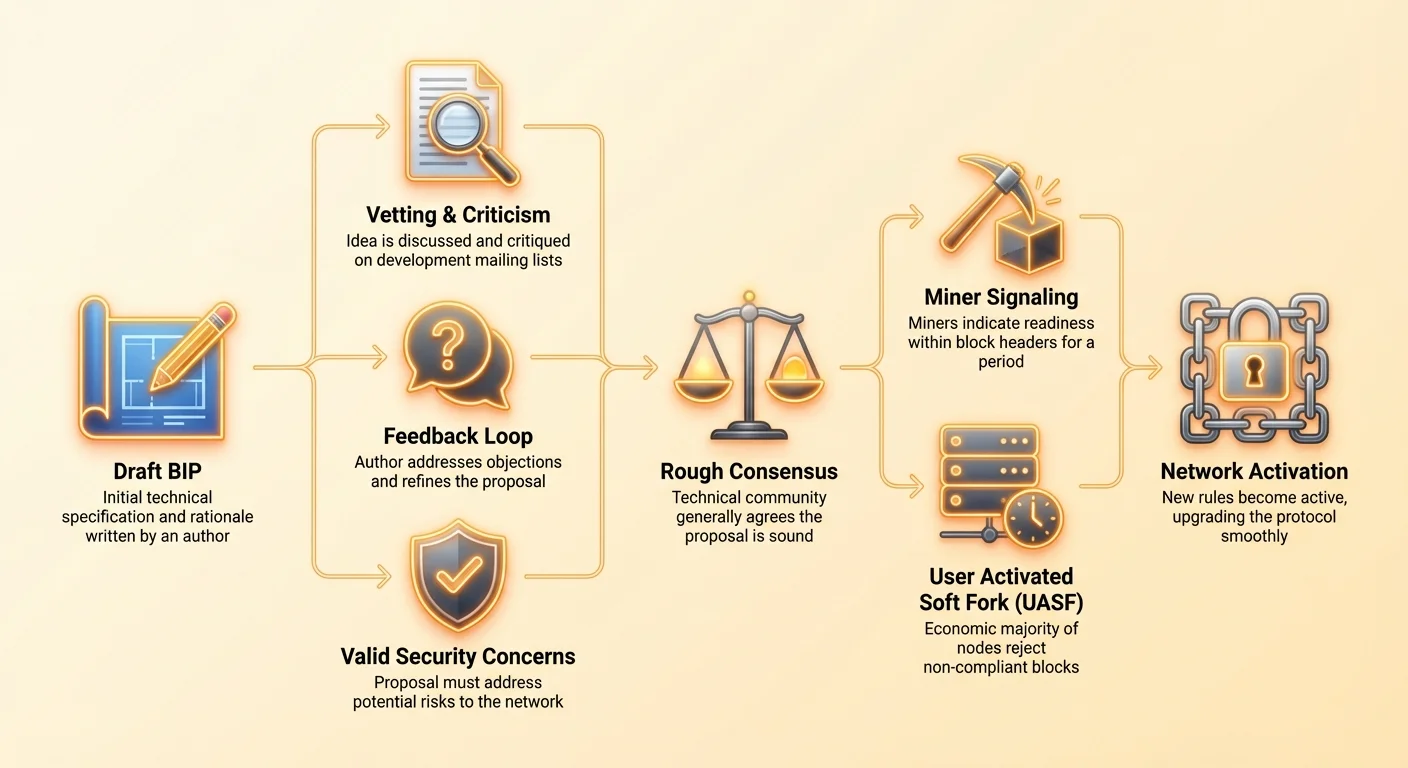
The life of a BIP begins long before it is assigned a number. It usually starts with discussions on the Bitcoin development mailing list. This is where the initial idea is vetted, criticized, and often torn apart by other developers. If the idea survives this initial trial by fire, the author drafts the BIP text.
Once the draft is submitted to the BIP repository, an editor assigns it a number. This status is known as "Draft." From there, the proposal moves through various stages. If the community agrees the work is valuable, it may move to "Proposed." If the changes are implemented and the network activates them, the BIP becomes "Final" or "Active." Conversely, proposals can be "Rejected," "Withdrawn" by the author, or marked "Obsolete" if they are replaced by newer solutions.
The Consensus Mechanism
The most confusing aspect of Bitcoin development for outsiders is the lack of a formal governance structure. There is no foundation or leader who stamps "approved" on a BIP. Instead, the network relies on a concept known as "rough consensus." This is a term borrowed from the Internet Engineering Task Force (IETF). It does not mean unanimity.
Understanding Rough Consensus
Rough consensus is achieved when the technical community generally agrees that a proposal is sound and that all significant objections have been addressed. It is a qualitative measurement rather than a quantitative vote. If a proposal has strong technical merit but faces valid security concerns from a significant portion of the developers, it will not proceed.
This dynamic forces authors to engage with critics. They must improve their proposals until the objections are resolved or proven to be unfounded. This process can take years. For example, the Taproot upgrade was discussed and refined for a considerable period before it was considered ready for activation. The slowness is a feature, not a bug, preventing rash decisions that could destabilize the financial network.
Developer Commit Access
A common misconception is that the developers with "commit access" to the Bitcoin Core GitHub repository control Bitcoin. While these maintainers have the ability to merge code into the master branch of the software, they function more like janitors than rulers. Their role is to ensure that the code being merged reflects the rough consensus of the community.
If a maintainer were to merge code that fundamentally changed Bitcoin against the will of the users, the node operators would simply refuse to update to that version. The network would continue on the previous version, and the maintainer's version would be ignored. This creates a powerful check on developer influence, ensuring they remain beholden to the desires of the node network.
Activation and Implementation Paths
Once a protocol upgrade is coded and merged into the Bitcoin Core software, it sits dormant. It must be "activated" by the network. This is the phase where the theoretical consensus interacts with the physical reality of the blockchain. Activation requires coordination among the economic actors of the system, primarily the miners and the full node operators.
Miner Signaling and Thresholds
Historically, activation often utilized a process defined in BIP 9. This involves miners signaling their readiness for an upgrade within the block headers they mine. For a specific period, usually two weeks (2016 blocks), the network monitors how many blocks contain a signal of support for the upgrade.
If the percentage of signaling blocks reaches a defined threshold—often 90% or 95%—the upgrade locks in. After a subsequent grace period, the new rules become active. This mechanism is designed to ensure that the network upgrades smoothly without leaving miners behind. However, it has also led to political standoffs where miners effectively veto upgrades by refusing to signal, even if the broader user base desires the change.
User Activated Soft Forks
The limitations of miner signaling became apparent during the "Block Size War" leading up to 2017. When miners stalled the activation of Segregated Witness (SegWit), a grassroots movement emerged proposing a User Activated Soft Fork (UASF), known as BIP 148.
In a UASF, node operators run software that rejects blocks from miners who do not signal for the upgrade after a certain date. This shifts the power from miners back to the economic majority of nodes. If the economic activity (exchanges, wallets, users) moves to the UASF chain, miners are economically incentivized to follow suit or risk mining on a worthless chain. The threat of BIP 148 was instrumental in forcing the activation of SegWit.
Fork Dynamics and Compatibility
Changes to the Bitcoin protocol generally fall into two categories: soft forks and hard forks. The distinction lies in backwards compatibility. Understanding the difference is crucial for grasping why Bitcoin has remained a single, continuous network despite numerous upgrades.
The Soft Fork Mechanism
A soft fork is a change to the protocol that restricts the set of valid blocks. It tightens the rules. Because the new rules are a subset of the old rules, old nodes that have not upgraded will still see the new blocks as valid. They may not understand the new features, but they will accept the chain.
This backwards compatibility is vital. it allows the network to upgrade gradually. Users are not forced to update their software immediately to remain part of the consensus. Most major upgrades, including SegWit and Taproot, were implemented as soft forks. This ensures that the network does not split into two incompatible chains simply because some users are slow to upgrade.
The Hard Fork Divergence
A hard fork loosens the rules or introduces rules that are incompatible with the old software. Old nodes will see blocks created under the new rules as invalid and reject them. For a hard fork to succeed without splitting the network, 100% of users must upgrade simultaneously, which is impossible in a decentralized system.
Consequently, contentious hard forks almost always result in a permanent chain split. The most famous example is the creation of Bitcoin Cash (BCH) in 2017. Proponents wanted to increase the block size limit, a rule change incompatible with Bitcoin's existing consensus. This resulted in two distinct networks and currencies. Hard forks are generally avoided in Bitcoin development due to this risk of fracturing the network and community.
| Comparison Attribute | Soft Fork | Hard Fork |
|---|---|---|
| Compatibility | Backwards compatible | Not backwards compatible |
| Rule Change | Tightens/Restricts rules | Loosens/Expands rules |
| Network Risk | Low risk of chain split | High risk of permanent split |
Major Protocol Upgrades: Segregated Witness
One of the most significant examples of a proposal moving to implementation is Segregated Witness (SegWit). Activated in August 2017, it addressed long-standing issues and set the stage for future scaling. The proposal fundamentally changed how transaction data was structured.
Solving Malleability
Before SegWit, it was possible to modify the unique ID of a transaction before it was confirmed on the blockchain without invalidating the signature. This issue, known as transaction malleability, made it difficult to build second-layer solutions like the Lightning Network. If the transaction ID could change, smart contracts relying on that ID would break.
SegWit solved this by moving the signature (witness) data outside the part of the transaction used to calculate the ID. By segregating the witness, the transaction ID became immutable. This fix was the linchpin that allowed payment channels to function securely, enabling the development of the Lightning Network.
The Weight Unit Concept
SegWit also served as a clever block size increase. Instead of simply raising the 1MB limit—which would have required a hard fork—SegWit changed how blocks are measured. It introduced "block weight."
Data in the witness section counts for less weight than data in the main transaction block. This allows blocks to exceed the traditional 1MB size in terms of raw data (up to 4MB theoretically) while remaining compatible with legacy nodes that only check the non-witness data. This effectively increased the network's capacity and lowered fees for transactions using the SegWit format.
The Taproot Upgrade
Following SegWit, the next major change was Taproot, activated in November 2021. Taproot combined three BIPs (340, 341, and 342) to improve privacy, efficiency, and scripting capabilities. It demonstrated a more refined activation process known as "Speedy Trial."
Schnorr Signatures
At the core of Taproot is the implementation of Schnorr signatures (BIP 340). This digital signature scheme offers significant advantages over the original Elliptic Curve Digital Signature Algorithm (ECDSA). The primary benefit is linearity.
Linearity allows for signature aggregation. In a multi-signature transaction, multiple public keys and signatures can be combined into a single key and a single signature. To the blockchain, a complex transaction involving multiple parties looks identical to a standard single-user transaction. This enhances privacy by masking the complexity of wallet arrangements and saves space on the blockchain, reducing fees.
Merkelized Abstract Syntax Trees
Taproot also introduced Merkelized Abstract Syntax Trees (MAST). Previously, if a user created a complex smart contract with multiple spending conditions, all those conditions had to be revealed on the blockchain when the funds were spent. This was inefficient and bad for privacy.
With MAST, users can structure spending conditions in a tree format. When spending, they only need to reveal the specific branch of the tree that is being used. The unexecuted branches remain hidden. This allows for intricate smart contracts that are private and data-efficient, further expanding Bitcoin's potential beyond simple value transfer.
Current Debates: The Case of OP_CAT
The evolution of Bitcoin is ongoing, with current discussions focusing on restoring lost functionality. One of the most prominent topics is OP_CAT. This is a specific opcode (operation code) that was part of the original Bitcoin software but was disabled by Satoshi Nakamoto in 2010 due to concerns about memory usage and security vulnerabilities.
Understanding Opcodes
Opcodes are the commands that the Bitcoin scripting language understands. They tell the network how to process a transaction. Some opcodes enable addition, others check signatures, and some verify time locks. When opcodes are disabled, the ability to perform those specific actions is removed from the network's toolbox.
The removal of OP_CAT and others severely limited Bitcoin's scripting language. This limitation was intentional at the time, prioritizing security and stability over functionality. However, as the understanding of the protocol has matured, developers are now exploring the safe reintroduction of these codes to enable new features.
The Concatenation Proposal
OP_CAT specifically allows for the concatenation (joining) of two strings of data. While this sounds simple, it enables a powerful feature known as "covenants." Covenants allow users to place restrictions on how future bitcoins can be spent, not just who can spend them.
For example, a covenant could enforce that a specific UTXO can only be sent to a specific whitelist of addresses. This has massive implications for vault mechanisms, where users could create "undo" buttons for stolen funds, and for Layer 2 bridging. The debate around OP_CAT illustrates the conservative nature of Bitcoin development; even a simple command requires years of security analysis before reintroduction.
Impact on Layer 2 Solutions
Protocol proposals often target the base layer, but their primary utility is realized on Layer 2 (L2) networks. The relationship between the main blockchain and these secondary layers is symbiotic. Improvements to the base protocol make L2s cheaper, safer, and more efficient.
Lightning Network Dependencies
The Lightning Network is a prime example of this dependency. It relies on the security of the base layer to settle transactions. As mentioned, the SegWit upgrade was a prerequisite for Lightning to function reliably. Future upgrades continue to target Lightning efficiency.
For instance, proposals like "Eltoo" (SIGHASH_ANYPREVOUT) aim to simplify channel management. By modifying how transactions are signed on the base layer, Lightning nodes can store less data and recover from failures more easily. This shows how L1 proposals are often driven by the needs of L2 scalability.
Sidechain Integration
Sidechains, such as Liquid or Rootstock, also benefit from protocol upgrades. Sidechains are independent blockchains that run in parallel to Bitcoin. They use a two-way peg to transfer value back and forth. Currently, these pegs often rely on federations—groups of trusted functionaries.
Upgrades like OP_CAT or new signature schemes could allow for more trustless bridging mechanisms. If the Bitcoin script can verify proofs from a sidechain (like Zero-Knowledge proofs), it would allow users to move funds between chains without trusting a federation. This remains a major area of research and motivation for new BIPs.
Unintended Innovation: The Ordinals Phenomenon
Sometimes, protocol upgrades lead to completely unexpected outcomes. The rise of Ordinals is a testament to the law of unintended consequences in open-source software. Ordinals utilize the mechanics of both SegWit and Taproot to inscribe data directly onto individual satoshis.
SegWit made it cheaper to store witness data, and Taproot removed the size limit on data pushes within transaction scripts. Combined, these changes allowed users to embed images, text, and even video games into the Bitcoin blockchain. This was not the specific intent of the developers who wrote those BIPs.
This development sparked a fierce debate within the community. Some view inscriptions as spam that congests the network, while others see it as a legitimate use of block space paid for by fees. Regardless of the viewpoint, Ordinals demonstrate that once a proposal is implemented, the network's users will utilize the new rules in ways the authors may never have anticipated.
Conclusion
The anatomy of a Bitcoin protocol proposal reveals a system that prioritizes survival above all else. From the initial drafting of a BIP to the grueling process of building rough consensus, every step is designed to filter out risks. The distinction between soft forks and hard forks illustrates a commitment to backwards compatibility, ensuring that the network remains inclusive even as it advances.
Upgrades like SegWit and Taproot show that Bitcoin can innovate without sacrificing its core principles. Meanwhile, the ongoing debates around OP_CAT and the emergence of Ordinals prove that the ecosystem remains vibrant and unpredictable. The interplay between miners, developers, and node operators creates a system of checks and balances that no centralized entity can override.
Bitcoin changes slowly not because it cannot move fast, but because the cost of breaking it is too high to risk.