
The rapid expansion of the cryptocurrency ecosystem has moved beyond the main Ethereum network. Users are increasingly migrating to Ethereum Virtual Machine (EVM) compatible layers and sidechains like Polygon. These networks offer faster transaction speeds and significantly lower fees compared to the Ethereum mainnet. However, this fragmentation of assets across multiple networks introduces complex security challenges, key among which is Ethereum's Modular Scaling Strategy.
Managing digital wealth across these diverse platforms requires a robust understanding of wallet technology. It is no longer sufficient to simply hold an asset on an exchange. Users must now navigate bridges, decentralized applications (dApps), and multiple network configurations. How to Use Bridges Safely is critical. This necessitates a deeper focus on self-custody, private key management, and the integration of hardware solutions.
Security in this multi-chain environment is defined by how users interact with their chosen interfaces. The tools used to access Arbitrum, Optimism, or Polygon are often the same ones used for Ethereum. Consequently, the security principles remain consistent, but the surface area for potential errors increases. A single vulnerability or mistake can compromise assets across every connected network.
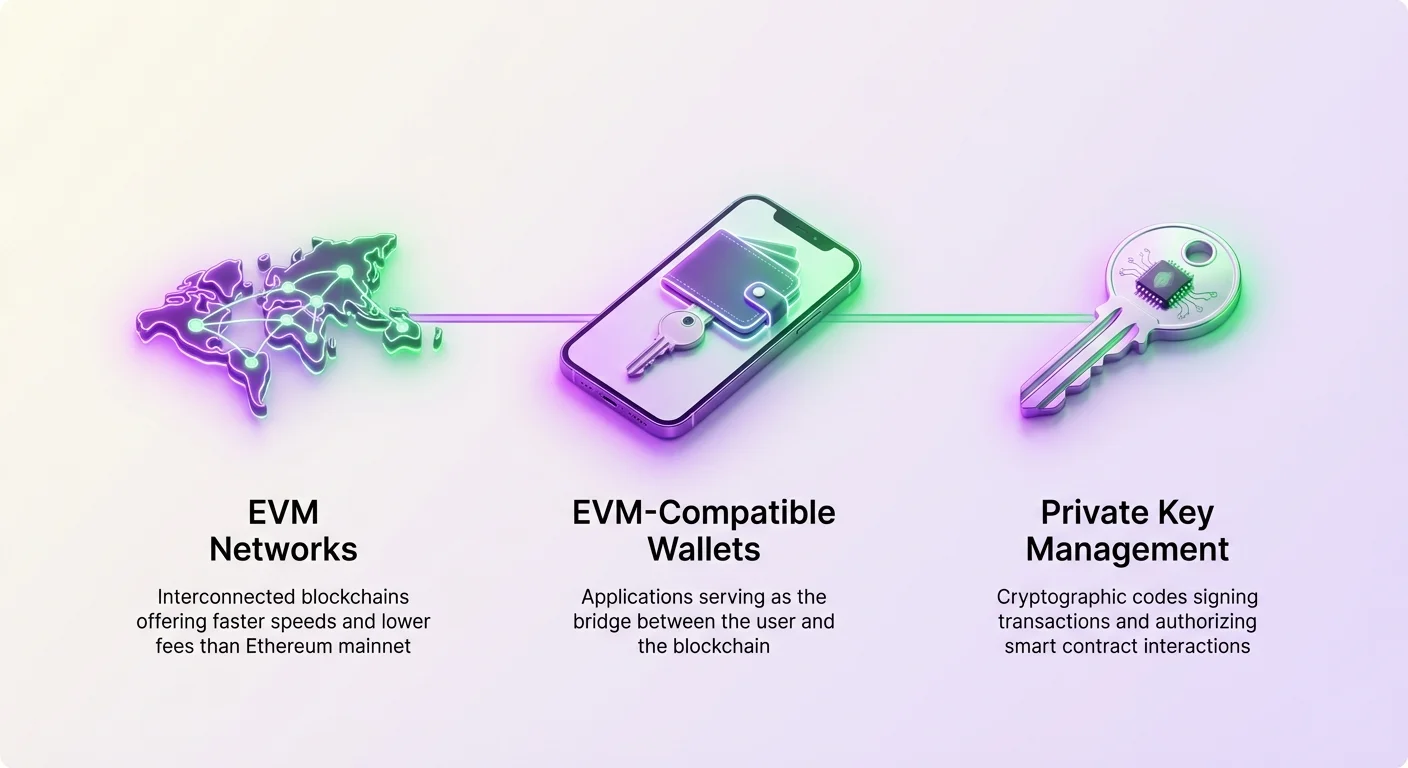
Understanding EVM-Compatible Wallets
The cornerstone of interacting with Layer 2 solutions and sidechains is the EVM-compatible wallet. These applications serve as the bridge between the user and the blockchain. They manage the private keys that sign transactions and authorize smart contract interactions.
The Role of Browser Extensions and Mobile Apps
Software wallets, often referred to as "hot wallets," are the primary gateway for Decentralized Finance (DeFi). MetaMask stands out as a leading example in this category. It allows users to manage assets not just on Ethereum, but on any EVM-compatible network, including Polygon and Binance Smart Chain (BSC). This flexibility makes it an essential tool for users navigating the Layer 2 landscape.
These wallets function as browser extensions or mobile applications. They inject Web3 capabilities into standard browsers, enabling direct interaction with decentralized exchanges and lending protocols. Features often include built-in token swapping and staking, allowing users to manage their portfolio without leaving the wallet interface.
However, the convenience of hot wallets comes with inherent risks. Because they are connected to the internet, they are more susceptible to phishing attacks and malware. Users must exercise extreme caution when connecting these wallets to new applications. Verifying the authenticity of a dApp before granting permissions is a critical security step.
Multi-Chain Asset Management
Modern wallets have evolved to support multiple networks simultaneously. A single seed phrase can generate addresses for Ethereum, Polygon, and other EVM chains. This unified management simplifies the user experience but concentrates risk. If a seed phrase is compromised, assets on all derived networks are at risk.
Users should look for wallets that offer clear network indicators. Knowing exactly which chain you are interacting with prevents costly mistakes, such as sending tokens to the wrong network. Advanced wallets allow for the management of Non-Fungible Tokens (NFTs) and standard tokens side-by-side, providing a comprehensive view of digital holdings.
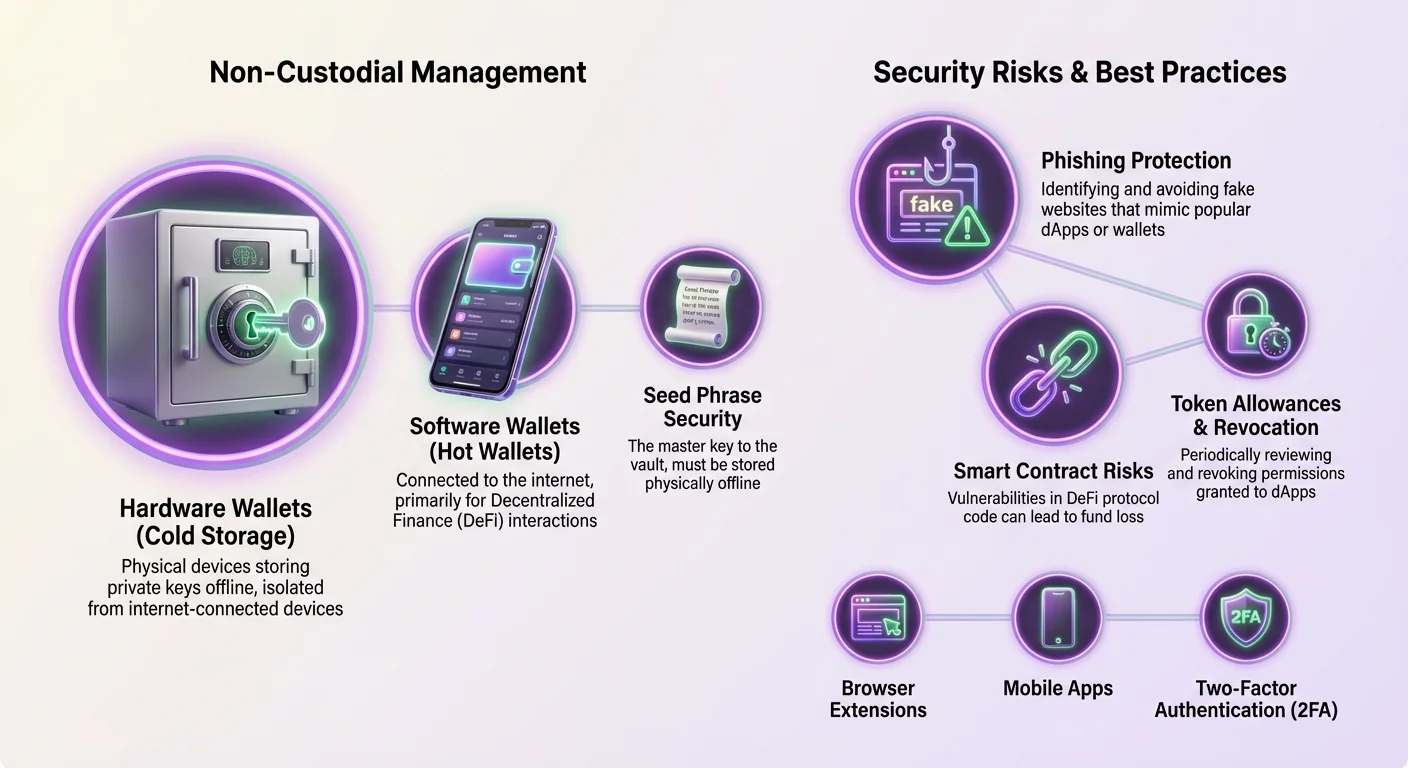
Hardware Wallets: The Gold Standard for Security
For substantial holdings, relying solely on software wallets is often discouraged by security experts. Hardware wallets, also known as "cold storage," provide a physical layer of security that software cannot match. Ultimate Guide to Hardware Wallets. These devices store private keys offline, isolating them from internet-connected devices that may be compromised.
integrating Cold Storage with EVM Networks
Devices like the Trezor Model T or the Ledger Nano X integrate seamlessly with software interfaces like MetaMask. In this setup, the software wallet acts as a "watch-only" interface. It can view balances and initiate transactions, but it cannot sign them. The signing process happens inside the hardware device.
When a user wants to move assets on Polygon or another Layer 2, they initiate the request on their computer. The transaction data is sent to the hardware wallet. The user must then physically confirm the transaction on the device's screen. This ensures that even if the computer has a virus, the attacker cannot move funds without physical access to the hardware wallet.
Advanced Hardware Features
Newer hardware models incorporate features designed to enhance usability and security. Touchscreens and haptic feedback improve the user interface, reducing the likelihood of input errors. Secure Elements, often rated EAL 6+, provide high-assurance protection against physical tampering.
One significant advancement is the implementation of Shamir’s Secret Sharing. This feature allows users to split their recovery backup into multiple unique shares. A defined number of these shares are required to recover the wallet. This eliminates the single point of failure associated with a standard 12 or 24-word seed phrase. If one share is lost or stolen, the funds remain secure as long as the threshold is not met.
| Feature | Software Wallet | Hardware Wallet |
|---|---|---|
| Connectivity | Always Online (Hot) | Mostly Offline (Cold) |
| Cost | Typically Free | Purchase Required |
| Security Level | Moderate | High |
The Importance of Non-Custodial Management
The philosophy of "not your keys, not your coins" is central to crypto security. Non-custodial wallets give users full control over their funds. Unlike centralized exchanges, where a third party manages the keys, non-custodial solutions place the responsibility entirely on the user.
Mastering Private Keys
A non-custodial wallet generates a private key and a corresponding public address. The private key is the mathematical proof of ownership. In user-friendly terms, this is often represented as a recovery phrase or seed phrase. This sequence of words is the master key to the vault.
If a user loses access to their device, the seed phrase is the only way to restore the wallet. Conversely, if someone else gains access to the seed phrase, they have full control over the funds. Therefore, securing this phrase is the single most important task for any crypto investor. We cover Securing and Utilizing Your Seed Phrase extensively.
Best practices dictate that seed phrases should never be stored digitally. They should be written down on paper or stamped into metal and stored in a secure physical location. Taking a screenshot or saving it in a cloud note exposes the key to potential hackers.
Privacy and Anonymity
Non-custodial wallets also offer superior privacy. Many centralized platforms require Know Your Customer (KYC) verification, linking a user's identity to their blockchain address. Non-custodial wallets generally do not require personal information to set up.
Some advanced wallets, like Cake Wallet, prioritize privacy by integrating Tor or VPN connections directly into the application. While initially designed for privacy-focused coins, these features highlight the growing demand for anonymity in the broader crypto space. Managing assets without linking them to a real-world identity protects users from targeted social engineering attacks.
Centralized Exchanges as Gateways
While self-custody is the ideal for security, centralized exchanges (CEXs) play a vital role in the ecosystem. Platforms like Coinbase and Uphold serve as on-ramps, allowing users to convert fiat currency into cryptocurrencies.
Security Measures on Exchanges
Reputable exchanges employ robust security measures to protect user funds. This includes holding the vast majority of assets in cold storage, inaccessible to online threats. They also offer account-level protections such as Two-Factor Authentication (2FA).
2FA adds a critical layer of defense. Even if a password is stolen, an attacker cannot access the account without the second verification step. Authenticator apps are preferred over SMS verification, as SIM-swapping attacks render SMS less secure.
The Trade-Offs of Custodial Services
Using a custodial service offers convenience. If a user forgets their password, the exchange can help recover the account. This safety net does not exist in self-custody. However, users are subject to the platform's policies. accounts can be frozen, and withdrawals can be halted during times of high volatility or regulatory pressure.
For managing assets across different networks, exchanges often simplify the bridging process. A user can deposit on one chain and withdraw on another, provided the exchange supports both networks. This avoids the complexity and risk of using decentralized bridges manually.
Navigating Transaction Risks
Interacting with EVM chains involves frequent transaction signing. Every interaction with a smart contract requires permission. Malicious contracts can be designed to drain wallets if granted unlimited approval.
Phishing and Scam Protection
Phishing remains a primary vector for theft. Attackers create fake websites that mimic popular dApps or wallet download pages. When a user connects their wallet or enters their seed phrase, the attackers steal the credentials.
Users must ensure they are downloading wallets from official sources. Browser extensions should be verified to have high download counts and positive reviews. Bookmarking legitimate DeFi platforms prevents accidental navigation to typosquatted domains.
Token Allowances and Revocation
When interacting with a dApp, users often grant it permission to spend a specific token. Indefinite or unlimited approvals are risky. Ultimate DeFi Security Checklist. If the protocol is exploited later, the attacker can use that pre-approved permission to drain the user's tokens.
Periodically reviewing and revoking token allowances is a healthy security habit. Various tools exist to view which contracts have access to a wallet and revoke permissions that are no longer needed. This limits the potential damage in the event of a protocol hack.
Mobile Security for Assets on the Go
Mobile wallets have become powerful tools for managing crypto. Apps like Trust Wallet and the Bitcoin.com Wallet offer intuitive interfaces for tracking portfolios and executing trades.
Balancing Convenience and Risk
Mobile devices are generally more secure than desktop computers due to sandboxed operating systems. However, they are also more prone to physical theft. Securing the wallet app with biometric authentication (FaceID or fingerprint) is essential.
Mobile wallets also facilitate the scanning of QR codes, making them ideal for peer-to-peer transactions or connecting to desktop dApps via WalletConnect. This feature bridges the gap between mobile security and desktop functionality.
Backup and Recovery
Just like desktop wallets, mobile wallets rely on recovery phrases. When setting up a new mobile wallet, users are prompted to back up their seed phrase. This step should never be skipped. If the phone is lost, damaged, or reset, the funds are irretrievable without this backup.
Some wallets offer "cloud backup" options for encrypted seed phrases. While convenient, this reintroduces a third-party risk. Users must weigh the convenience of cloud recovery against the security of strictly offline backups.
Staking and DeFi Participation
One of the main attractions of Layer 2 networks is the ability to participate in DeFi with lower fees. Staking tokens to earn yield is a common activity.
In-Wallet Staking Features
Many modern wallets integrate staking directly into the interface. This allows users to delegate their tokens to validators without navigating to external websites. For example, users can stake assets directly within wallets like Phantom or Trust Wallet.
This integrated approach reduces the risk of interacting with phishing sites. The wallet provider vets the validators or protocols available within the app, adding a layer of trust. However, users should still understand the slashing risks associated with staking on proof-of-stake networks.
Understanding Smart Contract Risk
Even when using a secure wallet, the underlying smart contract of a DeFi protocol carries risk. If the code has a bug, funds deposited into that contract can be lost. This is distinct from wallet security. A secure wallet cannot protect funds that have been voluntarily sent to a flawed smart contract.
Diversification is a key mitigation strategy. Spreading assets across different protocols and networks reduces the impact of any single failure. Users should avoid keeping all their liquidity in a single yield farm or bridge.
Conclusion
Managing assets across EVM-compatible networks like Polygon, Arbitrum, and Optimism requires a proactive approach to security. The tools available today, from versatile software wallets like MetaMask to robust hardware solutions like Trezor, provide the necessary infrastructure for self-custody. However, technology alone is not enough. User behavior is the final line of defense.
Secure management relies on a combination of cold storage for long-term holdings and carefully managed hot wallets for active usage. Protecting seed phrases, utilizing two-factor authentication, and remaining vigilant against phishing attempts are non-negotiable practices. As the ecosystem continues to grow, the complexity of managing cross-chain assets will likely increase, making these fundamental security habits even more critical.
By understanding the mechanics of EVM wallets and the risks associated with decentralized networks, users can confidently navigate the Layer 2 landscape. The freedom of self-custody comes with the responsibility of vigilance. Correctly leveraging these tools ensures that digital wealth remains secure and accessible only to its rightful owner.
True security is achieved when you control your private keys and keep them offline.