
Cryptocurrency markets are defined by their volatility. While traditional investors often view market downturns as periods to sit on the sidelines, sophisticated traders view them as opportunities. Short selling, or "shorting," is the financial strategy used to profit from declining asset prices. It allows market participants to generate returns when values drop, hedge their existing portfolios against losses, and maintain active strategies regardless of market direction. Understanding the mechanics of shorting is essential for anyone looking to move beyond simple accumulation strategies.
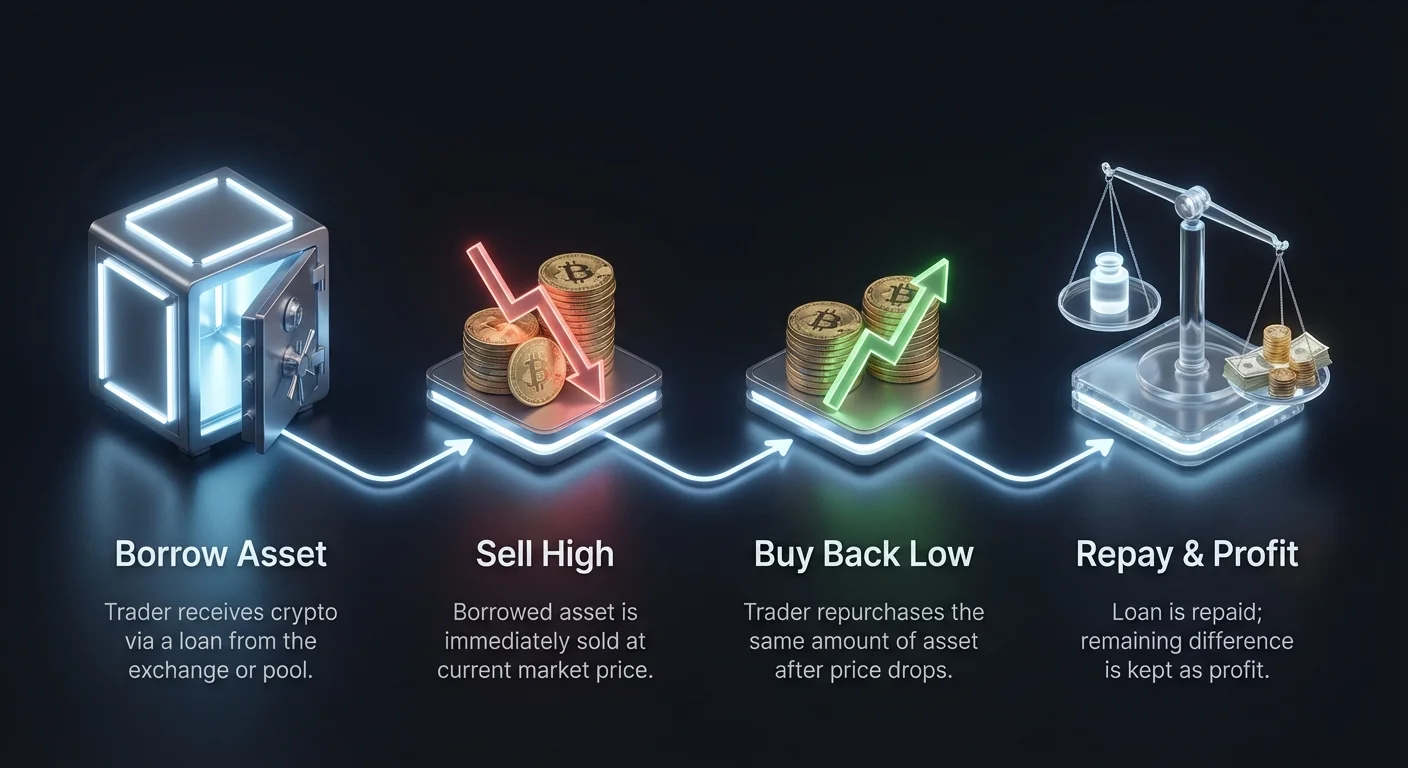
The concept of shorting reverses the traditional "buy low, sell high" logic. In a short trade, the sequence changes to "sell high, buy low." A trader borrows an asset they do not own, sells it at the current market price, and waits for the price to fall. Once the price drops, they purchase the asset back at the lower value to repay the loan. The difference between the initial selling price and the lower repurchase price constitutes the profit.
Shorting in the crypto ecosystem is distinct from traditional equity markets due to the unique infrastructure of digital assets. The 24/7 nature of crypto trading, combined with high volatility, creates a high-stakes environment. Traders do not typically short assets by calling a broker on the phone. Instead, they utilize automated platforms, smart contracts, and complex derivative products. These tools provide instant access to borrowed liquidity, but they also introduce specific risks that must be managed carefully.
The primary barrier to entry for shorting is understanding the instruments available. Unlike spot trading, where you simply own the coin, shorting almost always involves leverage and derivatives. This introduces concepts like maintenance margin, liquidation prices, and funding rates. Mastering these elements is required to navigate bearish market conditions effectively. Without this knowledge, the mechanisms designed to facilitate shorting can quickly lead to substantial capital losses.
The Fundamental Mechanics of Short Selling
At its core, short selling is a credit-based transaction. You cannot sell what you do not have unless someone lends it to you. In the cryptocurrency market, the "lender" is usually the exchange or a liquidity pool. When a trader initiates a short position, they put up collateral. This collateral acts as a security deposit. It ensures that if the trade goes wrong and the price rises, the trader has enough funds to cover the loss and repay the borrowed asset.
The process begins with the opening of a position. If a trader believes Bitcoin will fall from $60,000 to $50,000, they open a short position for 1 BTC. The exchange effectively lends them 1 BTC, which is immediately sold for $60,000 stablecoin (or equivalent). The trader now has a debt of 1 BTC and a credit of $60,000. If the price falls to $50,000, the trader buys 1 BTC back using only $50,000 of the held funds. They return the 1 BTC to the lender. The remaining $10,000 is their gross profit.
However, if the price rises to $70,000, the dynamics shift unfavorably. To repay the 1 BTC debt, the trader would need to spend the original $60,000 plus an additional $10,000 from their own collateral. This is where the risk lies. If the price rises high enough that the trader's collateral can no longer cover the repurchase cost, the exchange will execute a forced liquidation. This closes the position automatically to prevent the trader from falling into debt they cannot repay.
Spot Margin vs. Derivatives
There are two primary ways to execute a short position in crypto: Spot Margin and Derivatives. Spot margin trading involves the actual borrowing of the cryptocurrency asset. The trader utilizes the exchange's margin pool to borrow the coins directly. This is the most "physical" form of shorting. The trader pays interest on the borrowed coins, usually calculated hourly. It is transparent but can be capital inefficient and limited by the liquidity available in the exchange's lending pool.
Derivatives offer a more synthetic approach. When shorting via derivatives, such as futures or perpetual contracts, the trader does not necessarily borrow the underlying asset. Instead, they enter a contract that mimics the price action of the asset. The contract dictates that if the price goes down, the counterparty pays the short seller. If the price goes up, the short seller pays the counterparty. This method is often preferred for its high liquidity and the ability to use higher leverage without worrying about loan availability.
Crypto Derivatives: The Primary Vehicles
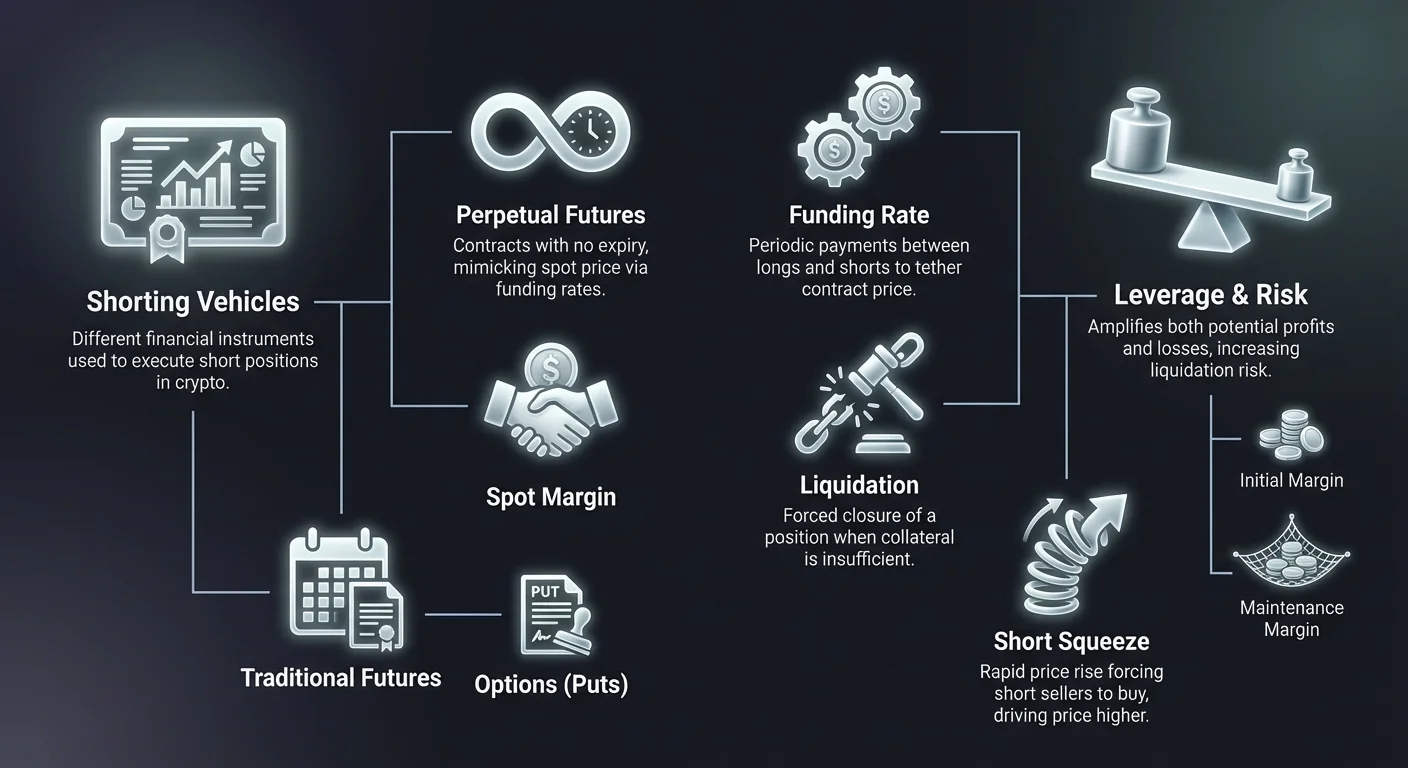
Derivatives are financial instruments that derive their value from an underlying asset, such as Bitcoin or Ethereum. In the context of short selling, they are the most popular tools due to their flexibility and efficiency. Derivatives allow traders to speculate on price movements without the logistical hurdles of managing actual wallets or blockchain transfers. The contract handles the exposure, while the trader manages the margin and strategy.
The derivative market in crypto has eclipsed the spot market in terms of volume. This is largely because derivatives allow for bidirectional trading with equal ease. In a spot market, selling requires ownership. In a derivative market, selling is simply opening a contract in the opposite direction. This structural efficiency makes derivatives the go-to choice for bear strategies.
Futures Contracts
Traditional futures contracts are agreements to buy or sell an asset at a predetermined price on a specific future date. These contracts have a fixed expiry. For a short seller, a futures contract locks in a sale price today for delivery later. If the market price falls below the contract price at expiry, the short seller profits. These instruments are widely used by institutional traders for hedging because the expiry date aligns with specific time horizons, such as quarterly financial reporting.
The pricing of futures contracts often diverges from the spot price. This is known as the "basis" or "premium." In a bullish market, future contracts may trade higher than the spot price (contango). In a bearish market, they may trade lower (backwardation). A short seller must be aware of this difference. Shorting a futures contract that is already trading at a steep discount to the spot price reduces potential profit margins.
Futures require patience and precise timing. Because the contract expires, the trader must be correct about the direction and the timeframe. If the market crashes the day after the contract expires, the short futures holder misses the opportunity. This limitation led to the invention of a crypto-native instrument that dominates the market today: the perpetual future.
Perpetual Futures (Perps)
Perpetual futures, often called "perps," are a special type of contract unique to the cryptocurrency markets. As the name implies, they do not have an expiry date. A trader can hold a short position in a perpetual contract for as long as they can maintain the margin requirements. This eliminates the need to "roll over" contracts or worry about expiration dates. It provides a continuous trading experience that closely mimics the spot market but with the added benefits of leverage and shorting capabilities.
Because perps never expire, there is no final settlement date to force the contract price to match the spot price. Without a mechanism to tether them, the price of a perpetual contract could theoretically drift far away from the actual price of Bitcoin or Ethereum. To solve this, exchanges utilize a mechanism called the Funding Rate. This system incentivizes traders to keep the contract price close to the spot price through periodic payments between long and short traders.
Perpetual contracts are the primary venue for retail and high-frequency shorting. They offer deep liquidity, meaning large positions can be entered and exited without causing significant price slippage. For a short seller, the ability to enter a position and hold it indefinitely allows for trend-following strategies that can last weeks or months during prolonged bear markets.
Options and Contracts for Difference (CFDs)
Options contracts provide a different mathematical approach to shorting. A "put option" gives the buyer the right, but not the obligation, to sell an asset at a specific strike price. Buying a put option is a bearish strategy. If the asset price falls below the strike price, the option gains value. The distinct advantage of buying puts is that the risk is limited to the "premium" paid for the contract. Unlike shorting a future, where losses can be unlimited, an option buyer can only lose the cost of the option itself.
Contracts for Difference (CFDs) are another vehicle, typically found on broker platforms rather than native crypto exchanges. A CFD is a straightforward agreement to exchange the difference in the value of an asset from the time the contract is opened to when it is closed. If you open a short CFD and the price drops, the broker pays you the difference. CFDs are simple and do not require managing crypto wallets, but they often come with wider spreads and are less transparent than on-chain or exchange-based derivatives.
Understanding Leverage and Margin
Leverage is a double-edged sword that is inextricably linked to crypto shorting. Leverage allows a trader to control a position size that is larger than their actual capital. For example, with 10x leverage, a trader with $1,000 can open a short position worth $10,000. If the price drops by 10%, the $10,000 position gains $1,000 in value. This represents a 100% return on the trader's initial capital. Leverage amplifies volatility, making small market moves significant for the trader's PnL (Profit and Loss).
However, leverage acts identically in reverse. If that same 10x leveraged short position faces a 10% price increase, the loss is $1,000. This equals the trader's entire initial capital. The exchange will liquidate the position to prevent the loss from exceeding the collateral. This creates a tighter margin for error. Higher leverage ratios, which can go up to 100x on some platforms, require extreme precision and strict risk management.
Initial and Maintenance Margin
To manage leveraged short positions, exchanges utilize two critical margin thresholds: Initial Margin and Maintenance Margin. Initial Margin is the amount of collateral required to open the position. For a $10,000 position at 10x leverage, the Initial Margin is $1,000. This is the "down payment" required to enter the market.
Maintenance Margin is the minimum amount of equity that must remain in the account to keep the position open. It is typically lower than the Initial Margin. As the trade moves against the short seller (price goes up), their equity decreases. If the equity falls below the Maintenance Margin level, a liquidation event is triggered. Understanding the gap between your entry price and your liquidation price is the most vital calculation in short selling.
Isolated vs. Cross Margin
Traders must choose how their collateral is allocated using either Isolated Margin or Cross Margin modes. Isolated Margin assigns a specific amount of funds to a single open position. If that position gets liquidated, the trader only loses the funds assigned to that specific trade. The rest of the portfolio remains unaffected. This is a protective tool for high-risk short strategies, ensuring that a single bad trade does not drain the entire account.
Cross Margin utilizes the entire available balance of the account as collateral for all open positions. This is useful for hedging or managing multiple positions that might balance each other out. For example, a trader might be short Bitcoin and long Ethereum. If Bitcoin rises (bad for the short) but Ethereum also rises (good for the long), the profits from Ethereum can support the margin requirements of the Bitcoin short. However, the risk is that a catastrophic move in one position could liquidate the entire account balance.
The Funding Rate Mechanism
The funding rate is the invisible hand that governs the perpetual futures market. It is a periodic payment exchanged between buyers (longs) and sellers (shorts). The direction of the payment depends on the relationship between the perpetual contract price and the spot price. This mechanism ensures that the derivative price does not diverge permanently from the real asset value.
When the market is bullish, the perpetual price often trades slightly higher than the spot price. To pull the price back down, the funding rate becomes "positive." In this scenario, traders holding long positions must pay a fee to traders holding short positions. This payment incentivizes traders to open short positions (to collect the fee) and close long positions (to avoid the fee), creating selling pressure that realigns the price.
Conversely, in a bearish market, the perpetual price may fall below the spot price. The funding rate becomes "negative." In this state, short sellers must pay fees to long holders. This creates a cost to holding a short position. Traders must be aware of the current funding rate before entering a trade. In an extremely bearish trend, the cost of funding can be significant, eating into the profits of a short trade over time.
Funding rates are typically calculated and exchanged every eight hours. Some platforms may use shorter intervals during periods of high volatility. Sophisticated traders monitor these rates closely. A strategy known as "cash and carry" or "funding arbitrage" involves opening a position specifically to collect these payments while hedging out the price risk, although this is generally a neutral strategy rather than a directional short.
Strategic Approaches to Shorting
Shorting is not merely about guessing that a crash is imminent. Professional traders employ specific strategies to integrate shorting into a broader investment approach. These strategies range from aggressive speculation to conservative protection. The goal dictates the leverage used, the duration of the trade, and the instrument selected.
Understanding the market environment is the first step. Shorting in a strong bull market is famously dangerous, often referred to as "picking tops." Strategies are usually most effective when confirming a trend reversal or capitalizing on established downtrends. The most successful short strategies often align with technical indicators or fundamental shifts in the market landscape.
Speculative Shorting and Trend Following
Speculative shorting attempts to profit from an anticipated decline. This is often driven by technical analysis, such as identifying a "head and shoulders" pattern or a break below a key support level. Trend following involves entering a short position after a downtrend is confirmed. Instead of trying to sell at the absolute peak, the trader waits for the market to signal weakness and then rides the momentum downward.
In speculative shorting, timing is critical. Traders often use stop-entry orders to ensure they only enter the short if the price breaks a specific support floor. This confirmation reduces the risk of getting caught in a "fake-out," where the price dips briefly before surging back up. Profit targets are usually set at historical support levels where buyers are expected to step in.
Hedging Portfolios
Hedging is a defensive strategy. Investors who hold large amounts of cryptocurrency (spot holdings) may fear a temporary market decline but do not wish to sell their assets for tax reasons or long-term conviction. To protect the dollar value of their portfolio, they can open a short position of equivalent size. This is known as creating a "delta neutral" position.
For example, if an investor holds 10 BTC and fears a bear market, they can short 10 BTC via a perpetual contract. If the price of Bitcoin drops by 20%, their spot holdings lose value, but their short position gains an equal amount. The net value of the portfolio remains stable in dollar terms. Once the investor believes the bottom is in, they close the short position, taking the profit, and retain their original 10 BTC.
Scalping and Day Trading
Scalping is a high-frequency strategy that seeks to profit from small price changes. Scalpers may open and close dozens of short positions in a single day, holding each for only minutes or seconds. This strategy relies heavily on leverage to make small price movements profitable. Scalping requires intense focus and low-latency execution, often utilizing automated bots or advanced trading terminals.
Day traders operate on slightly longer timeframes, looking to capture the intraday trend. A day trader might short Bitcoin in the morning if Asian markets show weakness, aiming to close the position before the US markets open. Both scalping and day trading require strict discipline regarding fees. Since profit margins per trade are small, trading fees and slippage can quickly turn a winning strategy into a losing one.
Risks Specific to Short Sellers
While the mechanics of shorting mirror long trading in many ways, the risk profile is asymmetric. When buying an asset (going long), the maximum loss is capped at the amount invested; the price cannot go below zero. The potential gain, theoretically, is infinite. Shorting flips this equation. The maximum gain is limited (price goes to zero), but the potential loss is theoretically unlimited because an asset's price can rise indefinitely.
This fundamental asymmetry necessitates stricter risk management protocols for short sellers. A 100% rise in price results in a 100% loss of the principal for a non-leveraged short. In crypto, assets can rally 300% or more in short periods. Without a stop-loss, a short seller can end up owing more money than they deposited, although modern exchanges usually have insurance funds and liquidation engines to prevent negative balances.
Short Squeezes
A short squeeze is a market phenomenon that occurs when a highly shorted asset begins to rise in price. As the price increases, short sellers face losses and are forced to buy back the asset to close their positions or limit damage. This buying pressure adds fuel to the fire, pushing the price even higher. This, in turn, triggers more stop-losses and liquidations among other short sellers, creating a feedback loop of buying.
Short squeezes are particularly violent in cryptocurrency markets due to the high use of leverage. A "cascade" of liquidations can cause price spikes of 10% or 20% in minutes. Traders monitoring order books can often see clusters of liquidation points. If a "whale" or large entity buys enough to push the price into these clusters, the resulting squeeze can wipe out bears instantly. Avoiding crowded short trades is a key survival skill.
Regulatory and Counterparty Risk
Shorting often involves derivative exchanges that may operate in gray regulatory zones. Unlike holding Bitcoin in a personal hardware wallet, holding a short position requires keeping funds on an exchange. This introduces counterparty risk. If the exchange suffers a hack, insolvency, or regulatory shutdown, the collateral backing the short position could be lost.
Furthermore, regulatory changes can impact the availability of shorting products. Some jurisdictions restrict retail access to derivatives or high leverage. Traders must be aware of the legal status of the platforms they use. A sudden ban on derivatives in a specific region could force the immediate closure of positions, potentially at unfavorable prices.
Borrowing and Cost Structures
Shorting is rarely free. Beyond the risk of price movement, there are structural costs associated with maintaining a short position. These costs must be calculated into the profitability of any trade. If the market stays flat, a short seller usually loses money due to these fees.
Understanding the fee schedule of a chosen platform is mandatory. High-frequency traders and institutional clients often receive tiered fee discounts, but retail traders typically pay the full rate. Over time, these costs compound, making long-term passive shorting expensive compared to long-term holding.
Interest Rates and Borrowing Fees
For spot margin shorting, the primary cost is the interest rate on the borrowed coins. These rates are dynamic and determined by supply and demand. If everyone wants to short Bitcoin, the demand for borrowing BTC rises, and so does the interest rate. During extreme market volatility, annualized interest rates for borrowing can spike to triple digits.
These fees are usually calculated hourly. A trader might see an interest rate of 0.05% per day. While small in isolation, this adds up over weeks or months. Some platforms also charge a fee to open the loan. Traders must check the "borrow rate" before executing a spot short, as it varies significantly between different cryptocurrencies and exchanges.
Transaction and Taker Fees
Every trade incurs a transaction fee. In crypto markets, these are divided into "Maker" and "Taker" fees. A "Maker" is a trader who places a limit order that rests on the order book, adding liquidity. A "Taker" is a trader who uses a market order to fill an existing order, removing liquidity. Takers generally pay higher fees.
Because shorting often happens during moments of panic or rapid movement, traders frequently use market orders to ensure they get into the position. This classifies them as Takers, incurring the higher fee tier. For scalpers, the spread (the difference between buy and sell prices) and the Taker fees can consume a significant portion of the trade's expected profit.
Liquidation and Hidden Costs
If a position is forcibly closed by the exchange, the trader often pays a liquidation fee. This is a penalty added on top of the loss. It serves as a disincentive to letting positions hit the liquidation wall. Additionally, slippage is a hidden cost during volatile entries. If a trader tries to short a crashing asset, the execution price might be significantly lower than the price seen on the screen due to the speed of the market drop.
Technical Execution and Orders
Executing a short trade requires familiarity with various order types. Simply hitting "sell" is rarely the optimal strategy. Professional execution involves managing entry prices, exit targets, and safety valves simultaneously. The volatility of crypto means that price action can move through targets in milliseconds, making manual execution unreliable.
Using the correct order type can mean the difference between a profitable trade and a missed opportunity. It also governs the fee structure (Maker vs. Taker) and protects against slippage.
Order Types
A Limit Order allows the trader to specify the exact price at which they wish to short. For example, "Sell 1 BTC if price hits $65,000." This guarantees the price but does not guarantee the fill; if the price only reaches $64,999, the trade never opens. This is ideal for entering positions at resistance levels.
A Market Order executes immediately at the best available current price. It guarantees the trade happens but not the specific price. In a fast-moving market, a market sell order could fill significantly lower than expected. This is used when speed is prioritized over price precision.
A Stop-Loss is an order designed to limit loss. For a short seller, this is a buy order placed above the entry price. If the entry was $60,000, a stop-loss might be set at $62,000. If the price hits $62,000, the system automatically closes the trade, accepting a small loss to prevent a larger one.
Risk Management Tools
Advanced platforms offer Trailing Stop orders. This is a dynamic stop-loss that moves with the price. If a trader shorts at $60,000 and the price drops to $55,000, a trailing stop can be set to follow the price at a $1,000 distance. If the price drops further to $50,000, the stop moves down to $51,000. If the price then reverses, the trade closes at $51,000, locking in most of the profit.
Take-Profit orders are the opposite of stop-losses. They automatically close the position when the price drops to a target level, securing the gain. Using a combination of Stop-Loss and Take-Profit orders (often called OCO or "One Cancels the Other") allows traders to automate the outcome of the trade once it is open, removing emotional decision-making.
Comparing Shorting Vehicles
Different market conditions and trader goals necessitate different shorting instruments. Understanding the pros and cons of each vehicle helps in selecting the right tool for the job. While perpetuals are the most common, they are not always the most efficient for every scenario.
Spot margin is often better for longer-term holds where funding rates might erode profits. Options are superior for volatile events like earnings reports or protocol upgrades where the outcome is binary. Futures are preferred by institutions managing fixed-date risks.
| Feature | Spot Margin Short | Perpetual Futures | Traditional Futures | Options (Puts) |
|---|---|---|---|---|
| Expiry | None | None | Fixed Date | Fixed Date |
| Cost | Borrow Interest | Funding Rates | Basis / Premium | Premium |
| Leverage | Low (3x-10x) | High (Up to 100x) | High (Up to 100x) | High |
| Risk | Liquidation | Liquidation | Liquidation | Premium Loss Only |
| Liquidity | Varies by Asset | Very High | High | Medium |
| Best For | Medium-term hold | Short-term trading | Institutional hedging | Event speculation |
Traders should assess the "cost of carry" for each vehicle. In a market where funding rates are extremely negative (shorts paying longs), holding a perpetual short becomes expensive. In this case, a spot margin short or a traditional future might be more cost-effective, even if the liquidity is slightly lower.
Regulatory Landscape and Ge restrictions
The ability to short crypto is not universally available. Financial regulations in various countries dictate which products exchanges can offer to retail clients. In the United States, for example, Contract for Difference (CFD) trading is generally prohibited, and access to high-leverage perpetual futures is restricted to specific regulated platforms.
In Europe and parts of Asia, regulations may cap the amount of leverage available to retail traders or ban crypto derivatives entirely. Traders must verify that the platform they are using is compliant with their local laws. Using VPNs to bypass restrictions on unregulated exchanges introduces significant risk, as the exchange may freeze accounts that violate their terms of service regarding jurisdiction.
Decentralized Exchanges (DEXs) offer an alternative. On-chain perpetual protocols allow for shorting and leverage via smart contracts, often without the same geographic restrictions (though this is a legally complex area). These platforms effectively replicate the functions of centralized exchanges but replace the order book with liquidity pools and automated market makers (AMMs). While they reduce counterparty risk regarding exchange insolvency, they introduce smart contract risk—the possibility of a bug in the code leading to loss of funds.
Conclusion
Short selling is a vital component of a mature cryptocurrency market. It provides the mechanism for price discovery, allowing traders to express negative sentiment and preventing asset bubbles from growing unchecked. For the individual trader, it unlocks the ability to profit during bear markets and protect the value of long-term holdings through hedging. However, the mechanics of borrowing, the costs of funding, and the risks of leverage make it a strategy that demands respect and education.
Success in shorting requires more than just a bearish outlook. It demands a mastery of the instruments—knowing when to use a perpetual contract versus a put option, understanding how to interpret funding rates, and strictly adhering to risk management protocols to avoid liquidations. The volatility that makes crypto shorting profitable is the same force that can punish undisciplined traders. By utilizing stop-losses, managing position sizes, and understanding the structural costs, traders can effectively incorporate short strategies into their broader financial toolkit.
Short selling allows you to profit when prices fall, but strict risk management is essential to survive market volatility.