
The integration of blockchain technology with traditional financial markets has created new avenues for investors seeking global diversification. By leveraging cryptocurrency infrastructure, individuals can now access traditional asset classes through digital representations known as tokenized stocks and real-world assets (RWAs). This convergence allows for a more inclusive financial system where geographic barriers and high entry costs are significantly reduced.
For decades, investing in the United States stock market or other major global exchanges was difficult for international participants. High brokerage fees, complex account requirements, and currency conversion costs often excluded smaller investors. The emergence of tokenized assets changes this dynamic by placing equities and commodities on the blockchain. This shift enables seamless trading, fractional ownership, and instant settlement, democratizing access to wealth creation tools that were previously reserved for a select few.
Understanding Tokenized Stocks
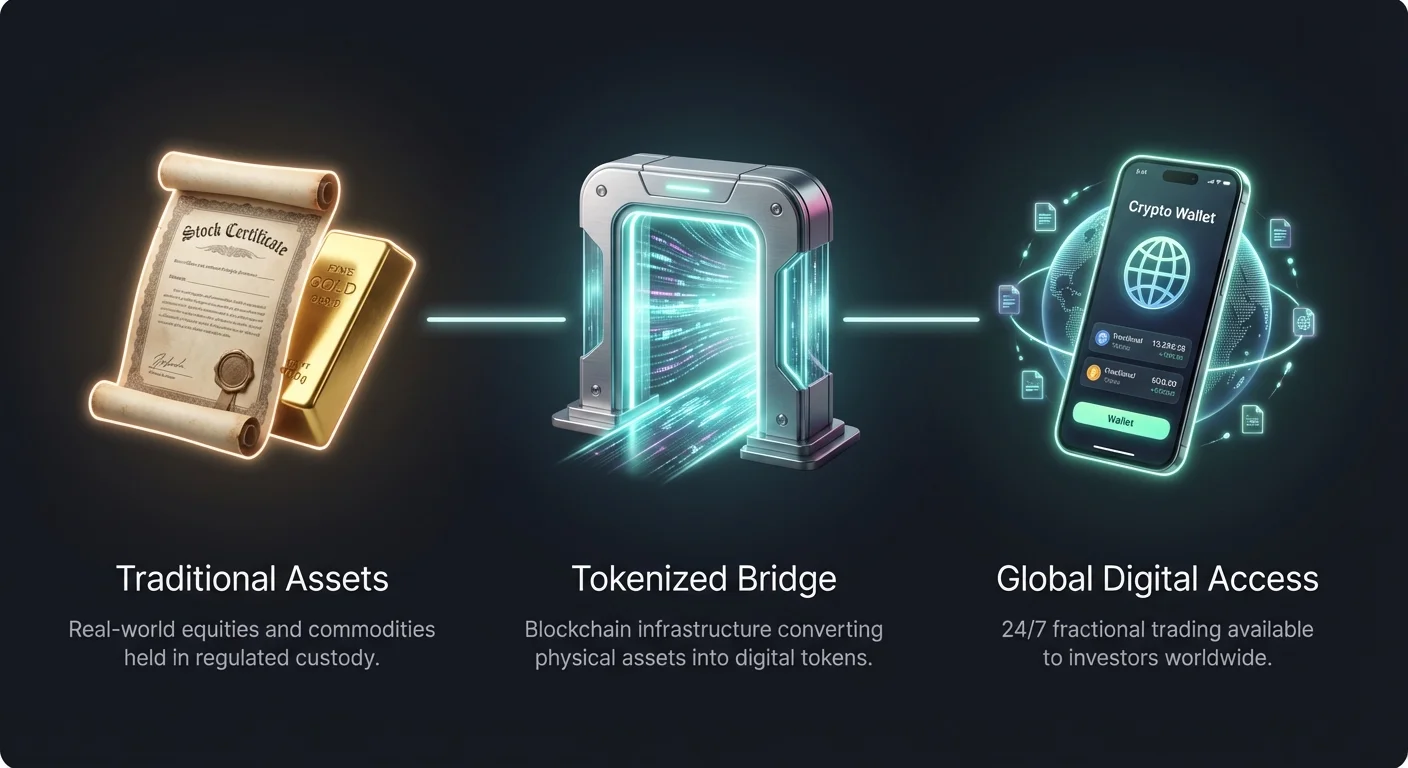
Tokenized stocks are digital assets that represent ownership or a stake in a publicly traded company. Unlike traditional shares held in a brokerage account, these tokens exist on a blockchain network. They are designed to track the price performance of the underlying asset, such as shares of major technology companies or industrial giants. This innovation bridges the gap between the stability of traditional equity markets and the efficiency of decentralized finance.
The Mechanics of Tokenization
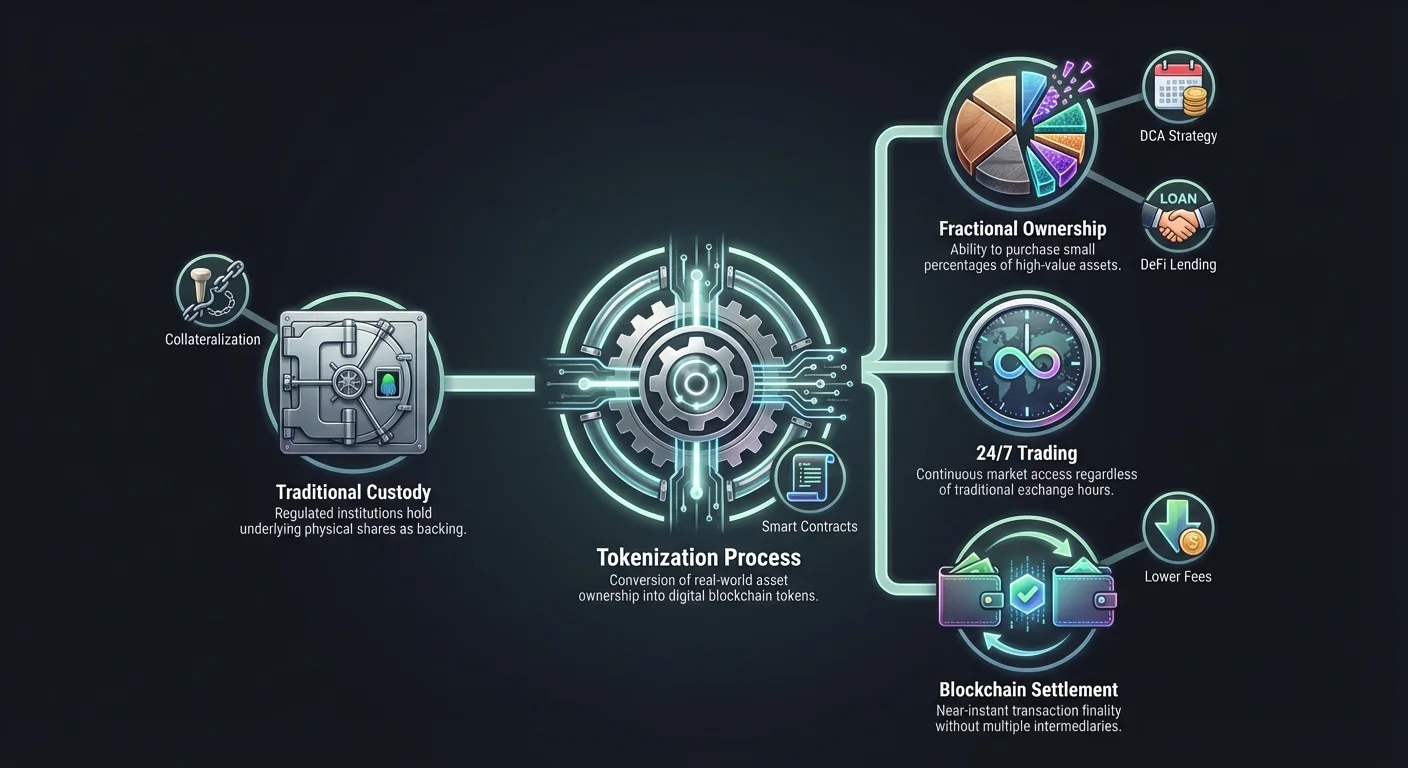
The process begins when a licensed entity purchases the actual underlying shares of a company. These shares are held in custody by a regulated financial institution. Once the shares are secured, digital tokens are minted on a blockchain to represent those specific shares at a one-to-one ratio or another determined value.
This structure ensures that the value of the token is directly pegged to the value of the real-world stock. If the price of the stock rises in the traditional market, the value of the token rises accordingly. This peg allows crypto traders to gain exposure to the stock market without leaving the cryptocurrency ecosystem.
Backing and Collateralization
A critical aspect of tokenized stocks is the collateralization model. For a token to reliably track a stock's price, it must be fully backed by the actual asset or a reserve of equivalent value. Reputable platforms ensure that for every token in circulation, there is a corresponding share held in a regulated vault.
This reserve-based model provides a layer of security for investors. It mitigates the risk of the token decoupling from the stock's actual market price. Regular audits and transparent reporting are often used to verify that the reserves match the number of issued tokens, maintaining trust in the system.
The Power of Fractional Ownership
One of the most significant barriers to entry in traditional stock markets is the high price of individual shares. Some popular technology stocks or indices can cost hundreds or even thousands of dollars for a single share. This pricing structure often prevents small-scale investors from building a diversified portfolio.
Tokenized stocks solve this problem through fractionalization. Because these assets exist as digital code, they can be divided into much smaller units than physical paper shares. An investor does not need to buy a whole share; they can purchase a fraction of a token worth as little as a few dollars.
This capability allows for precise portfolio construction. An investor with a limited budget can spread their capital across dozens of different companies rather than putting everything into one or two expensive stocks. This granular control enhances the ability to manage risk and diversify holdings across various sectors and industries.
Global Access and Market Efficiency
The traditional financial system operates on rigid schedules and within strict geographic borders. Stock exchanges typically open for only a few hours a day, five days a week. They are closed on weekends and holidays, limiting when investors can react to breaking news or market shifts. Furthermore, settling a trade in the traditional system can take days, locking up capital during the clearing process.
The 24/7 Trading Environment
Crypto markets operate continuously, 24 hours a day, 7 days a week, 365 days a year. Tokenized stocks inherit this persistent availability. Investors can buy or sell their equity positions at any time, regardless of whether the New York Stock Exchange or London Stock Exchange is open.
This round-the-clock access is particularly valuable for international investors in different time zones. It allows them to manage their portfolios during their own daylight hours rather than waking up in the middle of the night to trade during US market hours. It also provides the flexibility to react instantly to global economic events.
Simplified Settlement and Lower Fees
Blockchain technology streamlines the settlement process. In traditional finance, multiple intermediaries—brokers, clearinghouses, and banks—are involved in finalizing a trade. Each step adds time and cost to the transaction.
Tokenized asset transactions occur directly on the blockchain or through efficient exchange platforms. This reduces the number of middlemen required to execute a trade. Consequently, transaction fees are often lower than those charged by traditional brokerages, especially for cross-border investments. Settlement can occur in minutes rather than days, freeing up capital for other opportunities.
| Feature | Traditional Stocks | Tokenized Stocks |
|---|---|---|
| Trading Hours | Set market hours (Mon-Fri) | 24/7/365 availability |
| Ownership | Whole shares required | Fractional ownership possible |
| Settlement | T+2 days typically | Near-instant or minutes |
Strategic Investment Approaches
Investing in tokenized stocks and RWAs requires a disciplined strategy to navigate market volatility. While these assets track traditional markets, they are traded within the crypto ecosystem, which can introduce unique dynamics. One of the most effective methods for building a portfolio in this environment is Dollar-Cost Averaging (DCA).
The Dollar-Cost Averaging Strategy
Dollar-cost averaging is a technique designed to minimize the impact of volatility. Instead of investing a large lump sum at a single moment, an investor commits to buying a fixed dollar amount of an asset at regular intervals. This could be weekly, bi-weekly, or monthly.
This approach removes the emotional stress of trying to time the market. Predicting the exact bottom or top of a market cycle is incredibly difficult, even for professionals. By investing consistently, you purchase more units when prices are low and fewer units when prices are high. Over time, this lowers the average cost per unit of the asset.
Mitigating Volatility Risks
Volatility refers to the frequency and magnitude of price swings. While traditional stocks are generally less volatile than cryptocurrencies, they still experience fluctuations due to economic reports, earnings calls, or geopolitical events. DCA smooths out these jagged price movements.
For example, if an investor tries to "buy the dip" but enters too early, they may face immediate losses. Conversely, if they wait too long, they might miss the recovery. Regular interval buying ensures participation in the market regardless of short-term noise. It enforces discipline, preventing impulsive decisions driven by fear of missing out or panic selling during a downturn.
Automated Investment Tools
Many modern crypto platforms offer Auto DCA features. These tools allow users to set up recurring purchases automatically. An investor can configure the system to buy $50 worth of a tokenized index fund every Friday.
Automation eliminates the need for manual execution and ensures the strategy is followed strictly. It helps investors stick to their long-term goals without being distracted by daily market news. This "set and forget" method is ideal for accumulating wealth over years rather than chasing quick profits in days.
Leveraging Assets for Liquidity
A major advantage of holding assets on crypto rails is the ability to use them in decentralized finance (DeFi) protocols and lending platforms. In the traditional world, obtaining a loan against a stock portfolio is a complex process often reserved for wealthy clients. In the crypto ecosystem, lending and borrowing are accessible to anyone.
Collateralized Crypto Loans
Investors can pledge their tokenized stocks or other crypto holdings as collateral to secure a loan. This is known as a collateralized loan. The borrower deposits assets into a smart contract or lending platform, and in return, receives liquid funds, often in the form of stablecoins.
This mechanism allows investors to access cash without selling their investment positions. If an investor believes their tokenized stock will appreciate in value, selling it to pay for an expense would mean forfeiting those future gains. By borrowing against the asset instead, they retain ownership and upside potential while getting the liquidity they need.
Loan-to-Value (LTV) Ratios
The amount one can borrow is determined by the Loan-to-Value (LTV) ratio. This represents the percentage of the collateral's value that can be taken as a loan. For instance, if a platform offers a 50% LTV, depositing $10,000 worth of assets allows the user to borrow $5,000.
Lower LTV ratios generally carry lower interest rates because they present less risk to the lender. Higher LTV ratios provide more immediate cash but increase the risk of liquidation. It is crucial for borrowers to understand these ratios to manage the health of their loan.
Managing Liquidation Risks
The primary risk in crypto lending is the volatility of the collateral. If the value of the pledged tokenized stocks drops significantly, the LTV ratio increases. If it breaches a specific threshold, the platform may issue a margin call.
A margin call requires the borrower to add more collateral to restore a healthy ratio. If the borrower fails to do so, or if the price drops too quickly, the protocol will automatically sell (liquidate) a portion of the collateral to repay the loan. Monitoring market conditions and maintaining a conservative LTV buffer is essential to avoid asset loss.
Earning Passive Income
Beyond potential appreciation of the asset itself, the crypto ecosystem offers ways to generate passive income on holdings. Traditional brokerage accounts typically do not pay interest on held stocks, and dividends are usually the only source of yield.
In the crypto space, investors can deposit their idle assets into savings accounts or liquidity pools. This applies to the stablecoins used to purchase tokenized stocks or the assets themselves if supported. Platforms pool these deposits to lend to other traders or institutions, generating interest that is passed back to the depositor.
Yields in crypto savings accounts can be significantly higher than traditional bank savings rates. However, these returns come with different risk profiles. Understanding the source of the yield—whether it comes from lending demand or protocol incentives—is important for assessing the sustainability of the income.
Navigating Exchange Types
To trade tokenized stocks or RWAs, investors must choose an appropriate exchange platform. The crypto market offers several types of exchanges, each with distinct features, security models, and user experiences.
Centralized Exchanges (CEX)
Centralized exchanges are operated by a central authority or company. They function similarly to traditional stock brokerages. Users create accounts, verify their identity through Know Your Customer (KYC) procedures, and deposit funds.
These platforms typically offer the highest liquidity, meaning it is easy to buy and sell large amounts without affecting the price. They also provide user-friendly interfaces, customer support, and features like account recovery. For beginners, CEXs are often the easiest entry point into tokenized stocks.
Decentralized Exchanges (DEX)
Decentralized exchanges operate without a central intermediary. They rely on smart contracts and blockchain technology to facilitate peer-to-peer trading. Users connect their personal digital wallets directly to the platform to swap assets.
DEXs offer greater privacy and control, as users retain custody of their funds until the trade executes. However, they can be more complex to navigate and may have lower liquidity for specific niche assets. Trading on a DEX requires a basic understanding of wallet management and blockchain fees.
Hybrid and Peer-to-Peer Options
Hybrid exchanges attempt to combine the liquidity and speed of centralized platforms with the security of decentralized ones. Peer-to-Peer (P2P) exchanges connect buyers and sellers directly, allowing them to negotiate terms and payment methods. While less common for standardized tokenized stocks, P2P platforms are popular for exchanging fiat currency into crypto to start the investment journey.
| Exchange Type | Primary Benefit | Trade-off |
|---|---|---|
| Centralized (CEX) | High liquidity & ease of use | Custodial risk (not your keys) |
| Decentralized (DEX) | Self-custody & privacy | Higher technical learning curve |
| Peer-to-Peer (P2P) | Flexible payment methods | Slower trade execution |
Risks and Regulatory Considerations
While the innovation of tokenized stocks offers many benefits, it operates in a complex and evolving landscape. Investors must be aware of the risks associated with these new financial instruments to make informed decisions.
Regulatory Uncertainty
The regulatory status of tokenized stocks varies significantly by jurisdiction. In some regions, they are treated strictly as securities, subject to the same laws as traditional stocks. In others, the framework is less clear.
Changes in regulation can impact the availability of these tokens. A platform might be forced to delist certain assets or restrict access to users from specific countries. Investors should verify that the platform they use complies with local laws to avoid potential disruptions to their portfolio.
Counterparty and Platform Risk
When holding tokenized stocks on a centralized platform, users are exposed to counterparty risk. If the exchange faces insolvency or management issues, user funds could be at risk. This is distinct from the performance of the stock itself.
Furthermore, the mechanism pegging the token to the stock relies on the custodian holding the physical shares. If the custodian fails or if there is fraud in the reporting of reserves, the token could lose its value. Choosing reputable, transparent, and audited platforms is the best defense against this risk.
Security and Custody
Security is paramount in the digital asset space. Hacking remains a threat to both exchanges and individual wallets. Platforms employ measures like cold storage (keeping assets offline) and two-factor authentication to protect funds.
For individuals, using hardware wallets and practicing good security hygiene is crucial. Unlike a bank account, blockchain transactions are irreversible. If access keys are lost or stolen, the assets may be unrecoverable.
Conclusion
The digitization of real-world assets through tokenized stocks represents a significant shift in how global markets interact. By utilizing crypto rails, investors gain unprecedented access to equities that were previously out of reach due to geographic or economic barriers. The ability to trade fractionally and around the clock offers a level of flexibility that traditional markets currently cannot match.
However, this new frontier requires a balanced approach. While the technology lowers entry barriers, it introduces new responsibilities regarding security and due diligence. Combining proven strategies like dollar-cost averaging with the efficiency of blockchain infrastructure allows for a robust, diversified portfolio. As the infrastructure matures and regulatory frameworks clarify, the integration of RWAs into the crypto ecosystem will likely become a standard component of modern wealth management.
Tokenized assets democratize finance by using blockchain technology to make global investing accessible, efficient, and flexible for everyone.