
Bitcoin’s history is punctuated by critical updates that have defined its trajectory as a global digital currency. Among these technical milestones, few have been as transformative or as hotly debated as the implementation of Segregated Witness. Often referred to by its shorthand, SegWit, this protocol upgrade was activated in August 2017 after a period of intense community discussion and consensus building. It represented a pivotal moment for the network, addressing long-standing issues related to scalability and security.
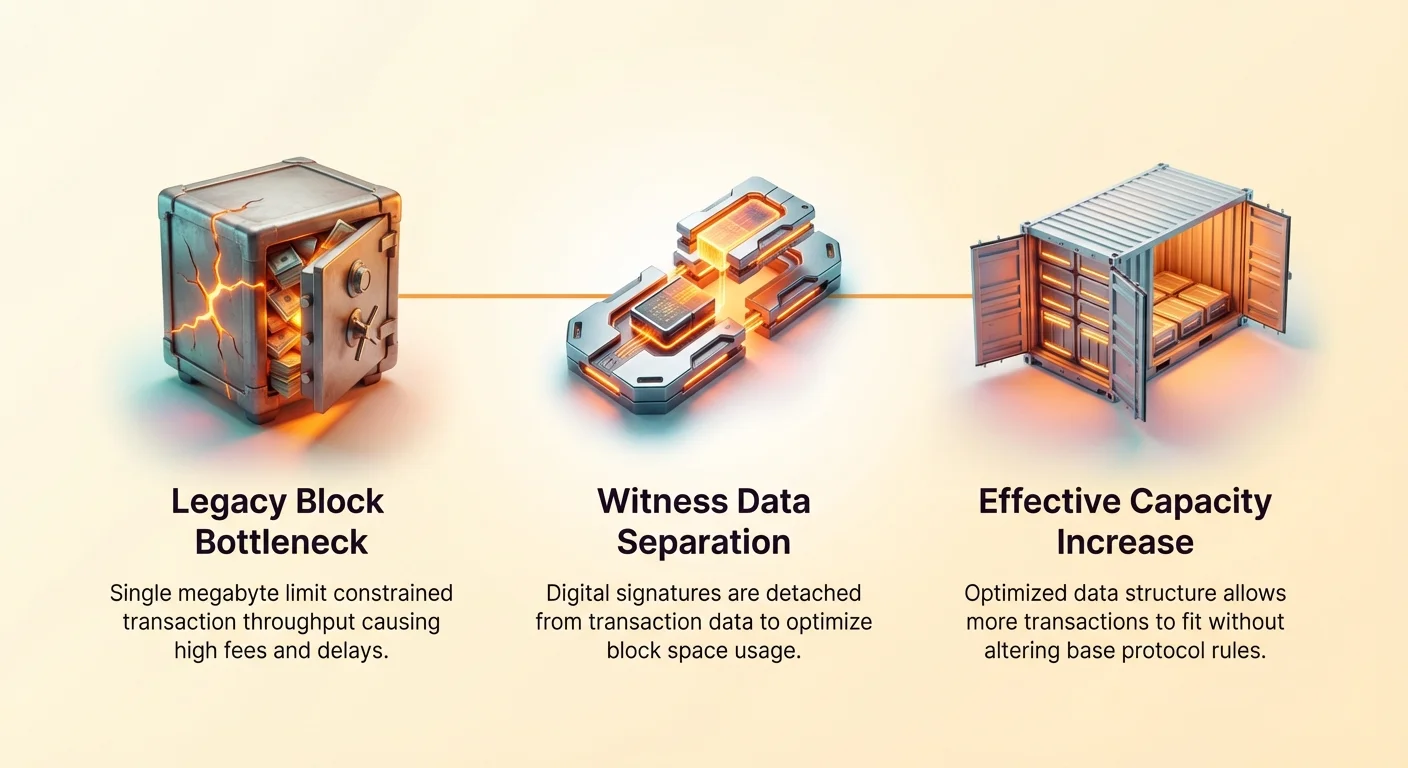
Before SegWit, the Bitcoin network faced mounting pressure from its growing user base. As adoption increased, the limitations of the original block size became a bottleneck, leading to network congestion and rising transaction costs. Developers and stakeholders sought a solution that could alleviate these pressures without compromising the decentralized nature of the blockchain. Segregated Witness emerged as a clever engineering solution that optimized how data was stored rather than simply increasing the block size limit.
The upgrade did more than just improve capacity. It fundamentally altered the mechanics of transaction processing by addressing a technical vulnerability known as transaction malleability. By fixing this issue, SegWit laid the necessary groundwork for second-layer solutions like the Lightning Network to flourish. This paved the way for instant, low-cost payments that were previously difficult to implement securely.
Understanding SegWit requires looking beyond just the technical specifications. It involves examining the governance model of Bitcoin, the economics of block space, and the community dynamics that drive protocol evolution. This upgrade demonstrated that Bitcoin could adapt and scale through soft forks, preserving backward compatibility while introducing radical improvements to efficiency and utility.
The Scalability Challenge
Bitcoin was originally designed with a limit on the size of blocks that could be added to the blockchain. This limit, set at 1 megabyte (MB), served as a protective measure against spam attacks in the network's early days. However, as Bitcoin grew from an obscure experiment into a globally recognized asset, this safety feature began to act as a constraint on growth.
The Block Size Bottleneck
Every Bitcoin transaction consists of data that must be processed and stored by miners. This data includes inputs, outputs, and digital signatures that prove ownership of the funds being spent. In the pre-SegWit era, all of this information had to compete for space within the rigid 1MB block limit. To understand this fully, explore the fundamentals of Bitcoin transaction mechanics.
As the popularity of the network surged, the demand for block space frequently exceeded the available supply. Users found themselves in a bidding war, attaching higher fees to their transactions to incentivize miners to include them in the next block. This dynamic resulted in slower confirmation times for users who paid standard fees.
During peak periods, the network became congested, making it impractical for small payments or microtransactions. The community recognized that for Bitcoin to function effectively as both a store of value and a medium of exchange, the throughput of the network needed to be increased. The debate centered on how to achieve this scaling without sacrificing security or decentralization.
The Hard Fork Dilemma
One proposed solution to the scalability problem was a hard fork. A hard fork is a radical change to the protocol that makes previously invalid blocks/transactions valid, or vice versa. In the context of scaling, this would have meant simply rewriting the code to allow for larger blocks, such as 2MB or 8MB.
However, hard forks carry significant risks. They require all nodes on the network to upgrade their software simultaneously. If a segment of the community refuses to upgrade or disagrees with the change, the blockchain can split into two separate chains. This occurred with the creation of Bitcoin Cash, which chose to increase the block size via a hard fork, fueling the history of network splits and controversies.
Bitcoin Core developers prioritized a safer approach known as a soft fork. A soft fork is a backward-compatible upgrade, meaning that nodes running older versions of the software can still participate in the network. SegWit was designed as a soft fork to ensure that the network remained unified while still delivering the necessary capacity improvements.
Consensus and Governance
The path to activating SegWit highlighted the unique nature of Bitcoin governance. Unlike centralized systems where a leader dictates changes, Bitcoin relies on consensus among a diverse group of participants. This includes miners, developers, node operators, and end-users.
The proposal for SegWit, known as Bitcoin Improvement Proposal (BIP) 141, required a very high threshold of support from miners to activate. Specifically, 95% of the mining hash power needed to signal readiness during a two-week period. This high bar ensures that upgrades have overwhelming support before they are enforced, minimizing the risk of network instability.
How SegWit Works Under the Hood
The primary innovation of Segregated Witness is hinted at in its name. "Segregated" means to separate, and "Witness" refers to the digital signatures that verify a transaction. In legacy Bitcoin transactions, the digital signature data was intertwined with the transaction data, occupying a significant portion of the valuable 1MB block space.
Separating the Witness Data
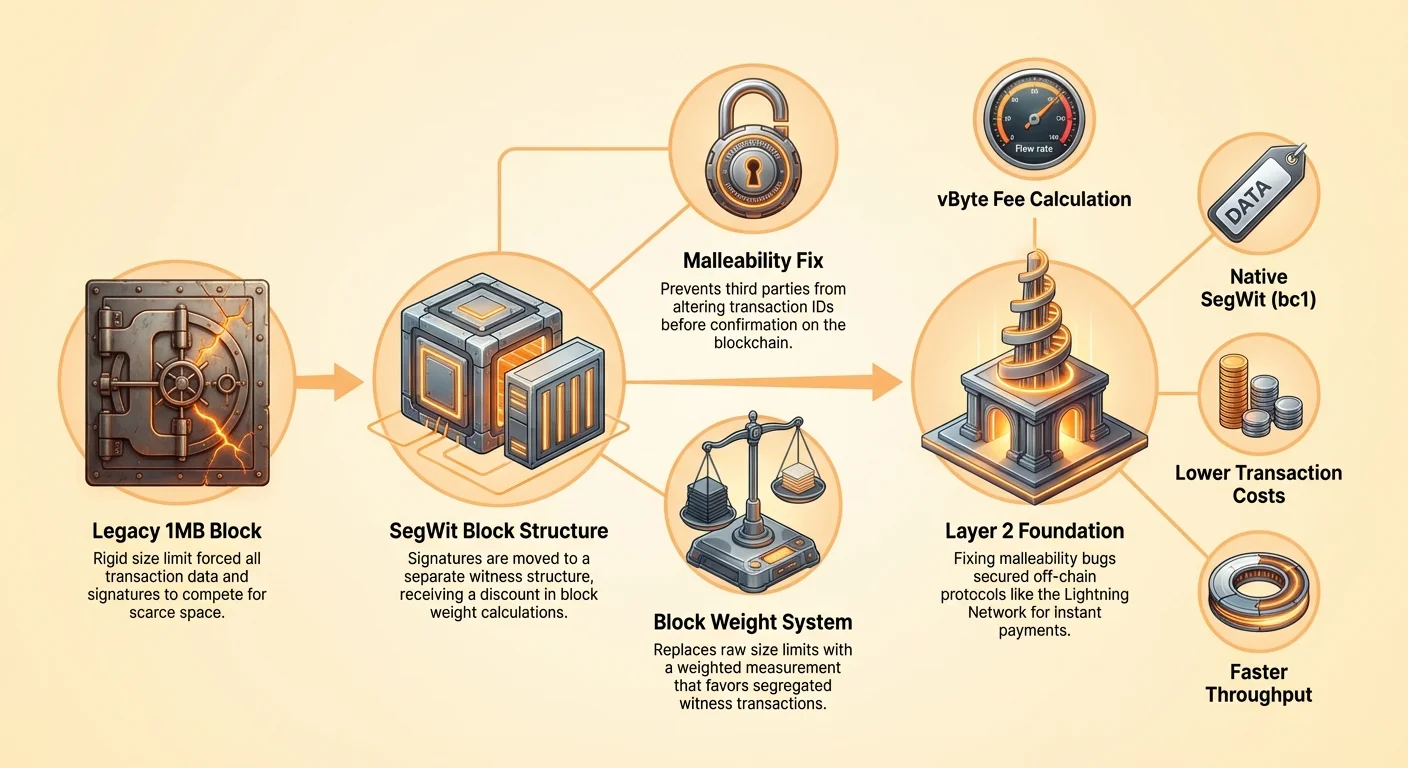
SegWit restructured the transaction format by moving the witness data (signatures) out of the main block structure. While this data is still recorded and validated, it is stored in a separate structure that runs parallel to the base transaction block. This separation was the key to unlocking more capacity without technically increasing the 1MB limit for old nodes.
To visualize this, imagine a train representing a Bitcoin block. In the legacy system, passengers (transaction details) and their luggage (signatures) were all crammed into the same train cars. The train had a strict limit on how much volume it could carry.
SegWit effectively added a specialized cargo car to the back of the train specifically for the luggage. By moving the heavy luggage out of the passenger cars, the train could suddenly carry significantly more passengers within the same main compartments. The "luggage" still travels with the train, but it no longer takes up the premium space needed for the passengers themselves.
Block Weight vs. Block Size
To implement this change, SegWit introduced a new concept called "block weight." The old measurement of block size in simple bytes was replaced by a system that assigns different "weights" to different parts of a transaction. This allowed the network to differentiate between critical transaction data and witness data.
Under this new system, the base transaction data is counted at its full size, while the witness data is discounted. Specifically, witness data weighs significantly less than transaction data in the calculation of the block limit. This change effectively increased the block size limit from 1MB to a theoretical 4MB of "weight units."
This shift incentivized users and wallet providers to adopt SegWit addresses. Transactions that utilized the new format were cheaper to send because they consumed less "weight" in a block compared to legacy transactions. This economic incentive helped drive the adoption of the upgrade across the ecosystem.
Virtual Bytes (vBytes)
With the introduction of block weight, the concept of transaction fees also evolved. Fees began to be calculated in "virtual bytes" (vBytes) rather than raw bytes. A vByte is a unit of measurement derived from the weight of the transaction.
Because witness data is discounted, a SegWit transaction has a smaller vByte size than a legacy transaction of the same raw size. This means that for the same fee rate (satoshis per byte), a SegWit transaction costs less in total fees. Understanding this difference is key to an optimal sending strategy.
This efficiency gain was immediate for users who switched to SegWit-compatible wallets. It allowed the network to process more transactions per second, effectively increasing the throughput without the dangers associated with a hard fork. The optimization proved that intelligent engineering could squeeze more performance out of the existing infrastructure.
Solving Transaction Malleability
While scaling was the headline feature of SegWit, the upgrade solved another critical technical flaw known as transaction malleability. This issue had plagued Bitcoin since its inception and acted as a major barrier to the development of advanced second-layer protocols.
Malleability refers to the ability of a third party to change the unique identifier (TXID) of a transaction before it is confirmed on the blockchain. Importantly, this change could be made without invalidating the transaction itself or changing the fundamental details like the sender, receiver, or amount.
In the legacy system, the digital signature was included in the calculation of the transaction hash (the TXID). However, cryptographic signatures can be mathematically represented in slightly different ways while remaining valid. An attacker or a relay node could modify the signature data slightly, which would result in a completely different TXID.
If the TXID changed, the sender might believe the transaction failed, while the receiver (or attacker) confirmed the modified version. This created confusion and made it dangerous to chain unconfirmed transactions together. If the first transaction in a chain had its ID changed, any subsequent transaction referencing that ID would become invalid.
SegWit fixed this by removing the signature data from the part of the transaction used to generate the TXID. Since the "witness" was segregated, any changes to the signature data would no longer affect the transaction ID. This rendered the transaction ID immutable from the moment it was created.
Enabling the Lightning Network
The fix for transaction malleability was the catalyst for the Lightning Network. The Lightning Network is a layer-2 scaling solution that relies heavily on the ability to create chains of unconfirmed transactions securely.
The Foundation for Layer 2
For payment channels to work, two parties effectively open a joint account on the blockchain and then trade signed transactions back and forth off-chain. These off-chain transactions update the balance of the channel without hitting the main blockchain.
However, these off-chain transactions depend on the initial "funding transaction" being anchored securely. If transaction malleability were still possible, a bad actor could potentially alter the ID of the funding transaction. This would invalidate all the subsequent off-chain logic that the parties had agreed upon.
By securing the transaction ID, SegWit provided the rock-solid foundation needed for these smart contracts. It allowed Lightning nodes to trust that the transactions they were signing off-chain would remain valid when eventually settled on the main Bitcoin network.
Instant Settlements
With the malleability risk removed, the Lightning Network could deploy safely. This enabled near-instant settlement of payments between users anywhere in the world. While SegWit provided a modest on-chain capacity increase, enabling Lightning offered the potential for virtually unlimited off-chain scaling.
Users could now transact millions of times without burdening the main blockchain, only settling the final result. This combination of on-chain efficiency (via SegWit) and off-chain scaling (via Lightning) represents Bitcoin's primary strategy for handling global transaction volume.
The Activation Saga: BIP 141 and UASF
The deployment of SegWit was not merely a technical update; it was a historic event in decentralized governance. The process revealed the complex power dynamics between miners, developers, and users within the Bitcoin ecosystem.
The Proposal (BIP 141)
The SegWit upgrade was formally proposed as Bitcoin Improvement Proposal 141. To activate smoothly, the developers set a threshold requiring 95% of blocks to signal support for the upgrade within a two-week difficulty epoch. This was intended to ensure that the network would not split.
However, achieving this consensus proved difficult. Various political and economic interests among major mining pools led to a stalemate. Some miners preferred a hard fork to increase block size directly, while others were hesitant to upgrade their infrastructure.
For months, the activation signaling hovered well below the required threshold. It appeared that the upgrade might stall indefinitely, highlighting a potential flaw in the reliance on miner signaling for protocol upgrades.
User Activated Soft Fork (BIP 148)
Frustrated by the lack of progress, a grassroots movement emerged within the community. This initiative was known as the User Activated Soft Fork (UASF), or BIP 148. The concept was revolutionary: instead of waiting for miners to vote, the economic majority of nodes (users, exchanges, and businesses) would enforce the upgrade themselves.
Participants in the UASF ran a version of the Bitcoin software that rejected any blocks that did not signal support for SegWit after a certain date. This effectively drew a line in the sand. If miners continued to ignore SegWit, their blocks would be rejected by a significant portion of the network, causing them to lose revenue.
The threat of a User Activated Soft Fork shifted the balance of power. It demonstrated that while miners process transactions, the users define the rules of the protocol. Faced with the economic pressure of the UASF, miners capitulated, and SegWit was locked in and activated in August 2017.
Address Types and Compatibility
Following the activation of SegWit, the Bitcoin ecosystem saw the emergence of different address formats. Understanding these formats is essential for users who want to take advantage of the lower fees and efficiency benefits that SegWit offers.
Legacy Addresses
The original Bitcoin address format is known as Legacy. These addresses typically start with the number 1. Transactions sent from Legacy addresses are larger in size because they do not utilize the witness data separation. Consequently, they are the most expensive to use in terms of transaction fees.
Nested SegWit (P2SH)
To ensure smooth adoption, developers introduced a compatibility layer known as Pay to Script Hash (P2SH). These addresses start with the number 3. They allowed users to send SegWit transactions even if the sender's wallet did not fully support the new native format.
Nested SegWit provided a middle ground. It offered significant fee savings compared to Legacy addresses, though not as much as the fully native implementation. For a long time, this was the standard for many exchanges and wallet providers as they updated their systems.
Native SegWit (Bech32)
The most efficient format is Native SegWit, also known as Bech32. These addresses start with bc1. Native SegWit addresses are distinct because they are case-insensitive, reducing the risk of typing errors. For a deeper understanding of the different types, review the Anatomy of a Bitcoin Address.
More importantly, Native SegWit transactions are smaller in virtual bytes than their Nested counterparts. This results in the lowest possible transaction fees for users. As the ecosystem has matured, Native SegWit has become the default standard for most modern wallets and services.
| Address Type | Prefix | Fee Efficiency | Compatibility |
|---|---|---|---|
| Legacy | 1... | Low | Universal |
| Nested SegWit | 3... | Medium | High |
| Native SegWit | bc1... | High | Modern Wallets |
Beyond SegWit: Taproot and Ordinals
The successful implementation of SegWit proved that Bitcoin could undergo complex upgrades without disrupting its core value proposition. This success paved the way for subsequent innovations that have further expanded the capabilities of the network.
Taproot and Schnorr Signatures
In November 2021, Bitcoin activated the Taproot upgrade. Taproot built directly upon the foundation laid by SegWit. It introduced Schnorr signatures, which allowed for even greater efficiency and privacy.
Like SegWit, Taproot altered how data is stored on the blockchain. It enabled signature aggregation, where multiple signatures in a complex transaction could be combined into a single signature. This made complex smart contracts indistinguishable from regular transactions, enhancing privacy while saving block space.
Without the structural changes introduced by SegWit, specifically the script versioning system, upgrades like Taproot would have been significantly harder to deploy. SegWit established a clear pathway for future extensibility.
The Rise of Ordinals
More recently, the introduction of Bitcoin Ordinals has leveraged the SegWit infrastructure in unexpected ways. Ordinals allow users to inscribe arbitrary data—such as images, text, or code—directly onto individual satoshis.
This is possible because SegWit discounted the "weight" of witness data. Inscribers realized they could store large amounts of data in the witness field of a transaction for a fraction of the cost of storing it in the main block area. While controversial to some who view it as spam, Ordinals demonstrated the flexibility of the witness data space.
This unexpected use case highlights the robust nature of the SegWit design. By creating a separate, discounted lane for data, the upgrade inadvertently created a canvas for digital artifacts, further diversifying the utility of the Bitcoin blockchain.
Conclusion
Segregated Witness stands as a testament to the resilience and adaptability of the Bitcoin network. Facing a critical bottleneck that threatened to stifle growth, the community united behind a solution that was elegant, backward-compatible, and forward-thinking. By reimagining how transaction data is structured, SegWit delivered immediate relief from high fees while preserving the decentralization that gives Bitcoin its value.
The legacy of SegWit extends far beyond simple block weight calculations. It resolved the persistent vulnerability of transaction malleability, unlocking the potential for layer-2 scaling solutions like the Lightning Network. Furthermore, it established a precedent for user-driven governance, proving that the economic majority can effectively check the power of mining entities.
As Bitcoin continues to evolve, the structures built by SegWit remain central to its operation. From the efficiency of Native SegWit addresses to the advanced capabilities of Taproot and Ordinals, the upgrade redefined what is possible on the blockchain. It ensured that Bitcoin could scale to meet global demand without compromising the principles upon which it was founded.
SegWit revolutionized Bitcoin by separating signatures from transaction data, effectively increasing block capacity and fixing critical bugs to enable future scaling.