
Sending cryptocurrency appears instantaneous to the user. You open an app, scan a QR code, and press send. Within moments, the digital assets seem to move from one device to another. However, the reality of what occurs behind the scenes is a complex orchestration of cryptography, network propagation, and decentralized consensus. The assets do not actually move between phones or computers. Instead, a global ledger is updated through a rigorous validation process.
Understanding the lifecycle of a transaction reveals the true nature of blockchain technology. It shifts the perspective from sending a file, like an email, to verifying a claim of ownership on a public registry. Every step, from the initial digital signature to the final confirmation block, ensures that the system remains secure and trustless. This process eliminates the need for central banks or clearinghouses.
To navigate this ecosystem effectively, one must understand the mechanics of wallets, the calculation of fees, and the role of miners or validators. Whether you are interacting with a centralized exchange or a decentralized protocol, the fundamental principles of value transfer remain consistent. This guide traces the journey of a digital asset from the moment a user initiates a transfer to the point it becomes an immutable part of the blockchain history.
The Foundation of Ownership: Wallets and Keys
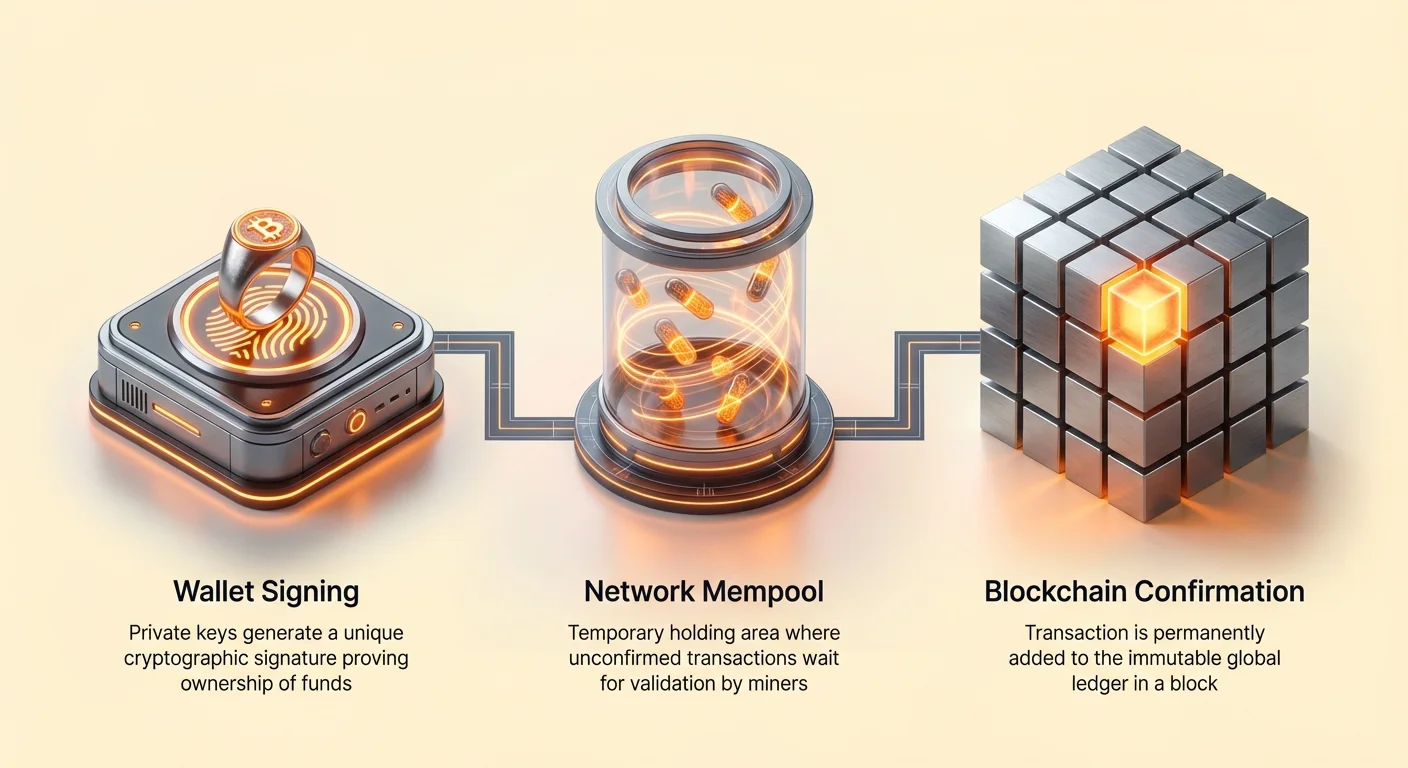
A common misconception is that cryptocurrency wallets store digital coins. In reality, these applications store the private keys required to sign transactions. The coins themselves live on the blockchain network as unspent outputs or account balances. The wallet acts as a keychain and an interface, allowing users to interact with the blockchain without needing to write raw code.
When you create a standard self-custodial wallet, the software generates a random private key. This key is the mathematical proof of ownership for any funds associated with it. From this private key, a public key is derived, which is then hashed to create your public address. This address is what you share with others to receive funds, similar to an email address or bank account number.
The security of the entire transaction lifecycle rests on the private key. If a user loses access to this key, the funds on the blockchain remain permanently inaccessible. Conversely, if a malicious actor gains access to the key, they can sign transactions and drain the funds. This relationship between the key and the ledger is why the phrase "not your keys, not your coins" is prevalent in the industry.
Custodial Versus Non-Custodial Initiation
The lifecycle of a transaction begins differently depending on who holds the keys. in a self-custodial (or non-custodial) model, the user initiates the transaction directly on the blockchain. The wallet app constructs the data packet, signs it with the user's private key, and broadcasts it to the network. The user has full control over the process, including the fee settings and the destination.
In a custodial environment, such as a centralized exchange (CEX), the process is different. When a user clicks "send" on an exchange interface, they are asking the exchange to initiate a transaction on their behalf. The exchange holds the private keys for a large pool of funds. They may batch multiple user withdrawal requests into a single transaction to save on network fees.
This distinction impacts the speed and transparency of the initiation. A self-custodial transaction enters the network memory pool immediately. A custodial transaction relies on the exchange's internal systems to process the request first. Users relying on custodial services must trust that the platform remains solvent and operational, as they do not possess the cryptographic proof of ownership required to move the funds independently.
Constructing the Transaction Packet
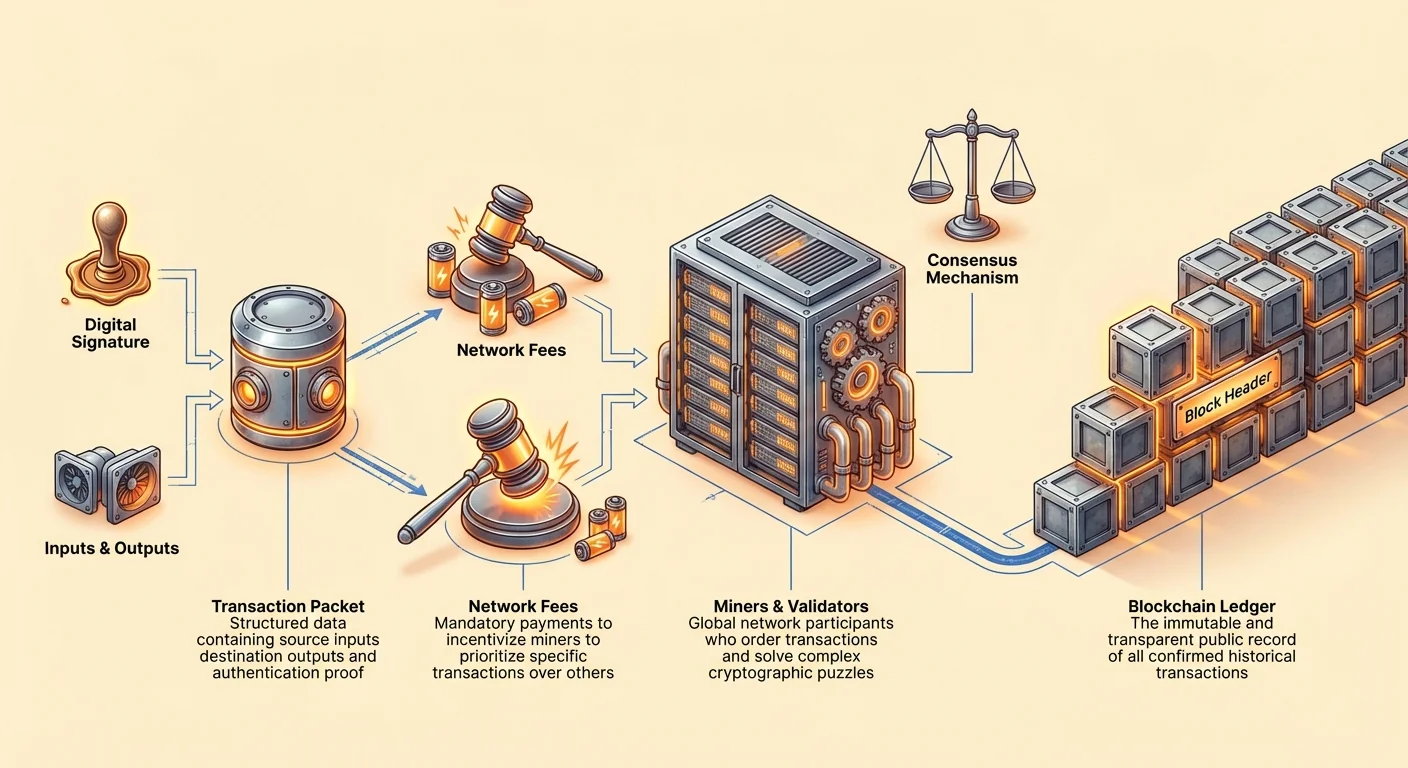
Before a transaction is broadcast, the wallet software must construct a specific data packet. This packet contains three primary components: the input, the output, and the digital signature. The input refers to the specific source of the funds being spent. In blockchain models like Bitcoin, this involves selecting Unspent Transaction Outputs (UTXOs) from previous transactions that the user received.
The output specifies the destination address and the amount to be sent. A single transaction can have multiple outputs. For instance, if a user wants to send 1 BTC but their smallest available UTXO is worth 5 BTC, the transaction will create two outputs. One output sends 1 BTC to the recipient, and the second output sends 4 BTC back to the user as "change."
This process occurs automatically in the background. The user simply enters a destination address and an amount. The wallet software calculates which inputs to consume to cover the total amount plus the network fee. It then applies the digital signature, which proves that the creator of the transaction owns the private keys associated with the chosen inputs.
The Concept of Digital Inputs
Understanding inputs helps explain why some transactions cost more than others. Imagine Alice wants to send 1 BTC to Carol. If Alice received that 1 BTC in a single transaction previously, her current transaction has one input. This is a simple, small data packet.
Now imagine Bob also wants to send 1 BTC to Carol. However, Bob received his funds in one hundred separate transactions of 0.01 BTC each. To send 1 BTC, Bob's wallet must bundle all one hundred inputs together. This data packet is significantly larger than Alice's, even though the value being sent is identical.
Because blockchain space is limited, transactions are priced based on the data size, measured in bytes or weight units. Therefore, Bob will pay a much higher network fee than Alice. The complexity of the transaction's history directly influences the cost of moving the funds.
Network Fees and The Auction for Block Space
Network fees are mandatory payments included in a transaction to incentivize miners or validators to process the data. These fees are not paid to the wallet provider or the recipient. They go directly to the infrastructure providers who secure the network. The fee structure varies depending on the blockchain architecture.
In the Bitcoin network, fees are calculated in satoshis per byte. A satoshi is the smallest unit of Bitcoin. Users can customize this fee based on urgency. A higher fee places the transaction at the front of the line, making it more attractive to miners who optimize for profitability.
On the Ethereum network and similar chains, fees are known as "gas." Gas is the unit that measures the amount of computational effort required to execute an operation. Simple transfers require less gas, while complex smart contract interactions require more. The price of gas fluctuates based on network demand and is typically denominated in "gwei."
Setting the Correct Fee
Most modern wallets provide fee estimation tools. They analyze the current network traffic and suggest fee rates, usually categorized as "Eco," "Fast," or "Fastest." Choosing the "Eco" or slow option means the transaction attaches a smaller reward for the miner.
If the network is congested, a low-fee transaction might sit in the waiting area for hours or even days. It is not lost; it is simply ignored by miners in favor of transactions with higher fees. In contrast, setting the fee to "Fastest" ensures the transaction is picked up in the next available block.
The fee market is essentially an auction. Space in a block is finite. When many users want to transact simultaneously, they bid against each other by raising their fees. This dynamic explains why transaction costs can spike during periods of high market volatility or popular token launches.
The Waiting Room: The Mempool
Once a transaction is signed and broadcast, it does not immediately appear on the blockchain. It first enters the Mempool, short for Memory Pool. This is a holding area for unconfirmed transactions. Every node on the network maintains its own version of the mempool.
When a user broadcasts a transaction, it propagates across the network via a gossip protocol. One node receives the data, validates that the signature is correct and the funds have not been double-spent, and then passes it to its neighbors. Within seconds, the transaction spreads to nodes globally.
While in the mempool, the transaction is in a state of limbo. It is visible to anyone watching the network, but it is not yet final. Wallets often display these funds as "pending" or "unconfirmed." The recipient can see that the money is on its way, but they cannot yet spend it.
Replacing Stuck Transactions
Occasionally, a user might set a fee that is too low for the current market conditions. The transaction gets stuck in the mempool as miners skip over it. To resolve this, protocols often support a feature called Replace-by-Fee (RBF).
RBF allows the sender to broadcast the same transaction again, but with a higher fee. Nodes recognize that the new transaction spends the same inputs as the stuck one but offers a better reward. They replace the old transaction in their mempool with the new, higher-fee version. This effectively "boosts" the transaction, making it attractive to miners once again.
Validation and Mining
The transition from the mempool to the blockchain requires the work of miners (in Proof of Work systems) or validators (in Proof of Stake systems). These participants act as the accountants of the network. Their job is to group pending transactions into a block and add that block to the permanent chain.
Miners select transactions from their mempool to fill the block. Since they are economically motivated, they prioritize transactions with the highest fee-to-data ratio. Once the block is full to its capacity limit, the miner begins the work of solving the cryptographic puzzle required to validly publish the block.
This process involves hashing the block header repeatedly until a specific value is found. This requires significant computational power and energy. The difficulty of this puzzle ensures that blocks are produced at a consistent interval, such as every ten minutes for Bitcoin.
The Consensus Mechanism
In Proof of Stake networks, the process avoids energy-intensive mining. Instead, a validator is chosen deterministically based on the amount of cryptocurrency they have "staked" or locked into the system. The selected validator proposes a block of transactions from the mempool.
Other validators then attest to the validity of that block. If the block contains invalid transactions—such as someone trying to spend money they do not have—the network rejects it. The validator who proposed the bad block may be penalized by losing a portion of their staked funds. This economic penalty ensures honest behavior.
Blockchain Confirmation and Immutability
When a miner or validator successfully adds a block to the chain, the transactions inside that block receive their first confirmation. At this point, the transaction is officially on the ledger. The recipient's wallet balance updates from "pending" to "available."
However, a single confirmation is not always considered final security for large amounts. In rare cases, two blocks might be found simultaneously, causing a temporary fork in the chain. The network eventually resolves this by following the longest or heaviest chain, which might orphan the other block.
To protect against this risk, merchants and exchanges often require multiple confirmations. For Bitcoin, six confirmations (roughly one hour) are the standard for absolute certainty. This means five more blocks have been built on top of the block containing the transaction. Each additional block makes it exponentially harder to reverse the transaction finality.
| Confirmation Count | Security Level | Typical Use Case |
|---|---|---|
| 0 Confirmations | Unsafe | Instant small payments (coffee) |
| 1 Confirmation | Moderate | Small to medium transfers |
| 3-6 Confirmations | High | Large purchases, Exchange deposits |
The Role of Block Explorers
Throughout this lifecycle, users can track the status of their transaction using a block explorer. This is a search engine for the blockchain. By entering the transaction ID (TXID) or the public address, anyone can view the details of the transfer.
Block explorers provide transparency. They show the size of the transaction, the fee paid, the number of confirmations, and the specific block number. If a user claims they sent funds but the recipient has not received them, the block explorer serves as the source of truth. If the transaction is not on the explorer, it likely was never broadcast or was rejected by the network.
Privacy-conscious users should be aware that because the ledger is public, linking an identity to an address reveals that person's entire financial history associated with that address. This is why many wallets generate a fresh address for every new transaction received, complicating the ability for outside observers to build a complete profile of a user's wealth.
Alternative Pathways: Centralized Exchange Transactions
The lifecycle described above applies to on-chain transactions. However, millions of trades happen daily on centralized exchanges (CEXs) without ever touching the blockchain. When you trade Bitcoin for Ethereum on a CEX, the exchange does not broadcast a transaction to the Bitcoin network or the Ethereum network.
Instead, the exchange updates its internal database. It subtracts Bitcoin from your account balance and adds Ethereum. This happens instantly and costs no network fees, only the exchange's trading fee. The assets remain in the exchange's cold or hot wallets the entire time.
On-chain activity only occurs when a user deposits funds into the exchange or withdraws them to a self-custodial wallet. This efficiency is why CEXs offer high liquidity and fast execution speeds. They act as a layer on top of the blockchain, batching settlement to save costs and reduce network congestion.
Order Books and Matching Engines
On a CEX, the transaction lifecycle is driven by an order book. Makers place limit orders, stating the price at which they are willing to buy or sell. These orders sit in the book, providing liquidity to the market. Takers place market orders, accepting the current available price.
The exchange's matching engine pairs these buyers and sellers. This matching process is centralized and occurs on private servers. It is much faster than block times but requires the user to trust the exchange operator. The transparency of a block explorer is replaced by the internal trade history provided by the exchange.
Decentralized Exchanges (DEXs) and Smart Contracts
Decentralized Exchanges (DEXs) offer a hybrid lifecycle. Like a wallet transfer, every action on a DEX is an on-chain transaction. However, instead of sending funds to another person, the user sends funds to a smart contract.
A smart contract is a self-executing program stored on the blockchain. When a user initiates a swap on a DEX, they are triggering a specific function within this contract. The contract verifies that the user sent the correct amount of Token A, calculates the exchange rate based on the liquidity pool reserves, and automatically sends the correct amount of Token B back to the user.
This process is "atomic," meaning it either happens entirely or not at all. There is no risk of sending funds and not receiving the swap, as the code controls the execution. However, because every step requires computational resources from the network, DEX swaps incur gas fees.
Liquidity Pools vs Order Books
Most DEXs utilize Automated Market Makers (AMMs) rather than traditional order books. In this model, users trade against a pool of assets provided by other users (liquidity providers). The price is determined mathematically based on the ratio of assets in the pool.
When a transaction interacts with a liquidity pool, it changes the ratio of assets, which slightly adjusts the price for the next user. This is known as slippage. Large transactions on pools with low liquidity can suffer from significant slippage. The lifecycle of a DEX transaction involves not just validation of the transfer, but the execution of this complex logic on-chain.
Layer 2 Solutions and Scaling
To address the constraints of fees and speed on main networks like Bitcoin and Ethereum, Layer 2 (L2) solutions have emerged. These protocols create an alternative lifecycle for transactions. They operate on top of the main blockchain, handling the heavy lifting of processing trades.
The Bitcoin Lightning Network is a prime example. Users open a payment channel by creating a single on-chain transaction. Once the channel is open, they can send unlimited transactions back and forth instantly with near-zero fees. These transactions are not broadcast to the main blockchain individually.
Instead, the channel updates the balance locally between the parties. Only when the users decide to close the channel is the final balance broadcast to the Bitcoin network. This condenses thousands of potential transactions into just two on-chain events: opening and closing. This provides the speed of a centralized database with the security of the blockchain settlement.
Privacy and Transaction Transparency
While the mechanics of a transaction are mathematical, the implications are social and financial. The public nature of most blockchains means that once a transaction is confirmed, it is visible to the world. This transparency is a feature, ensuring the supply of the currency is verifiable and no counterfeiting occurs.
However, this also means that wallet addresses can be tracked. If a user posts their address on social media for a donation, anyone can see how much money they receive and where they send it next. This has led to the development of privacy-focused practices.
Using a new address for every transaction is a standard recommendation for preserving privacy. Additionally, some users utilize privacy-specific wallets or protocols that obfuscate the link between the sender and the recipient. Understanding that the transaction lifecycle leaves a permanent digital footprint is crucial for user safety.
Security Best Practices During the Transaction
The irreversible nature of crypto transactions demands high vigilance. Unlike a credit card charge or a bank transfer, a confirmed blockchain transaction cannot be rolled back by calling customer support. If funds are sent to the wrong address or the wrong network, they are often lost forever.
Verifying the destination address is the most critical step in the user's portion of the lifecycle. Malware exists that can swap addresses in a computer's clipboard. Users are advised to check the first and last few characters of an address before signing the transaction.
Furthermore, users interacting with smart contracts on DEXs must be wary of unlimited approval requests. When enabling a DEX to spend a token, the user signs a transaction granting permission. If the contract is malicious or exploited, the attacker could drain the wallet of that specific token. Revoking these allowances is a necessary maintenance step for active users.
Conclusion
The journey of a crypto transaction is a testament to the power of decentralized technology. It begins with a private key, the sole guardian of digital assets, generating a cryptographic signature. From there, the data traverses a global network of nodes, competing for space in a block through a dynamic fee market. Whether settled instantly on a Layer 2 network, swapped via a smart contract, or mined into a Bitcoin block, the result is the same: a trustless, immutable update to a shared ledger.
Understanding this lifecycle empowers users to make better decisions. It clarifies why fees fluctuate, why confirmations take time, and why self-custody differs fundamentally from using an exchange. As the ecosystem evolves with new scaling solutions and complex applications, the core principle remains—value transfer relies on cryptographic proof, not institutional permission.
Every transaction is a permanent, unforgeable entry in history that you alone control.