
As the digital asset landscape matures in 2025, the criteria for selecting a cryptocurrency trading venue have shifted from simple availability to specific user intent. Investors and traders are no longer looking for a one-size-fits-all solution. Instead, they require platforms tailored to their specific goals, whether that involves learning the ropes, minimizing overhead costs, or executing high-volume strategies.
The market has evolved into a diverse ecosystem of centralized, decentralized, and hybrid platforms. Each offers distinct advantages regarding security, liquidity, and asset variety. For the modern investor, understanding the nuance between a custodial broker and a peer-to-peer network is as important as analyzing price charts.
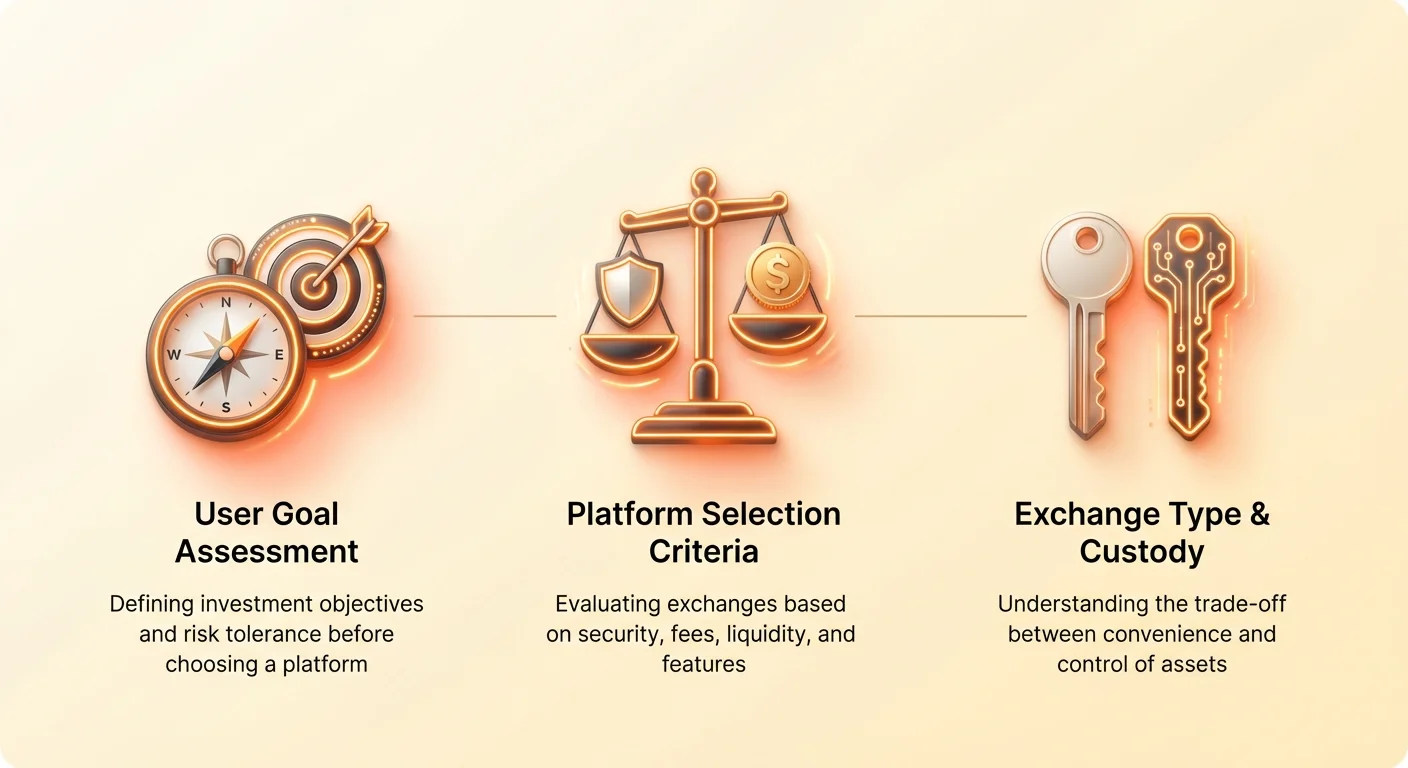
Choosing the right environment requires a clear assessment of your technical comfort level and financial objectives. A platform optimized for a first-time buyer may be prohibitively expensive for a day trader. Conversely, an exchange with professional charting tools and low fees might present a steep learning curve that alienates a newcomer.
This guide breaks down the top platforms for 2025 based on specific user profiles. It also explores the underlying mechanics of how these exchanges operate, ensuring you can navigate the market with confidence and security.
Platforms for the Novice Investor
For those entering the cryptocurrency market for the first time, the priority is often simplicity and safety rather than advanced charting or leverage. The best platforms for beginners strip away the complexity of blockchain technology. They present a clean interface that resembles traditional banking apps.
User Experience and Education
Coinbase remains a primary recommendation for beginners due to its intuitive design. Since its inception in 2012, it has focused on lowering the barrier to entry. The platform allows users to buy, sell, and manage assets without needing to understand the intricacies of private keys or gas fees immediately.
A standout feature for newcomers is the integration of educational resources directly into the trading experience. Users can access modules that explain blockchain fundamentals and specific token utility. Completing these short lessons often rewards the user with small amounts of cryptocurrency. This "learn and earn" model incentivizes education and helps build a diversified portfolio with zero initial risk.
Regulatory Trust and Security
Security is often the biggest concern for new entrants. Platforms that are publicly traded and operate under strict regulatory guidelines offer a layer of trust that unregulated entities cannot match. When an exchange creates a compliant environment, it ensures that user funds are segregated and protected.
Features such as two-factor authentication (2FA) and cold storage for the majority of assets are standard expectations for beginner-focused platforms. Cold storage involves keeping digital assets offline, away from potential internet-based threats. This approach significantly reduces the risk of hacks and unauthorized access.
Optimizing for Low Fees and Cost Efficiency
Active traders view trading fees as a primary overhead cost that must be managed to maintain profitability. Over time, high transaction costs can eat into gains, especially for those executing multiple trades per day. Platforms that specialize in low fees often utilize a volume-based tiered structure.
Understanding the Maker-Taker Model
To truly optimize for cost, traders must understand how exchanges generate revenue through the maker-taker model. This system differentiates between two types of market participants. Makers are traders who place orders that are not immediately filled. They add liquidity to the order book.
Takers are traders who agree to the current market price and fill existing orders. They remove liquidity from the book. Exchanges often incentivize makers by offering lower fees, sometimes as low as 0.01 percent or even offering rebates. Takers generally pay a slightly higher rate because they are consuming liquidity.
Platforms Prioritizing Value
Exchanges like BTCC have established themselves by focusing on competitive fee structures. Established in 2011, this platform appeals to cost-conscious users by keeping entry and exit costs minimal. Lower fees allow traders to execute strategies like scalping, where small price movements are captured for profit, without the fee erasing the margin.
Transparent fee schedules are essential. Users should look for platforms that clearly outline their deposit, withdrawal, and trading costs. Some exchanges may advertise zero trading fees but compensate for this by widening the spread. The spread is the difference between the buying and selling price. A wide spread acts as a hidden fee that can be more costly than a standard percentage commission.
| Fee Type | Description | Impact on Trader |
|---|---|---|
| Maker Fee | Charged for adding liquidity | Usually lower; benefits patient traders |
| Taker Fee | Charged for removing liquidity | Higher; cost of instant execution |
| Spread | Gap between buy/sell price | Hidden cost in "zero fee" models |
High Volume and Altcoin Diversity
For investors looking to diversify beyond Bitcoin and Ethereum, the range of available assets becomes the deciding factor. High-volume exchanges are often the first to list new projects, providing early access to emerging tokens.
Accessing the Altcoin Market
Bitget has positioned itself as a leader for altcoin enthusiasts. With support for over 550 cryptocurrencies, it provides a vast playground for traders looking to explore decentralized finance (DeFi) tokens, gaming assets, and infrastructure projects. High liquidity across these pairs ensures that traders can enter and exit positions without causing significant price slippage.
Slippage occurs when a large order moves the market price before the transaction is fully complete. On platforms with low volume, buying a less popular altcoin can be difficult without paying a premium. High-volume exchanges mitigate this risk by aggregating enough buyers and sellers to stabilize prices even during volatility.
Advanced Trading Tools
Experienced traders often require more than just a "buy" button. They need tools that allow them to hedge risk and amplify potential returns. Futures trading and margin accounts allow users to speculate on the future price of an asset without needing to hold the full value of the position.
Copy trading is another feature that has gained traction on platforms serving this demographic. This functionality allows users to automatically mirror the trades of successful, vetted investors. It serves as a bridge for intermediate traders who understand the market mechanics but may lack the time to perform daily technical analysis.
Multi-Asset and Hybrid Ecosystems
Some investors view cryptocurrency as just one component of a broader investment strategy. For these users, platforms that integrate digital assets with traditional financial instruments offer a distinct advantage.
The All-in-One Approach
PrimeXBT exemplifies this hybrid model. It allows users to trade cryptocurrencies alongside traditional markets such as forex, commodities, and indices. This "all-in-one" approach enables sophisticated portfolio management from a single dashboard. A trader can hedge a Bitcoin position against gold or foreign currency fluctuations without switching between different brokerage accounts.
This versatility is particularly useful during periods of crypto market stagnation. If the digital asset market is trading sideways, a multi-asset trader can pivot to commodities or forex volatility to find opportunities.
Bridging Finance with Uphold
Uphold takes a slightly different approach to the multi-asset concept. It offers a unique "Trade Anything to Anything" feature. This allows users to swap directly between disparate asset classes. For example, a user can trade Bitcoin directly for Gold, or XRP for a fiat currency, in a single step.
This eliminates the need to convert to a base currency like USD or USDT in between trades. By removing the intermediate step, the platform reduces conversion fees and streamlines the user experience. This type of flexibility is ideal for users who view their portfolio holistically rather than as separate buckets of assets.
Understanding Exchange Mechanics
To make an informed decision, it is necessary to understand what happens under the hood of a crypto exchange. At its core, an exchange is a matching engine. It connects buyers and sellers.
The Role of Liquidity
Liquidity is the lifeblood of any exchange. It refers to the ease with which an asset can be converted into cash or another asset without affecting its price. Cash is considered the most liquid asset. A rare collectible car is illiquid because finding a buyer takes time.
In the context of crypto, Bitcoin is generally the most liquid asset. However, liquidity varies wildly between exchanges. A top-tier exchange will have deep order books, meaning there are many buy and sell orders at various price points. This depth ensures that even large trades can be executed swiftly.
Order Books and Matching
Centralized exchanges maintain an order book. This is a real-time list of all outstanding buy and sell orders for a specific trading pair. When you place a "market order," the exchange's engine looks at the order book and matches you with the best available price immediately.
Alternatively, a "limit order" allows you to set a specific price at which you are willing to buy or sell. This order sits in the book until the market price reaches your specified level. Limit orders are crucial for strategic entry and exit points, allowing traders to plan their moves rather than reacting emotionally to market swings.
Decentralized vs. Centralized Architectures
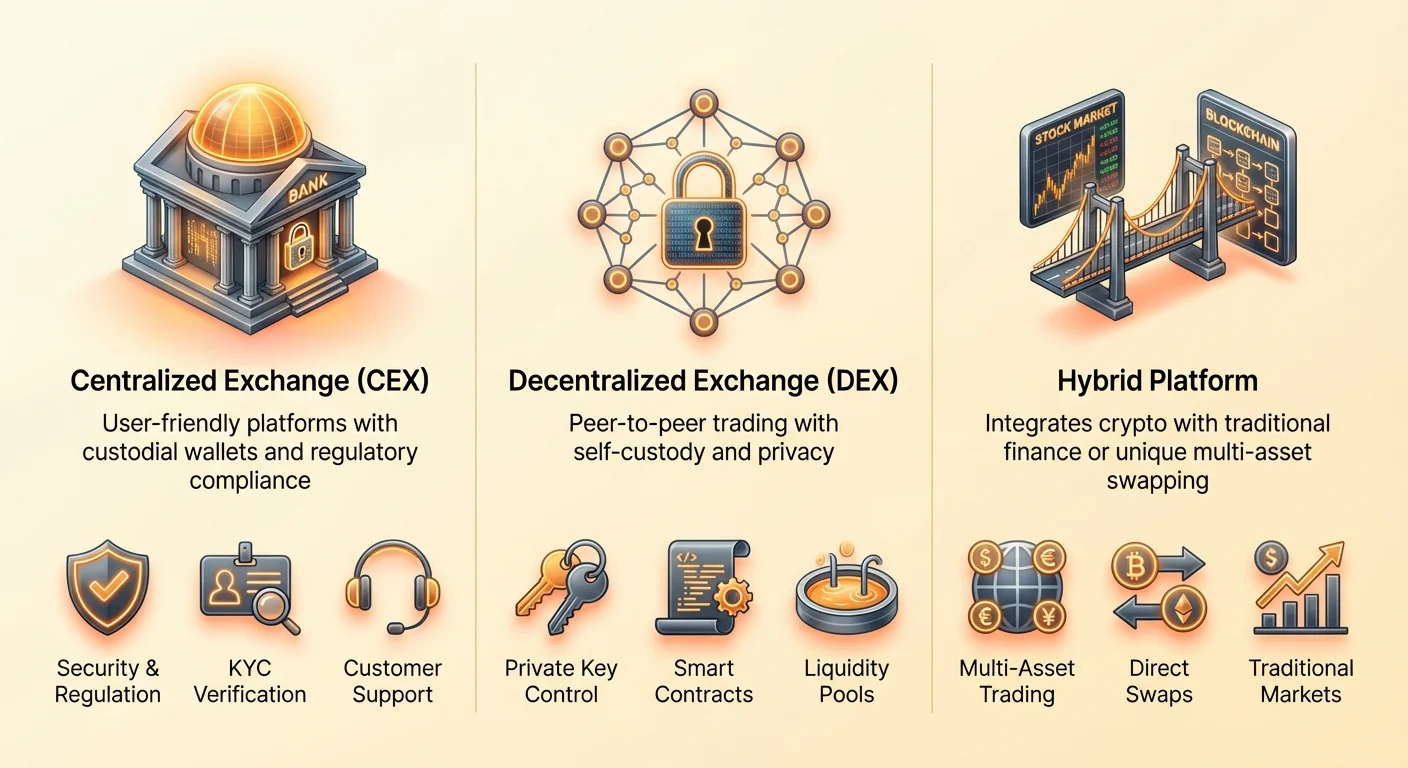
While centralized exchanges (CEXs) like Coinbase and Binance dominate in terms of user numbers, decentralized exchanges (DEXs) offer a different value proposition. Understanding the difference is vital for security and control.
The Centralized Model (CEX)
A CEX operates as a trusted middleman. The company controls the platform, manages the security, and holds custody of the user's funds. This model offers high speed, customer support, and features like password recovery. However, it introduces a single point of failure. If the exchange is hacked or mismanaged, user funds can be at risk.
CEXs are also subject to government regulations. They require Know Your Customer (KYC) verification, meaning users must upload ID documents. This removes anonymity but provides a legal framework for resolving disputes.
The Decentralized Model (DEX)
A DEX operates without a central authority. It is a peer-to-peer marketplace governed by code (smart contracts). Users trade directly with one another or against liquidity pools. The primary advantage is self-custody. Users retain full control of their private keys and funds at all times.
DEXs do not require account creation or identity verification. You simply connect your digital wallet and start trading. This preserves privacy and ensures open access for anyone with an internet connection. However, DEXs can be more complex to navigate and lack the customer support found on centralized platforms.
Peer-to-Peer (P2P) Platforms
P2P exchanges take decentralization a step further by allowing users to negotiate terms directly. Buyers and sellers post ads stating their price and preferred payment method. The platform acts only as an escrow service to ensure the crypto is released only when payment is confirmed.
This method is popular in regions with limited banking infrastructure or strict banking restrictions. It supports a wide variety of payment methods, from bank transfers to cash in person. However, it carries a higher risk of scams, requiring users to vet their trading partners carefully based on reputation scores.
Payment Integration and Debit Cards
The utility of cryptocurrency is expanding beyond trading and holding. Crypto debit cards are bridging the gap between digital assets and traditional commerce, allowing users to spend their holdings anywhere credit cards are accepted.
How Crypto Cards Work
These cards function similarly to prepaid debit cards. There are two main funding models. The first is preloaded funds, where the user converts a specific amount of crypto into fiat currency and loads it onto the card. The second is auto-conversion.
In the auto-conversion model, the card is linked directly to a crypto wallet. When a purchase is made, the exact amount of crypto needed is sold instantly for fiat to settle the transaction. This allows users to keep their funds invested in the market until the moment of purchase.
Virtual vs. Physical Options
Providers offer both virtual and physical cards. Virtual cards are designed for online shopping and can be generated instantly. They are secure and often compatible with mobile payment wallets like Apple Pay or Google Pay.
Physical cards allow for in-person point-of-sale transactions and ATM withdrawals. For users who want to live "unbanked" or rely primarily on digital assets, a physical crypto debit card is an essential tool for accessing liquidity in the real world.
Security and Asset Custody
Regardless of the platform chosen, security remains the most critical consideration. The industry adage "not your keys, not your crypto" highlights the risk of leaving funds on a centralized exchange.
Custodial vs. Self-Custodial
When you store funds on a CEX, you are using a custodial wallet. The exchange holds the private keys. You are essentially asking them for permission to access your money. If the exchange halts withdrawals, you cannot access your assets.
Self-custodial wallets give the user total control. The private key resides on the user's device. This means the user is the only one who can approve transactions. While this protects against exchange failure, it places the burden of security entirely on the individual. If a user loses their recovery phrase, the funds are unrecoverable.
Essential Security Features
For those who prefer the convenience of an exchange, enabling robust security settings is mandatory. Two-factor authentication (2FA) should be used on every account. This requires a secondary code (usually from an app) in addition to a password to log in.
Users should also verify if the exchange uses cold storage. Cold storage means the exchange keeps the majority of user funds in offline wallets that are physically isolated from the internet. This makes them virtually immune to remote hacking attempts.
Regulatory Compliance and KYC
Identity verification (KYC) is often viewed as a hurdle, but it serves a security function. It ensures that the platform is compliant with Anti-Money Laundering (AML) laws. This compliance reduces the likelihood of the exchange being shut down by authorities.
Regulated exchanges are also more likely to carry insurance or backing for user funds. While not a guarantee, operating within the legal framework provides a recourse mechanism that does not exist in unregulated "wild west" environments.
Advanced Features: Swapping and Staking
Modern platforms offer more than just buy and sell orders. They have evolved into comprehensive financial ecosystems offering staking, swapping, and earning opportunities.
Crypto Swapping
Swapping differs slightly from trading. In a traditional trade, you might sell Bitcoin for USD, then use that USD to buy Ethereum. A swap executes this in one motion. On decentralized exchanges, this is facilitated by Automated Market Makers (AMMs).
AMMs replace the traditional order book with liquidity pools. A pool contains two assets (e.g., ETH and USDC). Users trade against the pool rather than a specific person. The price is determined by a mathematical formula based on the ratio of assets in the pool. This allows for instant liquidity even for less popular tokens.
Shareable Links and Social Sending
Innovation in user experience is making it easier to transfer value. Features like "Shareable Links" allow users to send cryptocurrency via text, email, or messaging apps. The sender creates a link loaded with a specific amount of crypto.
The recipient simply clicks the link to claim the funds. This removes the need for the sender to know the recipient's complex wallet address. It is particularly effective for onboarding friends and family who may be intimidated by long alphanumeric addresses and QR codes.
Conclusion
The cryptocurrency market in 2025 offers a platform for every type of user. The ecosystem has segmented to serve distinct needs, from the security-focused beginner to the high-frequency algorithmic trader. Selecting the right exchange involves balancing the desire for convenience with the need for control and cost efficiency.
For newcomers, regulated platforms like Coinbase provide a safe harbor with educational guardrails. Cost-conscious traders can leverage the fee structures of platforms like BTCC to maximize margins. Meanwhile, those seeking asset diversity can explore the vast listings of Bitget or the decentralized freedom of DEXs. Ultimately, the "best" platform is the one that aligns with your specific intent, technical ability, and risk tolerance.
Your financial goals should dictate your platform choice, not the other way around.