
The cryptocurrency market has expanded far beyond the original vision of Bitcoin. It has evolved into a diverse ecosystem where digital assets serve vastly different purposes. For investors and users, understanding these distinctions is critical to building a coherent strategy. The market is no longer a monolith. It is a collection of sectors, each with unique risk profiles and technological goals.
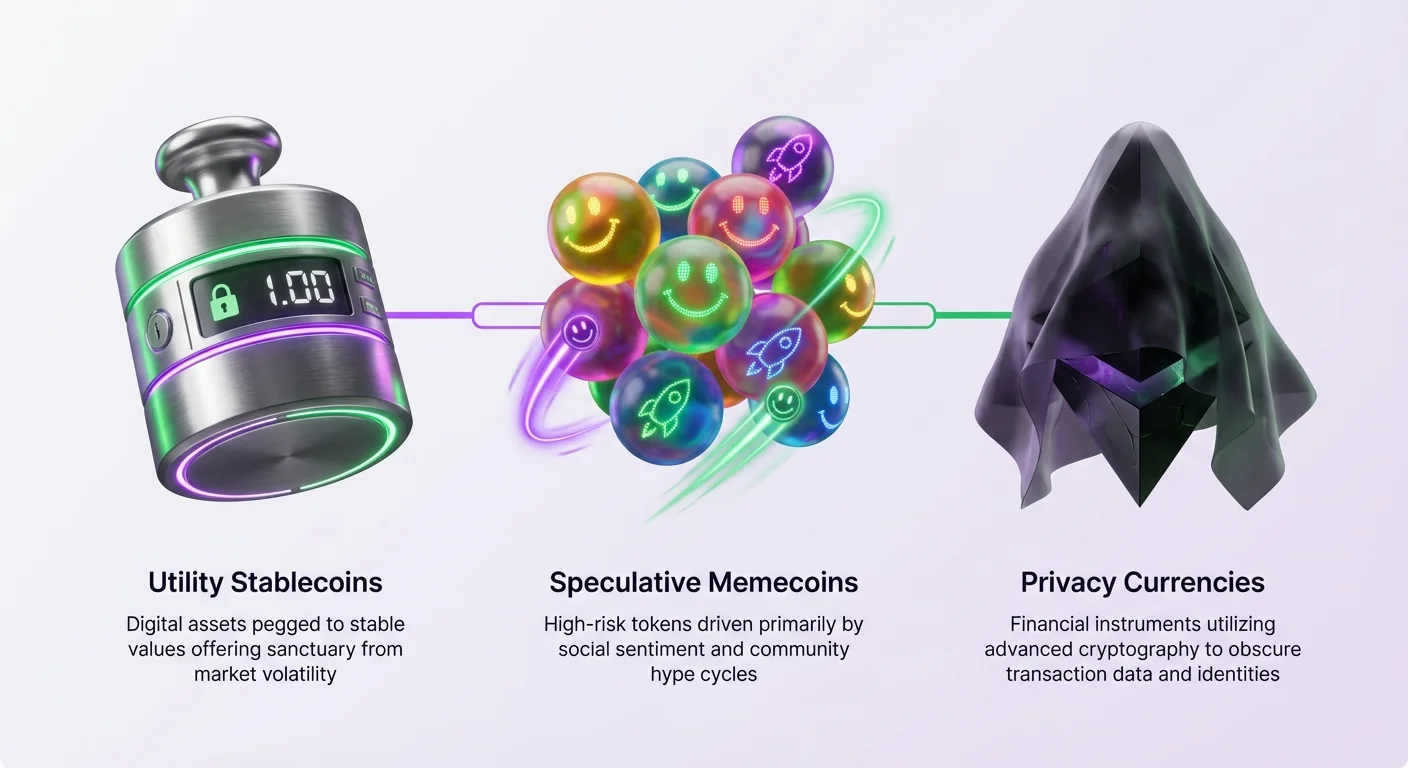
Navigating this environment requires categorizing altcoins based on their primary function. Most assets fall into three distinct categories: utility-focused stablecoins, speculation-driven memecoins, and privacy-centric currencies. Each category appeals to a different type of market participant and serves a specific role in a portfolio.
Stablecoins offer a sanctuary from volatility and a bridge to decentralized finance. Memecoins provide high-risk opportunities driven by social sentiment and internet culture. Privacy coins focus on data protection, anonymity, and the preservation of financial sovereignty. Recognizing the differences between these sectors helps users align their holdings with their personal financial goals and risk tolerance.
The Role of Stablecoins in a Portfolio
Stablecoins are cryptocurrencies designed to maintain a consistent value. They are typically pegged to a stable asset like the US dollar. Their primary purpose is to offer the efficiency of blockchain technology without the extreme price swings associated with assets like Bitcoin or Ethereum. For many, they act as a safe harbor during turbulent market conditions.
These assets enable traders to lock in profits without converting back to fiat currency. This avoids the delays and fees often found in the traditional banking system. Beyond trading, stablecoins have found utility in global payments. They allow businesses to settle international transactions quickly and efficiently. In regions with unstable local currencies, they serve as a reliable store of value.
Mechanisms Behind Price Stability
Fiat-Collateralized Models
The most common method for maintaining a stable peg is through fiat collateralization. In this model, a central entity holds reserves of fiat currency, such as cash or government bonds, in a bank account. For every token issued on the blockchain, there is a corresponding dollar (or equivalent asset) held in reserve. This creates a direct one-to-one backing that provides confidence to holders.
Centralized stablecoins like USDT and USDC operate on this premise. They are popular because they are easy to understand and generally maintain their peg effectively. However, they require trust in the issuing company. Users must believe that the reserves actually exist and that the issuer will honor redemptions. This introduces a layer of centralization into an otherwise decentralized industry.
Crypto-Backed and Algorithmic Approaches
Decentralized stablecoins aim to remove the reliance on a central authority. Crypto-collateralized options, such as DAI, use other cryptocurrencies as reserves. Because the underlying collateral is volatile, these systems often require over-collateralization. This means the value of the locked crypto assets exceeds the value of the stablecoins issued. This buffer protects the peg against market dips.
Algorithmic stablecoins attempt to maintain stability without traditional collateral. They rely on complex code and incentives to expand or contract the supply based on demand. While innovative, this model carries higher risks. If the incentive structure fails during a market crash, the stablecoin can lose its peg, as seen in historical failures like UST.

Earning Yield with Utility Assets
One of the primary attractions of the stablecoin sector is the ability to earn interest. Unlike traditional bank deposits that often offer negligible returns, stablecoins can generate significant yield within the crypto ecosystem. This has transformed them from passive stores of value into active income-generating assets.
There are multiple ways to generate this yield. The simplest method involves depositing stablecoins into centralized lending platforms. These entities lend user funds to borrowers and pass a portion of the interest back to the depositor. While convenient, this method involves counterparty risk, as the user must trust the platform to manage funds responsibly.
Decentralized finance (DeFi) offers a non-custodial alternative. Users can deposit stablecoins into smart contracts on protocols like Aave or Compound. These protocols automatically match lenders with borrowers. Another popular option is providing liquidity to decentralized exchanges (DEXs). By depositing stablecoins into trading pools, users earn a share of the transaction fees generated by the platform.
The Phenomenon of Memecoins
Origins in Internet Culture
Memecoins represent a unique segment of the crypto market driven by humor, community, and internet culture rather than technical utility. The sector began with Dogecoin, which launched as a joke based on a popular meme. Despite its humorous origins, it gained massive traction and demonstrated that social consensus could drive value.
These assets often lack the complex roadmaps or technological breakthroughs found in other projects. Instead, they leverage branding and viral marketing. The barrier to entry for creating a memecoin is low, leading to a flood of tokens inspired by animals, politicians, or trending topics. While many fade quickly, successful ones can achieve multibillion-dollar valuations.
Driven by Community and Hype
The value of a memecoin is almost entirely derived from its community. A strong, active user base can propel a token to new heights through social media engagement and word-of-mouth promotion. This creates a feedback loop where rising prices attract more attention, which in turn drives prices higher. This is often referred to as "FOMO," or the fear of missing out.
Unlike utility coins, which are evaluated based on adoption or revenue, memecoins are judged by their ability to capture attention. Endorsements from influencers or celebrities can cause immediate and drastic price movements. This makes them highly sensitive to social trends and news cycles.
Risks Inherent to Speculation
Investing in memecoins carries a high degree of risk. The same volatility that produces rapid gains can lead to equally rapid losses. Because these assets often lack intrinsic value or a clear use case, their price can collapse if community interest wanes. When the hype creates a bubble, late entrants often suffer significant losses.
The sector is also rife with scams and market manipulation. "Rug pulls" occur when developers abandon a project and sell their holdings, leaving investors with worthless tokens. Due to the anonymous nature of many memecoin teams, accountability is rare. Investors must be extremely cautious and treat these assets as speculative gambles rather than long-term investments.
The Critical Need for Privacy
Defending Financial Sovereignty
As the cryptocurrency market matures, privacy has emerged as a crucial pillar for many users. Public blockchains like Bitcoin and Ethereum are transparent by design. Every transaction is recorded on a public ledger, allowing anyone to trace funds and view wallet balances. For individuals concerned about financial surveillance, this transparency is a significant drawback.
Privacy coins address this issue by obscuring transaction data. They ensure that a user's financial history remains confidential. This protection is essential for personal security, as visible wealth can attract targeted attacks. Furthermore, privacy preserves the right to financial autonomy, preventing third parties from monitoring or censoring how individuals spend their money.
The Concept of Fungibility
Privacy is also directly linked to fungibility, a key property of sound money. Fungibility means that every unit of a currency is interchangeable with any other unit. On a transparent blockchain, coins can be "tainted" if they are associated with past illicit activities. Exchanges or merchants may refuse to accept these specific coins, reducing their value.
Privacy coins ensure fungibility by breaking the link between a coin's history and its current owner. Because the transaction history is hidden, all coins are treated equally. This ensures that a user's money cannot be blacklisted or discriminated against based on its past journey through the network.
Technologies Behind Privacy
Ring Signatures and Stealth Addresses
To achieve anonymity, privacy coins use advanced cryptographic techniques. Monero, a leader in this space, utilizes ring signatures. This technology mixes a user's transaction with several decoy transactions from other users. To an outside observer, it is mathematically impossible to determine which signer is the actual sender.
Stealth addresses add another layer of protection. For every transaction, the network generates a unique, one-time address for the recipient. This hides the recipient's actual public address from the ledger. Even if a user receives multiple payments, they cannot be linked to a single identity on the blockchain.
Zero-Knowledge Proofs
Another powerful tool is the zero-knowledge proof, specifically zk-SNARKs. This technology allows a user to prove that a transaction is valid without revealing any underlying information, such as the sender, recipient, or amount. Zcash is a prominent example of a project that uses this method to offer optional privacy.
Zero-knowledge proofs act like a digital notary. They verify the truth of a statement without seeing the data itself. This enables fully encrypted transactions that are still verifiable by the network consensus rules. It balances the need for privacy with the need for a secure, functional ledger.
The Evolution of Confidential Assets
Beyond Simple Transactions
The next generation of privacy technology extends beyond simple currency transactions. Projects like Zano have introduced the concept of Confidential Assets. These are tokens that operate on a privacy-focused blockchain but represent other values, such as stablecoins or loyalty points. They inherit the native privacy features of the underlying network.
In this system, not only is the native currency private, but any asset created on the platform enjoys the same protection. Transaction amounts, sender identities, and even the type of asset being transferred are concealed. This allows for the creation of a private financial ecosystem where diverse assets can be exchanged without surveillance.
Private Stablecoins
A major innovation in this space is the development of private stablecoins, such as the Freedom Dollar (fUSD). These assets combine the stability of a fiat peg with the anonymity of a privacy coin. Users can hold an asset that tracks the US dollar while ensuring their balance and transaction history remain hidden from the public eye.
This addresses a critical gap in the market. While traditional stablecoins like USDC are useful, they are transparent and centralized. A private stablecoin offers censorship resistance and data protection, making it an attractive option for users who prioritize both stability and confidentiality in their digital financial dealings.
Comparing the Categories
| Feature | Stablecoins (Utility) | Memecoins (Speculation) | Privacy Coins (Privacy) |
|---|---|---|---|
| Primary Goal | Price stability, payments | High returns, entertainment | Anonymity, data protection |
| Volatility | Very Low (Pegged) | Extremely High | Moderate to High |
| Value Driver | Underlying collateral | Community, hype, trends | Tech features, adoption |
| Key Risk | De-pegging, centralization | Sentiment shift, scams | Regulatory delisting |
| Transparency | Usually High (Public Ledger) | High (Public Ledger) | Low (Obscured) |
| Example Use | Remittances, DeFi Yield | Viral trading | Private savings |
Strategic Allocation and Use Cases
Balancing Risk and Reward
Choosing the right category depends heavily on an investor's goals. For those seeking to preserve capital or generate passive income, stablecoins are the logical choice. They enable participation in the crypto economy without exposure to wild price swings. They are the tools for banking-like services within the blockchain world.
Memecoins belong in the high-risk portion of a portfolio. They are speculative instruments best suited for capital that an investor is willing to lose. The potential for outsized gains exists, but it comes with the constant threat of total loss. Successful navigation of this sector requires close attention to social sentiment and strict risk management.
Prioritizing Digital Freedom
For users who value ideology and security, privacy coins are essential. They are not just investments but tools for digital sovereignty. Allocating a portion of a portfolio to privacy assets provides insurance against surveillance and censorship. It supports the technological development of a free and open financial system.
As regulations tighten and surveillance increases, the utility of privacy assets may grow. Confidential assets and private stablecoins offer a middle ground, providing the utility of stability with the security of anonymity. This hybrid approach represents the maturation of the crypto sector, moving toward tools that serve complex, real-world needs.
Conclusion
The cryptocurrency market is a spectrum of utility, speculation, and privacy. Stablecoins provide the infrastructure for reliable payments and decentralized finance, acting as the bedrock of the ecosystem. Memecoins capture the viral energy of the internet, offering high-risk opportunities driven by community sentiment. Privacy coins and confidential assets defend the fundamental right to financial secrecy and fungibility.
A well-rounded strategy often involves exposure to different categories based on individual needs. Whether the goal is earning yield, chasing market trends, or protecting personal data, there is a digital asset designed for that purpose. Understanding the mechanics and risks of each sector allows for more informed decision-making.
Identify your primary financial goal—stability, growth, or privacy—and select the asset class that directly serves that specific objective.