
Cryptocurrency markets in 2025 have matured significantly, offering traders a diverse array of tools to navigate price volatility. The days of manual day trading as the sole method for profit generation are fading. In their place, sophisticated strategies involving market making, automated bots, and liquidity management have become accessible to retail investors.
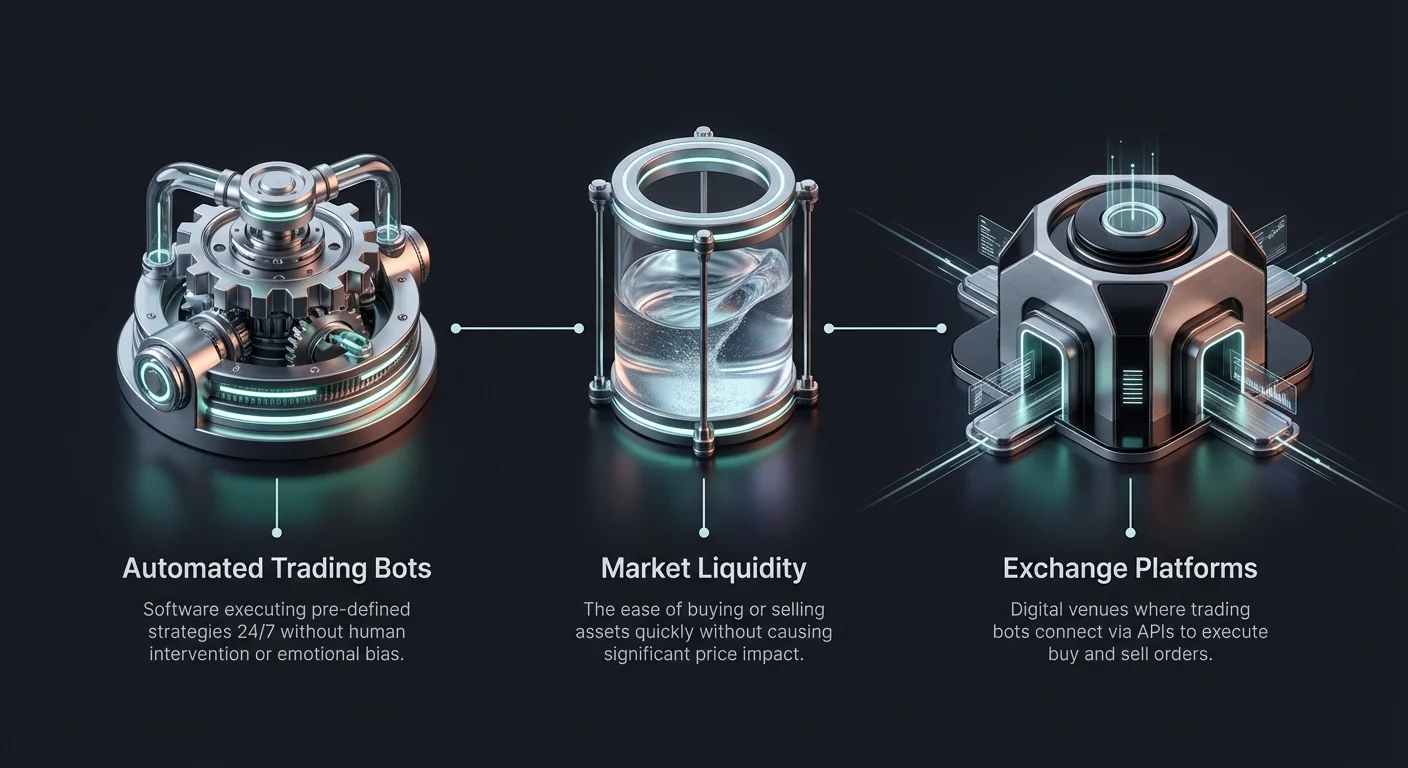
Understanding how liquidity works is fundamental to successful crypto trading. It refers to the ease with which an asset can be converted into cash or another coin without affecting its price. High liquidity generally means stable prices and fast execution, while low liquidity leads to slippage and volatility.
To capitalize on these market dynamics, traders now use automated software known as trading bots. These programs interact directly with exchange order books to execute strategies that would be impossible for a human to manage manually. They operate 24/7, removing the need for sleep and the danger of emotional decision-making.
By combining the right exchange environment with a well-configured bot, investors can adopt the role of a market maker. This involves providing liquidity to the order book and profiting from the spread or fee rebates, rather than just directional price movements. This article explores the technical and strategic landscape of setting up these automated systems.
The Evolution of Exchange Platforms
The infrastructure supporting digital assets has expanded beyond simple spot trading. Modern platforms now cater to various trading styles, from passive income seekers to high-frequency algorithmic traders.
Centralized vs. Decentralized Venues
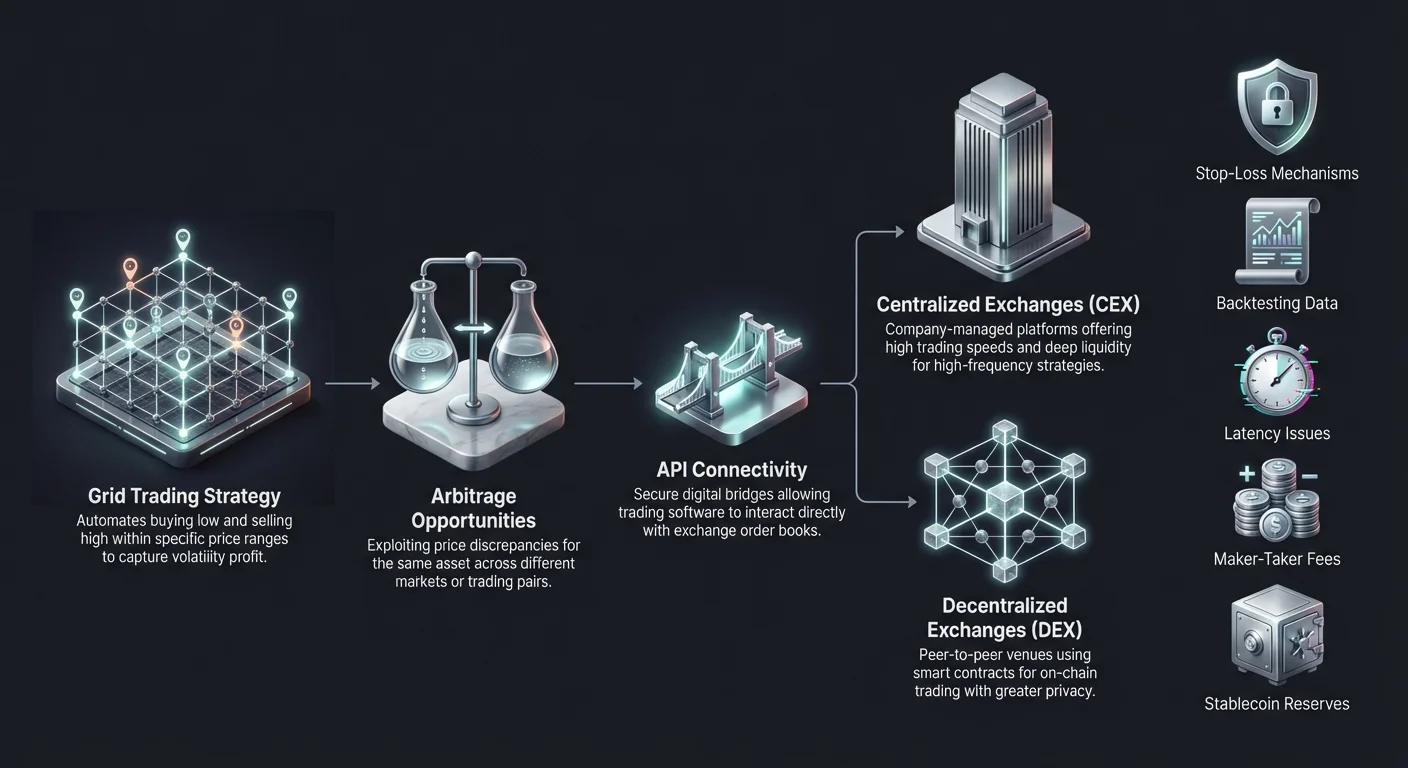
Centralized exchanges (CEX) remain the primary hubs for liquidity. They are operated by specific companies that manage the order books and custody funds. These platforms typically offer the highest trade speeds and deepest liquidity, making them ideal for high-frequency bots. They also provide fiat on-ramps, allowing users to deposit cash directly.
Decentralized exchanges (DEX), conversely, operate without a central authority. They use smart contracts and liquidity pools to facilitate swaps. While they offer greater privacy and self-custody, they can suffer from higher latency. This makes them less suitable for certain types of high-speed arbitrage bots but excellent for on-chain strategies.
Hybrid and Specialized Platforms
A new wave of hybrid exchanges attempts to merge the speed of centralized systems with the security of decentralized ones. These platforms often process orders off-chain for speed but settle them on-chain for transparency.
Specialized exchanges have also emerged. Some focus entirely on derivatives like futures and perpetual contracts, which are essential for hedging strategies. Others are dedicated to peer-to-peer (P2P) transactions or anonymous trading, catering to specific user needs regarding privacy and direct fiat settlement.
Defining Market Liquidity and Depth
Liquidity is often measured by the spread between the highest bid and the lowest ask. A tight spread indicates a liquid market where buyers and sellers agree closely on price. A wide spread suggests a lack of liquidity, which can be profitable for market makers but costly for market takers.
Market depth refers to the volume of orders waiting in the order book at different price levels. A market with good depth can absorb large buy or sell orders without the price shifting drastically. For bot traders, assessing market depth is crucial before deploying a strategy, as shallow markets can lead to significant slippage.
The Mechanics of Automated Trading
Trading bots are software applications that connect to an exchange via an Application Programming Interface (API). This connection allows the bot to read market data and send order instructions in real-time.
How Algorithms Execute Trades
Algorithms follow a strict set of logical rules defined by the user or the developer. For example, a simple algorithm might be programmed to buy Bitcoin when its price drops by 5% and sell when it rebounds by 3%. More complex algorithms analyze multiple indicators simultaneously.
These bots constantly poll the exchange for price updates. When the market conditions match the pre-set criteria, the bot triggers an order instantly. This speed is a primary advantage, as it allows traders to react to market movements in milliseconds, far faster than human reaction times.
Removing Emotional Bias
One of the most significant advantages of using bots is the elimination of emotional interference. Human traders often fall victim to fear during market crashes, selling at the bottom, or greed during rallies, buying at the top.
A bot has no feelings. It executes the strategy exactly as programmed, regardless of market sentiment or panic. This consistency is vital for long-term strategies like dollar-cost averaging (DCA) or grid trading, where success depends on disciplined execution over weeks or months.
Grid Trading Strategies
Grid trading is one of the most effective strategies for sideways or ranging markets. It automates the process of buying low and selling high within a specific price range.
Setting Up the Grid
To configure a grid bot, a trader defines an upper price limit and a lower price limit. The software then divides this range into multiple "grids" or levels. At each level, the bot places a limit buy order below the current price and a limit sell order above it.
As the market fluctuates, the bot executes these orders. If the price drops, it triggers a buy order. If the price then rises, it triggers the corresponding sell order, capturing the difference as profit. This strategy turns normal market volatility into a series of small, consistent gains.
Optimization for Volatility
Grid trading thrives on volatility. The more the price bounces up and down within the defined range, the more trades the bot executes, and the more profit it generates. However, if the price breaks out of the range, the strategy may become less effective.
If the price rises above the upper limit, the bot will have sold all its assets and will sit idle with cash. If the price falls below the lower limit, the bot will have bought positions all the way down and will be holding assets at a loss. Traders must adjust their grids based on changing market trends.
Arbitrage Opportunities in Crypto
Arbitrage involves profiting from price discrepancies for the same asset across different markets. Since crypto exchanges operate independently, prices for a coin like Bitcoin can vary slightly between platforms.
Cross-Exchange Arbitrage
This is the most common form of arbitrage. A bot monitors the price of an asset on Exchange A and Exchange B. If the price on Exchange A is lower than on Exchange B, the bot buys on A and sells on B simultaneously.
The difference in price, minus trading and transfer fees, represents the profit. Speed is critical here, as these price gaps often close within seconds as other traders and bots exploit them. High-performance bots and low-latency connections are often required to compete in this space.
Triangular Arbitrage
Triangular arbitrage occurs on a single exchange. It involves trading three different currencies in a loop to exploit pricing inefficiencies between trading pairs.
For example, a trader might trade Bitcoin for Ethereum, then Ethereum for Litecoin, and finally Litecoin back to Bitcoin. If the exchange rates between these pairs are not perfectly aligned, the trader ends up with more Bitcoin than they started with. This strategy eliminates the need to transfer funds between exchanges but requires complex calculation algorithms.
The Maker-Taker Fee Model
Understanding exchange fees is vital for profitability, especially for high-frequency bot strategies. Most exchanges use a "maker-taker" fee model to encourage liquidity.
"Makers" are traders who place limit orders that sit on the order book, waiting to be filled. They add liquidity to the market. Because they help the exchange operate smoothly, they are often charged lower fees or even given rebates.
"Takers" are traders who place market orders that are filled immediately. They remove liquidity from the order book. Consequently, takers usually pay higher fees. Market making bots are designed to act as makers, placing limit orders to capture the spread and minimize fee expenses.
Copy Trading Ecosystems
For those who prefer a hands-off approach without configuring technical parameters, copy trading offers a social alternative to algorithmic bots.
How Copy Trading Works
Copy trading platforms allow users to browse profiles of experienced traders. These profiles display historical performance, risk metrics, and preferred assets. A user can choose to allocate a portion of their funds to automatically replicate the trades of a specific expert.
When the expert executes a buy or sell order, the copy trading system mirrors that action in the follower's account, adjusted proportionally to the amount invested. This allows beginners to leverage the expertise of seasoned professionals.
Benefits and Limitations
The primary benefit is accessibility. It lowers the barrier to entry for complex trading strategies. Users do not need to understand technical analysis or bot configuration to participate.
However, reliance on another trader carries risk. If the expert makes a bad decision, the follower loses money too. Additionally, the past performance of a trader does not guarantee future results. Users must still monitor their chosen traders and diversify their allocations to manage risk effectively.
Risk Management in Automation
Automated trading introduces specific risks that differ from manual investing. While bots remove emotional error, they introduce technical and systemic risks.
Flash Crashes and Black Swans
A "flash crash" occurs when the price of an asset drops dramatically in a very short period, often due to a cascade of automated sell orders. Bots that are not configured with safety mechanisms may react poorly to these events.
For example, a grid bot might continue buying all the way down a crash, exhausting the trader's funds on a failing asset. "Black swan" events—unpredictable, major market disruptions—can render a bot's strategy obsolete instantly. Traders should use stop-loss orders to halt bot activity during extreme volatility.
System Failures and Latency
Bots rely on continuous internet connections and stable exchange APIs. If the exchange goes offline for maintenance or the user's internet connection fails, the bot cannot manage open positions.
This is particularly dangerous if the bot has open leverage positions that need monitoring. Latency, or the delay in data transmission, can also result in orders being filled at worse prices than expected. Hosting bots on cloud servers rather than local computers can help mitigate connectivity issues.
Security Best Practices for API Keys
Using trading bots requires generating API keys, which act as passwords allowing software to access an exchange account. Securing these keys is paramount to preventing theft.
When creating an API key, users can define specific permissions. It is essential to grant only "Trade" and "View" permissions. Never grant "Withdrawal" permissions to a trading bot. This ensures that even if the API key is compromised or the bot software is hacked, the attacker cannot remove funds from the exchange account.
Selecting the Right Exchange Platform
The choice of exchange is as critical as the choice of bot. Not all exchanges are compatible with all strategies or software.
Evaluating Liquidity and Volume
For strategies like arbitrage and market making, high trading volume is non-negotiable. A platform with low volume will not have enough activity to fill the bot's orders regularly.
Traders should look for exchanges that consistently rank high in volume for the specific pairs they intend to trade. Deep liquidity ensures that trades execute at predictable prices, which is vital for the thin profit margins often associated with automated strategies.
Reviewing Fee Structures
Fees eat into profits. This is especially true for grid trading and high-frequency bots that may execute hundreds of trades per day. A difference of 0.1% in fees can turn a profitable strategy into a losing one.
Traders should compare the fee schedules of top exchanges. Many platforms offer tiered fee structures where costs decrease as trading volume increases. Some also offer discounts for holding the exchange's native token. Finding a platform with low "maker" fees is crucial for market making bots.
Technical Configuration of Bots
Setting up a bot requires understanding various technical parameters. These settings dictate how the bot behaves and reacts to market changes.
Entry and Exit Signals
Most bots rely on technical indicators to trigger trades. Common indicators include Moving Averages (MA), the Relative Strength Index (RSI), and Bollinger Bands.
For example, a trend-following bot might be configured to buy when the short-term moving average crosses above the long-term moving average. Conversely, a mean-reversion bot might buy when the RSI indicates the asset is oversold. Users must backtest these parameters against historical data to verify their effectiveness before risking real capital.
Stop-Loss and Take-Profit
Automated strategies must have clear exit rules. A take-profit setting ensures the bot locks in gains when a target price is reached, rather than holding too long and watching the profit evaporate.
A stop-loss is a safety net. It instructs the bot to sell the position if the price drops by a certain percentage, preventing a small loss from becoming a catastrophic one. Trailing stops are an advanced feature where the stop-loss price moves up as the asset price rises, securing profits while allowing for further growth.
Psychological Aspects of Automation
While bots eliminate the fear of pulling the trigger on a trade, they introduce a new psychological challenge: the urge to interfere.
The Trap of Over-Optimization
Traders often fall into the trap of constantly tweaking their bot's settings in response to short-term market noise. This is known as over-optimization. A strategy that works well in the long run may have days or weeks of underperformance.
Constantly changing parameters to chase recent performance can lead to a strategy that is "fitted" to the past but fails in the future. Successful automated trading requires the discipline to let the strategy play out over a statistically significant period.
Monitoring vs. Meddling
It is important to monitor a bot to ensure it is functioning correctly technically. However, micromanaging its trades defeats the purpose of automation.
If a trader finds themselves manually closing the bot's positions because they "feel" the market is turning, they are re-introducing emotional bias. Trusting the data and the pre-configured logic is essential. Intervention should be reserved for structural market changes or technical failures.
| Feature | Manual Trading | Automated Bot Trading |
|---|---|---|
| Availability | Limited by sleep/schedule | 24/7 Operation |
| Speed | Human reaction time | Milliseconds |
| Emotion | High emotional bias | No emotional bias |
Dollar-Cost Averaging (DCA) Automation
DCA is a long-term strategy that involves investing a fixed dollar amount at regular intervals, regardless of the asset's price.
How DCA Bots Work
A DCA bot removes the manual effort of logging in every week or month to buy. The user sets the amount (e.g., $50) and the interval (e.g., every Monday). The bot automatically executes the market buy order at that time.
This strategy reduces the impact of volatility. By buying more when prices are low and less when prices are high, the average cost per coin tends to lower over time. It is a passive strategy well-suited for investors building a long-term portfolio.
Advanced DCA Features
Modern DCA bots offer "smart" features. For instance, they can be programmed to pause buying if the price is excessively high according to an indicator like the RSI.
Alternatively, "Martingale" DCA bots increase the buy size if the price drops, aggressively lowering the average entry price. While this can lead to faster recovery when the price rebounds, it also carries higher risk if the asset continues to fall indefinitely.
The Role of Stablecoins
Stablecoins are cryptocurrencies pegged to the value of fiat currencies like the US Dollar. They play a vital role in automated trading strategies.
Stablecoins act as the "cash" reserve for bots. When a bot sells a volatile asset like Bitcoin to take profit, it typically swaps it into a stablecoin like USDT or USDC. This preserves the value of the profit during market downturns.
Furthermore, many arbitrage and grid strategies operate on stablecoin pairs (e.g., USDT/USDC). Since these pairs should theoretically trade at 1:1, deviations are small but predictable. Bots can trade these pairs with very low risk, capturing tiny profits from the minute fluctuations between the two pegged assets.
Future Trends in Algorithmic Trading
As we move through 2025, the integration of Artificial Intelligence (AI) into trading bots is becoming more prevalent.
AI and Machine Learning
Traditional bots follow static "if-this-then-that" logic. AI-powered bots, however, can learn from data. They analyze vast amounts of historical and real-time market data to identify patterns that are too complex for human programmers to define explicitly.
These systems can adapt their strategies dynamically. If market volatility increases, an AI bot might automatically widen its grid spacing. If a trend reverses, it might switch from a momentum strategy to a mean-reversion strategy without user intervention.
High-Frequency Trading (HFT)
Retail access to high-frequency trading tools is expanding. HFT involves executing thousands of orders in fractions of a second to capture microscopic price discrepancies.
While historically the domain of institutional firms with supercomputers, cloud computing has made simplified HFT strategies available to the public. These strategies require extremely low-latency connections and exchanges that can handle massive throughput.
Regulatory Compliance and KYC
The regulatory landscape for crypto exchanges is tightening globally. Compliance is now a major factor in choosing a platform for automated trading.
Know Your Customer (KYC) regulations require users to verify their identity before trading. Most top-tier centralized exchanges mandate KYC. While this reduces anonymity, it generally increases the security and reliability of the platform.
Using regulated exchanges is often safer for bot traders. These platforms are more likely to have robust security measures, insurance funds for hacks, and legal recourse in case of disputes. Traders should be wary of unregulated "offshore" exchanges that promise high leverage but lack oversight.
Evaluating Exchange Security
Security is the foundation of any trading strategy. If the exchange is compromised, the profitability of the bot becomes irrelevant.
Cold Storage and Reserves
Top exchanges keep the majority of user funds in "cold storage," meaning they are offline and inaccessible to hackers. Only a small percentage is kept in "hot wallets" for active trading.
Additionally, many exchanges now publish "Proof of Reserves." This is a cryptographic verification that the exchange actually holds the assets it claims to hold. Traders should prioritize platforms that offer this transparency to ensure their funds are backed 1-to-1.
Insurance Funds
Some exchanges maintain an insurance fund (like Binance's SAFU). This fund is designed to compensate users in the event of a security breach or other platform failures.
Knowing that a safety net exists provides peace of mind, especially when running automated strategies with significant capital. It is worth checking the size and terms of these funds when selecting an exchange.
Social Trading Networks
Social trading extends beyond simple copy trading. It involves a community aspect where traders share insights, charts, and strategies.
Platforms that integrate social features allow users to discuss market conditions in real-time. A bot trader might share their configuration for a specific market cycle, allowing others to test and refine it. This collaborative environment accelerates learning.
However, users should remain critical. The "wisdom of the crowd" can sometimes become a herd mentality, leading to bubbles or panic selling. Independent analysis should always validate social sentiment.
Impact of Leverage on Automation
Leverage allows traders to trade with borrowed funds, amplifying both profits and losses. Many bots support margin and futures trading.
Amplified Risks
Using leverage with bots is high-risk. A small price movement against the position can lead to liquidation, where the exchange automatically closes the trade and seizes the collateral.
Because bots execute trades automatically, a series of losing trades on high leverage can wipe out an account balance very quickly. Beginners are strongly advised to start with spot trading (no leverage) before experimenting with margin bots.
Futures Arbitrage
One popular low-risk strategy involving leverage is "cash and carry" or funding rate arbitrage. This involves buying the asset on the spot market and shorting it on the futures market.
Since futures prices often trade at a premium to spot prices, the trader captures the difference. Bots can automate the management of these two opposing positions to ensure they remain balanced (delta neutral) while collecting the funding fees paid by other leverage traders.
Setting Up Your First Bot
The process of launching a bot involves several distinct steps, moving from strategy selection to live execution.
Strategy Selection
The first step is determining the goal. Is the objective to accumulate more Bitcoin over time? A DCA or grid bot is appropriate. Is the goal to grow USD value? An arbitrage or trend-following bot might be better.
The strategy must match the current market condition. In a bull market, trend-following works best. In a sideways market, grid trading excels. Using the wrong strategy for the market phase is a common cause of failure.
Backtesting
Before risking real money, users should "backtest" their configuration. This involves running the bot's logic against historical price data to see how it would have performed.
Most bot platforms offer backtesting tools. If the simulation shows a loss, the parameters need adjustment. However, traders must remember that past performance does not guarantee future results. Backtesting confirms the logic, not the future profit.
Paper Trading
After backtesting, the next step is "paper trading." This is a live simulation using fake money. The bot connects to the real-time market data and "executes" trades without actually moving funds.
Running a paper trading bot for a week or two allows the trader to see how the system behaves in real-time conditions. It helps identify issues with settings or connectivity before any financial risk is taken.
Diversifying Liquidity Strategies
Relying on a single strategy or a single coin is risky. Professional market makers diversify their operations.
Multi-Pair Trading
Instead of running a grid bot only on Bitcoin/USDT, a trader might run bots on Ethereum/USDT and Solana/USDT as well. Different assets have different volatility profiles.
When Bitcoin is stagnant, altcoins might be volatile, allowing those bots to generate profit. Diversifying across uncorrelated assets smoothes out the equity curve and reduces the impact of a single asset crashing.
Mixing Strategies
Traders can also mix strategy types. A portfolio might consist of 50% DCA bots for long-term accumulation, 30% grid bots for cash flow in sideways markets, and 20% arbitrage bots for low-risk gains.
This balanced approach ensures that the trader has exposure to different market mechanics. It prevents the portfolio from being entirely dependent on one type of market movement.
Troubleshooting Common Bot Issues
Even with careful setup, bots can encounter problems. Recognizing these issues early minimizes downtime and losses.
API Errors
"Invalid API Key" or "Permission Denied" errors are common. These usually mean the key has expired, was entered incorrectly, or lacks the necessary permissions. Regenerating the key on the exchange usually fixes this.
"Rate Limit Exceeded" errors occur when the bot sends too many requests to the exchange in a short time. Exchanges limit the number of actions a user can take per second. Increasing the time interval between the bot's checks can resolve this.
Insufficient Funds
A bot will stop working if it runs out of the quote currency (e.g., USDT) to buy or the base currency (e.g., BTC) to sell. This often happens in grid trading when the price moves out of range.
Traders need to monitor their balances. Rebalancing the portfolio or adding more funds may be necessary to keep the bot running. Some advanced bots have "auto-rebalance" features to handle this.
The Importance of Low Latency
In the world of automated trading, speed is a competitive advantage. Latency is the time delay between a signal and the execution.
Co-Location
Professional trading firms "co-locate" their servers in the same data center as the exchange's servers. This reduces the physical distance data must travel, shaving off milliseconds.
While retail traders cannot usually co-locate, using a Virtual Private Server (VPS) located in a major financial hub (like Tokyo or London) can significantly improve speed compared to running a bot on a home laptop with residential Wi-Fi.
Cloud-Based Bot Services
Many modern bot platforms are cloud-based. The user accesses a dashboard via a web browser, but the bot itself runs on the company's high-speed servers.
This eliminates the need for the user to keep their computer on 24/7. It also generally provides better reliability and lower latency than a local setup. For most retail traders, cloud-based solutions offer the best balance of performance and ease of use.
Conclusion
The landscape of cryptocurrency trading in 2025 offers unprecedented opportunities for retail investors to utilize institutional-grade strategies. Market making bots, grid trading systems, and arbitrage tools allow individuals to participate in the market as liquidity providers rather than just speculators. By automating entry and exit points, traders can remove the psychological barriers that often lead to losses and ensure consistent execution of their strategies around the clock.
However, automation is not a guarantee of profit. It requires a deep understanding of market mechanics, careful selection of exchange platforms, and rigorous risk management. Traders must navigate the technical challenges of API management and the systemic risks of flash crashes and platform outages. Success lies in the balance between leveraging technology for efficiency and maintaining human oversight for strategic direction.
Successful automated trading requires combining a robust strategy with continuous monitoring, strict risk management, and a diversified approach to market conditions.