
Trading with leverage introduces a high-stakes dynamic to the cryptocurrency market. It offers the allure of amplified profits, allowing traders to control large positions with relatively small amounts of capital. However, this financial power comes with a significant catch. The mechanism that magnifies gains also magnifies losses.
When the market moves against a leveraged position, the risk of liquidation becomes a reality. Liquidation is the forced closure of a trader's position by the exchange. This happens when the trader's account equity falls below the required level to support the open trade. It is a protective measure taken by the platform to ensure that the losing trade does not result in a debt that the trader cannot repay.
Understanding the mechanics of liquidation is essential for anyone engaging in derivatives trading. It is not merely about bad luck or market volatility. It involves precise mathematical thresholds, specific margin requirements, and distinct platform policies. Traders who fail to grasp these concepts often face total capital loss.
This guide explores the technical components of liquidation. We will examine how margin calls function, the critical difference between initial and maintenance margin, and the strategies used to avoid blowing up an account. By mastering these concepts, market participants can navigate the volatility of digital assets with greater security and confidence.
The Fundamentals of Margin Trading
The Concept of Buying Power
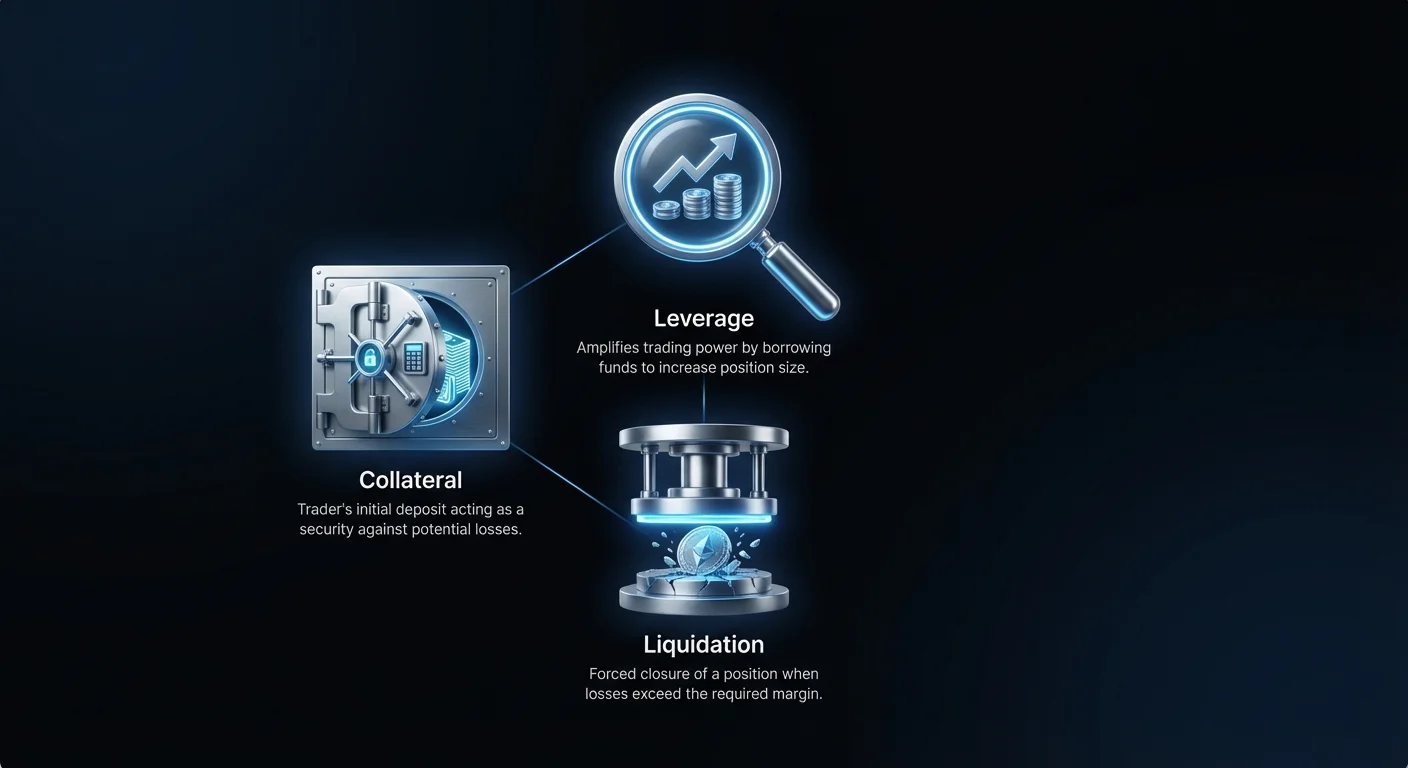
Margin trading fundamentally changes the relationship between capital and exposure. In a standard spot transaction, if you have $1,000, you can buy $1,000 worth of Bitcoin. Margin trading allows you to borrow funds to increase that buying power. This borrowed capital is what creates leverage.
If a platform offers 10x leverage, that same $1,000 can control a position worth $10,000. The $1,000 you provide acts as collateral. This collateral is your "skin in the game." It serves as a security deposit to cover potential losses.
The exchange lends the remaining $9,000 to complete the trade. While this arrangement allows for significant profit potential if the price moves favorably, it creates a scenario where the trader is responsible for the entire position's value. If the value of the position drops, the losses are deducted solely from the trader's collateral, not the borrowed funds.
Initial Margin Requirements
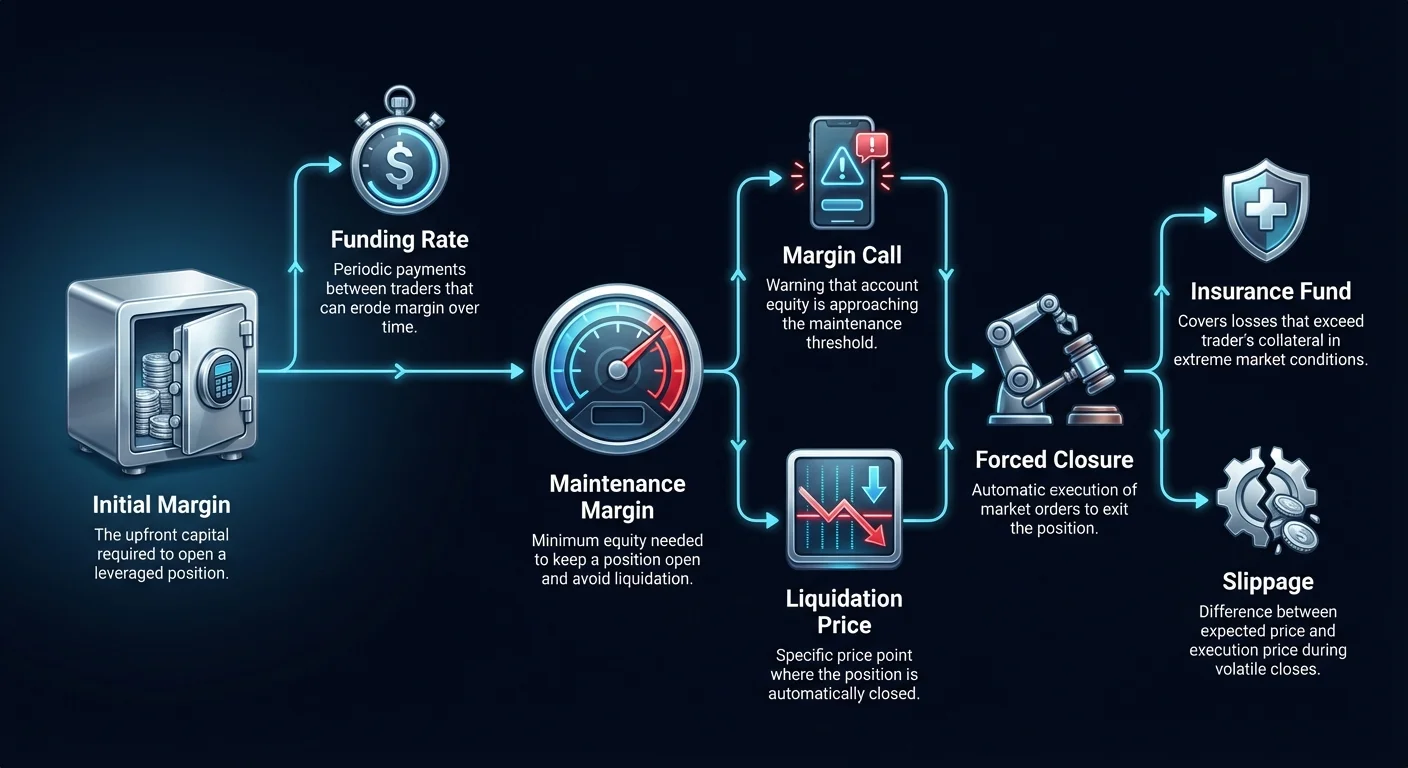
To open a leveraged position, a trader must deposit a specific amount of funds. This is known as the Initial Margin. It is the entry ticket to the trade. The amount required depends on the leverage ratio selected. Higher leverage requires less initial capital relative to the position size, but it increases risk.
For example, using 100x leverage might require only 1% of the total position value as initial margin. Using 2x leverage would require 50%. While high leverage reduces the upfront capital needed, it creates a much tighter window for price movement before losses eat through the collateral.
The initial margin is locked by the exchange for the duration of the trade. It cannot be withdrawn or used for other trades unless the position is closed or leverage is reduced. Understanding this requirement is the first step in calculating risk.
The Role of Collateral
Collateral in crypto margin trading can take various forms. On many platforms, traders use stablecoins like USDT or USDC as collateral. This provides a stable base value for calculations. However, some exchanges allow the use of volatile assets like Bitcoin or Ethereum as collateral.
Using a volatile asset as collateral introduces an extra layer of complexity. If the price of the collateral asset drops while the open position is also losing money, the trader faces a double impact. The value of the security deposit shrinks at the same time the trade is moving into the red.
This scenario accelerates the path toward liquidation. Therefore, managing the type of collateral used is just as important as managing the trade itself. Traders must be aware of how their collateral is valued and the specific "haircuts" or discounts exchanges might apply to volatile assets.
Maintenance Margin and the Liquidation Price
Maintenance margin is the absolute minimum amount of equity a trader must hold in their account to keep a position open. It is always lower than the initial margin. Think of the initial margin as the amount needed to open the door, and the maintenance margin as the amount needed to stay in the room.
As market prices fluctuate, the unrealized profit or loss of a position changes the trader's account equity. If a trade goes poorly, the equity begins to erode. The exchange watches this equity level closely.
If the equity drops to the level of the maintenance margin, the danger zone is reached. The exchange will not allow the equity to fall to zero or into negative territory. Before that happens, the liquidation protocols are triggered.
The liquidation price is the specific price point at which the account equity hits the maintenance margin threshold. This price is calculated the moment a trade is opened. It serves as a constant line in the sand.
If the market price touches this liquidation price, the platform's engine automatically takes over. It creates market orders to close the position immediately. This is done to preserve whatever capital remains to pay back the borrowed funds.
The gap between the entry price and the liquidation price depends entirely on leverage. Lower leverage results in a wide gap, allowing the asset to fluctuate significantly without triggering a blowout. Higher leverage results in a razor-thin gap.
Anatomy of a Margin Call
The Warning System
In traditional finance, a margin call was a literal phone call from a broker. The broker would demand that the client deposit more cash immediately to cover losses. If the client failed to do so, the broker would sell the assets.
In the fast-paced world of cryptocurrency, the "call" is often digital and automated. It typically arrives as an email or a notification from the trading app. It warns the trader that their margin balance is approaching the maintenance threshold.
However, due to the extreme volatility of crypto markets, prices can crash through the margin call level and hit the liquidation price in seconds. Sometimes, there is no time for the trader to react to the warning.
Adding Margin vs. Closing Positions
When a trader receives a margin call or sees their risk level rising, they have two primary options. The first is to add more collateral to the account. By depositing more funds, the trader increases their account equity. This effectively lowers the leverage ratio and pushes the liquidation price further away.
The second option is to close the position, or at least a portion of it. By realizing the loss and reducing the position size, the trader reduces the total borrowed amount. This can stabilize the account and prevent a total loss of funds.
Deciding between these options requires a cool head. Adding margin to a losing trade is often called "throwing good money after bad." It can lead to even larger losses if the market continues to move unfavorably.
Forced Liquidation Mechanics
If the trader does not act, or if the market moves too quickly, forced liquidation occurs. The exchange's matching engine places an immediate order to close the position. This is usually a market order, which accepts the best available price at that moment.
During a liquidation, the trader loses their initial margin. In many cases, they also lose any remaining maintenance margin to cover fees. Liquidation is not free. Exchanges often charge substantial liquidation fees to penalize the risky behavior and cover the administrative cost of the forced trade.
These fees are deducted from whatever capital is left. This explains why a liquidated account often ends up with a zero balance, or mere pennies, even if the market price bounces back moments later.
Types of Margin: Cross vs. Isolated
Risk management in derivatives trading heavily relies on the margin mode selected. Most exchanges offer two distinct modes: Cross Margin and Isolated Margin. Understanding the difference is vital for protecting one's total portfolio.
| Feature | Cross Margin | Isolated Margin |
|---|---|---|
| Scope | Uses entire account balance | Restricted to specific amount |
| Risk | Total wallet liquidation | Limited to assigned capital |
| Flexibility | Shared across positions | Separate for each trade |
Cross Margin Dynamics
Cross margin shares the entire balance of a trading account across all open positions. The available balance acts as a combined pool of collateral. If one position is in profit while another is in loss, the profit can help support the losing trade.
This mode is useful for hedging and for traders who want to avoid micro-managing the margin of every single active trade. It effectively lowers the risk of liquidation for individual positions because the collateral pool is larger.
However, the systemic risk is higher. If a single position goes catastrophically wrong and drains the shared pool, it can liquidate the entire account. Every other position, even those that were profitable, may be closed to cover the loss of the rogue trade.
Isolated Margin Security
Isolated margin compartmentalizes risk. In this mode, the trader allocates a specific amount of collateral to a single position. For example, a trader might put $100 into a Bitcoin long position.
If the price drops and the position is liquidated, the trader loses only that specific $100. The rest of the funds in their wallet remain untouched. The "fire" is contained within that one trade and cannot spread to the rest of the portfolio.
This mode allows for precise risk control. A trader can take a high-leverage gamble with a small amount of money without endangering their main capital. It is generally recommended for beginners and for speculative trades.
Choosing the Right Mode
The choice between cross and isolated margin depends on the strategy. Professional traders managing complex portfolios often use cross margin to balance exposure. They rely on strict stop-loss orders to prevent account-wide disasters.
Traders focusing on individual setups or volatile altcoins often prefer isolated margin. It provides peace of mind. They know exactly how much they stand to lose before the trade even begins.
Switching between modes is usually possible only when there are no open positions. Traders must decide their approach before entering the market. Mixing strategies without understanding the margin settings is a common cause of unexpected liquidations.
Perpetual Futures and Funding Rates
The Perpetual Contract Mechanism
Perpetual futures, or "perps," are the most popular derivative instrument in crypto. Unlike traditional futures, they have no expiry date. Traders can hold a position for as long as they can maintain the margin requirements.
Because there is no settlement date, the price of the perpetual contract must be anchored to the spot price of the underlying asset. Without a mechanism to tether them, the contract price could drift significantly away from the real market value.
The mechanism used to keep prices aligned is the Funding Rate. This is a periodic payment exchanged between buyers (longs) and sellers (shorts). It directly impacts a trader's margin balance and liquidation risk.
Funding Rates and Margin Erosion
Funding rates are typically calculated every eight hours. If the market is bullish and more people are going long, the funding rate is positive. This means traders with long positions must pay a fee to traders with short positions.
Conversely, if the market is bearish, the funding rate becomes negative. Short sellers pay the long traders. These payments are deducted automatically from the trader's margin balance.
If a trader holds a large position with high leverage, the funding fees can be substantial. Over time, these fees can eat away at the collateral. Even if the asset price stays flat, a trader paying funding fees could eventually see their margin drop below the maintenance level, triggering a liquidation.
Strategic Implications
Traders must monitor the funding rate before entering a long-term leverage position. In times of extreme euphoria, annualized funding rates can reach triple digits. Holding a position in such an environment is expensive.
Some traders use this to their advantage through arbitrage. They might open a position specifically to collect funding fees. However, for the directional trader, funding is a cost of doing business that must be factored into the liquidation calculation.
Ignoring funding rates is a common mistake. A position that is slightly profitable on the chart might actually be losing money once fees are subtracted. This "invisible" loss brings the liquidation price closer with every funding interval.
Shorting and Unlimited Risk
Short selling involves borrowing an asset to sell it, with the intention of buying it back later at a lower price. It is a way to profit from market declines. However, the mechanics of liquidation for short positions carry a unique danger profile.
When you buy an asset (go long), the worst-case scenario is that the price drops to zero. Your loss is capped at your initial investment. You cannot lose more than you put in (assuming no leverage debt).
When you short an asset, there is theoretically no limit to how high the price can go. A cryptocurrency can increase in value by 100%, 1,000%, or even 10,000%. Since the short seller must repurchase the asset to close the position, a rising price creates a mounting debt.
To prevent the trader from owing more than they have, exchanges enforce liquidation strictly on short positions. If the price rises to a point where the collateral can barely cover the repurchase cost, the system liquidates the trade.
This often leads to a "short squeeze." As short positions are liquidated, the exchange automatically buys the asset to close the trades. This buying pressure pushes the price up further, triggering more liquidations, which causes more buying.
This cascading effect can cause rapid, vertical price spikes. Short sellers can be wiped out in moments. Managing risk when shorting requires extremely disciplined stop-loss placement to avoid being caught in a squeeze.
Common Causes of Account Blow-Ups
Excessive Leverage
The most frequent cause of liquidation is greed. Using maximum leverage (such as 50x or 100x) leaves almost no room for error. A 1% price move against a 100x position results in a 100% loss of margin.
In the volatile crypto markets, a 1% fluctuation can happen in seconds. High leverage transforms minor market noise into a solvency crisis. Traders often overestimate their ability to predict short-term price action.
Ignoring Volatility
Different cryptocurrencies have different volatility profiles. Bitcoin might move 3% in a day, while a smaller altcoin might move 20%. Applying the same leverage strategy to different assets is a recipe for disaster.
A leverage ratio that is safe for Bitcoin might be suicidal for a meme coin. Traders often fail to adjust their position size based on the specific volatility of the asset they are trading.
Exchange Outages and Slippage
Technical failure is a risk factor in crypto trading. During periods of extreme market activity, exchanges can become overloaded. Users may find themselves unable to log in or place orders.
If a trader cannot access the platform to add margin or close a position manually, they are at the mercy of the liquidation engine. By the time the system comes back online, the position may be gone.
Additionally, during a crash, liquidity can dry up. This causes slippage. The liquidation engine might not be able to sell the position at the trigger price. It may have to sell at a much worse price, draining even more capital than expected.
Risk Management Strategies
The Hard Stop-Loss
The single most effective tool against liquidation is the stop-loss order. This is an instruction to close the position at a specific price before the liquidation point is reached.
A hard stop-loss ensures that a trader accepts a small, manageable loss rather than a total wipeout. It removes emotion from the decision. Professional traders always define their exit point before they enter the trade.
Position Sizing
Proper position sizing ensures that no single trade can destroy the account. A common rule of thumb is to risk only 1% to 2% of the total account capital on any single trade.
Even if a trader uses high leverage, they can manage risk by reducing the amount of capital assigned to that trade. It is better to have a small position with high leverage than a large position that puts the entire portfolio at risk.
De-leveraging
Traders should consider de-leveraging during volatile periods. Reducing the leverage ratio increases the buffer between the entry price and the liquidation price. This allows the trade to "breathe" and withstand normal market fluctuations without triggering a forced closure.
If a trade moves into profit, some traders choose to take partial profits. This locks in gains and reduces the overall exposure. It is a defensive strategy that prioritizes capital preservation over maximum potential yield.
The Role of Insurance Funds
When a liquidation occurs, the exchange must ensure that the winning side of the trade gets paid. In extreme volatility, a position might be liquidated at a price worse than the bankruptcy price. This means the trader's collateral is not enough to cover the loss.
To prevent this "contract loss" from affecting other users, exchanges maintain Insurance Funds. When a trader is liquidated, they are often closed out at a price slightly better than bankruptcy. The difference between the liquidation value and the bankruptcy value is fed into the insurance fund.
Conversely, if a position is closed at a loss exceeding the collateral, the insurance fund covers the deficit. This system protects the integrity of the exchange. It ensures that profitable traders can always withdraw their earnings, even if the losers go bust.
However, this also means that liquidation fees are often aggressive to keep the insurance fund solvent. Traders should view the insurance fund as a safety net for the system, not for themselves.
Regulatory Considerations and Leverage Limits
The landscape of leverage trading is heavily influenced by regulation. In many jurisdictions, authorities have imposed strict limits on the amount of leverage exchanges can offer to retail clients.
For example, some regions cap crypto leverage at 2x or 5x for non-professional traders. These regulations are designed to protect consumers from the rapid losses associated with high-leverage liquidation.
Exchanges operating in these regions must comply with these rules. This often leads to a split market, where offshore or decentralized platforms offer high leverage while regulated domestic entities offer more conservative products.
Traders should be aware of the legal environment they are operating in. Using unregulated platforms to access high leverage increases counterparty risk. If the platform fails or disputes a trade, the user has little legal recourse.
Psychological Aspects of Liquidation
The Trauma of Loss
Being liquidated is a psychological blow. It validates that the trader was wrong, and it removes their ability to fight back in that specific trade. The immediate reaction is often anger or denial.
This emotional state is dangerous. It creates an urge to earn the money back quickly. This leads to "revenge trading," where the trader opens new, riskier positions immediately after a loss.
Revenge trading almost invariably leads to further liquidations. The trader abandons their strategy and acts on impulse. Recognizing this emotional trigger is crucial for long-term survival.
Discipline and Acceptance
Successful traders accept liquidation as a possibility but structure their trades to make it a rarity. They view losses as the cost of doing business. When a stop-loss is hit, they analyze what went wrong rather than trying to force the market to pay them back.
Discipline involves sticking to the plan even when emotions run high. It means refusing to move a stop-loss further away in the hope that the price will turn. It means accepting a small loss today to preserve capital for tomorrow.
Conclusion
Liquidation is the ultimate enforcer in the world of leverage trading. It is the mechanism that keeps the system solvent by removing participants who can no longer support their positions. While it serves a necessary function for the exchange, it represents a catastrophic failure for the individual trader. Understanding the interplay between initial margin, maintenance margin, and price volatility is the only way to mitigate this risk.
The path to sustainable trading lies in respect for leverage. Traders who treat margin as a tool for efficiency rather than a lottery ticket tend to survive longer. By utilizing isolated margin, setting strict stop-losses, and understanding the implications of funding rates, market participants can access the benefits of derivatives without falling victim to the blow-up. The market will always be volatile, but the trader's exposure to that volatility should always be a calculated choice.
Leverage is a tool that must be handled with precision; without strict risk management, the market will inevitably reclaim your capital.