
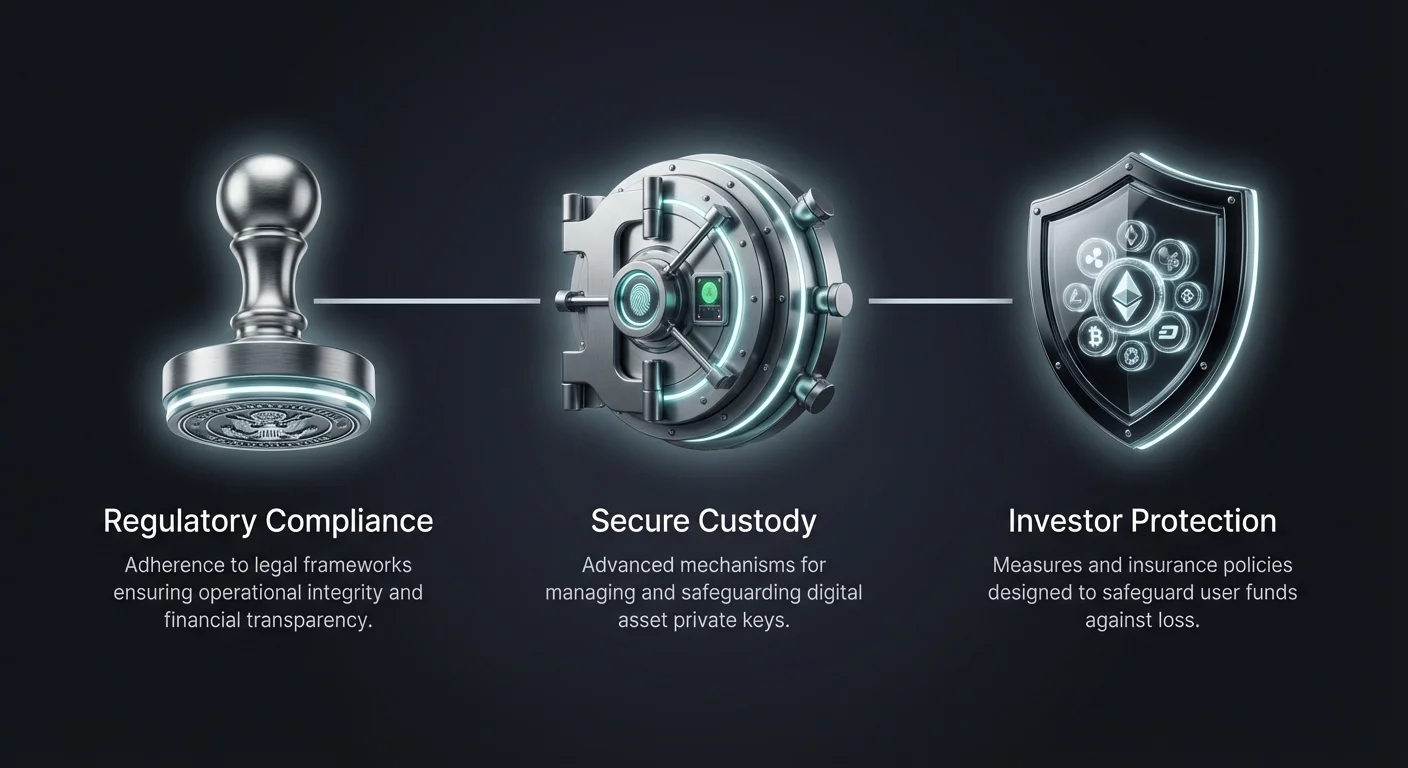
The cryptocurrency landscape has evolved significantly from its early days of unregulated experimentation. As digital assets have integrated into the broader financial system, the demand for secure trading environments has intensified. Investors now prioritize platforms that offer not just liquidity, but also rigorous compliance and robust custody solutions.
The shift toward regulation is not merely about following rules. It represents a fundamental maturity in market infrastructure. Institutional investors and retail traders alike seek assurance that their assets are protected against theft, insolvency, and operational failure. This has led to a clear distinction between regulated entities and unregulated marketplaces.
Custody lies at the heart of this security framework. It refers to how a platform holds, manages, and secures user funds. In the traditional banking world, custody is a standardized process with heavy government oversight. In the crypto sector, custody involves complex cryptographic key management and digital security protocols.
Choosing an exchange today requires understanding these mechanisms. Users must evaluate how an exchange balances accessibility with security. The most secure environments are those that combine regulatory oversight with advanced technological safeguards. This guide explores the critical components of regulation and custody in modern crypto trading.
The Foundation of Centralized Custody
Centralized exchanges (CEXs) act as intermediaries between buyers and sellers. When you deposit funds into a centralized exchange, you are effectively transferring custody of your assets to that platform. The exchange manages the private keys associated with the wallets holding your funds. This model mirrors traditional banking, where a financial institution safeguards your money.
The primary advantage of this model is convenience. Users do not need to manage complex private keys or worry about losing access to their funds due to a lost password. The exchange handles the technical aspects of security, allowing users to focus on trading. However, this convenience requires a high degree of trust in the platform's operational integrity.
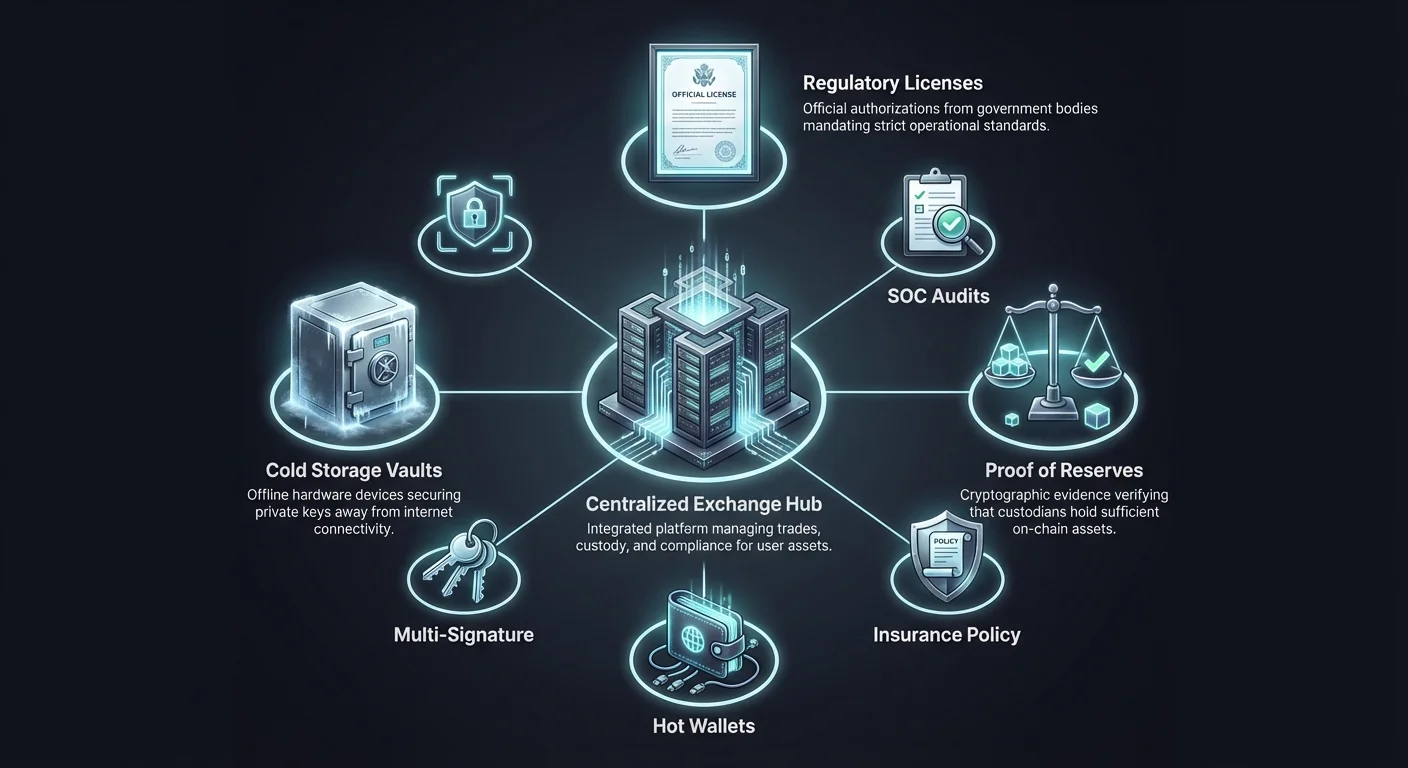
To maintain this trust, reputable exchanges implement tiered storage systems. They do not keep all user funds in a single wallet connected to the internet. Instead, they distribute assets across different storage types based on liquidity needs. This strategy minimizes the risk of a catastrophic loss in the event of a security breach.
Hot Wallets and Liquidity Management
Hot wallets are digital wallets that remain connected to the internet. Exchanges use these wallets to facilitate immediate trading, deposits, and withdrawals. Because they are online, they are necessary for high-frequency trading and instant liquidity. A user who wants to sell Bitcoin and withdraw cash immediately relies on the exchange having funds available in a hot wallet.
However, the internet connectivity of hot wallets makes them vulnerable to external attacks. Hackers target these entry points because they offer a direct route to the funds. To mitigate this risk, secure exchanges strictly limit the amount of capital held in hot wallets.
Industry best practices dictate that only a small percentage of total assets should be kept in hot wallets. This amount is typically calculated based on daily turnover requirements. If an exchange keeps 98% of its funds offline, a breach of the hot wallet would only impact a fraction of the total holdings.
The Cold Storage Standard
Cold storage represents the gold standard for digital asset custody. This method involves storing private keys on devices that are completely disconnected from the internet. These devices can include hardware wallets, paper wallets, or air-gapped computers. By removing the internet connection, cold storage eliminates the primary vector for remote cyberattacks.
Leading platforms like Coinbase and BTCC utilize cold storage for the vast majority of their customer assets. This ensures that even if a platform's web interface is compromised, the core funds remain inaccessible to attackers. The physical devices used for cold storage are often distributed across multiple geographic locations to prevent physical theft or damage from natural disasters.
Operational security for cold storage is rigorous. Accessing these funds often requires multiple approvals and physical access to secure facilities. This introduces a time delay for large withdrawals, which serves as an additional security feature. It allows the exchange to verify the authenticity of a request before any significant movement of funds occurs.
Regulatory Frameworks and Compliance
Regulation provides the legal framework within which exchanges operate. It establishes the rules for how a platform must handle customer funds, report to authorities, and protect user data. In the United States, this often involves a patchwork of federal and state regulations.
One of the most stringent regulatory standards is the BitLicense issued by the New York Department of Financial Services (NYDFS). Platforms like Gemini operate under this framework, which subjects them to capital reserve requirements and regular compliance exams. This level of oversight is designed to ensure that the exchange remains solvent and operates ethically.
Compliance also extends to anti-money laundering (AML) and know-your-customer (KYC) protocols. Regulated exchanges must verify the identity of their users to prevent illicit activities. While some traders view this as a privacy intrusion, it acts as a significant deterrent against fraud and criminal usage of the platform.
The Role of Public Listings
Some exchanges have taken the step of becoming publicly traded companies. Coinbase, for example, is listed on major stock exchanges. This status brings a higher level of transparency to the platform's operations. Public companies are required to file quarterly financial reports and disclose material risks to shareholders.
This public scrutiny forces the exchange to maintain rigorous accounting standards. They cannot hide financial difficulties or operational failures from the public eye. For traders, this transparency offers a layer of assurance that is often missing from private, unregulated entities.
The transition to a public company also implies a long-term commitment to compliance. These firms must answer to regulators like the SEC, ensuring that their business practices align with broader financial laws. This alignment helps legitimize the crypto industry and attracts institutional capital.
International Standards and MiCAR
Regulation is not limited to the United States. Europe has introduced the Markets in Crypto-Assets Regulation (MiCAR), a comprehensive framework for digital assets. Platforms like Bitpanda are adapting to these rules to serve European customers compliantly. MiCAR aims to harmonize rules across the European Union, providing legal certainty for service providers and protection for consumers.
Global compliance requires exchanges to navigate different rules in different jurisdictions. A platform operating in Asia, Europe, and the US must build a flexible compliance infrastructure. This often involves geofencing certain products or varying verification requirements based on the user's location.
Exchanges that proactively engage with international regulators demonstrate a commitment to longevity. They are less likely to face sudden shutdowns or legal actions that could freeze user funds. For a global trader, using a platform that is compliant in multiple top-tier jurisdictions offers the highest level of safety.
Audits and Proof of Reserves
Trust in a centralized entity should not be blind. The concept of "Proof of Reserves" has gained prominence as a way for exchanges to verify their solvency. This involves cryptographic proof that the exchange holds enough on-chain assets to cover all customer liabilities.
Uphold, for instance, promotes a model of transparency where reserve data is updated in real-time. This allows users to verify that their funds are actually backing their account balances. A 100% reserve model ensures that the exchange is not lending out customer funds for high-risk investments.
However, a simple snapshot of a wallet balance is not always sufficient. It must be paired with proof of liabilities to show that the assets exceed what is owed to customers. This is where third-party audits become essential.
SOC Certifications
Service Organization Control (SOC) certifications are rigorous audits performed by independent accounting firms. They evaluate a company's internal controls regarding security, availability, processing integrity, confidentiality, and privacy. Gemini, for example, has achieved SOC 1 Type 2 and SOC 2 Type 2 certifications.
A SOC 1 audit focuses on financial reporting controls. It verifies that the exchange's financial data is accurate and that internal processes prevent accounting errors or fraud. This is crucial for institutional clients who need to report their holdings accurately.
A SOC 2 audit focuses on information security and data privacy. It tests the exchange's ability to protect sensitive user data and resist cyber threats. Achieving these certifications requires a significant investment of time and resources, signaling a mature approach to operational security.
Independent Security Assessments
Beyond financial audits, secure exchanges undergo regular security penetration testing. This involves hiring ethical hackers to attempt to breach the system. These tests identify vulnerabilities in the platform's code or infrastructure before malicious actors can exploit them.
Exchanges often publish the results of these assessments or maintain a bug bounty program. A bug bounty program rewards independent researchers for finding and reporting security flaws. This crowdsourced approach to security helps platforms stay ahead of emerging threats.
Continuous monitoring is also vital. Security is not a one-time achievement but an ongoing process. Exchanges must constantly update their protocols to defend against new types of phishing attacks, malware, and social engineering tactics.
Insurance and Consumer Protection
In the traditional financial world, bank deposits are often insured by government agencies. In the crypto world, government insurance is rare, so private insurance policies play a critical role. Leading exchanges purchase insurance policies to cover potential losses from theft or cybersecurity breaches.
Coinbase and Gemini are examples of platforms that carry digital asset insurance. This coverage typically applies to funds held in hot wallets, which are the most vulnerable to attacks. It provides a safety net for users in the unlikely event of a successful hack against the exchange's online infrastructure.
It is important for users to understand the limits of these policies. Exchange insurance generally covers errors or theft on the part of the exchange itself. It does not usually cover losses resulting from unauthorized access to a user's individual account due to weak passwords or phishing.
| Feature | Description | Benefit |
|---|---|---|
| Commercial Crime Insurance | Covers theft of digital assets | Protects against exchange-level hacks |
| Specie Insurance | Covers assets in cold storage | Protects against physical theft or damage |
| FDIC Pass-Through | Covers USD balances | Protects fiat currency up to limit |
FDIC Insurance for Fiat Balances
While crypto assets are not covered by the FDIC, US dollar balances held on some exchanges may be eligible for pass-through insurance. Platforms like Uphold and Coinbase often hold customer fiat funds in custodial accounts at FDIC-insured banks.
This means that if the bank holding the US dollars were to fail, the customer's fiat funds would be protected up to the standard limit, typically $250,000. This protection applies specifically to the cash held in the account, not the cryptocurrency.
Understanding this distinction is vital. A user holding Bitcoin is not protected by the FDIC if the exchange fails or if Bitcoin's value drops. However, a user holding USD in preparation for a trade does have a layer of federal protection on compliant platforms.
The Non-Custodial Alternative
Decentralized exchanges (DEXs) offer a fundamentally different approach to custody. On a DEX, the platform never takes possession of the user's funds. Instead, trading occurs directly between users' wallets via smart contracts. This is known as non-custodial trading.
The primary security benefit of a DEX is that there is no central honey pot of funds for hackers to target. To steal funds, an attacker would need to compromise individual user wallets or find a flaw in the smart contract code. For users who prioritize control, this model is appealing because they retain full ownership of their private keys.
However, the lack of a central custodian transfers all security responsibility to the user. If a user loses their private key or falls victim to a phishing scam, there is no customer support team to assist with recovery. The irreversible nature of blockchain transactions makes mistakes permanent.
Compliance Challenges in DeFi
Decentralized exchanges often operate without the strict KYC/AML checks found on centralized platforms. This offers greater privacy but creates a complex relationship with regulators. As regulatory frameworks evolve, some DEXs are beginning to implement permissioned pools or interface-level screening to comply with sanctions lists.
The lack of identity verification means that DEXs are generally not suitable for institutional investors who have strict compliance mandates. These investors require a clear audit trail and the assurance that they are not transacting with sanctioned entities.
For the retail trader, the compliance gap can also be a risk. In the event of a dispute or a technical failure, there is often no legal entity to hold accountable. The "code is law" philosophy of DeFi means that smart contract bugs can lead to total loss without recourse.
Hybrid and Assisted Custody Models
The industry is increasingly exploring hybrid models that attempt to bridge the gap between centralized convenience and decentralized control. These solutions aim to offer the security of self-custody with the support features of a centralized service.
Uphold's Vault is an example of an assisted self-custody solution. It allows users to hold their own keys while maintaining a backup key with the service provider. This setup enables the user to initiate trades and move funds independently, but also offers a recovery path if the primary key is lost.
This model addresses one of the biggest fears in self-custody: the loss of keys. By splitting the key management responsibilities, users get the benefits of ownership without the catastrophic risk of being locked out of their own wealth.
Multi-Signature Security
Multi-signature (multi-sig) technology is a core component of secure custody. It requires multiple private keys to authorize a transaction. For example, a 2-of-3 multi-sig setup might require signatures from the user, the exchange, and a third-party security firm to move funds.
This architecture prevents any single bad actor from stealing assets. Even if a hacker compromises the exchange's key, they cannot move the funds without the other signatures. This is widely used in institutional custody solutions and is becoming more common for retail products.
Exchanges like Bitget and PrimeXBT employ multi-sig wallets to secure their hot and cold storage. This redundancy ensures that internal collusion or external breach of a single server is insufficient to execute an unauthorized withdrawal.
Institutional-Grade Security for Retail
Features that were once exclusive to institutional investors are trickling down to the retail market. Over-the-counter (OTC) trading desks, for example, offer private execution for large orders. Platforms like Gemini and Kraken provide these services to prevent large trades from disrupting market prices.
While OTC is primarily about liquidity, it also offers a security benefit. By keeping large orders off the public order book, traders reduce the risk of front-running and price manipulation. The settlement process for OTC trades is often handled directly between custodians, reducing the time funds are exposed.
Furthermore, the security protocols developed for institutional clients—such as whitelisted addresses and dedicated account managers—are becoming standard features for all users. These tools allow retail traders to lock down their accounts with the same rigor as a hedge fund.
Advanced Order Types and Risk Management
Secure trading environments also provide tools for risk management. Advanced order types like stop-loss and take-profit limits allow traders to automate their exit strategies. This is crucial in the volatile crypto market, where prices can swing dramatically in minutes.
Platforms like BTCC and PrimeXBT offer these contract trading tools. By automating trades, users reduce the emotional element of trading, which can often lead to poor security decisions. For instance, a panic-induced manual transfer is more likely to result in a mistake than a pre-set automated order.
Derivatives exchanges also provide hedging mechanisms. Futures and options allow traders to protect their portfolio value against downside moves. While these are financial tools rather than custodial ones, they contribute to the overall security of an investment strategy.
User-Side Security Responsibilities
Even the most secure exchange cannot protect a user who acts carelessly. The final line of defense is always the user. Secure exchanges provide the tools, but the user must activate and utilize them effectively.
Two-factor authentication (2FA) is non-negotiable. However, not all 2FA is created equal. SMS-based 2FA is vulnerable to SIM swapping attacks. Secure platforms encourage the use of authenticator apps or hardware security keys (like YubiKeys) which offer much stronger protection.
Address whitelisting is another critical feature. This allows users to designate specific external wallet addresses as the only approved destinations for withdrawals. If an attacker gains access to the account, they cannot withdraw funds to their own wallet because it is not on the whitelist.
Recognizing Phishing and Fraud
Phishing remains the most common method for compromising accounts. Attackers create fake websites or send emails pretending to be the exchange support team. They trick users into revealing their login credentials or private keys.
Safe exchanges will never ask for your password or private keys via email. They use anti-phishing codes—a personalized phrase or code that appears in every official email—to help users verify the authenticity of communications.
Education is a key component of defense. Platforms like Coinbase invest heavily in educational resources to teach users how to spot scams. Understanding the common tactics used by fraudsters is as important as the technical security of the platform itself.
Evaluating Exchange Safety
When selecting an exchange, users should conduct their own due diligence. A flashy interface or high leverage offers should not distract from the fundamentals of security and compliance. There are specific indicators that reveal a platform's commitment to safety.
First, check the regulatory status. Is the exchange licensed in a major jurisdiction like the US, UK, or EU? Does it comply with KYC/AML regulations? Operating in the shadows is a major red flag for long-term security.
Second, look for transparency. Does the exchange publish proof of reserves? Are their audit reports available? A trustworthy platform is open about its financial health and security practices.
Finally, assess the track record. How long has the exchange been in operation? Has it ever been hacked? If so, how did they handle it? Did they reimburse users? Platforms like BTCC highlight their long operational history without security incidents as a primary selling point.
The Importance of Customer Support
In the event of a security concern, rapid access to support is vital. The best exchanges offer 24/7 customer support through multiple channels. This ensures that if a user suspects compromised access, they can freeze their account immediately.
Automated bots are often insufficient for security emergencies. Access to human support staff who can verify identity and take administrative action is a crucial safety feature.
Conclusion
The cryptocurrency market has matured into an ecosystem where security and compliance are paramount. The days of prioritizing unregulated speed over safety are fading. Today, the most secure trading environments are those that successfully integrate rigorous custodial standards with regulatory oversight.
Investors must recognize that the choice of exchange is a security decision. Platforms that employ cold storage, undergo independent audits, and maintain transparent reserves offer the best protection against systemic risks. Whether choosing a centralized custodian for convenience or a non-custodial solution for control, understanding the underlying mechanics is essential.
As the industry continues to evolve, the line between traditional finance and crypto will blur further. Regulatory frameworks like MiCAR and NYDFS licensing will likely become the global baseline. For the trader, aligning with these standards is the surest path to long-term asset preservation.
True security in crypto trading comes from the combination of regulatory compliance, transparent custody, and personal vigilance.