
The cryptocurrency market is known for its volatility and rapid price fluctuations. While many investors focus on holding assets for the long term or attempting to time market peaks, a different strategy exists that capitalizes on market inefficiencies. Arbitrage trading offers a method to generate profits by exploiting price differences for the same asset across different platforms. This approach is often considered lower risk compared to directional trading because it does not rely on the market going up or down.
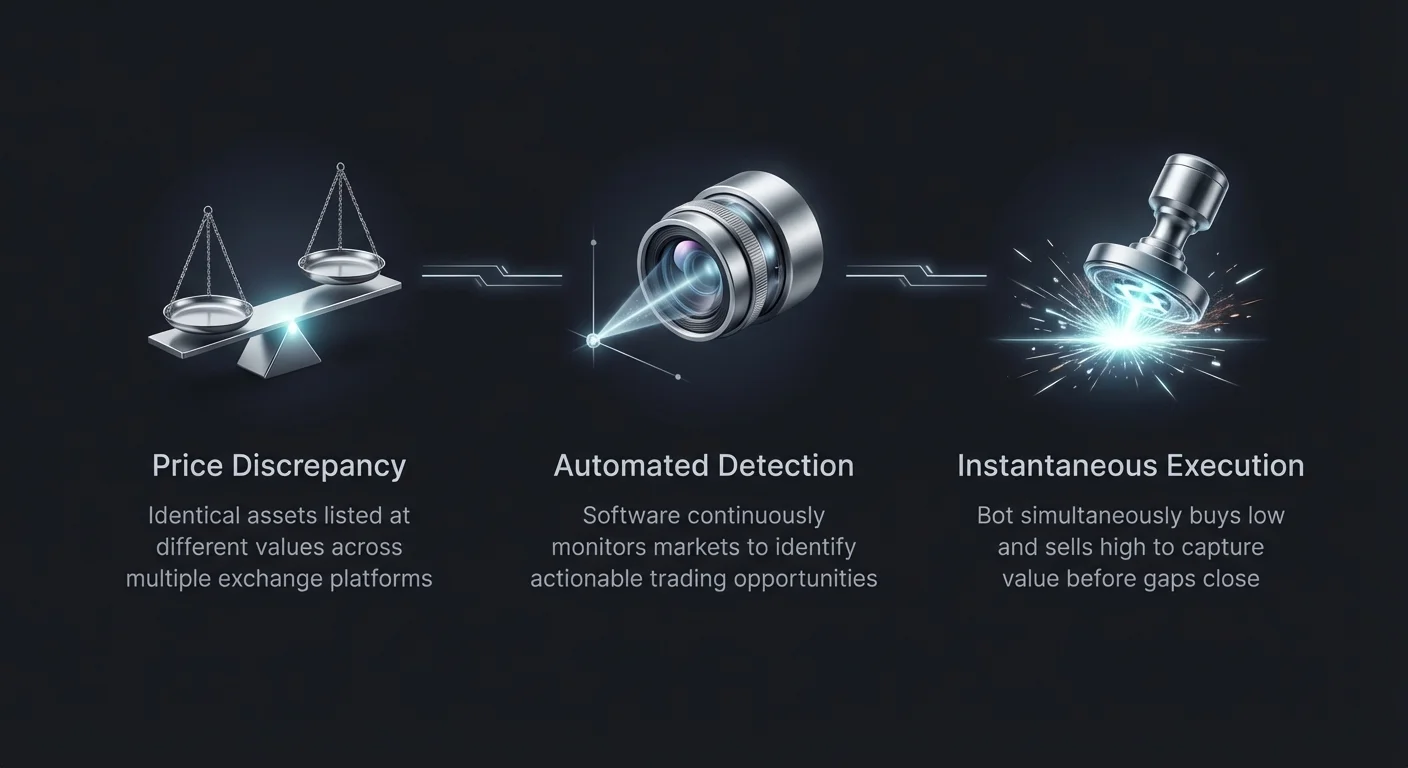
However, the speed at which cryptocurrency markets move makes manual arbitrage nearly impossible for the average trader. Prices correct themselves in seconds or even milliseconds as the market absorbs liquidity. This is where automated trading solutions come into play. Arbitrage trading bots are sophisticated software programs designed to monitor markets, identify price discrepancies, and execute trades instantaneously. By removing human reaction time and emotional decision-making, these bots allow traders to capture value from fleeting market opportunities.
Understanding how these bots function is the first step toward maximizing profits. It requires a deep dive into market mechanics, the technology behind automated trading, and the strategies that define successful arbitrage. From triangular arbitrage within a single exchange to complex cross-platform strategies, the landscape is diverse. This guide explores the technical and strategic elements of using arbitrage bots to navigate the crypto ecosystem.
The Mechanics of Crypto Arbitrage
Arbitrage is a financial concept that predates cryptocurrency, but digital assets have created a unique environment for it to thrive. In a perfectly efficient market, an asset would have the exact same price on every exchange simultaneously. However, the crypto market is fragmented across hundreds of exchanges, each with its own order book and liquidity depth. This fragmentation leads to price disparities.
Understanding Price Discrepancies
Price differences occur for several reasons. One primary factor is trading volume. A large buy order on one exchange might drive the price of Bitcoin up temporarily on that specific platform, while the price remains stable on another exchange with lower volume. Until traders or bots step in to sell on the expensive exchange and buy on the cheaper one, a gap exists. This gap is the profit margin for an arbitrageur.
Another cause of disparity is geographic demand. In certain regions, capital controls or high demand for digital assets can inflate prices on local exchanges compared to the global average. This phenomenon, sometimes referred to as the "Kimchi Premium" in South Korea, highlights how local market conditions create arbitrage opportunities. Bots are programmed to scan these prices constantly, looking for gaps that exceed the cost of trading fees.
The volatility of the asset itself also plays a role. During periods of rapid market movement, exchanges may update their price feeds at slightly different rates. Network congestion can delay deposits or withdrawals, isolating an exchange’s liquidity pool and causing prices to diverge from the broader market market. Arbitrage bots thrive in these chaotic moments.
The Necessity of Automation
While the concept of buying low and selling high is simple, the execution in arbitrage is technically demanding. A human trader cannot monitor dozens of exchanges simultaneously, calculate fees, and execute two synchronized trades in under a second. By the time a person notices a price gap, logs into their accounts, and types in the order, the opportunity has usually vanished.
Automation solves the issue of latency. Trading bots connect directly to exchange servers via Application Programming Interfaces (APIs). This allows them to receive price data and send order instructions without the overhead of a graphical user interface. A well-optimized bot can execute a trade in milliseconds. This speed is the defining factor between a profitable arbitrage trade and a failed one.
Bots also offer the advantage of 24/7 operation. Cryptocurrency markets never close, and significant price movements often happen outside of standard business hours. An automated system continues to hunt for opportunities while the trader sleeps, ensuring that no profitable gaps are missed due to human downtime. This continuous operation maximizes the efficiency of capital deployment.
Types of Arbitrage Strategies
Arbitrage is not a monolithic strategy. There are several distinct methods that bots use to generate profit. Each comes with its own set of technical requirements, risks, and capital considerations. Understanding the differences is crucial for selecting the right bot and configuration for your goals.
Cross-Exchange (Spatial) Arbitrage
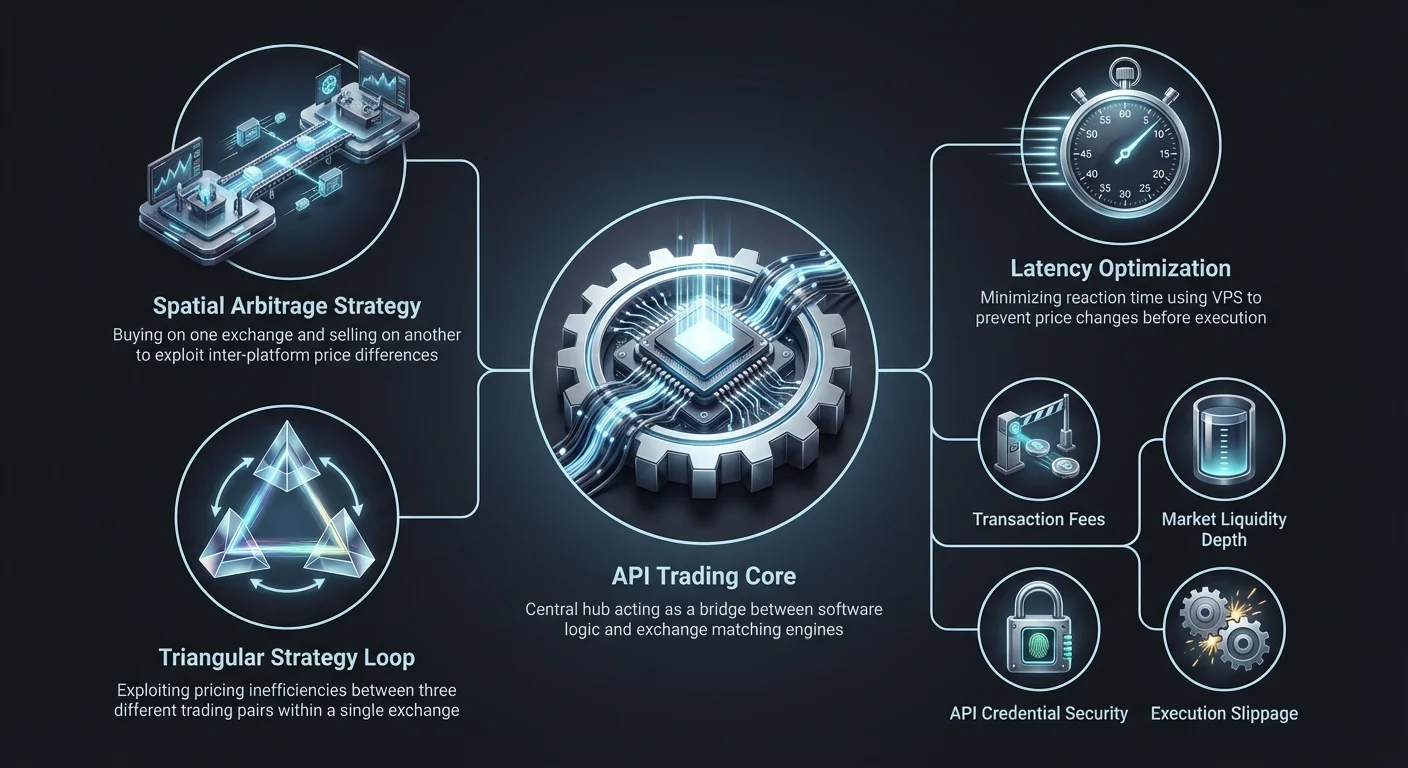
Cross-exchange arbitrage, also known as spatial arbitrage, is the most intuitive form of this trading style. It involves buying a cryptocurrency on one exchange where the price is low and immediately selling it on another exchange where the price is high. For example, a bot might detect that Ethereum is trading at $2,500 on Exchange A and $2,510 on Exchange B. It buys on A and sells on B to capture the difference.
There are two ways to execute this. The first is the "transfer method," where assets are moved between exchanges. This is slow and risky due to blockchain transfer times. By the time the funds arrive, the price gap may have closed. This method is rarely used for high-frequency arbitrage.
The second, more effective method involves holding balances on both exchanges simultaneously. The bot holds US Dollars (or stablecoins) on Exchange A and the cryptocurrency on Exchange B. When the opportunity arises, it buys on Exchange A and sells on Exchange B at the exact same moment. No funds need to be transferred between exchanges to lock in the profit. The trader simply rebalances the portfolio later.
Triangular Arbitrage
Triangular arbitrage takes place entirely within a single exchange. This strategy exploits pricing inefficiencies between three different trading pairs. For instance, a trader might start with Bitcoin, use it to buy Ethereum, use the Ethereum to buy Litecoin, and finally sell the Litecoin back into Bitcoin. If the exchange rates between these pairs are not perfectly aligned, the trader ends up with more Bitcoin than they started with.
This method is highly popular for bots because it eliminates the risk of transfer times and exchange solvency issues. The entire loop happens on one platform. However, because it is lower risk and easier to execute, competition is fierce. High-frequency trading firms often dominate this space with extremely fast connections, making it competitive for retail bots.
Statistical and Convergence Arbitrage
Statistical arbitrage involves using mathematical models to predict price movements based on historical data. While not strictly "risk-free" in the same way as spatial arbitrage, it uses bots to identify when the price of an asset has deviated statistically from its expected value relative to other assets. The bot places trades betting that the prices will converge back to their historical mean.
This strategy often employs a "long/short" approach. If two assets typically move in sync but temporarily diverge, the bot might go long on the underperforming asset and short the outperforming one. When the relationship normalizes, the bot closes both positions for a profit. This requires sophisticated algorithms and usually involves leverage, which introduces higher risk.
Technical Architecture of Trading Bots
To effectively utilize arbitrage bots, one must understand the technical infrastructure that powers them. The software does not exist in a vacuum; it relies on a web of connections, permissions, and data streams. The quality of these technical components often dictates the success of the strategy.
API Integration and Management
The core connection between a bot and an exchange is the API. An API acts as a bridge, allowing the software to "talk" to the exchange's matching engine. When setting up a bot, the user must generate API keys on their exchange account. These keys act as a secure password that authorizes the bot to perform specific actions.
Security is paramount here. Users should only grant the necessary permissions to these keys. Typically, a trading bot needs "Read" permissions to view balances and prices, and "Trade" permissions to place orders. Crucially, "Withdrawal" permissions should almost never be granted to a trading bot. If a bot is compromised, the lack of withdrawal access prevents attackers from draining the account.
Latency and Connection Speed
In the race for arbitrage profits, speed is everything. Latency refers to the delay between a signal being sent and a response being received. High latency can result in "slippage," where the price changes between the moment the bot sees the opportunity and the moment the order is executed. If the price slips too much, the potential profit can turn into a loss.
Professional traders often use Virtual Private Servers (VPS) to host their bots. By placing the bot on a server that is geographically close to the exchange's data center, traders can shave milliseconds off their reaction time. For example, if an exchange's servers are in Tokyo, hosting the bot on a cloud server in Tokyo is far superior to running it on a home computer in New York.
Order Types and Execution
Arbitrage bots typically rely on "Limit" orders or "Market" orders, depending on the strategy. A Market order executes immediately at the current best available price. This ensures the trade happens, but the final price might be worse than expected if liquidity is thin. This is risky for tight arbitrage margins.
Limit orders set a specific price at which the bot is willing to buy or sell. This guarantees the price but not the execution. If the market moves away from the limit price, the order may sit unfilled, leaving the arbitrage loop incomplete. Advanced bots use complex algorithms to manage these orders, sometimes placing "Fill or Kill" orders that cancel automatically if they cannot be fully executed at the desired price.
The Impact of Fees on Profitability
One of the most common pitfalls for new arbitrage traders is failing to account for fees. Crypto exchanges are businesses that charge for their services, and these costs directly eat into arbitrage margins. Since arbitrage relies on capturing small price differences, fees can easily turn a winning trade into a losing one.
Trading Fees: Maker vs. Taker
Exchanges typically use a maker-taker fee model. "Makers" are traders who place limit orders that are added to the order book, providing liquidity to the market. "Takers" are traders who place market orders that match with existing orders, removing liquidity. Exchanges often incentivize makers with lower fees (or even rebates) while charging takers higher fees.
Arbitrage often requires speed, which forces bots to act as "takers" to ensure immediate execution. This means the bot incurs the highest tier of fees. To be profitable, the price spread between assets must be wider than the combined taker fees of both the buy and the sell side. If the total fees are 0.2% and the price gap is only 0.15%, the trader loses money.
Withdrawal and Network Fees
For strategies involving cross-exchange transfers, withdrawal fees are a significant factor. Exchanges charge a flat fee to move assets off their platform, which covers the blockchain network costs. For assets like Bitcoin or Ethereum, these fees can be substantial during times of network congestion.
If a trader is moving small amounts of capital, the flat withdrawal fee can represent a huge percentage of the total value, destroying profitability. Therefore, cross-exchange transfer strategies are generally only viable with larger capital amounts where the flat fee becomes a negligible percentage of the total volume.
Fee Optimization Strategies
To mitigate the impact of fees, traders often utilize exchange tokens. Many centralized exchanges offer significant discounts on trading fees if the user holds their native token or pays fees using that token. Additionally, high-volume traders can qualify for VIP tiers that drastically reduce costs.
Bots can be programmed to calculate these fees in real-time before executing a trade. If the calculated profit after fees does not meet a minimum threshold, the bot will skip the trade. This "minimum profit filter" is a critical setting in any arbitrage software to prevent death by a thousand cuts.
Risk Management in Arbitrage
Despite being labeled as "low risk," arbitrage is not risk-free. The risks are simply different from those associated with holding an asset. Technical failures, market dynamics, and platform risks all pose threats to capital. A robust risk management strategy is essential for long-term survival.
Execution Risk and Slippage
Execution risk occurs when one leg of the arbitrage trade fills, but the other does not. For example, in a cross-exchange strategy, the bot might successfully buy Bitcoin on Exchange A, but before it can sell on Exchange B, the price on Exchange B crashes. The trader is left holding the asset with an open exposure to market direction.
This is often caused by slippage or a sudden lack of liquidity. To manage this, sophisticated bots check the order book depth before trading. They verify that there is enough volume at the target price to absorb the entire order. If the order book is thin, the bot may reduce the trade size or abort the attempt.
Platform and Security Risks
Holding funds on centralized exchanges introduces counterparty risk. If an exchange is hacked, becomes insolvent, or pauses withdrawals, the trader’s capital is trapped. Since cross-exchange arbitrage requires keeping funds on multiple platforms simultaneously, the exposure to this risk is multiplied.
Diversification is the key defense. Rather than keeping all capital on two exchanges, traders spread funds across four or five reputable platforms. This ensures that if one platform faces issues, the entire trading operation is not wiped out. Additionally, enabling strict security protocols like two-factor authentication (2FA) and whitelist-only withdrawals adds layers of protection.
API Key Security
The API keys used by bots are sensitive credentials. If a hacker gains access to a user's API secret key, they can execute trades on the user's behalf. A common attack vector involves using the compromised key to pump a low-liquidity coin that the hacker holds, effectively siphoning value from the victim's account.
To prevent this, API keys should be IP-restricted. This setting tells the exchange to only accept commands from a specific IP address (such as the trader's VPS). If a command comes from anywhere else, it is blocked. Furthermore, keys should be rotated regularly, and old, unused keys should be deleted immediately.
Choosing the Right Arbitrage Bot
The market is flooded with trading bot providers, ranging from free open-source software to expensive enterprise-grade platforms. Selecting the right tool depends on the trader's technical skill, capital size, and preferred strategy.
| Feature Category | What to Look For | Why It Matters |
|---|---|---|
| Exchange Support | High number of major CEXs | More exchanges equal more potential price gaps. |
| Speed | Cloud-based or local execution | Lower latency increases the chance of winning trades. |
| Customization | Configurable logic/triggers | Allows tailoring strategies to specific market conditions. |
Cloud-Based vs. Local Bots
Cloud-based bots run on the provider's servers. They are generally easier to set up and accessible from any device. The user logs into a dashboard, connects their exchanges, and starts the bot. The downside is that the user trusts a third party with their API keys, and they share bandwidth with other users.
Local bots are software packages downloaded and installed on the user's machine or private server. This offers greater privacy and security, as API keys never leave the user's control. It also allows for dedicated resource usage. However, it requires more technical knowledge to maintain the server and ensure 24/7 uptime.
Pre-Built Strategies vs. Scripting
For beginners, platforms offering pre-built strategies are ideal. These "plug-and-play" bots require minimal configuration—usually just selecting the trading pair and the investment amount. They rely on standard algorithms that are proven to work but may offer lower returns due to high usage by the public.
Advanced platforms offer scripting languages or visual editors that allow traders to build custom logic. A trader can create complex conditions, such as "Only trade if volume increases by 10% and the spread is above 0.5%." This flexibility allows traders to find unique niches in the market that standard bots might miss.
Alternative Automated Strategies
While arbitrage is a powerful tool, it is not the only automated strategy available. Market conditions change, and sometimes arbitrage opportunities dry up. In these scenarios, having alternative automated strategies in the toolkit ensures that capital continues to work efficiently.
Grid Trading Automation
Grid trading is a strategy that excels in sideways or ranging markets—conditions where arbitrage can sometimes be difficult to find due to low volatility. A grid bot divides a price range into multiple levels, creating a "grid" of buy and sell orders. As the price fluctuates within this range, the bot buys when the price drops and sells when it rises slightly.
This strategy profits from the "noise" of the market. It does not require the price to go to the moon; it just needs the price to wiggle. Grid bots are highly complementary to arbitrage bots. While arbitrage bots hunt for specific inefficiencies, grid bots passively harvest volatility. Many leading exchanges now offer built-in grid trading tools, making them accessible to everyone.
Copy Trading
For those who prefer a hands-off approach or lack the technical confidence to configure their own bots, copy trading is a viable alternative. This system allows users to automatically mirror the trades of experienced investors. When the "lead trader" executes a buy order, the follower's account executes the same order proportionally.
Copy trading platforms provide detailed statistics on lead traders, including their win rates, drawdown history, and return on investment (ROI). This transparency allows users to vet traders before allocating funds. While it introduces the human element back into the equation (since you are copying a human), the execution is automated. It serves as a passive income stream that can run alongside an active arbitrage operation.
Dollar-Cost Averaging (DCA) Bots
DCA bots are the simplest form of automation but are highly effective for long-term accumulation. Instead of trying to time an entry or exploit a spread, a DCA bot buys a fixed dollar amount of an asset at regular intervals (e.g., $50 of Bitcoin every Monday).
This strategy smoothes out the average entry price over time, mitigating the risk of buying a market top. While not an arbitrage strategy, DCA bots are a crucial tool for managing the "holding" portion of a portfolio. They remove the emotional stress of trying to buy the dip and ensure disciplined investing regardless of market sentiment.
Evaluating Exchange Liquidity and Reliability
An arbitrage bot is only as good as the exchange it trades on. The underlying infrastructure of the platform dictates how effectively a strategy can be executed. Liquidity, in particular, is the lifeblood of arbitrage.
The Role of Liquidity
Liquidity refers to the ease with which an asset can be bought or sold without affecting its price. In an order book, deep liquidity means there are many buy and sell orders at various price levels. For an arbitrage bot, high liquidity ensures that orders are filled immediately and at the expected price.
If an exchange has low liquidity, a bot placing a moderate-sized order might experience significant slippage. The order might eat through the top of the order book and start filling at worse prices, destroying the arbitrage margin. Therefore, bots should primarily target top-tier exchanges with high volume, as these platforms offer the stability required for consistent execution.
Reliability and Uptime
Arbitrage often occurs during periods of high volatility. Unfortunately, these are the exact times when exchange infrastructure is under the most stress. If an exchange's interface lags or its API goes down during a market spike, the bot is blinded.
Reliability is a key metric when choosing where to deploy capital. Traders often look for exchanges with a history of 99.9% uptime and robust matching engines capable of handling millions of transactions per second. Historical data on exchange outages can provide insight into which platforms crumble under pressure and which ones stand firm.
Navigating Regulatory Compliance
As the cryptocurrency industry matures, regulatory compliance has become a significant factor for automated traders. Different jurisdictions have different rules regarding trading frequency, tax reporting, and the use of automated software.
KYC and Account Limits
Most centralized exchanges now require Know Your Customer (KYC) verification. This involves submitting identity documents to unlock higher trading limits. For arbitrage traders, these limits are crucial. A low withdrawal limit can bottleneck a cross-exchange strategy, preventing the necessary rebalancing of funds.
Traders operating bots must ensure they are fully verified on all platforms they use. Furthermore, they must be aware of the geographic restrictions of certain exchanges. Some platforms do not allow users from specific countries to access futures or margin trading products, which limits the types of arbitrage strategies (like funding rate arbitrage) that can be employed.
Tax Implications of High-Frequency Trading
Automated trading can generate thousands of transactions per year. From a tax perspective, this can be a nightmare to track manually. Every trade is a taxable event in many jurisdictions, requiring the calculation of capital gains or losses.
Traders using bots should utilize specialized crypto tax software that integrates with exchange APIs. These tools automatically import transaction histories and calculate the tax liability. Ignoring this aspect can lead to severe legal and financial consequences. The efficiency of a bot is wasted if the profits are consumed by fines for improper tax reporting.
Optimization and Continuous Monitoring
Setting up an arbitrage bot is not a "set it and forget it" activity. The crypto market is a living, breathing ecosystem that evolves constantly. A strategy that prints money today might bleed capital tomorrow if market conditions shift.
Performance Analytics
Successful traders treat their bot operations like a business. This involves regular auditing of performance metrics. Key indicators to monitor include the fill rate (percentage of orders successfully executed), the average profit per trade, and the total fees paid.
If the fill rate drops, it might indicate that the bot's latency is too high or that competitors are beating it to the punch. If fees are eating up a larger percentage of profits, it might be time to adjust the minimum profit threshold. Constant analysis allows for fine-tuning the parameters to maintain peak efficiency.
Adapting to Market Cycles
Arbitrage opportunities change with the market cycle. In a bull market, prices vary wildly, and premiums on certain exchanges can skyrocket. In a bear market, volatility often compresses, and spreads tighten. A bot configured for the wild swings of a bull run might sit idle in a bear market.
Traders must be adaptable. This might mean switching from a cross-exchange strategy to a grid trading strategy during quiet periods. It might mean moving capital to different assets that are currently experiencing volatility. The ability to recognize a change in market regime and reconfigure the software accordingly is the hallmark of an expert algorithmic trader.
Conclusion
Arbitrage trading bots represent a powerful intersection of finance and technology, offering a systematic way to profit from the inherent inefficiencies of the cryptocurrency market. By automating the detection and execution of trades, these tools allow individuals to compete in an arena previously dominated by institutional players. Whether utilizing simple spatial arbitrage or complex triangular strategies, the core principle remains the same: using speed and precision to capture value that human traders simply cannot reach.
However, the path to profitability is paved with technical challenges. From managing API security and minimizing latency to navigating the complex web of fees and regulatory requirements, successful automation requires diligence. It is not a magic money printer but a sophisticated tool that rewards careful planning, risk management, and continuous optimization. The most successful traders are those who understand both the code running their bots and the economic forces moving the market.
As the crypto landscape continues to evolve in 2025 and beyond, the technology behind these bots will only become more advanced. Artificial intelligence and machine learning are already beginning to play larger roles in predictive analysis and execution strategies. For the informed trader, staying ahead of these trends and mastering the fundamentals of automated arbitrage offers a compelling avenue for maximizing low-risk profits in the digital asset economy.
Success in automated trading comes from mastering the balance between speed, security, and strategy.