
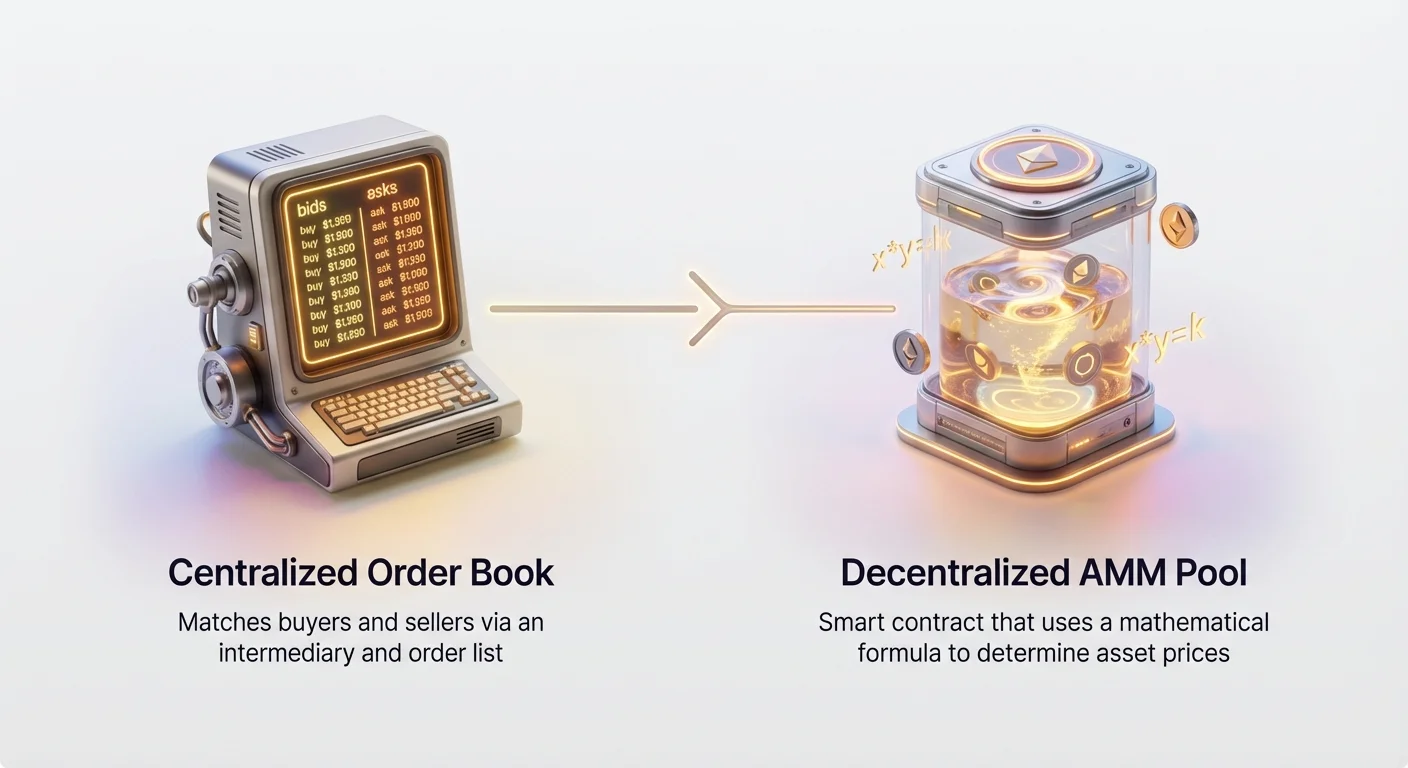
Zamislite da pokušavate razmijeniti valutu u stranoj zemlji bez banaka, brokera ili centraliziranih mjenjačnica. U tradicionalnom financijskom svijetu, kupnja i prodaja imovine oslanja se na središnju knjigu naloga gdje posrednik spaja kupce (ponude za kupnju) i prodavače (ponude za prodaju).
Kada se svijet kriptovaluta prebacio na decentralizirane mjenjačnice (DEX), pojavio se novi problem: tko se bavi spajanjem i osigurava da je uvijek netko spreman za trgovanje, 24/7, bez središnjeg autoriteta?
Rješenje je Automatski tvorac tržišta (AMM). AMM-ovi su ključna infrastruktura koja pokreće decentralizirane financije (DeFi). Oni zamjenjuju tradicionalne kupce i prodavače pametnim ugovorima koji matematički određuju cijene imovine i automatski izvršavaju trgovine. Za kripto početnike, razumijevanje AMM-a je poput gledanja ispod haube DEX-a – to je mjesto gdje se stvarno događa magija, matematika i novac.
Ovaj vodič će vas korak po korak provesti kroz tehnologiju koja pokreće zamjenu, suprotstavljajući izvorne, revolucionarne modele konstantne funkcije sa složenijim, učinkovitijim sustavima koncentrirane likvidnosti koji dominiraju DeFi krajolikom danas.
The Foundations of Decentralized Trading
To understand why AMMs are necessary, we first need to appreciate the mechanism they replaced: the centralized order book.
Order Books vs. Liquidity Pools: The Problem AMMs Solved
In a traditional or centralized crypto exchange (like Coinbase or Binance), trading is facilitated by an order book.
Order Book: This is a list of all current offers to buy (bids) and sell (asks) a specific asset at various prices. When you place a market order, the exchange looks for a matching bid or ask in the book and executes the trade. This requires professional market makers (large firms or institutions) to constantly provide bids and asks to ensure enough assets are available for trading.
The Challenge in DeFi: Decentralized platforms cannot rely on a single, continuously updated, centralized order book. They need a decentralized, trustless, and always-on system.
AMMs solve this by introducing liquidity pools. Instead of matching buyers and sellers, traders interact directly with a pool of tokens locked within a smart contract. The price is not determined by the last bid/ask but by the ratio of the tokens remaining in the pool.
Defining the Automated Market Maker (AMM)
An Automated Market Maker (AMM) is simply a smart contract that manages a pool of two or more tokens and uses a mathematical formula (an algorithm) to determine the price relationship between them.
When a trader wants to swap Token A for Token B:
- They send Token A to the smart contract pool.
- The AMM uses its formula to calculate how much Token B they should receive based on the pool’s current ratio.
- Token B is released to the trader.
Because Token A was added and Token B was removed, the ratio within the pool changes, causing the price of Token B to increase relative to Token A. This process ensures the pool remains mathematically balanced and liquid.
The Role of Liquidity Providers (LPs)
AMMs are useless without tokens to swap. This is where Liquidity Providers (LPs) come in. LPs are everyday users (or institutions) who deposit an equal value of two different assets into the pool (e.g., $1,000 worth of ETH and $1,000 worth of USDC).
In return for providing this crucial liquidity, LPs receive:
- LP Tokens: These represent their share of the pool.
- Trading Fees: A small percentage fee is charged on every trade that occurs in that pool (usually 0.05% to 0.3%). These fees are collected by the pool and distributed proportionally to all LPs.
LPs are essentially the decentralized market makers, earning income for enabling global trading.
The Constant Product Market Maker (CPMM) — The Pioneer
The first successful and most widely implemented AMM model was the Constant Product Market Maker (CPMM), famously popularized by Uniswap V1 and V2. This model established the core foundation for virtually all decentralized swapping.
The Core Formula: $x * y = k$
The Constant Product Market Maker operates under one inviolable rule: the product of the quantities of the two tokens in the pool must always remain constant.
- x: The reserve amount of Token A (e.g., ETH)
- y: The reserve amount of Token B (e.g., DAI or USDC)
- k: The constant product (a fixed number)
The Rule: $x$ multiplied by $y$ must always equal $k$.
When a swap occurs, the ratio of $x$ and $y$ changes, but the algorithm ensures that the product remains $k$. This mechanism inherently dictates the price:
- If you remove a large amount of $y$, the pool must demand a proportionally larger amount of $x$ to restore the product $k$.
- The price of $y$ (in terms of $x$) increases automatically, reflecting the scarcity created by the trade.
Example: The CPMM Balance
Imagine a simple ETH/DAI pool where the price of ETH is 1,000 DAI.
| Pool State | ETH (x) | DAI (y) | Constant (k) | ETH Price (DAI/ETH) |
|---|---|---|---|---|
| Initial State | 100 ETH | 100,000 DAI | 10,000,000 | 1,000 |
| Trade (Buy 5 ETH) | 95 ETH | 105,263 DAI | 10,000,000 | ~1,108 |
To buy just 5 ETH, the trader had to pay 5,263 DAI (5,263 / 5 = 1,052.6 DAI per ETH average). The exchange resulted in the ETH price within the pool increasing from 1,000 to 1,108. The algorithm constantly moves along the price curve to maintain the value $k$.
How Swaps Affect the Pool (and Price Discovery)
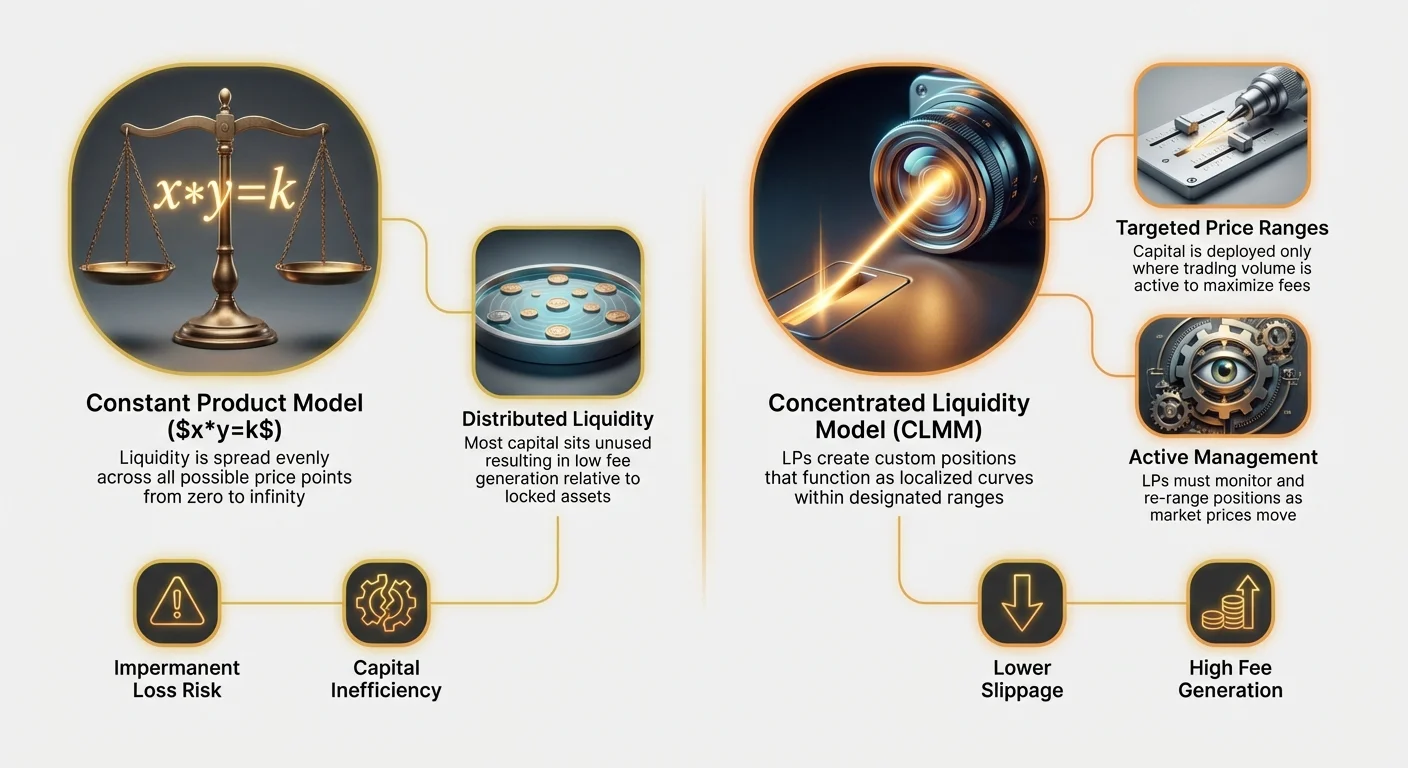
The geometric curve generated by the $x * y = k$ formula means that liquidity is distributed evenly across all possible price points, from $0 to infinity$.
- Smaller Trades: If the amounts being swapped are small relative to the size of the pool, the movement along the curve is minimal, and the trader gets a price close to the current market rate.
- Larger Trades (Slippage): If the trade involves a large amount, the pool ratio shifts dramatically, pushing the price far along the curve. This results in slippage—the difference between the expected price when the order is submitted and the executed price when the transaction is completed. Large CPMM pools are vulnerable to high slippage.
Understanding Impermanent Loss in CPMM
While providing liquidity sounds like a profitable endeavor, it introduces a major risk known as Impermanent Loss (IL). This is one of the most misunderstood concepts for new LPs.
Definition: Impermanent Loss is the temporary difference in value between simply holding two assets (HODLing) and depositing them into an AMM liquidity pool. It arises when the price ratio of the deposited tokens changes.
Why IL Occurs
When the price of one asset (say, ETH) rises dramatically outside the pool (on a centralized exchange), arbitrage traders step in. They buy the now relatively cheaper ETH from the liquidity pool until the price ratio inside the pool matches the external market price.
Because the pool maintains $x*y=k$, the arbitrage trader effectively removes some of the appreciating asset (ETH) and leaves more of the stable asset (DAI).
- If ETH price doubles, the pool algorithm requires LPs to end up with fewer ETH and more DAI than they started with.
- This results in a smaller total dollar value than if the LP had simply kept the original 50/50 portfolio in their wallet.
The loss is called "impermanent" because if the price ratio returns to the original deposit ratio, the loss vanishes. However, if the LP withdraws their liquidity before the price ratio reverts, the loss becomes permanent.
The Problem of Capital Inefficiency
The inherent design of the CPMM model—distributing liquidity across the full spectrum of possible prices ($0$ to )—is its greatest limitation.
Consider the ETH/USDC pool: ETH currently trades between $3,000 and $4,000. It is extremely unlikely that ETH will trade at $1 or $1,000,000 in the near future.
In a traditional CPMM pool, the liquidity provided is spread out across these virtually irrelevant price points.
Result: A vast majority of the capital provided by LPs sits unused, resulting in low fee generation relative to the total assets locked. This is known as capital inefficiency. LPs need to provide massive amounts of capital to make the trading experience smooth (i.e., reduce slippage) within the current price range.
Limitations and the Need for Evolution
While CPMM was a breakthrough, the capital inefficiency and high potential for slippage on highly correlated assets prompted DeFi builders to innovate, leading to specialized AMMs and, eventually, concentrated liquidity models.
High Slippage for Large Trades
Slippage is the enemy of high-volume traders. Because the CPMM curve is asymptotic (it approaches the axes but never touches them), moving along the curve becomes progressively more expensive as the pool becomes imbalanced.
If a fund wants to swap $10 million USDC for ETH, they would incur catastrophic slippage in a standard CPMM pool unless that pool had hundreds of millions of dollars of depth. To maintain a smooth trading experience, the system needed a way to put all available capital where the trades actually occur.
Wasted Capital (Liquidity Across All Prices)
As noted, liquidity deployed outside the current price range is functionally useless for current traders. LPs were tying up significant collateral that was generating zero fees.
This wastage became a major driving factor for creating a better model. LPs wanted to increase their return on investment (ROI) by maximizing fee generation on their deposited assets.
Specialized AMMs: Optimizing for Stablecoins
The inefficiencies of CPMM were particularly glaring for highly correlated assets, such as two stablecoins (USDC and DAI) or two wrapped Bitcoin tokens (WBTC and renBTC). Since the ideal price ratio for these assets is almost exactly 1:1, a CPMM curve is too volatile and expensive for swaps.
This led to the creation of specialized AMMs, such as the one popularized by Curve Finance, which use a StableSwap Invariant.
- StableSwap Function: This formula mixes the behavior of a standard AMM (to maintain reserves) with that of a traditional arithmetic mean (straight line) around the 1:1 peg.
- Result: Extremely low slippage for trades near the peg, allowing users to swap millions of dollars between stablecoins with minimal friction. However, this model only works for assets that are meant to be equal in value.
The success of these specialized AMMs demonstrated that liquidity efficiency was the key metric for the next generation of general-purpose AMMs.
Introducing Concentrated Liquidity (The Game Changer)
The solution to the capital inefficiency problem arrived with the introduction of Concentrated Liquidity Market Makers (CLMMs), most notably implemented by Uniswap V3 in 2021.
Concentrated liquidity fundamentally changes how LPs deploy their capital. Instead of distributing funds across the entire price spectrum, LPs can choose to dedicate their capital only to specific, defined price ranges.
What is Concentrated Liquidity? (Uniswap V3 Model)
In a traditional CPMM ($xy=k$), the liquidity is everywhere. In a CLMM, LPs create custom, individual positions that function as localized $xy=k$ curves within a designated range.
Imagine an ETH/USDC pool where ETH is currently $3,500.
- CPMM: An LP must deposit liquidity for the entire range ($0 to $\infty$).
- CLMM: An LP can choose to deposit liquidity only between $3,000 and $4,000.
When the price of ETH is inside this $3,000–$4,000 range, the LP's capital is active, earning fees. When the price moves outside that range (say, dropping to $2,900), the LP's capital becomes inactive and stops generating fees.
Setting Price Ranges: Deploying Capital Where It Matters
The ability to customize price ranges allows LPs to target their capital deployment strategically.
1. Narrow Ranges (Aggressive Strategy)
- Example: An LP sets a range between $3,400 and $3,600 when ETH is $3,500.
- Benefit: Because this liquidity is concentrated right where the trading volume is happening, it generates significantly more fees than the same amount of capital spread out widely.
- Risk: The moment ETH moves outside this narrow $200 band, the LP’s position goes completely inactive, and all their funds convert entirely into the less-valued asset (a form of realized impermanent loss).
2. Wide Ranges (Conservative Strategy)
- Example: An LP sets a range between $2,000 and $5,000.
- Benefit: This position is less likely to become inactive, reducing the need for constant monitoring.
- Drawback: It generates fewer fees compared to a narrow range because the capital is spread thinner. It behaves more like the old CPMM model.
Customizing Risk and Reward (Active Management)
Concentrated liquidity transforms the role of the LP from a passive depositor to an active manager.
In Uniswap V2 (CPMM), an LP could "set and forget" their position. In V3 (CLMM), LPs must actively monitor the market. If the asset price leaves their designated range, they need to pay gas fees to re-range their position (i.e., withdraw the inactive capital and redeploy it into a new, relevant range).
This shift fundamentally increased the complexity for LPs but massively boosted the capital efficiency of the DEX ecosystem as a whole.
Mehanika koncentrirane likvidnosti u dubini
Da bismo istinski razumjeli snagu koncentrirane likvidnosti, moramo ispitati kako sustav upravlja imovinom i izvršava trgovine unutar definiranog raspona.
Kako zamjena funkcionira u definiranom rasponu
Kada trgovac izvrši zamjenu na DEX-u s koncentriranom likvidnošću, protokol pretražuje sve dostupne pojedinačne LP pozicije (ili "tick-ove") kako bi pronašao najučinkovitiji put.
- Više fondova unutar jednog para: Za razliku od CPMM-a, gdje postoji samo jedan fond, CLMM par (ETH/USDC) sastoji se od potencijalno tisuća preklapajućih, pojedinačnih raspona likvidnosti koje su postavili različiti LP-ovi.
- Motor: Kada stigne zamjena, pametni ugovor izračunava potrebni volumen trgovanja trošeći likvidnost počevši od pozicije najbliže trenutnoj cijeni.
- Potrošnja: Kako trgovina troši likvidnost unutar uskog raspona jednog LP-a, cijena se pomiče dok ne dosegne granicu tog raspona. Kada se granica dosegne, ta se specifična pozicija iscrpi (jedna imovina je potpuno uklonjena), a trgovina se automatski premješta na sljedeću susjednu LP poziciju/raspon, nastavljajući zamjenu na novoj razini cijene.
Ovaj mehanizam osigurava da se najveće trgovine izvršavaju prelaskom preko nekoliko uskih raspona, koristeći maksimalnu efikasnost kapitala uz minimiziranje proklizavanja za trgovca, u odnosu na CPMM.
Koncept ponovnog određivanja raspona (razine likvidnosti)
Ako LP postavi uski raspon od 3.400 USD – 3.600 USD, a cijena padne na 3.300 USD, pozicija više nije aktivna.
Što se događa s kapitalom?
Kada se cijena spusti ispod 3.400 USD:
- Sav početni ETH je prodan iz fonda.
- Kapital LP-a sada je 100% sastavljen od USDC-a (imovine manje vrijednosti u ovom silaznom trendu).
- Kapital stoji neaktivan, ne zarađujući nikakve naknade za trgovanje, učinkovito djelujući kao 100% izloženost USDC-u na toj cjenovnoj točki.
Da bi se vratio u igru, LP mora izvršiti ponovno određivanje raspona (re-range):
- Povući 100% USDC kapitala.
- Zamijeniti polovicu USDC-a za ETH izvana (ili čekati da se cijena oporavi).
- Položiti sredstva u novi, niži aktivni raspon (npr. 3.200 USD – 3.400 USD).
Ova potreba za stalnim upravljanjem i ponovnim određivanjem raspona primarni je operativni trošak za LP-ove u CLMM-ovima.
The Trade-Off: Increased Capital Efficiency vs. Increased Management Complexity
Koncentrirana likvidnost lijepo je riješila problem efikasnosti kapitala, ali je stvorila nove kompromise:
| Značajka | Koncentrirana likvidnost (CLMM) | Konstantna funkcija (CPMM) |
|---|---|---|
| Efikasnost kapitala | Vrlo visoka. Sredstva generiraju maksimalne naknade po jedinici kapitala. | Niska. Većina likvidnosti je neiskorištena preko nebitnih cijena. |
| Složenost za LP-ove | Visoka. Zahtijeva aktivno praćenje, naknade za plin za ponovno određivanje raspona i upravljanje rizikom. | Niska. Postavi-i-zaboravi; održavanje je minimalno. |
| Nepostojani Gubitak (IL) | Potencijalno viši. Uski rasponi prisiljavaju LP-ove da se brzo pretvore u imovinu koja opada, brže realizirajući IL. | Niži/Sporiji. IL je raspoređen preko masivne krivulje cijena. |
| Proklizavanje za trgovce | Nisko. Veća dubina tamo gdje se cijena kreće. | Visoko. Niska dubina na trenutnim cijenama osim ako je fond masivan. |
Za sofisticirane korisnike, povećani potencijal generiranja naknada obično nadmašuje složenost. Za početnike, CPMM model ostaje sigurniji i lakši za korištenje, zbog čega mnogi noviji DEX-ovi usmjereni na početnike koriste hibridne modele ili nude pojednostavljene LP strategije.
AMM मॉडेल्सची तुलना: CPMM विरुद्ध केंद्रित (Concentrated)
अग्रगण्य CPMM मॉडेल आणि प्रगत CLMM मॉडेलमधील फरक हे आधुनिक विकेंद्रीकृत वित्तामधील (DeFi) मूलभूत अंतर आहे.
भांडवली कार्यक्षमता: निधीचा योग्य वापर
भांडवली कार्यक्षमता हे एक मेट्रिक आहे जे लॉक केलेल्या मालमत्तेच्या एकूण मूल्याच्या (TVL) तुलनेत पूल किती व्हॉल्यूम (आणि त्यामुळे किती शुल्क) निर्माण करू शकते हे मोजते.
CLMMs घातांकानुसार (exponentially) उच्च कार्यक्षमता प्राप्त करतात. Uniswap V3 वरील काही उच्च-व्हॉल्यूम जोड्यांमध्ये, $10 दशलक्ष TVL तेवढ्याच किमान स्लिपेजसह समान ट्रेडिंग व्हॉल्यूमला समर्थन देऊ शकते, ज्यासाठी पारंपारिक CPMM पूलवर $100 दशलक्ष TVL ची आवश्यकता असू शकते.
परिणाम: उच्च भांडवली कार्यक्षमतेचा अर्थ असा आहे की, मोठ्या संस्थात्मक तरलतेची कमी गरज असल्यामुळे, व्यापार्यांना चांगली अंमलबजावणी किंमत (execution prices) मिळते, ज्यामुळे DeFi अधिक लवचिक आणि सुलभ बनते.
स्लिपेज परिणाम आणि खोली (Depth)
स्लिपेज स्वॅपच्या वास्तविक-जगातील किमतीचे निर्धारण करते.
- CPMM: स्लिपेज नेहमी संपूर्ण पूलच्या $k$ चे कार्य असते. जर पूल उथळ (shallow) असेल, तर मोठ्या ट्रेडमुळे किमतीत मोठ्या प्रमाणात चढ-उतार होतात.
- CLMM: स्लिपेज व्यापाराच्या विशिष्ट किंमत श्रेणीतील एकूण एकत्रित तरलतेद्वारे निर्धारित केली जाते. LP (तरलता प्रदाते) त्यांचे निधी येथे केंद्रित करत असल्यामुळे, व्यापार्यासाठी उपलब्ध असलेली प्रभावी "खोली" खूप जास्त असते, परिणामी समान आकाराच्या व्यापारासाठी कमी स्लिपेज होते.
एक CLMM मूलभूतपणे सध्याच्या बाजारभावाभोवतीच्या पारंपारिक ऑर्डर बुकच्या उच्च खोलीचे (depth) अनुकरण करते, ज्यामुळे व्यापार सर्वात सक्रिय असलेल्या ठिकाणी वक्र (curve) खूप सपाट होतो.
निष्क्रिय विरुद्ध सक्रिय व्यवस्थापन आवश्यकता
CPMM आणि CLMM मधील निवड अनेकदा LP ची त्यांच्या गुंतवणुकीचे व्यवस्थापन करण्याची तयारी यावर अवलंबून असते.
| व्यवस्थापन शैली | आदर्श मॉडेल | वापरकर्ता प्रोफाइल |
|---|---|---|
| निष्क्रिय (Passive) | CPMM (किंवा सरलीकृत CLMM रॅप्स) | नवीन वापरकर्ते, मालमत्तेवर जास्त विश्वास असलेले वापरकर्ते, दीर्घकाळ गुंतवणूक करणारे, जे दररोज बाजार तपासू शकत नाहीत. |
| सक्रिय (Active) | CLMM (संकीर्ण श्रेणी - Narrow Ranges) | व्यावसायिक, वारंवार व्यापार करणारे, उत्पन्न (yield) वाढवू इच्छिणारे वापरकर्ते, अत्याधुनिक धोरणे वापरणारे. |
अनेक नवीन वापरकर्त्यांसाठी, CLMM मध्ये वारंवार श्रेणी (re-ranging) बदलण्याशी संबंधित जोखीम आणि गॅस खर्चांमुळे, कमी शुल्क उत्पन्न असूनही जुनी, साधी CPMM रचना अधिक स्वीकार्य प्रारंभिक बिंदू ठरते.
शुल्क संरचना आणि LP पुरस्कार
जरी दोन्ही मॉडेल्स LPs ला ट्रेडिंग शुल्कासह बक्षीस देत असले तरी, त्याचे वितरण नाट्यमयरित्या भिन्न असते.
CPMM पूलमध्ये, सर्व तरलतेमध्ये शुल्क समान रीतीने वितरित केले जाते, मग ती तरलता वापरली गेली असो वा नसो. दूरच्या किंमत श्रेणींमध्ये निष्क्रिय, कमाई न करणाऱ्या भांडवलामुळे पुरस्कार कमी होतो.
CLMM पूलमध्ये, व्यापार चालू असताना सक्रिय असलेल्या LPs द्वारेच शुल्क निर्माण केले जाते आणि त्यांनाच वितरित केले जाते. एक चतुर LP जो एक संकीर्ण, सक्रिय श्रेणी राखतो, तो खूप विस्तृत, निष्क्रिय श्रेणी असलेल्या LP पेक्षा जास्त प्रमाणात शुल्क कमावतो, जरी दोघांनी समान प्रमाणात भांडवल जमा केले असले तरी. नफा वाढवण्यासाठी सक्रिय व्यवस्थापनाची आवश्यकता यामुळे वाढते.
Practical Tips for Interacting with AMMs
Understanding AMM mechanics is not just theoretical; it profoundly impacts how you swap tokens and how you earn income as a liquidity provider.
1. Why Understanding Slippage Limits is Crucial
Every time you execute a swap on a DEX, you set a slippage tolerance (e.g., 0.5%, 1%, or 3%). This is the maximum negative price deviation you are willing to accept before the transaction fails.
- Low Slippage (e.g., 0.1%): This ensures you get the best possible price, but your transaction is more likely to fail if network congestion causes the price to move slightly while the transaction is pending.
- High Slippage (e.g., 3%): Your transaction is much more likely to succeed, but you risk getting a significantly worse price if the liquidity is shallow or if a large, simultaneous transaction hits the pool first.
Rule of Thumb: Use low slippage for large, deep pools (like major ETH/USDC pairs) and slightly higher slippage (1% or more) for small-cap tokens with shallow liquidity. The structure of CLMMs generally allows you to use tighter slippage limits safely, due to the concentrated depth.
2. Best Practices for LPs in Concentrated Pools (Monitoring Ranges)
If you decide to become an LP in a CLMM, treat it like an active investment strategy, not a savings account.
- Choose Appropriate Tiers: Most CLMMs offer multiple fee tiers (e.g., 0.05%, 0.30%, 1.00%). High-volatility pairs (e.g., small altcoin/ETH) should use higher fee tiers to compensate for higher risk, while stablecoin pairs use lower tiers.
- Set Realistic Ranges: If you are conservative, set a wider range to minimize re-ranging frequency. If you are aggressive, monitor the market closely. Tools and services are available that alert LPs when their position is about to move out of range.
- Acknowledge IL: Always remember that fee profits must be weighed against impermanent loss. In a sharp bear market, LPs in concentrated pools may earn fees but lose overall dollar value because their position converted entirely into the depreciating asset.
3. How AMMs Power Complex Swap Routing
The ultimate power of the AMM model, especially the concentrated variety, lies in its integration with DEX Aggregators (like 1inch or Paraswap).
Since liquidity is no longer centralized in one place, these aggregators use algorithms to determine the most efficient swap path, often splitting a single trade across multiple pools and even multiple DEX protocols.
Example of Routing: You want to swap 10 ETH for $35,000 worth of Token Z.
- The aggregator determines the best route is to swap 5 ETH into USDC via Uniswap V3 (using a highly concentrated pool).
- The remaining 5 ETH is routed through a traditional CPMM pool on another DEX to get the final amount of Token Z.
- The USDC is then converted into the remainder of Token Z using a specialized stablecoin-based AMM.
This behind-the-scenes routing, built entirely on the mathematical structure of AMMs, ensures that the user always gets the optimal execution price by leveraging the capital efficiency and depth wherever it resides.
Zaključak
Automatski tvorci tržišta su motor decentraliziranih financija, pomičući paradigmu s institucionalnog stvaranja tržišta na algoritamsku likvidnost vođenu zajednicom.
Evolucija od pionirske formule Konstantnog proizvoda ($x*y=k$) do sofisticiranih modela Koncentrirane likvidnosti predstavlja brzu zrelost DeFi-ja. Dok je CPMM nudio jednostavnost i pouzdanost, inovacija koncentrirane likvidnosti riješila je kritični problem neefikasnosti kapitala, dovodeći do dubljih fondova, manjeg proklizavanja i daleko robusnijeg iskustva trgovanja za sve.
Za početnike, ključna poruka je da je "crna kutija" zamjene matematička krivulja kojom upravlja pametni ugovor. Razumijevanje trgujete li protiv krivulje konstantnog proizvoda ili zbirke visoko upravljanih, koncentriranih raspona ključno je za postavljanje odgovarajućih ograničenja proklizavanja i maksimiziranje vašeg povrata, bez obzira jeste li pasivni trgovac ili aktivni pružatelj likvidnosti. Kako DeFi nastavlja sazrijevati, vjerojatno ćemo vidjeti još specijaliziranijih AMM-ova, ali temeljni koncepti invariantnih funkcija i dubine likvidnosti ostat će stupovi trgovanja bez povjerenja.