
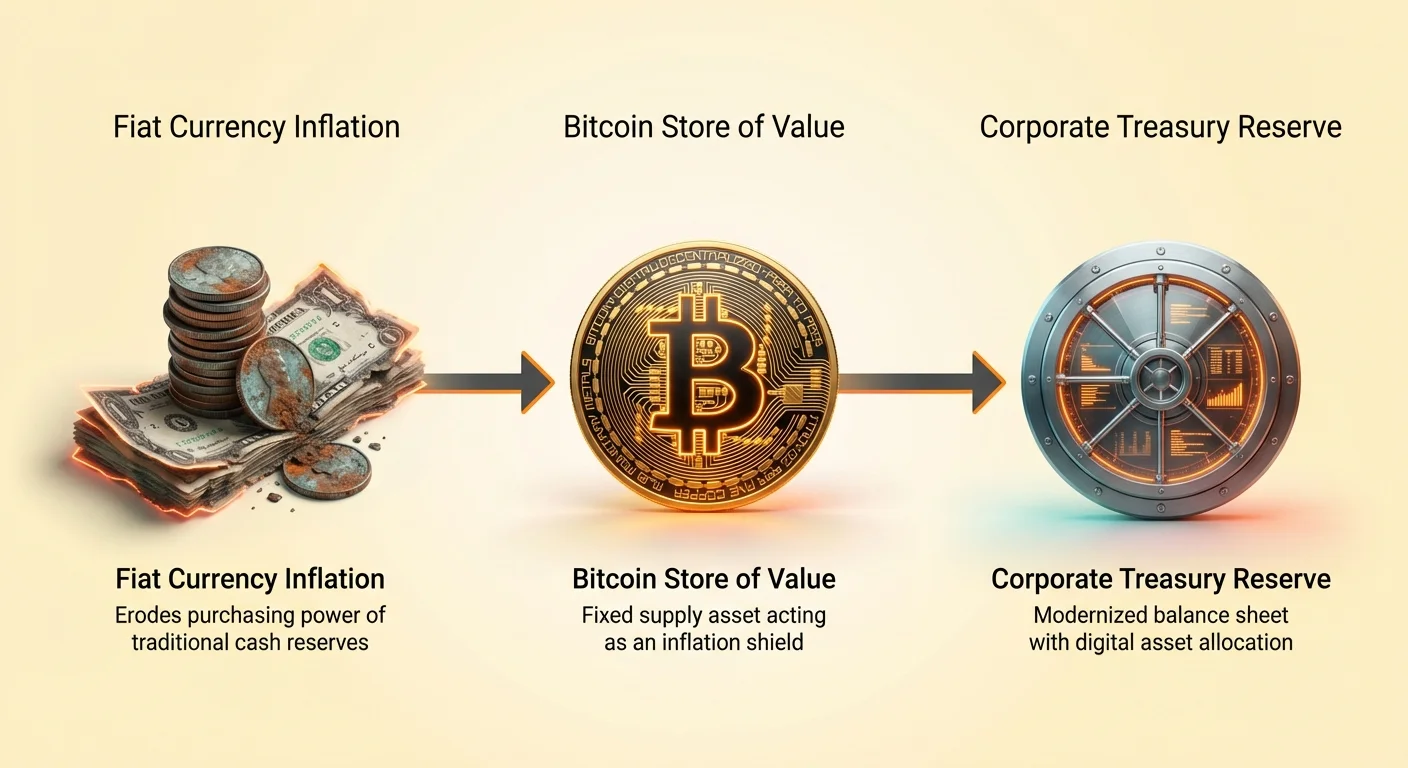
Corporate treasuries have historically relied on low-risk, highly liquid assets like government bonds, money market funds, and cash deposits to preserve capital. The primary goal was stability and liquidity rather than significant capital appreciation. However, the economic landscape has shifted dramatically over the last decade. Persistently high inflation rates and the rapid expansion of monetary supply have eroded the purchasing power of traditional cash reserves.
In response to these macroeconomic pressures, forward-thinking corporations are increasingly looking toward alternative assets to protect their balance sheets. Bitcoin has emerged as a leading contender in this shift, transitioning from a speculative retail experiment to a legitimate institutional asset class. Companies like MicroStrategy, Tesla, and Block have paved the way by allocating portions of their treasury reserves to Bitcoin.
Adopting a Bitcoin standard for corporate finance is not merely about buying a digital asset. It involves a fundamental restructuring of how a company views value, risk, and long-term planning. Integrating digital assets requires navigating complex accounting standards, understanding distinct tax obligations, and implementing rigorous security protocols. It represents a move from passive capital preservation to active value maintenance in a digital age.
The Strategic Case for Corporate Bitcoin
Unlike fiat currencies, which can be printed in unlimited quantities by central banks, Bitcoin has a fixed supply cap of 21 million coins. This mathematical scarcity creates a deflationary pressure that contrasts sharply with the inflationary nature of modern fiat money. For corporations holding large cash piles, Bitcoin offers a potential shield against the silent erosion of value caused by inflation.
Diversification and Asymmetric Upside
Traditional treasury assets often move in tandem with broader equity or debt markets. Bitcoin has historically shown a lower correlation to these traditional financial instruments over long time horizons. By adding an uncorrelated asset to a portfolio, companies can potentially improve their risk-adjusted returns. Furthermore, Bitcoin offers an asymmetric upside potential that bonds or cash equivalents cannot match. While the downside risk exists, the potential for significant appreciation allows companies to potentially grow their reserves rather than just maintaining them.
Technological Alignment and Innovation
For technology-focused companies, holding Bitcoin signals alignment with the future of digital finance. It demonstrates a commitment to open, decentralized networks and can enhance brand value among digital-native demographics. Beyond investment, holding Bitcoin enables companies to interact directly with the blockchain economy. This opens doors for accepting payments in crypto, participating in decentralized finance (DeFi) protocols, or streamlining cross-border settlements without relying on slow legacy banking rails.
Managing Volatility and Market Risk
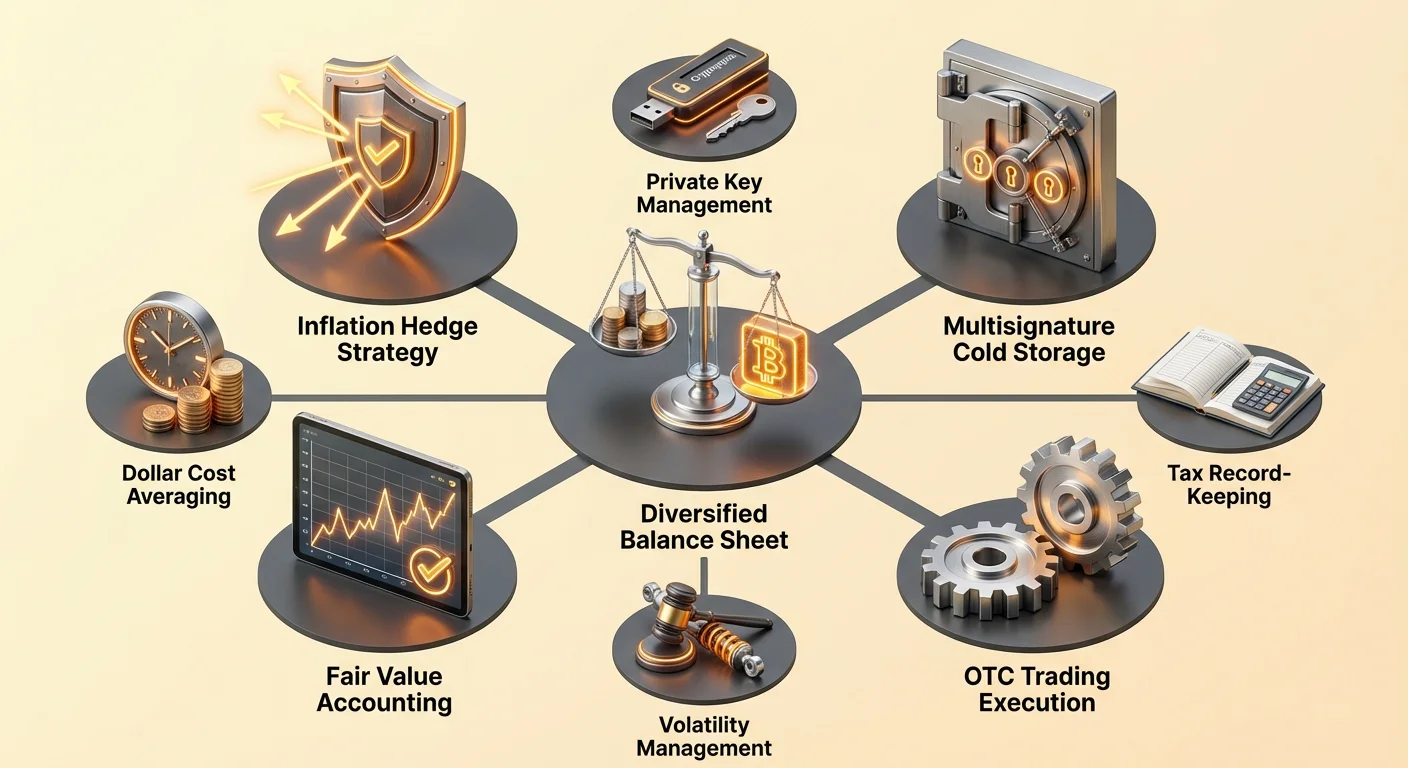
While the long-term trajectory of Bitcoin has been upward, its short-term price action is notoriously volatile. Corporate treasurers must be prepared for significant drawdowns that can occur within a single financial quarter. This volatility poses a challenge for short-term liquidity planning. If a company needs to convert its reserves back to cash to cover immediate operational expenses during a market downturn, it may be forced to realize a loss.
To mitigate this, companies rarely allocate their entire treasury to Bitcoin. Instead, they typically adopt a percentage-based allocation strategy, often ranging from 1% to 5% of total reserves. This ensures that day-to-day operations are funded by stable, liquid cash, while Bitcoin serves as a long-term store of value. The investment horizon for corporate Bitcoin holdings is generally measured in years, not months.
Treasurers must also assess their company's risk tolerance. Publicly traded companies face additional scrutiny from shareholders who may be uncomfortable with the price swings affecting quarterly reports. Private companies often have more flexibility but must still ensure that their allocation does not jeopardize payroll or critical capital expenditures. Understanding market cycles is essential for timing entries and managing expectations regarding portfolio performance.
Accounting Standards and Financial Reporting
One of the most complex hurdles for corporate adoption has been the accounting treatment of digital assets. In many jurisdictions, including under U.S. Generally Accepted Accounting Principles (GAAP), Bitcoin is historically classified as an "intangible asset" with an indefinite life. This classification differs significantly from how financial instruments or foreign currencies are treated.
The Impairment Challenge
Under traditional intangible asset rules, companies must test their Bitcoin holdings for impairment. If the market price of Bitcoin drops below the purchase price (book value) at any point during the reporting period, the company must write down the value of the asset and record an impairment charge on their income statement. This charge reduces reported earnings. Crucially, if the price subsequently recovers, the company cannot write the value back up. The asset remains on the books at the lowered value until it is sold.
Fair Value Accounting Evolution
Recent developments in accounting standards are moving toward a "fair value" model for crypto assets. This approach allows companies to report their Bitcoin holdings at their current market value. Under fair value accounting, both unrealized gains and unrealized losses are recognized in the financial statements. This provides a more accurate picture of a company's financial health and removes the punitive nature of permanent impairment charges. This shift is expected to encourage more widespread corporate adoption by reducing the accounting friction associated with price volatility.
Tax Implications for Corporations
Tax treatment of Bitcoin varies significantly by jurisdiction, but most tax authorities treat it as property rather than currency. This distinction has profound implications for corporate tax liability. Every time a company sells Bitcoin or uses it to pay for goods and services, it triggers a taxable event. Corporations must calculate the capital gain or loss based on the difference between the acquisition cost and the value at the time of disposal.
Record-keeping becomes a critical operational requirement. Companies must track the cost basis of every satoshi (the smallest unit of Bitcoin) acquired. When disposing of assets, they need to determine which specific units are being sold to calculate the tax impact accurately. Common methods include First-In-First-Out (FIFO) or specific identification, depending on local regulations.
Using Bitcoin for operational expenses can complicate tax reporting. For example, if a company pays an employee or vendor in Bitcoin, it is effectively selling the asset at its current market value. If the Bitcoin has appreciated since it was acquired, the company owes capital gains tax on that transaction, in addition to any payroll or sales taxes. This administrative burden leads many companies to hold Bitcoin strictly as a reserve asset rather than a transactional currency.
Execution: Sourcing Liquidity
Acquiring substantial amounts of Bitcoin requires different strategies than retail purchasing. Buying millions of dollars worth of Bitcoin on a standard exchange order book can cause "slippage," where the size of the order drives the price up before the purchase is complete. Corporate treasurers need execution methods that minimize market impact and ensure price efficiency.
Over-The-Counter (OTC) Trading
For large volume transactions, Over-The-Counter (OTC) trading desks are the standard solution. OTC desks act as intermediaries, matching large buyers directly with large sellers or liquidity pools. These trades occur off the public order books, preventing the transaction from triggering immediate price volatility in the broader market. OTC brokers provide a fixed price quote, giving treasurers certainty regarding their cost basis and execution speed.
Dollar Cost Averaging (DCA)
Rather than attempting to time the market with a single lump-sum purchase, many corporations employ a Dollar Cost Averaging strategy. This involves purchasing a fixed dollar amount of Bitcoin at regular intervals, regardless of the price. DCA smoothes out the average entry price over time and reduces the risk of deploying capital at a local market peak. Automated recurring buy programs can be established with institutional partners to execute this strategy without manual intervention.
Storage and Security Architectures
Once acquired, the safety of corporate Bitcoin holdings is paramount. Unlike bank deposits, Bitcoin transactions are irreversible. If private keys are lost or stolen, the funds are unrecoverable. Corporations cannot rely on simple retail wallet solutions; they require robust security architectures that eliminate single points of failure and mitigate internal collusion risks.
Custodial vs. Self-Custody
Companies face a primary choice between third-party custodians and self-custody. Qualified custodians are regulated financial institutions that hold assets on behalf of clients. They offer insurance protections and simplified reporting but introduce counterparty risk. If the custodian fails, the company's assets could be tied up in bankruptcy proceedings. Self-custody gives the company direct control over its assets using private keys, eliminating counterparty risk but placing the full burden of security on the internal team.
Multisignature (Multisig) Wallets
For companies choosing self-custody, multisignature technology is the industry standard for security. A "multisig" wallet requires multiple approvals to authorize a transaction. For example, a "3-of-5" setup requires three out of five designated authorized signers to approve any movement of funds. This structure ensures that no single employee, including the CEO or CFO, can unilaterally move assets. It also protects against external threats; even if a hacker compromises one key, the funds remain secure.
Cold Storage Protocols
Corporate reserves should generally be held in "cold storage," meaning the private keys are generated and stored on devices that are never connected to the internet. This air-gapped approach makes the assets immune to online hacking attempts. Combining cold storage hardware with a multisignature governance scheme creates a vault-like environment for digital treasury assets.
Governance and Internal Controls
Implementing Bitcoin into a treasury requires establishing clear governance policies. These internal controls define who has authority to access funds, how transactions are initiated, and the specific steps required for approval. A robust policy prevents unauthorized access and protects employees from liability by creating a verifiable audit trail of all actions.
Key person risk is a significant concern in digital asset management. If access to funds depends on a single individual who becomes incapacitated or leaves the company, the assets could be permanently locked. Governance protocols must include redundancy plans. This often involves distributing key shards or backup seeds across geographically separated secure locations, such as bank safety deposit boxes or secure institutional vaults.
Regular audits of these security procedures are essential. Companies should conduct periodic drills to test their ability to recover funds using backup protocols. This ensures that in a real emergency, the designated team members know exactly how to reconstruct the wallet access without relying on a single point of failure. Documentation of these processes must be thorough yet kept strictly confidential to maintain operational security.
The Role of Bitcoin ETFs in Treasuries
The approval of Bitcoin Exchange-Traded Funds (ETFs) has introduced a new vehicle for corporate exposure. ETFs allow companies to gain price exposure to Bitcoin through traditional brokerage accounts without managing private keys or navigating crypto exchanges. This familiarity makes ETFs an attractive on-ramp for more conservative institutions.
However, investing via an ETF introduces management fees that erode performance over time. More importantly, holding an ETF share is not the same as owning the underlying asset. The company owns a claim on a fund, which in turn owns the Bitcoin. This reintroduces counterparty risk and removes the utility of the asset. A company holding an ETF cannot use its Bitcoin for payments, cannot engage in smart contract operations, and relies entirely on the fund manager for security.
| Feature | Direct Bitcoin Ownership | Bitcoin ETF |
|---|---|---|
| Control | Full control via private keys | No direct control |
| Utility | Can be used for payments/DeFi | Price exposure only |
| Fees | Network fees only | Annual management fees |
For treasuries strictly seeking price exposure with minimal operational overhead, ETFs serve a purpose. For those seeking to hedge against systemic financial risk or utilize the technology, direct ownership remains the superior option.
Comparison with Other Treasury Assets
To understand Bitcoin's role, it must be compared against traditional store-of-value assets like gold and cash equivalents. While often called "digital gold," Bitcoin possesses distinct characteristics that differentiate it from precious metals and fiat instruments.
Portability and Verifiability
Gold is heavy, expensive to transport, and difficult to verify without specialized equipment. Bitcoin is weightless and can be transferred anywhere in the world in minutes. Its authenticity is verified instantly by the network protocol, eliminating the risk of counterfeit assets. This makes Bitcoin a far more liquid and portable reserve asset for global corporations than physical gold bars.
Yield vs. Appreciation
Cash equivalents and bonds offer a predictable, albeit often low, yield. Bitcoin generates no inherent yield; it does not pay dividends or interest. Its value proposition relies entirely on price appreciation driven by supply and demand mechanics. In a high-inflation environment where real yields on bonds are negative (meaning inflation outpaces the interest rate), Bitcoin's lack of yield is offset by its potential to maintain purchasing power through scarcity.
Comparison to Stablecoins
Stablecoins offer the efficiency of blockchain transactions without the price volatility of Bitcoin. They are pegged to fiat currencies like the US Dollar. While stablecoins are excellent for operational liquidity and payments, they do not serve as an inflation hedge. Holding stablecoins carries the same long-term devaluation risk as holding cash, along with additional platform and regulatory risks associated with the stablecoin issuer.
Conclusion
Integrating Bitcoin into a corporate treasury is a strategic move that modernizes a company's approach to value preservation. It offers a robust hedge against monetary inflation and provides exposure to a high-growth asset class that is uncorrelated with traditional markets. While the benefits of diversification and asymmetric upside are compelling, they come with the responsibilities of managing volatility and implementing rigorous security standards.
Success in this domain requires a multidisciplinary approach involving finance, legal, and technical teams. By leveraging tools like multisignature wallets, OTC trading desks, and fair value accounting practices, corporations can effectively manage the risks. As regulatory clarity improves and institutional adoption deepens, Bitcoin is poised to become a standard component of the diversified corporate balance sheet.
Bitcoin offers corporate treasuries a unique tool to protect purchasing power and modernize financial operations through verifiable digital scarcity.